

For a quick flight, a short car rental, or a simple sale, unbundled low-cost options usually win on price. For complex itineraries, group travel, or high-stakes sales, full-service bundles usually save time and reduce risk. The real test is not the sticker price, but the total suitable price: everything you will actually pay once every fee, protection, and service you need is added in.
TL;DR:
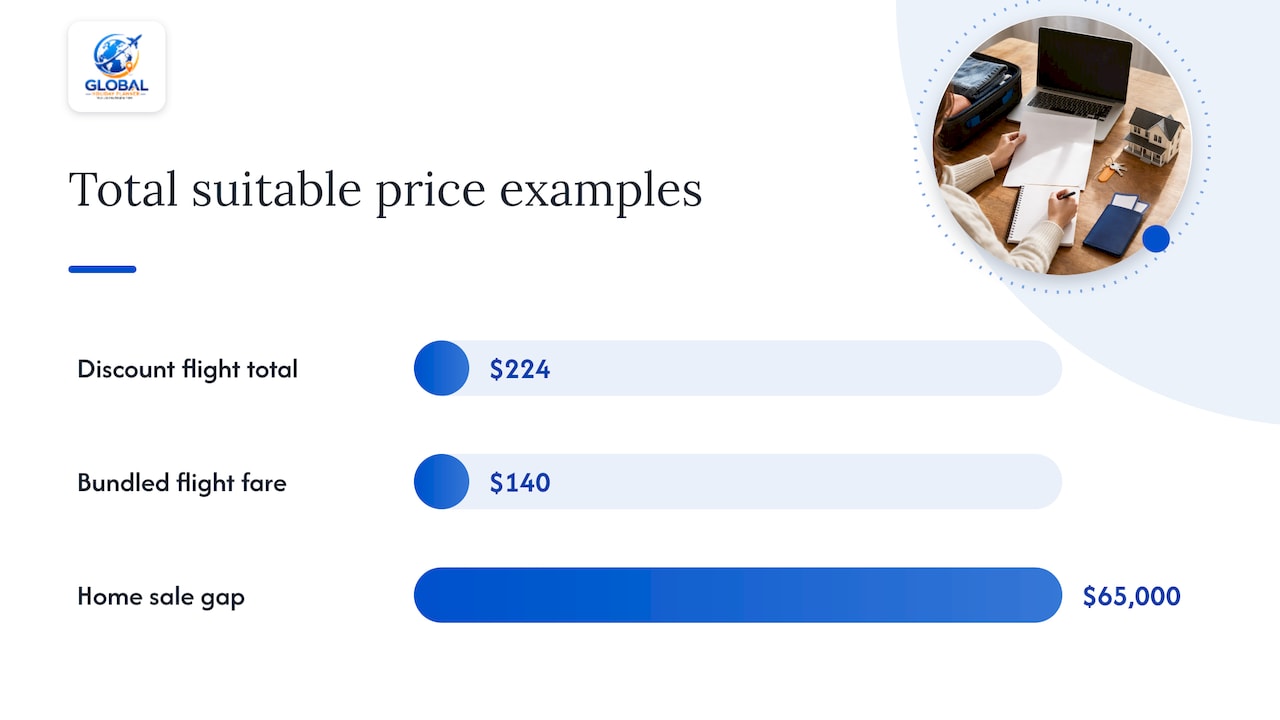
- A $89 discount fare reaches $224 after a $35 bag, $25 seat assignment, and $75 change fee, exceeding the $140 bundled fare.
- A full service itinerary usually protects connections and handles rebooking, while separate discount tickets can leave travelers responsible when a delay breaks their connection.
- HomeLight reported 2025 median sale prices of $360,000 for FSBO homes and $425,000 for agent assisted homes, a gap that may outweigh saved commission.
- For groups of ten or more, a managed booking can reduce mismatched seats and missed connections that become harder to coordinate across separate tickets.
Table of Contents
- Low Cost vs Full Service: The Key Differences at a Glance
- What to Expect From Low-Cost, Unbundled Options
- What You Get When You Pay for Full Service
- How to Calculate Your Real Total Suitable Price
- Your Checklist Before You Book or Hire
- Putting the Framework to Work on Real Trips
- Our Take: Default to Full Service Unless the Trip Is Simple
- Compare Total Cost and Book With Global Holiday Planner
- FAQ
- Sources
Low Cost vs Full Service: The Key Differences at a Glance
A low-cost or unbundled model charges a lower base price and sells everything else separately: bags, seat choice, changes, support, and sometimes basic comfort. A full-service or bundled model folds most of that into one price; you pay more upfront but less in surprises later. The same logic applies whether you are booking a flight, renting a car, or hiring a real estate agent.
Each model shows up the same way across industries. A discount carrier, a shuttle van, or a for-sale-by-owner listing all strip out services to cut the headline price. A full-service airline, a private transfer, or a traditional listing agent all build those services back in and charge for the bundle.
What typically differs between the two:
- Base price: lower for unbundled options, higher for bundled ones, before any extras are added.
- Inclusions: bundled options typically fold in baggage, seat selection, support staff, or marketing and negotiation; unbundled options sell these separately or skip them entirely.
- Flexibility: bundled options tend to allow easier changes and cancellations, while unbundled fares and contracts often carry stricter, costlier rules.
- Support and protection: bundled models generally include more customer service, rebooking help, or professional representation, which matters most when something goes wrong.
Those gaps are exactly where ancillary fees and service shortfalls change the math. A flight that looks $100 cheaper can cost more once a bag, a seat, and a change fee are added, and a home sold without an agent can net less even after the commission savings. The DOT final rule on airline fee disclosure exists precisely because these gaps were hard for consumers to see before they booked.
What to Expect From Low-Cost, Unbundled Options
Low-cost options are built around a simple trade: a lower starting price in exchange for fewer included services and less flexibility. You are buying the core product, a seat, a car, a listing, and little else unless you pay for it separately.
Common characteristics of unbundled pricing:
- A lower base price than comparable full-service options, often the main draw in search results or listings.
- Ancillary fees for anything beyond the basics, including baggage, seat assignment, and date changes.
- Stricter change and refund rules, with many fares or contracts offering no free changes and limited or no refunds.
- Less built-in protection, since there is often no rebooking support if something goes wrong, especially across separately booked tickets.
- More effort required from you, whether that means managing your own bags, researching your own comps, or marketing your own listing.
In air travel, this plays out through baggage fees, seat selection charges, and the absence of rebooking protection when you have booked two separate one-way tickets instead of one connecting itinerary. Our breakdown of baggage fees and total landed cost shows how quickly a discount fare can lose its edge, and our comparison of basic economy versus standard economy covers the same pattern for seat and boarding restrictions.
In real estate, the unbundled equivalent is a for-sale-by-owner, or FSBO, listing. Sellers avoid a commission, but they also take on pricing, marketing, negotiation, and paperwork themselves. Many FSBO sales that go smoothly happen because the seller already had a buyer lined up before listing, which limits how much exposure the property gets compared to a listing promoted through full agent channels.
Pro Tip: Before booking a low-cost fare or signing a no-agent sale, price out every extra you will realistically need, not just the ones you think you can skip.
What You Get When You Pay for Full Service
Full-service pricing bundles the base product with the services most people end up needing anyway, which is why the upfront number is higher. You are prepaying for convenience, protection, and support instead of negotiating for each piece separately later.
Across travel and real estate, full-service bundles typically include:
- Checked bags and seat selection built into the fare, instead of charged per item.
- Full-service support staff available for rebooking, schedule changes, and problems during the trip.
- Network protection, meaning a missed connection on one leg is the carrier’s problem to fix, not yours.
- Professional marketing and negotiation in a real estate context, where an agent prices, lists, shows, and negotiates on your behalf.
- Broader access to buyers or routes, since full-service listings and carriers typically reach more of the market than a self-managed sale or a point-to-point discount route.
The value of bundling shows up most clearly when something goes wrong. IATA’s analysis of airline cost performance notes that full-service carriers tend to maintain broader network connectivity, which gives you protected connections and schedule stability that a collection of separate low-cost tickets cannot offer. If one leg is delayed, a full-service itinerary usually rebooks you automatically; two unrelated low-cost tickets usually do not.
In real estate, NAR’s 2025 profile of home buyers and sellers found that roughly 88% of buyers and 91% of sellers used an agent, largely for help finding the right match, negotiating terms, and managing paperwork. That reliance suggests most people decide the bundled support is worth the fee once they see what managing a sale alone actually involves.
How to Calculate Your Real Total Suitable Price
The fastest way to compare low-cost and full-service options fairly is to stop comparing headline prices and start comparing total suitable price: the full cost of getting the exact outcome you need, nothing more and nothing less.
A simple formula:
- Total suitable price = base price + required ancillaries + likely-to-be-used extras + expected cost of lower protection.
- Base price is the number you see first, whether that is a fare, a rental rate, or a commission-free sale price.
- Required ancillaries are the fees you cannot avoid given your trip or transaction, such as a checked bag or a required title service.
- Likely-to-be-used extras are the services you will probably buy anyway, like seat selection on a long flight.
- Expected cost of lower protection accounts for the risk of paying more later if something goes wrong, like a missed connection or a sale that drags on.
A short-haul flight example: a discount fare at $89 looks far cheaper than a full-service fare at $140. Add a $35 checked bag, a $25 seat assignment, and a $75 change fee you end up needing, and the discount ticket reaches $224, more than the bundled fare that already included all three. Our guide to seat selection fees walks through this same comparison in more detail.
A home sale example: HomeLight’s FSBO data found FSBO homes sold at a median price lower than agent-assisted sales in 2025. Even after paying a commission, many sellers net more through an agent-assisted sale than they do selling on their own, because the sale price gap outweighs the fee saved.
One figure worth keeping in view: a $65,000 median sale price gap between FSBO and agent-assisted homes in 2025, according to HomeLight’s data, which is often larger than the commission a seller was trying to avoid.
Your Checklist Before You Book or Hire
Before you commit to either model, run through a short, consistent set of questions so you are comparing like for like.
Start by ranking your own priority: is this decision mostly about money, time, certainty, or specific included services? That answer tells you which model deserves more weight before you even look at numbers.
- Ask what the base price includes, and get a written list of what costs extra.
- Ask about change, cancellation, and refund policies, including specific fees and deadlines.
- Ask what support looks like if something goes wrong, such as a missed flight, a canceled booking, or a stalled sale.
- Ask for a realistic timeline, since full-service options often move faster precisely because more is handled for you.
- Ask for the full itemized total, not just the headline figure, before you decide.
A simple scoring approach works well for quick decisions: give each option a score from 1 to 5 on price, flexibility, and support, then weight the categories based on your priority ranking from step one. The option with the higher weighted score, not the lower sticker price, is usually the better fit.
Pro Tip: Ask every vendor or agent the same five questions in the same order. Inconsistent questions produce answers that are impossible to compare fairly.
Putting the Framework to Work on Real Trips
The same framework applies whether you are booking a quick trip or something more complex, and running the comparison takes just a few minutes.
- A family vacation with checked bags, multiple travelers, and a connecting flight usually favors full service, since the bundled protections cover more of what a family actually needs.
- A short, direct business trip with no checked bag and a flexible schedule often favors a low-cost fare, since there is little to go wrong and few extras required.
- Group travel with ten or more travelers tends to favor full service or a managed group booking, since coordinating separate low-cost tickets multiplies the risk of mismatched seats or missed connections.
Our flights comparison page lists ancillary costs alongside the base fare so you can see the total suitable price before you commit, and our group flight booking guide covers the specific coordination issues that come up when you are booking for ten or more people. Running the same comparison for car rentals or airport transfers takes the same few minutes: check the base rate, then check what is actually included.
Our Take: Default to Full Service Unless the Trip Is Simple
For most readers, we default to full-service options whenever a trip involves connections, checked bags, or more than one or two travelers, and we only recommend low-cost options for simple, single-leg trips with little room for things to go wrong. The rule that matters most is total suitable price, not the number on the first screen. We built our comparisons to show ancillary costs alongside base fares specifically because that gap is where most travelers get surprised.
— Global
Compare Total Cost and Book With Global Holiday Planner
We offer a platform that aims to show the full picture before you pay, not just the base fare. Comparing flights, hotels, car rentals, and transfers side by side helps you see ancillary costs upfront instead of discovering them at checkout.

Three steps to run your own comparison:
- Search your route or dates on our flights page to see base fares next to likely ancillary costs.
- Check what each fare or rate actually includes, from bags to seat selection to cancellation terms.
- Book the option with the lower total suitable price, not just the lower headline number.
If flexible dates matter more to you than a fixed itinerary, our date grid tool can help you find a lower total cost across nearby travel dates. Start your comparison on our flights page and see the real total before you book.
FAQ
What does black service mean?
“Black service” generally refers to a premium, chauffeur-driven car service, often associated with black sedans or SUVs, that includes a professional driver, door-to-door pickup, and a higher level of comfort than a standard taxi or rideshare. It sits closer to the full-service end of ground transport, since the higher price bundles in service quality and reliability rather than charging separately for each feature.
What does town car service mean?
A town car service is a private, prearranged car service, typically using a sedan or similar vehicle with a professional driver, booked in advance rather than hailed on the spot. Like black car service, it is a full-service ground transport option: you pay more than a shared shuttle or rideshare in exchange for a dedicated vehicle, fixed pricing, and a known pickup time. Our airport transfer options guide covers how these compare with shared and low-cost transfer alternatives.
Is low-cost always cheaper than full-service in the end?
Not necessarily. Once you add required ancillary fees, such as baggage, seat selection, or change fees, a low-cost option can end up costing more than a full-service bundle that included those services from the start. The DOT’s ticket-pricing guidance requires the total price to be shown prominently so you can compare the real cost, not just the starting fare.
Should I sell my home FSBO or use a full-service agent?
It depends on your priorities, but the data suggests agent-assisted sales often net more even after paying a commission. HomeLight’s research found FSBO homes sold at a median of $360,000 in 2025 compared with $425,000 for agent-assisted sales, a gap that frequently outweighs the commission a seller saves by going without an agent.
How do airline fee disclosure rules help me compare fares?
The DOT’s final rule on airline fee disclosure requires airlines and ticket agents to show critical fees, including checked bag, carry-on, and change or cancel fees, upfront rather than after you have started booking. That makes it easier to calculate the total suitable price across low-cost and full-service fares before you commit to either one.
Sources
- Biden-Harris Administration Announces Final Rule to Protect Consumers from Surprise Airline Junk Fees | US Department of Transportation
- Airline cost performance | IATA
- FSBO statistics: Will You Save Money Selling By Owner? | HomeLight
- 2025 profile of home buyers and sellers | NAR