
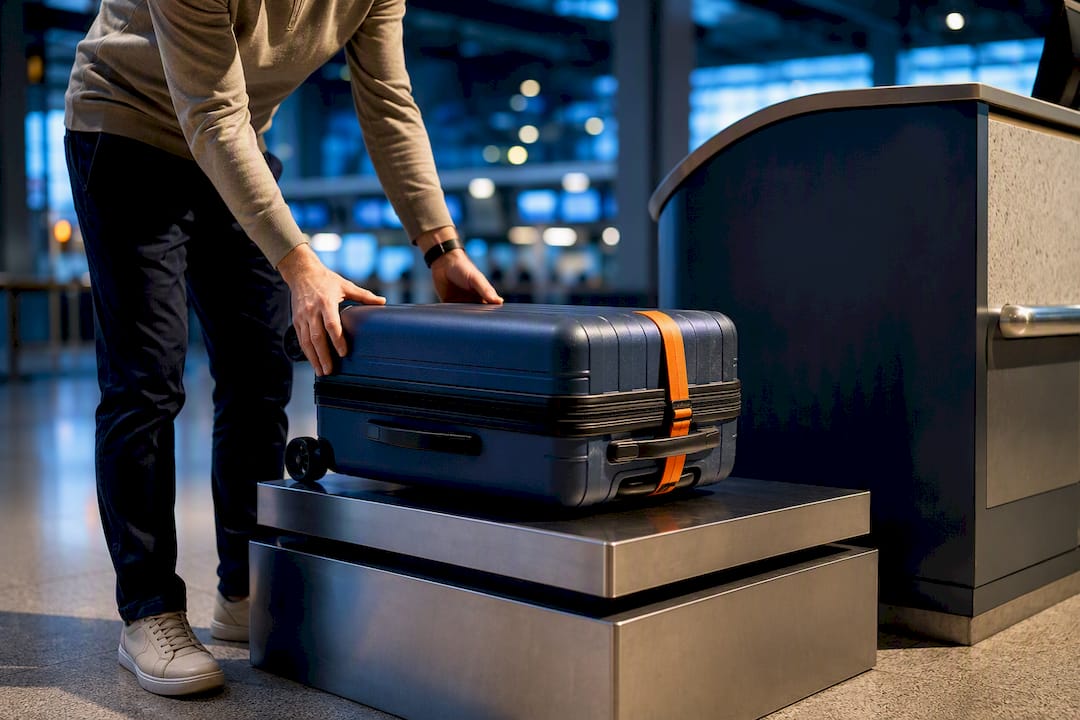
Expect to pay around $35 to $50 for a first checked bag on most major U.S. carriers in 2026, and $55 or more for a second, if you pay online in advance. The single biggest driver of sticker shock isn’t the base fee. It’s stacking: paying at the airport instead of online, flying an ultra-low-cost carrier that also charges for carry-on, or going even a few pounds over the weight limit and watching one $40 bag turn into a $150 bag.
TL;DR:
- Paying online in advance for baggage can save $10 to $20 per bag compared to airport purchases, especially as fees increase closer to departure.
- International long-haul flights often include a free checked bag, unlike domestic routes where fees typically range from $35 to $50 for the first bag.
- Overweight and oversize fees can stack quickly, with bags over 51 pounds costing up to $150 extra, and combined penalties easily exceeding $190 for one bag.
- Booking fare class matters more than route, as many economy tickets have restrictive baggage rules, while higher classes often include free or cheaper checked bags.
- Using a flight comparison tool that includes baggage costs in the total price helps avoid unexpected charges at check-in and ensures accurate trip budgeting.
Table of Contents
- Baggage Fees Comparison: How Carriers Group Up
- Why Baggage Fees Vary So Much by Route and Fare
- Typical Checked Bag Fee Ranges for 2026
- How Overweight and Oversize Fees Stack Up Fast
- Practical Ways to Cut Your Baggage Costs
- Calculating Your Real Baggage Cost for a Round Trip
- How Global Holiday Planner Simplifies This Comparison
- The One Mistake That Costs Travelers the Most
- Compare Flights With Baggage Costs Built In
- Where to Verify Current Baggage Rules
- Sources
- FAQ
Baggage Fees Comparison: How Carriers Group Up
Airlines split into three rough tiers, and knowing which tier you’re booking tells you almost everything about what your bag will cost before you even check a fee chart.
Legacy full-service carriers (think the big network airlines) typically charge $35 to $40 for a first checked bag domestically, include a carry-on and personal item free on most fares, and reserve the steep charges for overweight or oversized bags. Low-cost carriers sit in the middle. They still include a carry-on most of the time, but first-bag fees have crept toward $40 to $50 after the 2026 fee increases most major U.S. carriers implemented. Ultra-low-cost carriers are where budgets go sideways: they often charge for carry-on bags too, use dynamic pricing tied to route and travel date, and can push a “cheap” base fare well above a legacy airline’s all-in price once bags are added.
A few patterns to watch heading into your next booking:
- Southwest’s 2026 policy shift ended its long-standing free-checked-bag model for most fares, aligning it closer to legacy competitors.
- Second checked bags now commonly run $55 or higher when prepaid online, and noticeably more at the gate.
- International long-haul tickets often still include one free checked bag, even on airlines that charge domestically.
- Carry-on inclusion is the real dividing line between “affordable” and “actually affordable” once you compare full itineraries.
Why Baggage Fees Vary So Much by Route and Fare
Fare class does more to determine your bag cost than the route itself. A basic economy ticket on a legacy carrier can carry the same restrictive baggage terms as a budget airline, while a standard or premium economy fare on the same route might include a free checked bag. Airlines use this tiering deliberately: the base fare draws you in, and the fare rules determine how much of your total cost shows up later at check-in.
International long-haul rules complicate the comparison further. Many carriers that charge $35 to $50 for a first checked bag on domestic routes will include it for free on transatlantic or transpacific itineraries, since baggage allowances there are often set by fare class and alliance agreements rather than a flat domestic fee schedule. That’s a genuine trap for travelers who assume domestic pricing patterns carry over to international legs.
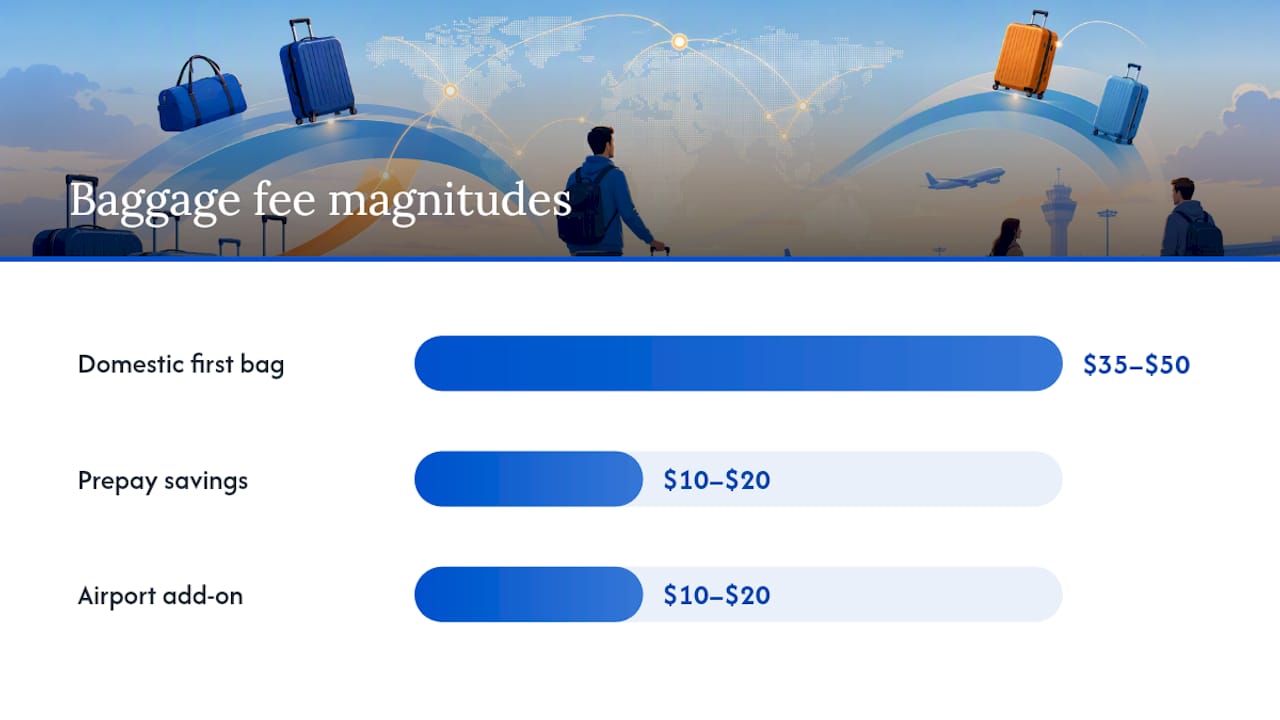
Timing matters just as much as the ticket itself. Prepaying online is consistently cheaper than adding a bag at the airport, sometimes by $10 to $20 per bag, and ultra-low-cost carriers frequently use dynamic pricing that rises as the departure date approaches. Booking your bag the same day you book your flight is almost always the cheapest moment to lock in the fee.
A few mechanics worth knowing before you compare airlines side by side:
- Carry-on and personal item are not the same thing. A personal item (small bag under the seat) is nearly always free; a carry-on with overhead bin space is where ultra-low-cost carriers start charging.
- Fare class, not just airline, determines whether a checked bag is included.
- Dynamic pricing means the fee you see today may not be the fee you pay next month.
Pro Tip: Screenshot or save the baggage fee page when you book. Airlines update pricing throughout the year, and having a record protects you if a fee changes between booking and travel.
Typical Checked Bag Fee Ranges for 2026
Budgeting for baggage gets easier once you see the ranges laid out side by side. These figures reflect prepaid online pricing on major U.S. carriers unless noted; airport pricing runs higher across the board.
| Fee type | Typical range (2026) | Notes |
|---|---|---|
| First checked bag (domestic, prepaid) | $35–$50 | Airport purchase often adds $10–$15 |
| Second checked bag (domestic, prepaid) | $55+ | Rises further at the airport |
| First checked bag (international long-haul) | Often included | Depends on fare class and alliance |
| Overweight bag, 51–70 lb | ~$100–$150 | Added on top of the base bag fee |
| Oversize bag (over 62 linear inches) | Varies by carrier | Frequently stacks with overweight fee |
The spread between carriers is wide. Per-airline checkers show first-bag charges ranging from $0 to $67 depending on route, fare, and whether the bag is prepaid. That $67 ceiling usually shows up at the airport counter on an ultra-low-cost carrier, not on a legacy airline’s website.
The gap between “included” and “$50” on a long-haul international ticket is exactly why comparing base fares alone tells you almost nothing about what a trip will really cost.
How Overweight and Oversize Fees Stack Up Fast
Here’s the part travelers underestimate most: overweight and oversize fees don’t replace your base checked bag fee. They pile on top of it. A bag that’s both over the weight limit and over the size limit can trigger two separate penalties on the same piece of luggage.
The fee bands escalate quickly:
- Bags in the 51 to 70 pound range commonly add $100 to $150 on top of the standard checked bag fee.
- Bags over 70 pounds often aren’t accepted at all, or carry even steeper penalties, sometimes requiring special cargo handling.
- Oversize fees (bags exceeding 62 linear inches, the sum of length, width, and height) vary by carrier but frequently apply alongside the overweight charge, not instead of it.
A $40 checked bag that comes in 15 pounds overweight and slightly oversized can easily cost $190 or more once both penalties stack, turning a budget-friendly flight into one of the priciest parts of the trip.
International itineraries add a second layer of confusion: weight limits are sometimes listed in kilograms rather than pounds, and a 23 kg threshold reads very differently than a 50 lb one if you’re doing the math in your head at the counter. Confirm the unit the airline actually uses, not just the number, especially on connecting itineraries where two carriers might use different systems.
Practical Ways to Cut Your Baggage Costs
You have more control over baggage fees than most people realize. The tactics below work best in this order.
- Prepay online at booking, not at the airport. This single habit saves $10 to $20 per bag on most carriers and avoids dynamic pricing spikes closer to departure.
- Compare total landed cost, not the base fare. A cheaper ticket with a $50 bag fee can cost more than a pricier fare that includes one free checked bag, especially on long-haul routes.
- Use a travel credit card with checked-bag benefits. Many cards waive the first bag fee for the cardholder and companions on the same reservation, which can offset the card’s annual cost in a single round trip.
- Leverage elite frequent flyer status if you have it. Even mid-tier status often includes one or two free checked bags.
- Choose fare classes that include baggage on long-haul international routes rather than assuming the cheapest fare is the better deal once bags are factored in.
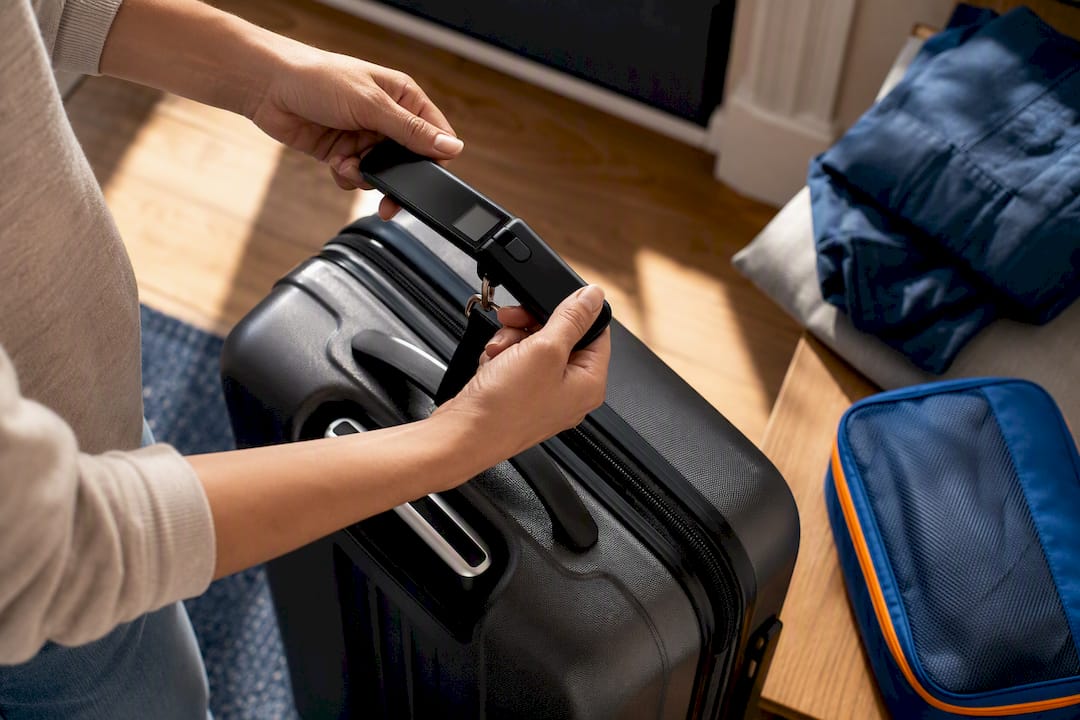
- Weigh your bag at home with a luggage scale before you leave. Redistributing a few pounds between bags at home is free; doing it at the airport counter under pressure is stressful and sometimes impossible.
- Ship bulky or heavy items ahead when the shipping cost is lower than the airline’s overweight fee, which is common for sports equipment or gear-heavy trips.
Pro Tip: If you’re traveling with a companion, pack both checked bags to roughly equal weight rather than one heavy and one light. Airlines charge per bag, not per traveler’s total weight, so an even split avoids an unnecessary overweight fee on one bag while the other rides nearly empty.
Small planning tricks like these are also useful reading if you want more ways to cut overall trip costs beyond just baggage, particularly for family trips where bag counts multiply fast.
Calculating Your Real Baggage Cost for a Round Trip
Run the numbers before you buy, not after. Here’s what to gather and how to use it.
- List the per-leg fee for each direction. Baggage is typically charged per passenger, per direction, so a round trip means paying the first-bag fee twice, not once.
- Check the timing discount. Confirm whether the price you’re seeing is the prepaid online rate or the airport rate, since the gap can be $10 to $20 per bag each way.
- Factor in weight and size bands. If you’re likely to be near a threshold, add the overweight or oversize fee to your estimate now rather than discovering it at check-in.
- Multiply by travelers. A family of four each checking one bag turns a $45 fee into $180 one way, $360 round trip, before any overweight surcharge.
- Add it to the base fare. Only this total, the landed cost recommended by baggage fee aggregators, tells you which ticket is actually cheaper.
A worked example: a $220 fare with two $45 checked bags each way runs $220 plus $180 ($45 times two bags times two directions), for a landed cost of $400. A $250 fare on a different airline that includes one free checked bag each way, with only a $55 second bag added round trip, lands at $305. The “cheaper” ticket wasn’t cheaper at all.
How Global Holiday Planner Simplifies This Comparison
Comparing base fares across airline websites tells you almost nothing about what you’ll actually pay once bags enter the picture, which is exactly the gap a flight comparison tool is built to close. Rather than forcing you to open five airline tabs and manually add baggage fees to each fare, the comparison surfaces total trip cost side by side.
This matters most on the itineraries where fee stacking does the most damage: family trips with multiple checked bags per traveler, multi-leg journeys where fees apply on each segment, and international long-haul routes where baggage inclusion varies wildly by fare class. Seeing the full landed cost upfront, rather than discovering the gap at check-in, is the difference between a budget that holds and one that doesn’t.
The One Mistake That Costs Travelers the Most
The costliest mistake in baggage budgeting isn’t picking the wrong airline. It’s assuming the base fare is the final number. Travelers who ignore per-direction charging and stacked overweight fees routinely end up paying more at the airport than they did for the flight itself.
The fix is simple and repeatable: calculate the full landed cost before you buy, and prepay bags whenever it’s cheaper than paying at the gate. That one habit, applied every time you book, prevents nearly every unpleasant surprise this article describes.
— Global
Compare Flights With Baggage Costs Built In
Base fares hide the real story. A flight search tool folds baggage fees into the total price comparison, so you’re weighing what a trip actually costs, not just the number an airline puts on its homepage.

That matters most when you’re juggling multiple travelers, connecting flights, or long-haul routes where one carrier includes a checked bag and another charges $50 for it. Run your route through the flight comparison tool before you commit, and check whether a slightly higher fare with an included bag actually beats the “cheap” option once fees are added. If you’re pairing the trip with a hotel or a rental car, the hotel booking tool and car rental comparison work the same way. Start your search, add your dates, and see the full landed cost before you pay for anything.
Where to Verify Current Baggage Rules
Baggage fees change often enough that any snapshot, including this one, needs periodic rechecking against primary sources.
- DeepArrival’s airline baggage fee comparison tracks pricing across 50 carriers with 2026 updates.
- CatchFlights’ baggage and landed cost tool folds fees directly into total trip pricing.
- TravelVient’s checked bag fee checker breaks down per-airline overweight and oversize bands.
- Always confirm final terms on the airline’s own policy page before booking, since aggregators update on their own schedule.
Sources
- Airline Baggage Fees: Compare 50 Airlines (2026)
- The death of the free checked bag: US airline baggage fees in 2026 | CatchFlights
- Checked Bag Fees by Airline 2026, Travel Vient
- Frontier baggage policy summary (TravelPro excerpt)
FAQ
Who has the cheapest checked baggage fees?
Legacy full-service carriers generally offer the lowest first-bag fees domestically, often in the $35 to $40 range when prepaid online, and they’re more likely to include a free checked bag on international long-haul fares. Ultra-low-cost carriers can look cheaper on the base fare but frequently cost more once baggage and carry-on fees are added.
Which airline is the cheapest for baggage overall?
There’s no single cheapest airline across every route. The real answer depends on your fare class and itinerary, since total landed cost, not the sticker fee, determines which airline actually saves you money on a given trip.
Which airline has the most expensive baggage fees?
Ultra-low-cost carriers tend to carry the highest all-in baggage costs, particularly when a traveler pays at the airport rather than online and also gets charged for a carry-on bag. Per-airline checkers show first-bag fees reaching as high as $67 at the top end of that range.
How much will airline baggage fees be in 2026?
Expect first checked bags to run roughly $35 to $50 when prepaid online on most major carriers, with several airlines raising fees in 2026. Second bags typically start around $55 and climb from there, especially if purchased at the airport instead of in advance.
[…] you have booked two separate one-way tickets instead of one connecting itinerary. Our breakdown of baggage fees and total landed cost shows how quickly a discount fare can lose its edge, and our comparison of basic economy versus […]