

The fastest way to book flights for a group is to contact the airline’s group desk or a specialist booking platform and place a hold on space before you pay anything. Most carriers, including Delta, define a group as 10 or more passengers traveling together, and IATA’s own booking data model treats groups as a distinct category with their own attributes and rules. From there, Global Holiday Planner and similar platforms can help you compare terms once you know what deposit and ticketing deadlines to expect.
TL;DR:
- Booking early is crucial, with international group space opening up 240 to 331 days before departure, especially for long-haul flights.
- Group fares are primarily about securing seats together and flexible payment options, not necessarily lower prices, making comparison essential.
- Final passenger names and ticketing deadlines usually fall several weeks to 30 days before travel, so setting calendar reminders is vital to avoid losing space.
- Group contracts often include a utilization threshold, meaning unused seats after a certain point may incur penalties rather than being released for free.
- Using a platform can streamline managing multiple airline quotes and deadlines, especially for large or complex multi-city trips.
Table of Contents
- A step-by-step checklist to start a group booking
- How group fares and group contracts work
- Timing: how far in advance to book and key deadlines
- Pricing reality: when group bookings save money and when they don’t
- Seat assignments, name deadlines, and special-case rules
- Practical contact tips: what to ask and when to use a platform or agent
- Global Holiday Planner perspective and practical recommendations
- How Global Holiday Planner can help with group bookings
- Sources
- FAQ
A step-by-step checklist to start a group booking
Before you call anyone, get your basics straight. Airlines and platforms move faster when you arrive with real numbers instead of vague plans.
- Decide whether your travel dates are fixed or flexible, and settle on a tentative headcount versus a confirmed one.
- Name a single group leader or billing contact who will handle payments and communication with the airline.
- Put together a provisional passenger list, even if names are not final, since most airlines accept placeholder entries at this stage.
- Request a written quote and space hold, then confirm the deposit amount, deposit due date, and ticketing deadline in writing.
- Ask directly about name-change deadlines, seat-assignment windows, and the airline’s utilization or cancellation policy before you commit any money.
Getting these five items locked down early prevents the most common group-booking problem: discovering a deadline after it has already passed.
How group fares and group contracts work
Airlines generally treat 10 or more passengers on the same flight, date, and route as a group, a threshold used across carriers like Delta. Below that number, you are booking individually even if you are traveling together.
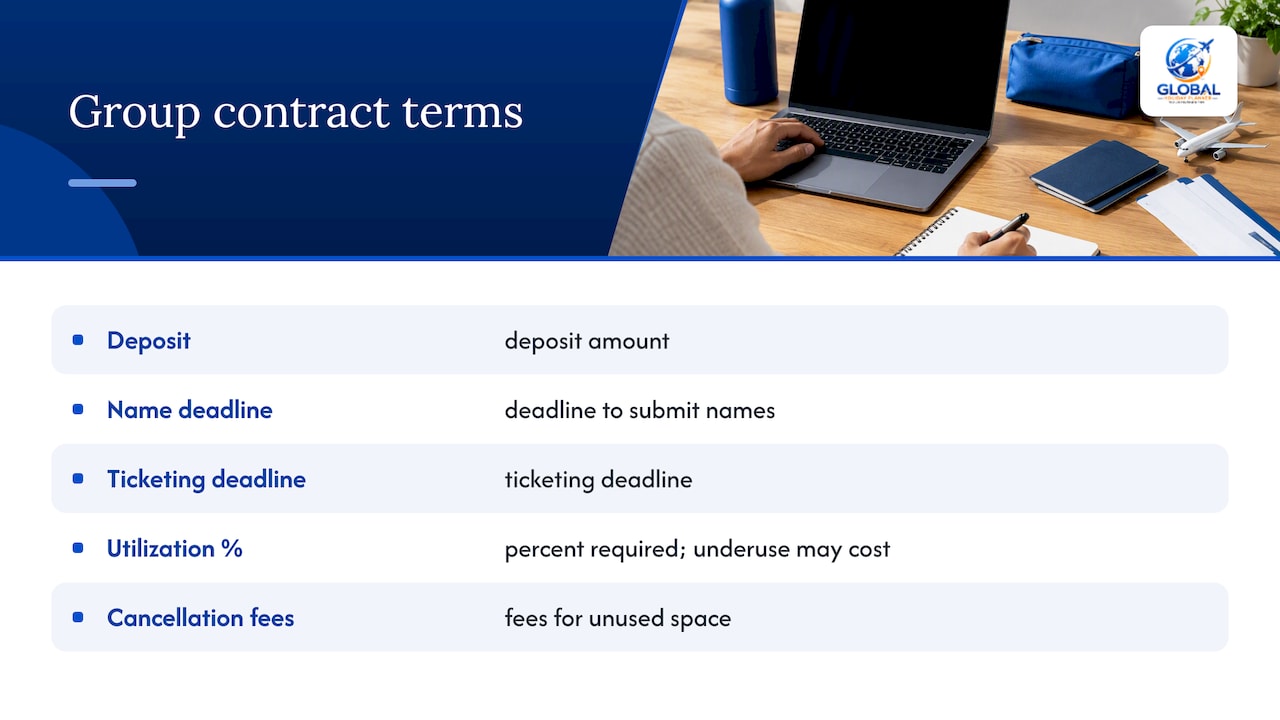
A group contract, sometimes formalized in an online group system like the one described in the British Airways Groups leaflet, typically includes a deposit amount, a deadline for submitting final passenger names, a ticketing deadline, a utilization percentage, and cancellation fees for space you don’t use. Utilization matters more than most organizers expect: if you hold 20 seats and only ticket 14, the airline may charge a penalty on the difference rather than simply releasing the unused seats for free.
Individual changes inside a group booking are handled differently than a normal ticket change. Swapping one traveler for another before the naming deadline is usually simple and sometimes free, but changes made after names are locked can trigger the same fees as a standard fare change. IATA’s group data model notes that these specifics are often set by bilateral agreements between the airline and the booking agency, which is why terms can vary even for similar group sizes.
Timing: how far in advance to book and key deadlines
Group space should generally be requested as early as you have a realistic headcount and date range, since availability shrinks well before public fares start moving. Delta’s group booking windows range widely by destination, with some international routes opening space 240 to 331 days before departure, so long-haul groups benefit from starting nearly a year out.
Naming and ticketing deadlines usually land separately from the initial hold:
- Final passenger names are often due weeks before travel, though the exact window is carrier specific.
- Ticketing deadlines commonly fall around 30 days before departure in examples published by British Airways Groups.
- Missing a ticketing deadline can release your held fare entirely, forcing a rebook at current prices.
- Option holds, which extend your decision window before the deposit is due, can buy extra planning time on some contracts.
Set calendar reminders at each deadline rather than relying on the airline to follow up, since staged deposits and naming windows rarely align with a single date.
Pricing reality: when group bookings save money and when they don’t
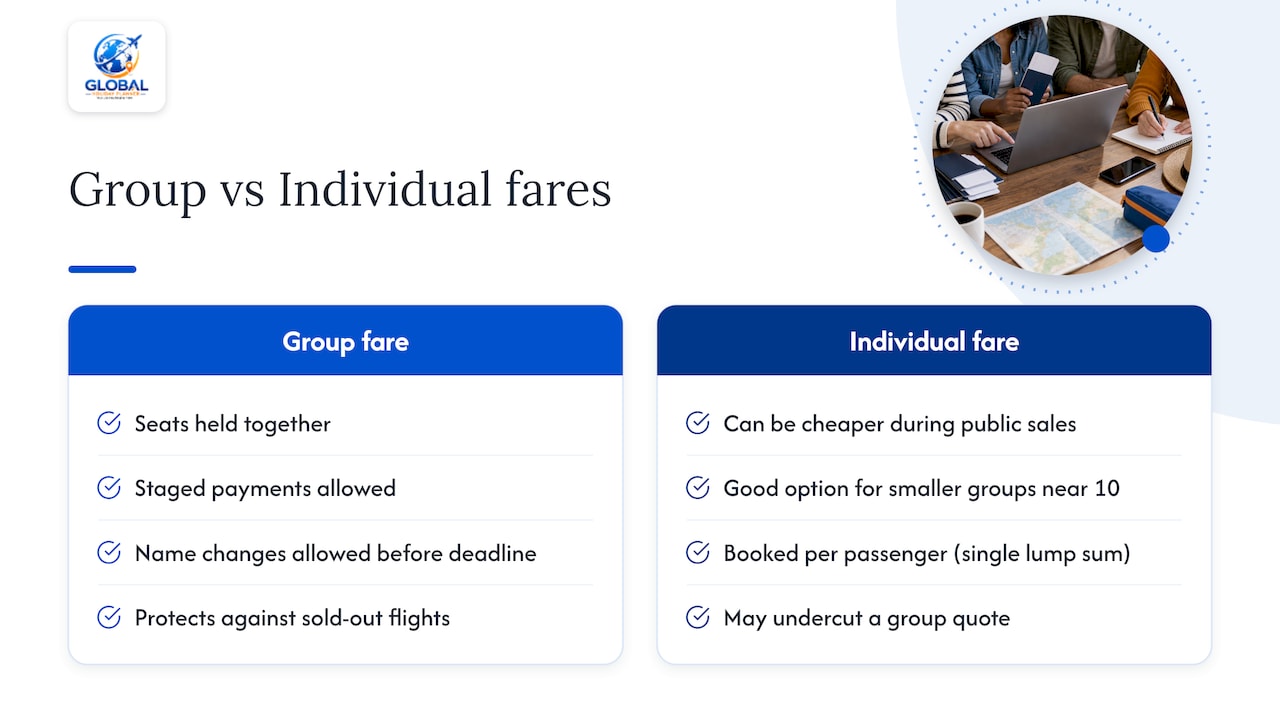
Group fares are not automatically the cheapest option available. Their real value is logistical: they hold seats together, allow staged payments instead of one lump sum, and give you flexibility to adjust passenger names before the deadline. A public sale fare booked individually can sometimes beat the group rate, particularly for smaller groups or complex multi-stop itineraries where group contracts add restrictions rather than savings.
Smaller groups closer to the 10-passenger minimum should compare both routes before committing, since booking individually during a sale can undercut a group quote. Larger or time-critical groups usually come out ahead with a group contract because the protections against sold-out flights outweigh a marginally lower published fare.
To judge the real cost, add the base fares, the deposit (including what you’d forfeit if plans change), any ancillary fees for bags or seats, and travel insurance, then compare that total against booking the same group individually. Our guide on finding cheap flights covers tactics that apply to both approaches.
Seat assignments, name deadlines, and special-case rules
The U.S. Department of Transportation advises confirming seating policies early and booking children on the same reservation as the adults traveling with them, then contacting the airline directly to resolve any seating gaps before departure. That guidance applies just as well to adult groups: booking everyone under a single record locator, rather than splitting the group across multiple reservations, gives you priority when seat blocks are assigned.
Ask the airline to hold a seat block at the time of your group contract rather than waiting until check-in. For families or groups traveling with unaccompanied minors, confirm the carrier’s specific minor policy and make sure emergency contact details are recorded on every relevant reservation, since this information is checked separately from the main passenger list.
Practical contact tips: what to ask and when to use a platform or agent
Booking directly with an airline’s group desk gives you the clearest view of contract terms, since you’re negotiating straight from the source. Using an agent or a platform trades some of that direct control for consolidation: one point of contact, packaged pricing, and less time spent chasing separate deadlines across multiple bookings.
When you call, ask these questions and get the answers in writing:
- What is the deposit amount and when is it due?
- What is the naming deadline, and what happens if we miss it?
- What is the ticketing deadline relative to departure?
- What utilization percentage do we need to hit to avoid penalties?
- What are the cancellation fees if the group size drops?
Pro Tip: Save the written Group Travel Agreement, not just a confirmation email, since it’s the document that specifies dates, penalties, and payment details if a dispute comes up later.
Global Holiday Planner perspective and practical recommendations
A managed group booking makes the most sense when you’re short on time, juggling a complex multi-city itinerary, or coordinating ancillaries like extra bags and seat upgrades for a large party. A platform can centralize passenger data and staged payments in one place, which cuts down on the name-change fees that pop up when details are scattered across separate emails and spreadsheets.
Whichever route you choose, compare the full trip cost, not just the headline fare. Add deposits, potential forfeitures, ancillaries, and insurance before deciding between a group contract and individual bookings.
— Global
How Global Holiday Planner can help with group bookings
Coordinating ten or more travelers usually means juggling quotes from multiple airlines while tracking deposits, names, and seat blocks by hand. Some platforms bring fare comparisons, payment tracking, and passenger data collection into a single view, so your group leader isn’t managing five spreadsheets at once.
After you reach out, an organizer can expect:
- A side-by-side comparison of group fare options across airlines.
- Support tracking deposit and ticketing deadlines so nothing slips.
- Help finalizing passenger names before the naming cutoff.
Start by comparing group flight options for your travel dates, and pair the trip with the right travel insurance in case plans shift before departure.
Sources
- Tips for Families and links to airline webpages | U.S. Department of Transportation
- Group Travel | Delta Air Lines
- British Airways Groups Travel leaflet
FAQ
What is the cheapest way to book group flights?
There’s no single cheapest method, since group fares prioritize space holds and payment flexibility rather than the lowest possible price. Comparing a group quote against individually booked public fares, especially for smaller groups, often reveals which route actually costs less for your dates.
How do I book group flights step by step?
Start by deciding your headcount and date flexibility, then contact the airline’s group desk or a booking platform to request a quote and space hold. Confirm the deposit amount, naming deadline, and ticketing deadline in writing before you pay anything.
How do I book a flight for 20 passengers?
Twenty passengers qualifies as a group under most airline policies, since the common threshold is 10 or more travelers on the same flight and route, as seen in Delta’s group program. Contact the airline’s group desk directly or use a platform to request a group quote, then follow the standard deposit and naming process.
Is group booking cheaper than booking individually?
Not always. Group bookings mainly offer logistical benefits like staged payments and held seats rather than consistently lower fares, so it’s worth checking public sale prices before committing to a group contract, particularly for smaller groups.
What information do I need to provide for a group flight booking?
Airlines typically ask for a provisional passenger list, a group leader or billing contact, and your expected travel dates before issuing a quote. Final passenger names are usually due later, closer to the airline’s naming deadline.
[…] costs alongside the base fare so you can see the total suitable price before you commit, and our group flight booking guide covers the specific coordination issues that come up when you are booking for ten or more people. […]