

A corporate travel policy is a short written set of rules that tells employees how to book trips, what they can spend and how they get reimbursed. The best ones are brief, specific and tied to a booking routine that makes the compliant choice the easy one. That is where we start: put flights, hotels, cars, rail, transfers and insurance side by side with their total cost, and a policy stops being a document people skip and becomes the way trips actually get booked. On globalholidayplanner.com you can compare all of these in one place, which is exactly what a policy needs to enforce.
Below is what to cover, sample numbers from real company policies, the U.S. expense rules that trip people up, and a rollout plan.
TL;DR
- A good policy covers who may travel, how and where to book, spending limits, approvals, expenses, safety and exceptions.
- Keep it short. In a 2025 survey of corporate travel managers, 32% said employees break policy because they have not read it or do not know it.
- Set limits by city and by advance-booking window, and say plainly who approves what.
- In the U.S., expense reimbursements stay tax-free only under an accountable plan: account for the trip within 60 days and return any excess within 120 days.
- Review the policy at least once a year and measure how many trips are booked through the required channel.
Table of Contents
- What a corporate travel policy does
- Step 1: Set the goal before you write a rule
- Step 2: Define who and what is covered
- Step 3: Write booking rules that people can follow
- Step 4: Set spending limits by category and by city
- Step 5: Spell out approvals and exceptions
- Step 6: Handle expenses, receipts and per diems
- Step 7: Put safety and duty of care in writing
- Step 8: Communicate, measure and update
- Sustainability and convenience
- Our perspective
- Book policy-ready trips in one place
- FAQ
- Sources
What a corporate travel policy does
A travel policy answers five questions before an employee asks them: Who can travel? How do they book? What can they spend? Who signs off? How do they get paid back? Everything else in the document is detail on those five.
Done well, it does four jobs for the business:
- Controls cost. Limits on airfare, lodging and ground transport make spend predictable.
- Protects travelers. Insurance, emergency contacts and cancellation rules put the employer’s duty of care in writing.
- Keeps you compliant. Documented rules and receipts support tax treatment and audits.
- Treats people fairly. The same rules apply to every team, so nobody negotiates their own perks.
For a founder with five employees, the policy can be one page. For a company with several departments and international trips, it grows, but the structure stays the same.
Step 1: Set the goal before you write a rule
Decide what the policy is for. Cutting cost, getting visibility into who is where, and keeping people safe pull in different directions, and a rule written for one can undermine another. A rule that forces the cheapest flight, for example, may put a traveler on a red-eye before a client meeting.
Write the goal in one or two sentences at the top. A useful template: “We want employees to travel safely and productively at a reasonable cost, with clear approvals and fast reimbursement.” Every later rule should be checkable against it.
Step 2: Define who and what is covered
State the scope in plain words:
- Who: employees, contractors, interns, board members, guests traveling on company money.
- What counts as business travel: client visits, conferences, training, site visits, relocations. Say whether commuting and personal side trips are in or out.
- Personal extensions: if someone adds a weekend to a business trip, say who pays for what and who must book the extra nights.
This section is short but prevents the most common arguments later.
Step 3: Write booking rules that people can follow
Booking rules are where policies are won or lost. The largest compliance problem reported in the 2025 GBTA and ALTOUR survey was booking outside required channels, cited by 35% of respondents. People go around the system when the system is slow or when they can find a better price somewhere else.
So make the required channel the one with the broadest choice. Specify:
- Where to book. Name one place, or a short list, that shows flights, hotels, cars and rail with total cost.
- How far ahead. Set a window. One published example, Robinhood’s travel policy for its extended workforce, requires airfare to be bought at least 14 days in advance. Aperam’s global policy asks for reservations at least two weeks ahead where possible and intercontinental flights at least six weeks ahead.
- Which fare class. Many policies use economy for short flights and a higher cabin only above a set flight length. Pick a threshold in hours and write it down.
- Flexibility. Decide when a refundable or changeable fare is required, such as for trips where plans are likely to move. Our guide to business travel booking tips covers how to save money and avoid delays when you book.
Timing matters for price, too. If your rule says “book early,” back it up with data: our piece on the best time to book hotels explains how far ahead to reserve, and the flexible date flight grids show how shifting a departure by a day or two changes the fare.
Step 4: Set spending limits by category and by city
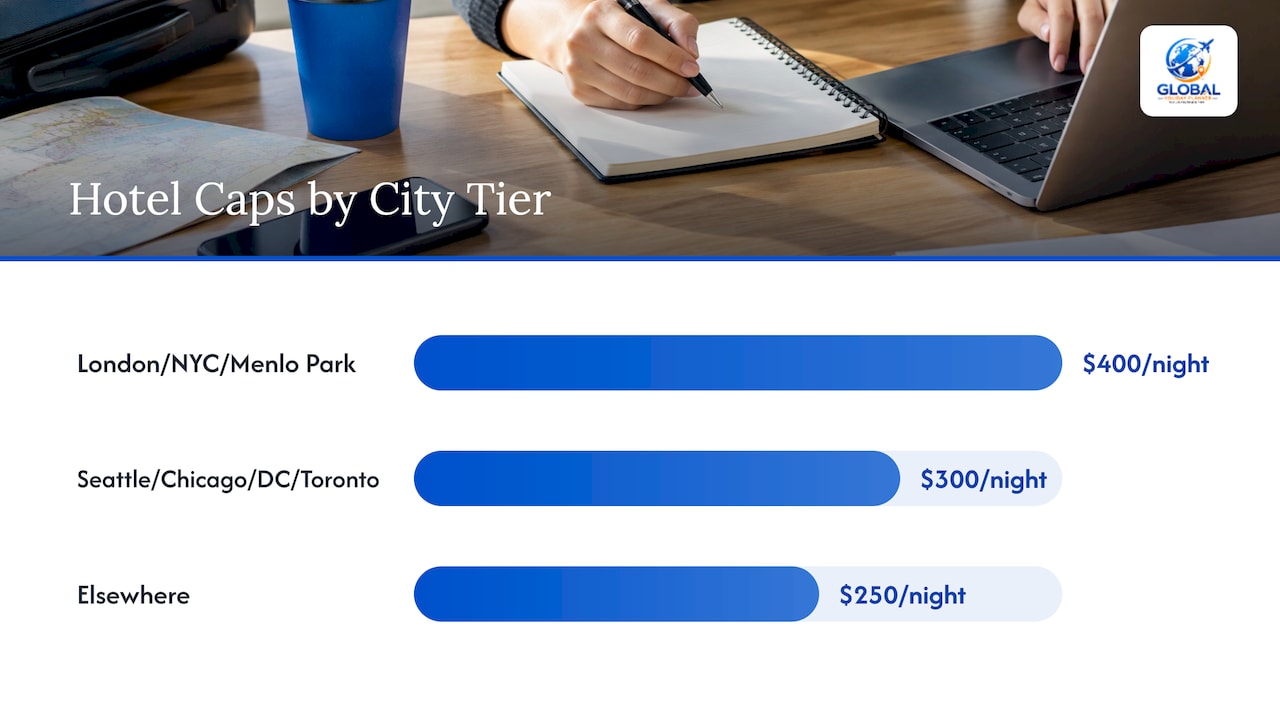
A single national hotel cap is either too tight for New York or too generous for a smaller city. Use tiers. In the Robinhood policy, hotel rates are capped at $400 a night in London, New York City and Menlo Park, $300 in Seattle, Washington DC, Chicago and Toronto, and $250 everywhere else, before tax and fees. Those are one company’s figures from November 2023, so treat them as a model for the structure, not a number to copy.
A simple way to see what a policy has to specify:
| Category | What to set | Example wording |
|---|---|---|
| Air | Advance window, cabin by flight length, change rules | Book 14+ days ahead; economy under 6 hours |
| Hotel | Nightly cap by city tier, preferred rate programs | $250 standard, $300 and $400 in listed cities |
| Ground | Car class, rideshare vs. rental, airport transfers | Midsize or below unless 3+ travelers |
| Rail | When rail is preferred over short flights | Rail for city pairs under 3 hours |
| Meals | Per diem or actual cost with a daily cap | Per diem aligned to GSA rates |
| Insurance | Coverage for medical, cancellation and interruption | Required on international trips |
For hotels, negotiated rates can cut a lot of spend, and our guide to getting better hotel corporate rates walks through how. For cars, specify the class so nobody upgrades by default: car rental classes explained shows what each category means.
Group trips
If you send teams to the same event, a group booking is usually cleaner than ten separate ones. Our group flight booking playbook covers locking seats for ten or more travelers, and it is worth a line in the policy: “Groups of ten or more book together.”
Step 5: Spell out approvals and exceptions
Approvals should be few and fast. Define thresholds and name roles, not people. Aperam’s policy, for example, requires pre-approval from the Head of Entity or Platform for trips estimated under 500 EUR or USD, and from a leadership team member above that. You do not need that many layers. A small company can say: “Trips under $1,000 need your manager’s approval; above that, the finance lead’s.”
For exceptions, write the process, not just the rule. A good exception clause includes:
- Who can grant it (one role)
- What they need to see (the reason and the cost difference)
- How fast they must answer (24 hours is reasonable)
- Where it is recorded
Otherwise exceptions become the real policy.
Step 6: Handle expenses, receipts and per diems
This is where U.S. tax rules touch your document. Two points matter most.
Receipts. The IRS generally requires receipts for expenses of $75 or more, and the Business Travel News Buyer’s Handbook notes that electronic data from card suppliers can replace paper receipts if it carries enough detail. That handbook is from 2019, so confirm current requirements with your accountant. Your policy should state the receipt threshold and the format you accept (photo, PDF, card feed).
Accountable plan. Reimbursements are not taxable income for the employee when they come under an accountable plan. IRS Publication 463 says that means the employee adequately accounts for expenses within 60 days after they were paid or incurred and returns any excess reimbursement within 120 days. Put both deadlines in your policy, and name who processes the claims.
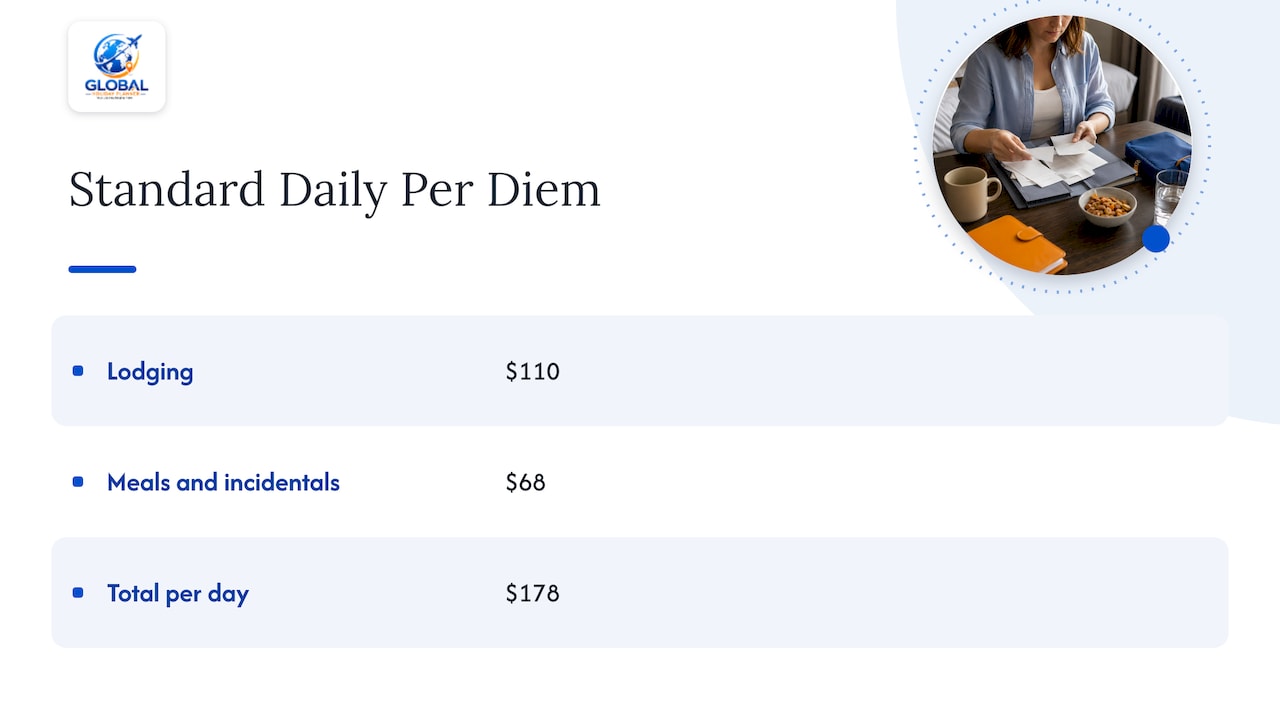
Per diems. A per diem is a fixed daily allowance for lodging and meals instead of reimbursing each receipt. The U.S. General Services Administration publishes official rates by locality. For fiscal year 2026, the standard rate was $178 a day, made up of $110 for lodging and $68 for meals and incidentals, with higher rates in many high-cost areas. GSA updates the rates each fiscal year, which starts October 1, so check its live tables when you write the policy and again each autumn.
Rules differ by country, and in some cases by state. If your people travel abroad or you have staff elsewhere, there is no single global standard for how business travel expenses are taxed, so write the policy per jurisdiction or add a local appendix.
Step 7: Put safety and duty of care in writing
Duty of care means the employer’s responsibility to keep traveling staff reasonably safe. Your policy should say, at minimum:
- Which trips require travel insurance, and what it must cover
- Who to call in an emergency, with a number that works abroad
- What to do after a cancellation, missed connection or medical event
- Whether the company needs to know a traveler’s itinerary and where they are staying
The legal weight varies by country. In the UK, employers have a legal duty to safeguard staff that cannot be handed off to a provider, and in France employer safety obligations extend to employees abroad. If you have staff in those countries, ask your legal adviser what applies.
Inclusion is part of safety. The GBTA and ALTOUR survey found that only 13% of travel managers say their policies strongly address accessibility needs, and 19% report clear guidance for diverse traveler groups. A short section on how to request accommodations, and whom to tell about safety concerns, covers a gap most companies have.
For insurance, our guides help you decide what to require: is travel insurance worth it for U.S. travelers maps trip risks, and the trip cancellation vs. interruption checklist explains the two coverages you will want your policy to name.
Cancellations and changes
People cancel trips, and your policy should say who absorbs the cost. Cover three things: whether unused tickets must be reported, who is responsible for nonrefundable charges when the business cancels, and what employees should do first. Two of our guides help here: the 24 hour flight cancellation rule in the U.S. and a step-by-step script for recovering money from nonrefundable hotel bookings.
Step 8: Communicate, measure and update
A policy nobody reads does nothing. The same GBTA and ALTOUR survey found that 32% of employees break policy because they have not read it or are unfamiliar with the rules, while 51% of policies run past 10 pages and 24% past 20. Those two facts are connected.
What works in practice:
- Cut length. Aim for a page or two of rules plus a quick-reference summary. Move forms and edge cases to appendices.
- Lead with the traveler’s questions. “How do I book?” comes before “Definitions.”
- Make the rule the default. If the booking tool shows the approved options first, with total cost, most people choose them.
- Brief new hires and re-send the summary before the busy travel season.
- Track three numbers: share of trips booked through the required channel, average spend per trip by category, and the number of exceptions requested.
- Review yearly. Rates, per diems and travel risks change. Put a review date on the first page.
In that survey, 32% of travel managers said their policy is stricter than three years ago, and only 5% said it is more lenient. Stricter does not have to mean longer: clear, tiered limits are easier to follow than a long list of prohibitions.
Sustainability and convenience
Many policies add a short section on sustainability: prefer rail over short flights, choose direct routes, and combine trips where possible. Pair it with convenience, because travelers follow rules that save them time. This look at convenience in business travel shows how much weight travelers give to ease, which is why a policy that points to one simple booking routine wins more compliance than one that only restricts.
Our perspective
We see a travel policy as a booking tool first and a legal document second. If the rules live in a PDF and the prices live somewhere else, travelers will always book where the prices are.
That is why we build our comparison around the real total cost of a trip: flights, hotels, car rentals, rail, transfers and insurance side by side, with recommendations by trip type. When a business traveler can see the whole itinerary in one place, a rule like “economy under six hours, hotel under the city cap, insurance on international trips” is something they can check in a minute instead of a policy they have to remember.
Write the limits, name the booking channel, and make that channel the most useful one. The rest follows.
Global
Book policy-ready trips in one place
Global Holiday Planner lets travelers compare flights, hotels, car rentals and airport transfers side by side, with rail tickets and travel insurance available from the main site. Name it as your booking channel and your policy’s rules about class, hotel caps and insurance can be checked against one set of results.
FAQ
What should a corporate travel policy include?
Cover purpose and scope, who is eligible, booking channel and timing, airfare class, hotel limits, ground transport, meals or per diems, approvals, expense reporting, cancellations, safety and emergencies, and exceptions. Keep each section to a few lines. Put the quick-reference summary on the first page.
How do I create a travel policy from scratch?
Start with the goal, then list your last year’s trips and what they cost. Set limits slightly above your average so most trips fit, add an approval rule and an exception path, and have a manager and finance lead read the draft. Publish it with a one-page summary and review it after six months.
How long do employees have to submit travel expenses?
There is no single legal deadline for every company, since it is set by your policy. For tax-free treatment in the U.S., the IRS accountable-plan rules call for accounting for expenses within 60 days and returning excess reimbursement within 120 days. Ask your accountant how to apply this to your plan.
Do we need a different policy for international trips?
Often you need an addendum, not a separate policy. Tax treatment of expenses differs by country, and so do employer safety obligations. Add rules for insurance, emergency contacts and documents, and have legal counsel check the countries where you send people most.
Sources
- Corporate Travel Policies Strengthen, Modernize and Embrace AI (GBTA and ALTOUR)
- Extended Workforce and Third Party Travel Policy (Robinhood)
- Aperam Global Corporate Policy
- Establishing a T&E Policy (Business Travel News Buyer’s Handbook 2019)
- IRS Publication 463, Travel, Gift, and Car Expenses
- What Is Per Diem? 2026 Rates and Best Practices
- Taxation and business travel expenses: a global guide
- Do Organisations Understand Their Travel Risk Exposure? (GSA Global)
[…] lounge cost is a policy question. Whether the company reimburses a day pass belongs in the corporate travel policy, and the business travel booking tips cover the booking […]