
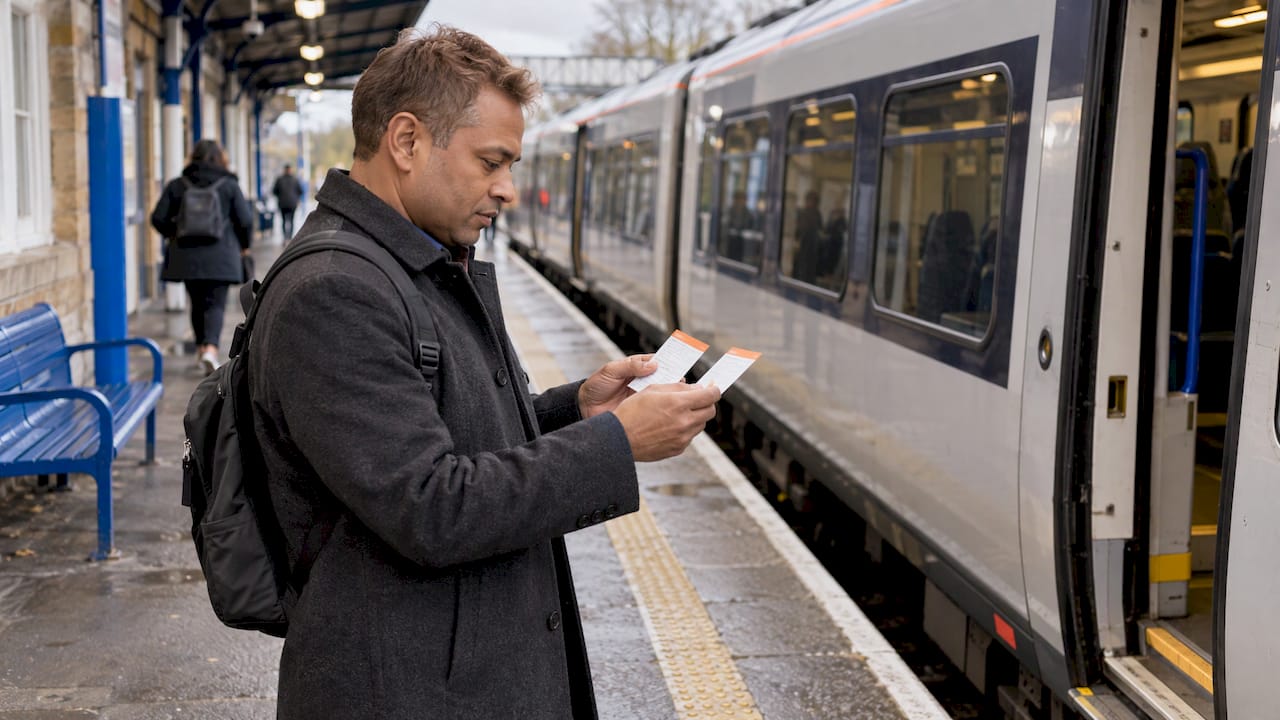
Split ticketing means buying two or more tickets for successive sections of one train journey instead of a single through ticket. It works best in Great Britain, where fares are priced per ticket and a split can cost less than the through fare. Most other rail networks price journeys differently, so the trick rarely applies there. If you are a U.S. traveler planning a trip, check which country you are riding in before you spend time hunting for splits.
Below you will find how a split works, a worked method for finding one, what to do about seats and delays, and how the rules change from country to country.
TL;DR
- A split ticket replaces one A to C ticket with A to B and B to C tickets. National Rail describes this as permitted in Great Britain when the train stops at every split station.
- You normally stay on the same train. You do not get off at the split point.
- Splits are not always cheaper, and some routes, services and ticket types do not allow them. Always compare against the through fare.
- Delay compensation in Great Britain is assessed on your arrival at the final destination when the tickets together covered the journey.
- Outside Great Britain, treat splitting as the exception. Some operators, such as French regional trains, restrict it in their conditions.
Table of Contents
- What split ticketing is
- Why two tickets can cost less than one
- Where split ticketing works, and where it does not
- How to find a valid split: a step-by-step method
- Do you have to get off the train?
- Delays, cancellations and compensation
- Pre-travel checklist for split tickets
- Booking your rail trip with Global Holiday Planner
- Our view on splitting
- FAQ
- Sources
What split ticketing is
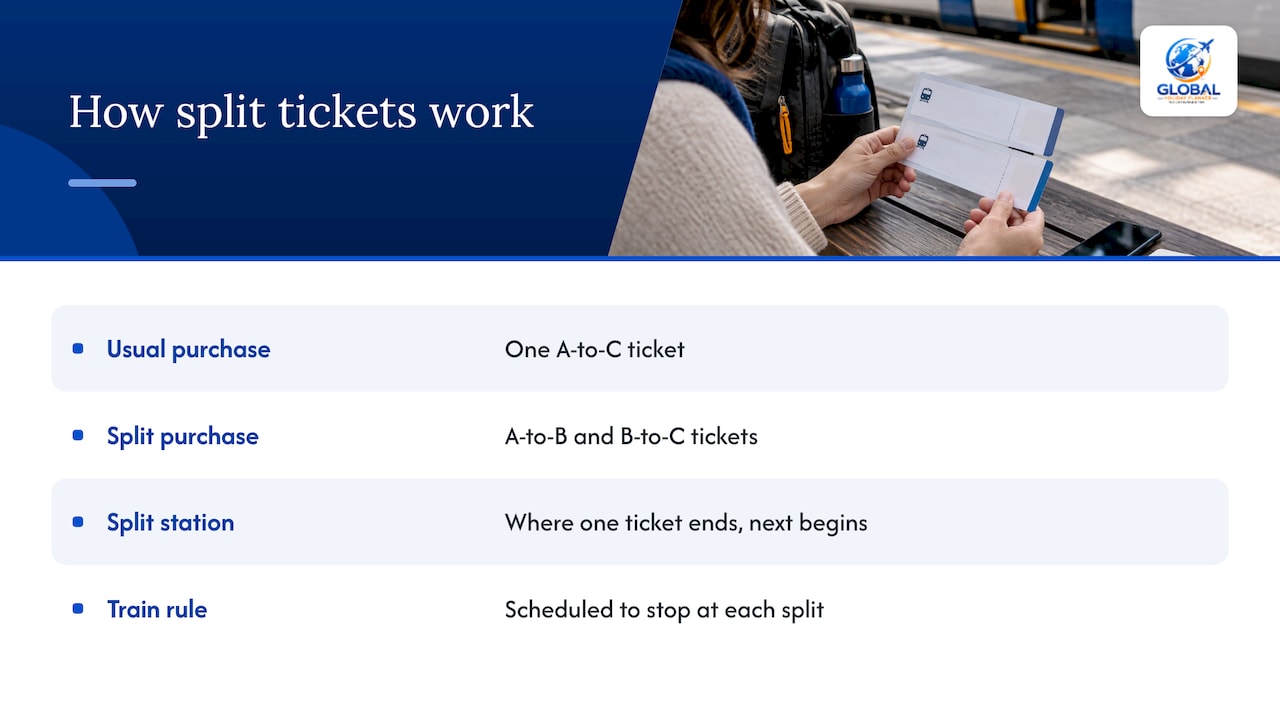
Imagine a trip from A to C that passes through B. The usual purchase is one ticket from A to C. With split ticketing you buy A to B and B to C separately. Your origin and destination stay the same, and so does the train you ride.
National Rail, the information body for Britain’s train operators, defines it as buying two or more tickets for successive sections of one journey instead of one through ticket. The split station is simply the place where one ticket ends and the next begins.
The idea sounds like a loophole, but in Britain it is a recognized way to buy a ticket. The same page notes that split tickets are allowed under Condition 14 of the National Rail Conditions of Travel, provided the train is scheduled to stop at each split station.
This is a British rail concept first. If your trip is in Spain, Italy, Germany or Japan, the logic of “two short tickets cost less than one long one” often does not hold, because fares are built differently. More on that below.
Why two tickets can cost less than one
British rail fares are priced ticket by ticket. They are not simply a function of distance. A fare for a shorter section can be set at a different level than the fare for the whole route, and peak and off-peak boundaries differ by station. So the sum of two sections can come in under the through price.
Three published examples show the pattern:
- Shrewsbury to Liverpool. The Independent reported a £31 Anytime through fare that could be cut by more than £10 with separate Shrewsbury to Chester and Chester to Liverpool tickets.
- Hitchin to Brighton. The same article described a £44.50 through fare reduced by £5 by splitting at London St Pancras, where the journey moves from peak into off-peak pricing.
- London Paddington to Bristol. BBC News described a split at Didcot that could save roughly one-third against an unsplit Monday-morning fare, provided the train stopped at Didcot.
These are reported examples from past years, not current prices. Treat them as illustrations of where savings come from: crossing a peak boundary, or a shorter leg priced unusually low. Fares change, so the only number that matters is the one shown for your date and time.
The flip side is just as important. National Rail states that split tickets are not guaranteed to be cheaper and are unavailable for some routes, services and ticket types. Many journeys have no saving at all.
Where split ticketing works, and where it does not
Great Britain
This is the home territory. The rule is simple: the train must call at each station where you split. Each ticket still carries its own conditions, so a ticket with a time or train restriction must be used at that time or on that train.
France
Do not assume the British approach carries across the Channel. A conditions document for TER Pays de la Loire regional trains says two complementary tickets at different fares cannot be used for the same segment on one train and that extensions without changing trains are not authorized. In effect, you need a ticket for the whole journey. That is one operator’s regional conditions, but it shows why you check local rules first.
The European Union
EU rail passenger rights rules do not ban separate tickets, but they care how tickets were sold. Regulation 2021/782 says passengers must be told before purchase whether connected tickets constitute a through-ticket. Tickets bought in one commercial transaction from a railway undertaking are treated as a through-ticket, which makes that undertaking liable when a connection is missed, subject to the Regulation’s conditions. Separate tickets bought in separate transactions do not get that protection in the same way.
The United States and the rest of the world
If you are riding in the U.S., the British method does not map onto how fares are sold, and for most trips you will simply book the through journey. If you are planning rail in Europe or Asia, your better question is usually pass or point-to-point, which our 1.5× rule guide walks through, and how to book fast trains well, covered in our high-speed train booking guide.
How to find a valid split: a step-by-step method
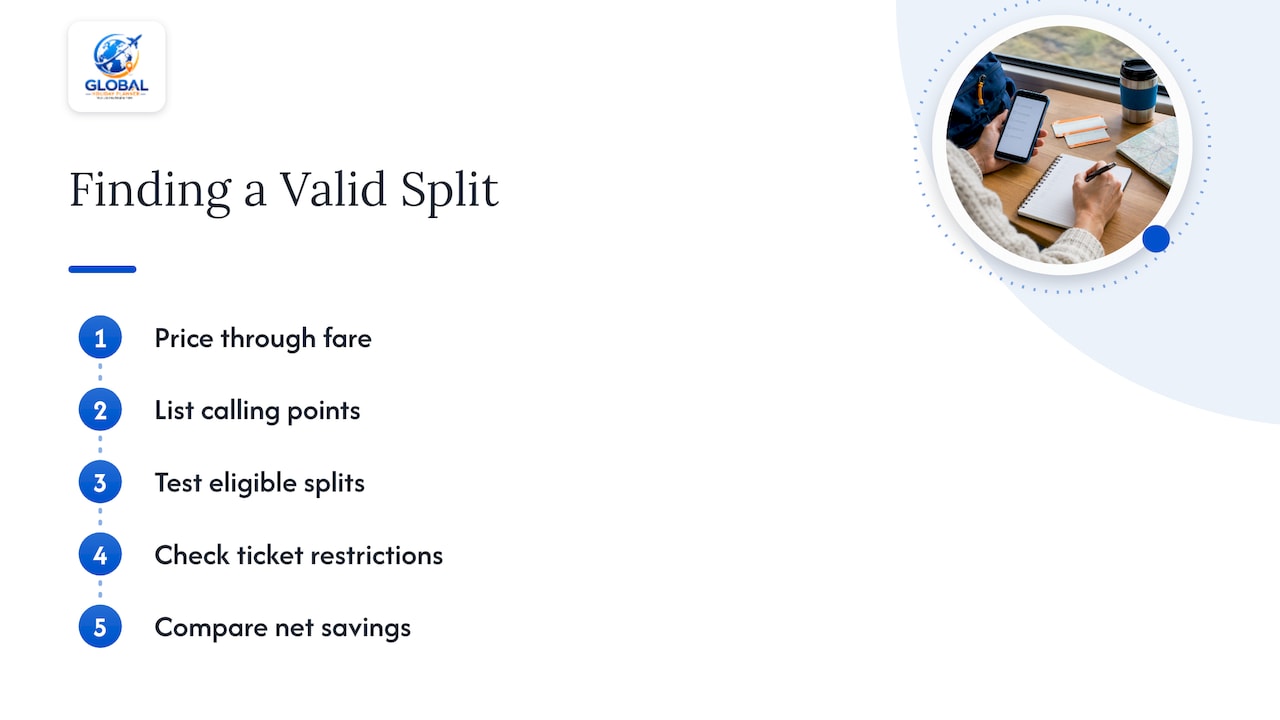
Splitting by hand is a comparison exercise. MoneySavingExpert’s method is to establish the through fare, inspect the train’s calling points, then test intermediate stations as split points. Here it is in practice.
Step 1: Price the through ticket
Search your exact date and time and write down the cheapest through fare, including any booking fee and any Railcard discount. This is your baseline. Without it, a split that looks cheap may not beat what you could have paid in one go.
Where it goes wrong: comparing a split fare for one time against a through fare for another. Use the same train, the same day, the same ticket type.
This is the step where a side-by-side view helps. Our rail tickets page is built around showing fares next to one another so you can see the total cost before you commit, rather than adding up numbers from several tabs.
Step 2: List the calling points
Open the timetable for the train you plan to take and list every station where it stops. Only those stations can serve as split points. A split at a station the train passes through does not meet the rule.
Where it goes wrong: choosing a station because it is on the line, not because your specific service stops there. Express services skip many stations, and a slower train on the same line may stop where yours does not.
Step 3: Test the intermediate stations
Price each leg from your origin to a stopping station, and from that station to your destination. MoneySavingExpert says you can test multiple splits, and that the train must call at every station you choose. Start with major interchange stations and with the points where peak pricing changes, since that is where the reported savings tended to appear.
Where it goes wrong: assuming every intermediate station will reduce the price. Most will not. Test several and keep only the combination that beats the baseline by a margin worth the extra complexity.
Step 4: Check each ticket’s restrictions
For each leg, read the ticket type and the time or train restriction. National Rail’s guidance says to carry every ticket and any Railcard, and to travel at the correct time and on the correct train for each ticket type. An Advance ticket is tied to one specific train, so both legs must match the train you ride.
Where it goes wrong: buying two Advance tickets for different trains and then trying to ride one service for both. Match every leg to the same train.
Step 5: Decide if the saving is worth it
Subtract the combined split price, including any fees, from your through fare. If you save a few pounds on a long trip with an important connection at the other end, one through ticket may suit you better. If the saving is large, split away. Our guide on how to book trains online covers the steps for completing the purchase itself.
Do you have to get off the train?
No, not if the train stops at the split station. National Rail says a passenger normally does not need to leave and re-board at a split point, and the same train may be used throughout if it calls there. You carry on in your seat, and on a ticket check you show whichever ticket covers the section you are in.
Seat reservations across two tickets
Reservations can be made for each ticket where reservations are offered. National Rail warns that the reserved seat may change at the ticket boundary. So if you are traveling with luggage or a group, check your seat on each leg. If a seat for the second leg is in another carriage, you may need to move at the split station, or sit in an unreserved seat if one is available.
This is a good moment to think about the seat itself. Class and seat type affect price and comfort, and our guide to train seat classes worldwide explains what you get at each level. If you are paying extra for a chosen seat, our note on comparing the total fare before seat selection fees shows how those add up, which matters when you are paying for two reservations instead of one.
Delays, cancellations and compensation
The usual worry is simple: if something goes wrong on one leg, are you covered for the whole trip?
In Great Britain
National Rail says the same delay and compensation rules apply to journeys using multiple tickets. Under the 2025 Conditions of Travel, delayed Advance-ticket passengers may take the next available train, and compensation is assessed by arrival at the final destination when the tickets together covered the journey.
The same document sets the minimum industry compensation for arriving at least 60 minutes late at 50% of the price paid for a single ticket, subject to the conditions. It also says claims under industry arrangements should generally be submitted within 28 days of completing the journey. Put that deadline in your calendar the day you travel.
Refunds
Refund rights depend on the fare type, not on whether the ticket is part of a split. For example, National Rail’s page for an Anytime Day Return says it is refundable until 23:59 the day before validity, and a refund after validity generally needs a failure of train service or exceptional discretionary treatment. Since two tickets mean two sets of refund rules, check both before you buy.
In the EU
Under Regulation 2021/782, minimum delay compensation is 25% of the ticket price for delays of 60 to 119 minutes and 50% for delays of 120 minutes or more, calculated on the price actually paid for the delayed service. Whether a missed connection is covered depends on whether your tickets count as a through-ticket, which is why one booking is more straightforward than several.
International journeys on separate tickets
The Agreement on Journey Continuation, described in a leaflet hosted by ÖBB, can help passengers with separate tickets continue after a delay or cancellation. It requires reasonable planned connection time and generally applies only to the railway undertaking whose missed service was ticketed. The leaflet also says the assistance does not reimburse hotels, taxis, ticket costs or compensation, and does not guarantee a seat on every later service.
The practical lesson for any trip with separate tickets: leave generous connection time, and keep the night’s accommodation flexible. Travel insurance can be part of that safety net. Our guide to whether travel insurance is worth it for U.S. travelers helps you map the risks of your own trip, and you can compare cover alongside your rail tickets on our rail and insurance page.
Pre-travel checklist for split tickets
- Confirm the train stops at every split station, on your date.
- Check each ticket’s time and train restrictions.
- Carry every ticket, plus any Railcard used.
- Check seat reservations for each leg.
- Note the 28-day claim window for delays in Great Britain.
- Look at the refund rules for each fare type.
- If you cross a border, find out whether your tickets count as a through-ticket.
Booking your rail trip with Global Holiday Planner
We built our platform for travelers who want to compare flights, hotels, car rentals, rail tickets, transfers and travel insurance in one place. For a rail trip, you can look at fares side by side and see the total cost of your itinerary before you book. If your trip also includes a flight into the country or a transfer from the station, you can price those on the same site: see flights and airport transfers, or start with rail tickets.

If the trip is overnight, you may save a hotel night by taking the sleeper, which we cover in our guide to overnight trains in Europe.
Our view on splitting
Splitting a ticket is a good example of why we compare total cost, not a single headline price. A fare is only useful once you know what comes with it: the time restriction, the seat, the booking fee, the refund terms and the cover if a train runs late.
We built our comparisons to show the real total cost and the best fit for each itinerary. A cheap fare for the wrong train is not a saving, and a through ticket that keeps your whole journey under one booking can be the better buy for a tight connection.
Our advice for travelers heading to Great Britain: price the through fare first, test a few splits at stations your train calls at, and keep the split only if the saving is clear. For everywhere else, start with the question that matters more: pass or point-to-point, and which seat class suits your day.
Global
FAQ
Is split ticketing legal?
Yes, in Great Britain. National Rail says split tickets are permitted under Condition 14 of its Conditions of Travel when the train stops at every split station. Other countries have their own conditions, and some operators restrict it, so read the rules for your route.
Is split ticketing always cheaper?
No. National Rail says split tickets are not guaranteed to be cheaper and are unavailable for some routes, services and ticket types. Savings tend to appear where a journey crosses peak and off-peak pricing or where a shorter section is priced low. Compare against the through fare for the same train.
Do I need to change trains at the split station?
No, as long as the train calls there. You may stay on the same service for the whole journey. Keep both tickets handy, because staff may ask to see the ticket for the section you are in.
What happens if my train is delayed on a split journey?
In Great Britain, compensation is assessed by your arrival at the final destination when the tickets together covered the journey. Arriving at least 60 minutes late earns a minimum of 50% of the price paid for a single ticket, subject to the conditions. Submit claims within 28 days of completing the journey.
Can I use split tickets in the United States?
The British approach does not carry over to U.S. fares in the same way, so for most U.S. trips you will book one through ticket. For a trip to Great Britain, it is worth testing splits. For Europe more widely, compare a pass with point-to-point fares first.
Sources
- Split Train Tickets, National Rail
- Cheap train tickets: find hidden fares and split tickets, MoneySavingExpert
- What is split ticketing and how can it save me money, The Independent
- Split ticket rail fares to go mainstream, BBC News
- National Rail Conditions of Travel 2025
- Anytime Day Return, National Rail
- EU Regulation 2021/782 on rail passengers’ rights
- Agreement on Journey Continuation leaflet
- TER Pays de la Loire conditions of sale and transport
[…] cancellation or missed connection on one leg does not automatically refund the others. Our guide to split ticketing on trains covers when the savings are worth that extra […]