
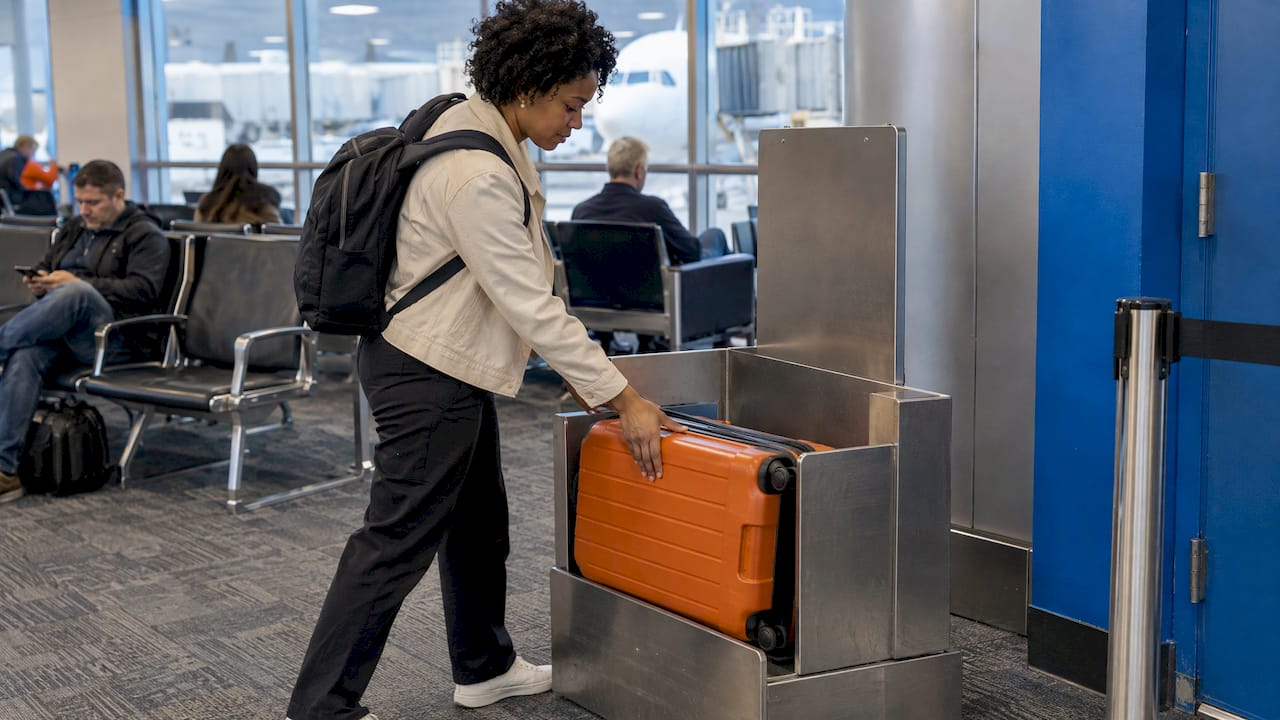
Most major US airlines allow a carry-on of 22 x 14 x 9 inches, wheels and handles included, but that number is only the starting point. Your fare, your airline and your route decide whether the bag flies free, so check the rule for your exact ticket before you pack. Below you get the standard, the personal item sizes, the international limits that run smaller, and a measuring routine that matches how gate agents actually check bags.
TL;DR
- The common US carry-on limit is 22 x 14 x 9 inches (about 56 x 35 x 23 cm), measured with wheels and handles, which adds up to 45 linear inches.
- Personal item limits are much smaller and vary: some airlines publish a box (American uses 18 x 14 x 8 inches), others only say it must fit under the seat.
- European and Asian carriers often use 55 x 35 x 20 to 25 cm and add weight limits of 7 to 10 kg, so a US-sized bag can fail abroad.
- On a personal-item-only fare such as Basic Economy, even a bag that fits the sizer can cost extra at the gate.
- A bag around 50 x 35 x 20 cm (19.5 x 13.5 x 7.5 in) clears every limit in one 2026 airline table.
Table of Contents
- The standard US carry-on size
- Personal item size: the limit people miss
- International carry-on limits that run smaller
- Your fare matters as much as your bag
- How to measure your carry-on the way airlines do
- What happens at the gate if your bag is too big
- Which limit applies to which traveler
- Recent rule changes
- Compare flights with your bag in mind
- FAQ
- Sources
The standard US carry-on size
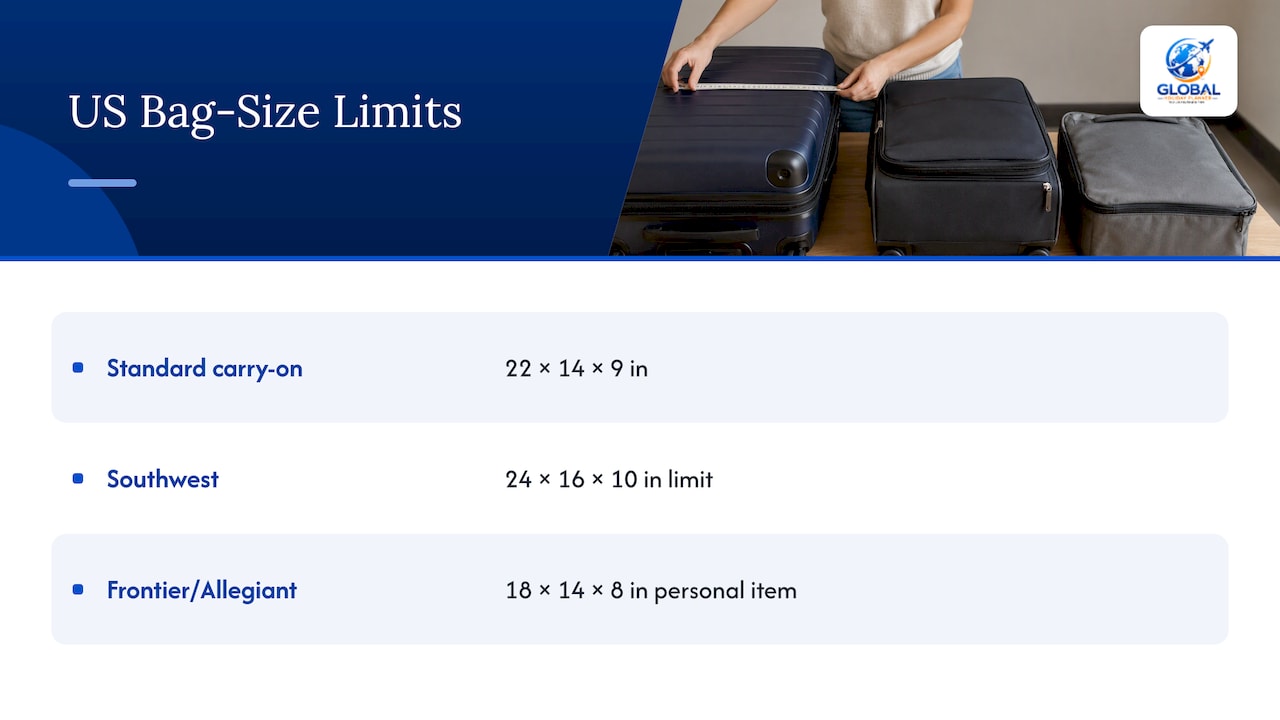
The number you will see everywhere is 22 x 14 x 9 inches. Luggage Wiz notes that American, Delta, United, JetBlue and Alaska all publish this size with wheels and handles included. The Points Guy also reports it as the standard US domestic carry-on.
The three numbers are height, width and depth. Add them and you get 45 linear inches (115 cm), the total some airlines use instead of a box. Can I Carry It shows the math: 22 + 14 + 9 = 45.
Two US exceptions are worth knowing. Budget Travel reports that Southwest allows bags up to 24 x 16 x 10 inches, while many major carriers use 22 x 14 x 9. Frontier and Allegiant, according to Luggage Wiz, publish strict 18 x 14 x 8 inch personal-item boxes and charge for larger carry-ons.
Why there is no single rule
No law sets one worldwide size. The International Air Transport Association (IATA, the airline trade body) frames 56 x 45 x 25 cm (22 x 18 x 10 in) as a general reference, not a rule, and says allowances vary by airline, cabin class and aircraft type. Its guidance also says weight limits typically start at 5 kg (11 lb).
So the same suitcase can be fine on one ticket and wrong on the next. That is why the rest of this guide works from your airline and fare, not from a universal number.
Personal item size: the limit people miss
A personal item is the second, smaller bag you may bring in addition to a carry-on: a backpack, purse or laptop bag. It goes under the seat in front of you, not in the overhead bin. It is the most-searched part of this topic because the limits are the least consistent.
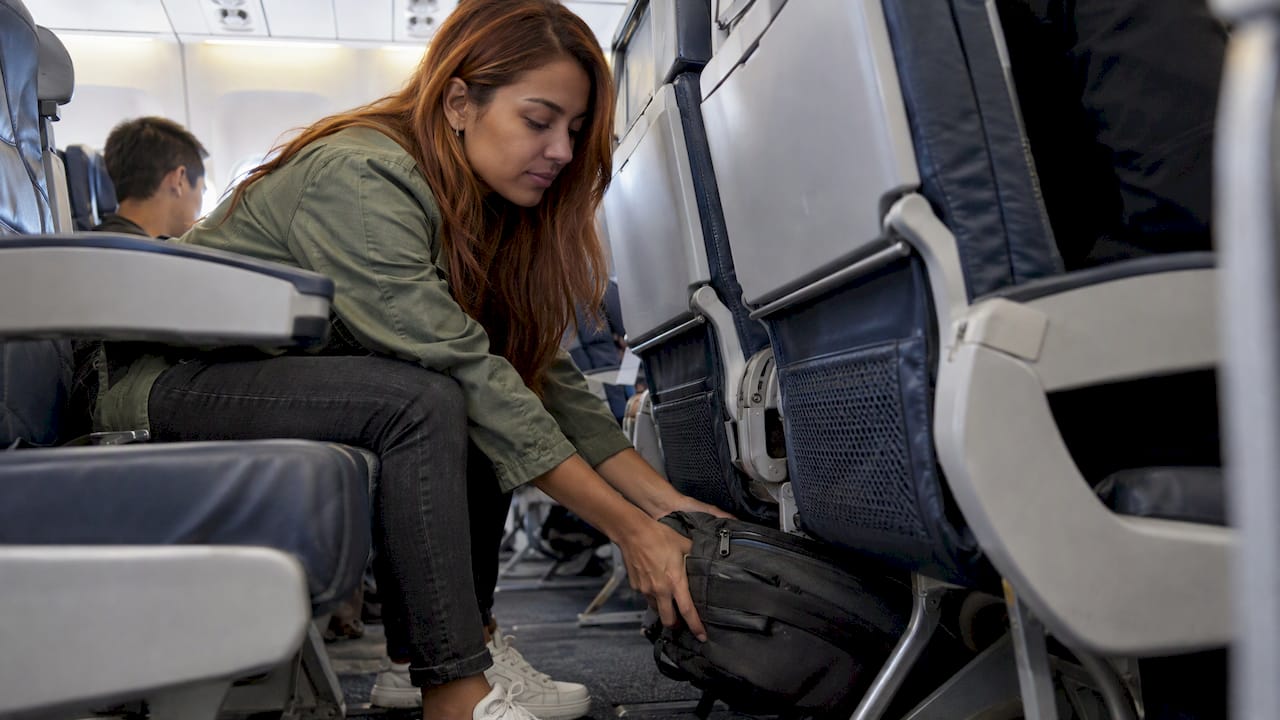
A 2026 survey of more than 75 airlines found published personal-item sizes range from 30 x 20 x 10 cm on VietJet and Bamboo Airways to 18 x 14 x 8 inches on American, Allegiant, Frontier and Viva Aerobus. It also reports that 17 airlines, including Delta and Southwest, publish no exact size and simply require the bag to fit under the seat. Some airlines, Emirates among them, allow no separate personal item.
In Europe the usual personal item is 40 x 30 x 15 cm. Lufthansa and Brussels Airlines both list that size, and both allow a carry-on up to 55 x 40 x 23 cm at 8 kg on eligible fares. Ryanair and Wizz enforce 40 x 30 x 20 cm.
On US flights, a practical rule: if you choose a personal item to avoid a fee, build to the smallest box you might meet, 18 x 14 x 8 inches, and it will pass on most airlines. Keep in mind that under TSA rules, passengers departing the USA may take only one carry-on and one personal item through security.
Traveling with children adds its own checkpoint questions. The rules on TSA PreCheck with kids are worth reading before a family trip, since every traveler, including each child, still counts bags against the airline’s carry-on and personal-item allowance.
International carry-on limits that run smaller
A bag that is perfect for a domestic flight can be too big abroad, usually in depth, width or weight. The table below pulls together limits reported for economy fares. Always confirm on the airline’s own page, since fares and aircraft change.
| Airline | Reported carry-on size | Notes |
|---|---|---|
| Air Canada | 21½ x 15½ x 9 in | Per The Points Guy |
| British Airways | 22 x 18 x 10 in | Same source |
| Emirates | 21⅔ x 15 x 8⅔ in | Same source |
| Turkish Airlines | 21⅔ x 15¾ x 9 in | Same source |
| ANA | 55 x 40 x 25 cm, sum within 115 cm | Personal item 40 x 30 x 20 cm, combined 10 kg, per ANA |
| Lufthansa | 55 x 40 x 23 cm, 8 kg | Personal item 40 x 30 x 15 cm, per Lufthansa |
| Singapore Airlines, Korean Air | 45-inch sum of dimensions | Per The Points Guy |
Two more details catch travelers out. First, depth: Budget Travel reports Icelandair’s maximum carry-on depth is 20 cm, just under 8 inches, well below the 9 inches on US carriers. Second, weight: Kit Authority reports that Emirates, Qatar and Qantas cap carry-on weight at 7 kg, and Japan Airlines and ANA at 10 kg combined.
The weakest link on a multi-airline trip is the strictest airline. A bag around 50 x 35 x 20 cm (19.5 x 13.5 x 7.5 in) cleared every carry-on limit in Kit Authority’s table, which makes it a safe size when your itinerary mixes carriers.
Converting 55 x 35 x 25 cm to inches
This is a common European and Asian cabin size. Divide each figure by 2.54: 55 cm is 21.65 in, 35 cm is 13.78 in and 25 cm is 9.84 in. Inchescm.com gives the same conversion. That depth of 25 cm exceeds the 9-inch US depth, and BagFacts reports it is too big for every under-seat personal-item limit it tracks, and fits the carry-on limit on only 11 of the 38 airlines it checked.
Your fare matters as much as your bag
This is the part most size charts skip. Many airlines now sell a fare that includes only a personal item. Kit Authority lists United Basic Economy on most routes, Lufthansa Economy Basic on short and medium-haul, Air France and KLM Basic, Ryanair, easyJet, Frontier, Allegiant, Breeze and Avelo as examples. On those fares, a carry-on that fits the sizer perfectly still costs extra at the gate.
The lesson: a cheap fare is only cheap if the bag you planned to bring is included. Before you compare prices, decide whether you are traveling with a personal item only, a carry-on, or a checked bag, and compare the landed cost, meaning fare plus bag fees. Our guides on baggage fees and landed cost for US travelers, how a $30 bag changes your total and Basic Economy versus Economy walk through that math.
How to measure your carry-on the way airlines do
The tag on your suitcase is usually the shell size, not the size at the gate. Airlines measure what is in the sizer: wheels, handles and pockets included, and in whatever state the bag is in. Here is a routine that matches it.
- Pack the bag first. Soft pockets and packed sides get thicker. IT Luggage notes soft front pockets may become deeper when packed.
- Stand it upright on a hard, level floor with the telescoping handle pushed down. Hanke advises measuring upright on a hard floor.
- Measure height from the floor, under the wheels, to the highest point, including the handle housing and any top carry handle.
- Measure width at the widest point, including side handles and latches.
- Measure depth front to back where the bag is thickest, including external pockets. Delsey includes pockets and expansion in depth.
- Compare each dimension separately to the airline’s published box. Travel Bag Experts recommends this, since a bag that totals 45 inches can still fail if one side is over.
- Round up, not down. Hanke notes gate staff round up too.
- Weigh it. If your airline has a weight limit, you need that number as well.
Here is a worked example from FitsOnBoard: a shell advertised at 53 x 35 x 20 cm, with 2 cm wheels, a 1 cm top handle and a 2 cm packed pocket, becomes 56 x 35 x 22 cm in travel. In inches, that is about 22 x 13.8 x 8.7, which still fits the US standard but not a stricter 55 cm height.
The expansion zipper trap
Expandable bags are the most common reason a bag fails. An expansion zipper can add about two inches of depth, according to Luggage Inspector, and a fully expanded carry-on may not meet airline restrictions. Keep it zipped closed for the flight out, and treat the expanded depth as the figure that counts if you use it.
A flexible tape is easiest. Where possible, press the bag between two parallel upright surfaces, such as a wall and a book, and measure the gap at the outermost point on each axis.
What happens at the gate if your bag is too big
If the bag does not fit the sizer, or the cabin runs out of room, the airline can move it to the hold. IATA says that if cabin stowage capacity is exceeded, carry-on baggage may be removed at the gate and loaded into the hold. Many airlines charge a fee for that on personal-item-only fares, and gate checking means your bag travels separately from you.
Three habits lower the risk:
- Put valuables, medication, chargers and documents in your personal item so you can pull them out if the bag is taken.
- Board in your group’s window. Overhead space fills quickly.
- Pack to about 90 percent of the box, not 100, so a stuffed pocket does not tip you over.
For more on deciding what to bring, our guide on checked bag versus carry-on covers when each option saves money, and carry-on only travel shows how to pack light for longer trips.
Which limit applies to which traveler
Budget travelers. Your target is the personal item. Pack for the 18 x 14 x 8 inch box and you avoid fees on most low-cost and Basic Economy fares. Decide before booking, not at the airport.
Families. Each ticketed passenger usually gets their own allowance, which is where multi-generational groups gain: a grandparent’s carry-on and a teenager’s backpack together can carry shared items. Check each fare, since adults and children can be on different fare types.
Golfers. Clubs are not a carry-on item. Plan clubs as checked baggage, and use your carry-on for shoes, clothing and valuables. Golf trips also benefit from the right cover, so see our guide on golf travel insurance.
Couples. Two matched carry-ons that fit the strictest limit on your route are simpler than one oversized checked bag, especially on short getaways.
Corporate travelers. Tight connections favor carry-on only. Our business travel booking tips cover how to keep trips efficient.
Recent rule changes
Allowances shift as airlines rework fares. Travel Weekly reported that Virgin Australia’s updated allowance took effect on 2 February 2026: one carry-on up to 8 kg plus a personal item of up to 45 x 33 x 20 cm in Economy. Some US airlines have also clarified that handles and wheels count, with PreppedTrip noting that American’s and Delta’s policies both specify this as of September 2026. Treat any chart, including this one, as a guide and confirm on the airline’s baggage page before you fly.
Our view: size is a price question
At Global Holiday Planner we compare flights, hotels, car rentals and travel insurance side by side, and bags are where that approach matters most. A fare that looks $30 cheaper can lose that advantage once the carry-on you planned is not included.
Our approach is to show the real total cost and best fit for your itinerary in one place, with recommendations for the kind of trip you are taking, whether that is a family vacation, a romantic getaway, a golf tournament or a business trip. For bag rules, that means deciding your bag first, then choosing the fare.
The size limit is the easy part. Matching it to the fare, the airline and the route is the part worth doing before you pay.
Global
Compare flights with your bag in mind
Once you know your bag size, compare fares with the baggage allowance in view. On Global Holiday Planner you can compare flight bookings across airlines, then add hotels, car rentals, airport transfers and travel insurance for the same trip, so the full cost is visible before you commit.

If you are planning a family or group trip, our group flight booking guide explains how to keep everyone on the same fare type, so allowances match.
FAQ
What is the standard carry-on size for US airlines?
The most common limit is 22 x 14 x 9 inches, including wheels and handles. American, Delta, United, JetBlue and Alaska all publish it, per Luggage Wiz. Southwest allows 24 x 16 x 10 inches. Always confirm on your airline’s page for your fare.
Is a personal item the same as a carry-on?
No. A personal item is a smaller bag that goes under the seat, while a carry-on goes in the overhead bin. Many airlines allow one of each, but personal-item-only fares include just the smaller bag. American’s published box is 18 x 14 x 8 inches, and some airlines only say it must fit under the seat.
Do wheels and handles count toward the size?
Yes, on the major US airlines. American and Delta both specify that wheels and handles count, so measure from the floor under the wheels to the top of the handle housing. Measure the packed bag, because pockets and expansion zippers add depth.
Will my US carry-on fit on international flights?
Not always. Many European and Asian carriers use about 55 x 35 x 20 to 25 cm and weight caps of 7 to 10 kg. The depth and weight are the usual problems. A bag near 50 x 35 x 20 cm fits the strictest limits in one 2026 table.
Sources
- IATA: Passenger Baggage Rules
- Kit Authority: Carry-on size rules by airline
- The Points Guy: Airline carry-on bag size policies
- Luggage Wiz: New carry-on rules 2026
- Budget Travel: Airline baggage fees, size limits and rules
- Can I Carry It: Airline size limits guide
- Travel Vient: Personal item size limits
- Lufthansa: Carry-on baggage
- Brussels Airlines: Carry-on baggage
- ANA: Carry-on baggage size and rules
- BagFacts: 55x35x25 cm cabin bag
- Inchescm.com: 55 x 35 x 25 cm to inches
- IT Luggage: How we measure
- Hanke: Reading an airline cabin box
- Delsey: How to measure a suitcase
- Travel Bag Experts: How to measure luggage
- FitsOnBoard: How to measure a carry-on bag
- Luggage Inspector: Is 20 inch luggage carry-on
- PreppedTrip: How to measure carry-on luggage
- Travel Weekly: Virgin Australia carry-on update