

Trip cancellation insurance reimburses nonrefundable costs when you cancel a trip before you leave; trip interruption insurance reimburses unused costs and extra transportation when something forces you to cut a trip short after you’ve already departed. If you’re worried about losing prepaid deposits before departure, buy cancellation coverage. If your bigger fear is getting stranded or sent home early once you’re traveling, interruption coverage matters more. Most standalone policies bundle both, but the distinction changes what you can actually claim.
TL;DR:
- Trip interruption coverage is more valuable for trips with high costs or multiple legs, as it reimburses unused prepaid expenses and costly last-minute flights home.
- Standard policies may cap reimbursement amounts for certain triggers like medical emergencies and natural disasters, so reading the detailed coverage list is crucial.
- Buying trip insurance within a short window after your initial deposit is essential to qualify for benefits like pre-existing condition waivers and cancellation Flexibility (CFAR).
- Most claim denials happen due to mismatched covered reasons, so documenting emergencies, official evacuation orders, or family deaths greatly increases claim success.
- Combining cancellation and interruption coverage provides better protection for high-value trips, with standalone policies generally offering higher benefit caps than credit-card protections.
Table of Contents
- Trip cancellation vs interruption at a glance
- What trip cancellation insurance covers before you leave
- What trip interruption insurance covers once you’re traveling
- Testing your situation against covered reasons
- Common exclusions and mistakes that void a claim
- How claims and reimbursements actually work
- When to buy coverage and what drives the cost
- Choosing the right coverage for your trip
- Comparing policies through Global Holiday Planner
- When extra coverage is worth paying for
- Compare and book your trip protection in one place
- Where to check the official rules
- Sources
- FAQ
Trip cancellation vs interruption at a glance
The easiest way to separate these two benefits is timing: cancellation activates before you leave home, interruption activates after your trip has started.
- Cancellation reimburses prepaid, nonrefundable costs like airfare, hotel deposits, and tour packages when you cancel for a covered reason before departure.
- Interruption reimburses the unused portion of your trip plus reasonable extra costs, like a last-minute flight home, when a covered reason cuts the trip short after it has begun.
- Triggers overlap for both types: sudden illness, a death in the family, jury duty, and severe weather all show up on typical covered-reasons lists.
- Cancel For Any Reason (CFAR) is an optional add-on that widens cancellation flexibility but usually reimburses a partial amount and must be purchased within a short window of booking.
Limits, sublimits, and waiting periods vary by insurer and by trip cost, so the label on a policy tells you less than the actual document. A “trip interruption” benefit on one policy might cap reimbursement far below what a comparable policy pays for the same event, which is why reading the covered-reasons list matters more than the plan name.
What trip cancellation insurance covers before you leave
Cancellation coverage begins the day your policy becomes effective, which is usually the purchase date, and it applies to any covered reason that happens before your scheduled departure. “Before departure” typically means anything up to the moment you check in or board your first flight, hotel stay, or tour.
Covered reasons commonly include:
- Sudden illness or injury to you, a travel companion, or an immediate family member.
- Death of a family member, even one not traveling with you.
- Jury duty or a subpoena that conflicts with travel dates.
- Mandatory work reassignment that a job requires with no alternative.
Reimbursable expenses typically include nonrefundable airfare, prepaid hotel nights, tour deposits, and event tickets purchased in advance. Cancellation coverage reimburses these nonrefundable costs for covered reasons.
CFAR riders sit on top of standard cancellation coverage and let you cancel for reasons the base policy would not otherwise cover, such as simply changing your mind. The tradeoff is a lower reimbursement rate and a strict purchase deadline, often within 14 to 21 days of your initial trip deposit.
What trip interruption insurance covers once you’re traveling
Interruption coverage begins on your scheduled departure day and runs through your scheduled return. It exists for the scenario cancellation cannot touch: something goes wrong after you’ve already started the trip.
What interruption typically pays for:
- The unused, prepaid portion of your trip, like hotel nights or tour days you never used.
- Additional transportation costs to get home early or to rejoin your trip.
- Extra lodging or meals when you’re stuck waiting for a new flight home.
Common triggers include a medical emergency abroad, a mandatory evacuation order, or a natural disaster that makes your destination unsafe. Say you’re on a two-week trip and a parent back home is hospitalized on day four. Interruption coverage would reimburse the unused ten days of prepaid hotel and tour costs, plus the cost of a new one-way flight home, which is often far more expensive than the original round-trip fare. Credit-card interruption benefits exist too, but they generally cap out at much lower amounts than a standalone travel insurance policy, so relying on card coverage alone for an expensive trip can leave a real gap.
Testing your situation against covered reasons
Most claim denials come down to a mismatch between what happened and what the policy actually lists as a covered reason. Running your own situation against these categories before you buy, or before you file, tells you a lot about whether a claim would succeed.
- Medical emergencies generally require a doctor’s note or hospital record showing the illness or injury prevented travel; vague statements without documentation rarely satisfy insurers.
- Natural disasters and evacuations are covered when a government or local authority issues a mandatory evacuation order for your destination, but a storm that merely disrupts flights without an official order may fall under travel delay instead.
- Death in the immediate family, jury duty, and mandatory work orders are consistently covered reasons across most standard policies, though “immediate family” definitions vary by insurer.
- Excluded situations typically include forgetting a passport, missing a flight due to poor planning, or a voluntary business trip change, since these fall under personal error rather than a covered event.
The pattern is simple: events outside your control and documented by a third party tend to qualify, while personal oversights and voluntary choices tend not to.
Common exclusions and mistakes that void a claim
Even a well-matched claim can fail on technical grounds, and a few patterns show up again and again.
- Pre-existing condition clauses often exclude a medical event if it relates to a condition treated within 60 to 180 days before you bought the policy, unless you paid for a waiver.
- “Avoidable conduct” clauses mean insurers can deny a claim if you didn’t first try to mitigate the loss, such as requesting a refund directly from the airline or hotel.
- The policy’s definition of “trip begins” matters more than most travelers realize: some policies define it as the first prepaid activity, others as your first day of travel, and that distinction decides whether an early problem counts as cancellation or interruption.
- Late purchase can strip out benefits entirely; CFAR and pre-existing condition waivers usually require buying within a short window of your first trip deposit, and missing that deadline forfeits the option permanently.
How claims and reimbursements actually work
Filing a claim starts before you contact the insurer. Regulatory guidance from the United Kingdom’s Financial Conduct Authority advises consumers to pursue provider refunds first, whether that’s a hotel refund policy, an airline rebooking, or a package-travel refund scheme, before or alongside a formal insurance claim.
- Contact the provider first for a refund or credit, and keep every email and confirmation number as evidence.
- Credit-card protections, including chargebacks or, in the United Kingdom, Section 75 claims, can offer an alternative route to recovery in some jurisdictions.
- Document everything: receipts, medical reports, evacuation orders, and airline cancellation notices are the standard proof insurers expect.
- Expect a claims timeline of several weeks once documentation is complete, though this varies by insurer and claim complexity.
Under EU package-travel rules, travelers who terminate a package before departure due to unavoidable and extraordinary circumstances are entitled to a refund promptly, typically within about two weeks. This timeframe is a useful benchmark even outside package-travel contracts, since it illustrates how quickly regulators expect refund processes to move. The FCA’s guidance adds that insurers should not impose unreasonable burdens, like demanding a consumer go to court, before paying a valid claim.
When to buy coverage and what drives the cost
The right time to buy cancellation or interruption coverage is the moment you make your first nonrefundable payment, since some benefits, like CFAR and pre-existing condition waivers, require purchase within a short window afterward.
- Trip cost is the biggest driver of premium: a $10,000 trip costs more to insure than a $2,000 one.
- Traveler age and destination risk both raise or lower premiums, with older travelers and higher-risk regions typically costing more.
- CFAR adds a separate cost on top of the base premium, often a meaningful percentage increase, in exchange for broader cancellation flexibility.
- Per-person caps and sublimits apply to specific benefits like medical evacuation or repatriation, and these sublimits often sit well below the policy’s overall maximum.
Waiting periods differ between benefit types too. A trip delay benefit might kick in after a shorter wait than an interruption benefit tied to a multi-day disruption. Credit-card travel benefits usually cap interruption reimbursement at a fraction of what a standalone policy pays, which makes them a supplement rather than a replacement for a dedicated policy on an expensive trip.
Choosing the right coverage for your trip
Matching coverage to your actual risk takes a short checklist rather than guesswork.
- Add up your total nonrefundable trip cost, including deposits, since this sets the minimum coverage amount worth considering.
- Weigh your own health risk and that of close family members, since a higher risk of a medical cancellation or interruption argues for broader coverage.
- Consider trip complexity, since multi-country itineraries or multiple prepaid components create more points of potential loss.
- Decide whether CFAR is worth the added cost given your flexibility needs and budget.
- Check whether travel companions affect your claim, since some policies require all companions to have matching coverage for a shared claim to pay out fully.
When you call an insurer or compare policies, ask directly for the covered-reasons list, required documentation, per-person caps, sublimits for evacuation or medical repatriation, specific exclusions, and claim filing deadlines. Watch for vague “acts of God” exclusions or a loosely defined “immediate family,” since both are common places where claims get denied.
Pro Tip: Ask an insurer to send you the full policy wording, not just the summary brochure, before you buy: the covered-reasons list and exclusions only show up in full there.
Comparing policies through Global Holiday Planner
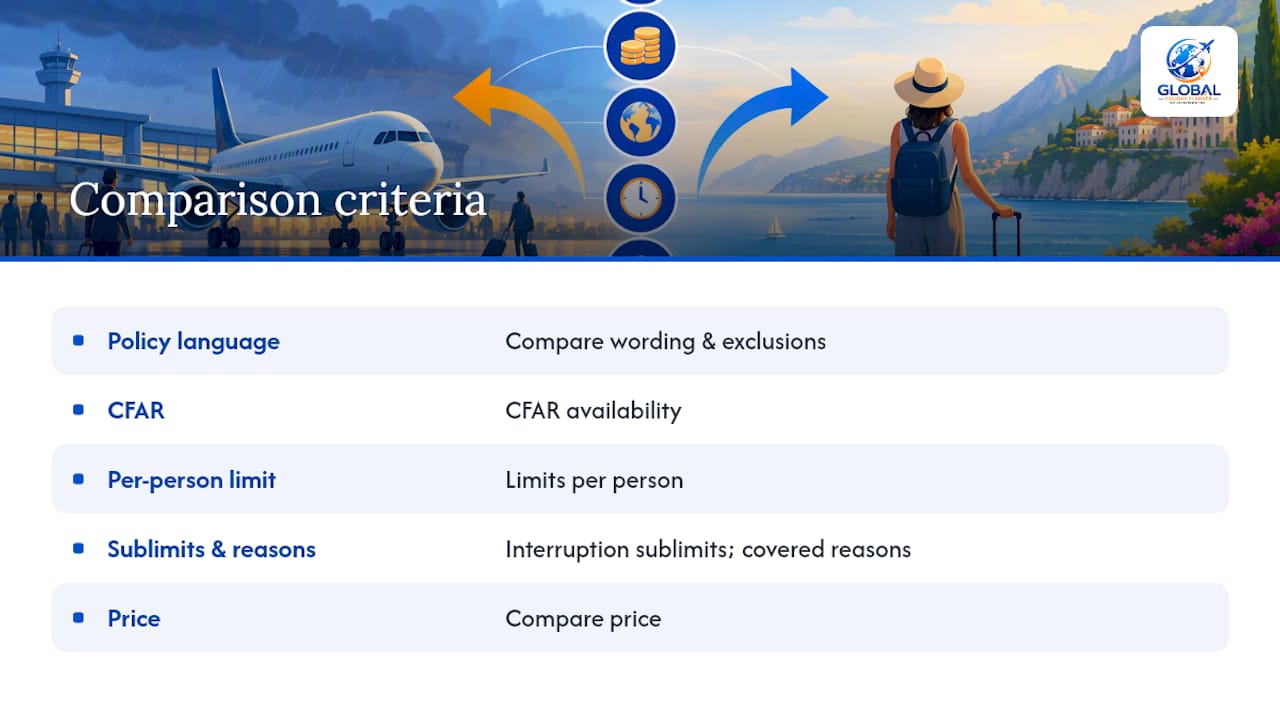
Comparison tools exist that let you view policy language, CFAR availability, per-person limits, and price side by side, which maps directly onto the checklist above. Instead of reading five separate insurer websites, you can line up the covered-reasons lists and sublimits in one view and see where one policy’s interruption benefit actually beats another’s on the specifics that matter for your trip. For a deeper look at how several standalone plans stack up, the comparison of travel insurance plans breaks down features and limits in more detail.
When extra coverage is worth paying for
High-cost trips and travelers with real health risk should lean toward buying both cancellation and interruption coverage rather than picking one. The math is simple: a $200 premium is a rounding error against a $6,000 nonrefundable trip, but the reverse is not true. CFAR is worth the added cost mainly for travelers who value flexibility over maximizing reimbursement percentage, since it trades a partial payout for the freedom to cancel for reasons a standard policy would reject outright.
— Global
Compare and book your trip protection in one place
Once you know whether you need cancellation coverage, interruption coverage, or both, the next step is comparing real policies against your actual trip cost instead of guessing from marketing pages. Certain travel planning platforms let you compare travel insurance options alongside flights, hotels, and car rental choices in one search, so you can see total trip cost and coverage fit side by side.

Start by entering your travel dates and destination, then compare the policy highlights, covered-reasons lists, and price for each option before you book. You can browse travel insurance options alongside your flight search and hotel bookings, or check car rental and airport transfer options if your itinerary includes them, all from the same planning session.
Where to check the official rules
For readers who want to go straight to the regulatory text or official guidance behind the points above, a few primary sources are worth bookmarking.
- The EU package-travel directive sets out termination rights and refund deadlines for package travel contracts.
- The FCA’s finalised guidance explains consumer refund routes and insurer conduct expectations in the United Kingdom.
- The U.S. Department of Transportation’s airline dashboard tracks flight cancellation and delay data useful for distinguishing systemic disruptions from individual claims.
- Coverage of how delay-related conveniences shape traveler decisions is explored in this look at business travel priorities.
Sources
- Directive 2015/2302 (EU)
- Cancellations and refunds: helping consumers with rights and routes to refunds (FCA)
FAQ
What is trip cancellation and trip interruption insurance?
Trip cancellation insurance reimburses nonrefundable costs when you cancel a trip before departure for a covered reason, while trip interruption insurance reimburses unused costs and extra transportation when a covered reason cuts a trip short after it has started. Most standalone travel insurance policies include both benefits in a single plan.
Is trip interruption coverage worth it?
It’s generally worth it for trips with high nonrefundable costs or multi-leg itineraries, since interruption pays for the unused portion of your trip plus the often-expensive cost of a last-minute flight home. Travelers relying only on credit-card interruption benefits should check the per-person cap, since those benefits often reimburse far less than a standalone policy.
What is considered a flight interruption?
A flight interruption typically refers to a covered event, like sudden illness, a family emergency, or a mandatory evacuation, that forces you to change or end your travel plans after departure. It differs from a routine delay or cancellation caused by the airline, which usually falls under separate delay coverage rather than trip interruption.
Can I get a full refund with trip interruption insurance?
Trip interruption insurance reimburses the unused, prepaid portion of your trip and reasonable extra costs like a return flight, but it rarely refunds the entire original trip cost since you already used part of it. Under EU package-travel rules, a full refund applies mainly to package contracts terminated before departure under unavoidable and extraordinary circumstances, not to interrupted trips already underway.
[…] insurance is worth it breaks down how to weigh the cost against your group’s actual risk, and our trip cancellation versus interruption checklist clarifies what each type of coverage actually pays […]
[…] coverage, think about what you would lose if a trip were canceled. Two guides help you decide: trip cancellation versus interruption, and the timing rules for cancel for any reason coverage. Read the policy wording for covered […]
[…] listed reasons before you leave, and trip interruption covers listed reasons after you leave. Our checklist on trip cancellation versus interruption helps you see which one fits. If you want to cancel for any reason at all, read how cancel for any […]
[…] either way, since you may claim them back through the airline or your insurer. Our guide to trip cancellation versus interruption explains what travel insurance may cover when a trip is cut […]