

A cash refund is rarely automatic once you book a nonrefundable rate, but you can often preserve value or recover money. Start by reading your rate rules and confirming who controls the booking, whether that’s the hotel, an online travel agency, or a brand chain, then contact that party before canceling anything.
TL;DR:
- Contact the booking source directly before canceling, and understand whether the reservation is controlled by the hotel, OTA, or third-party reseller.
- Request date changes or credits first, as hotels and OTAs prefer these options over cash refunds, especially for loyal customers or emergencies.
- Refunds are mainly available in cases of serious illness, family death, flight cancellations, or hotel failures, all requiring strong documentation to succeed.
- Use travel insurance, especially cancel-for-any-reason coverage, to safeguard nonrefundable costs and verify the coverage terms before booking.
- Always check refundability and options to transfer or resell the room before finalizing the reservation to avoid losing money entirely.
Table of Contents
- What to check first: rate rules, payment holder, and timing
- Options that preserve value: date changes, credits, and waivers
- When a refund is possible: qualifying exceptions and required documentation
- Travel insurance, CFAR, and credit-card disputes: when each works
- Resell the room or request a name change: mechanics and risks
- Step-by-step script and documentation checklist to request an exception or refund
- What not to do and escalation: disputes, consumer agencies, and small-claims
- Global Holiday Planner’s take on avoiding nonrefundable losses
- Compare rates and insurance before you book again
- FAQ
- Sources
What to check first: rate rules, payment holder, and timing
Your confirmation email holds the terms that matter most: cancellation deadlines, no-show penalties, and whether modification is allowed. Look at the merchant name listed on your card statement or booking receipt. If it shows the hotel brand directly, you may have more room to negotiate than if a third-party booking site processed the charge, since the hotel itself often cannot override an OTA’s system.
Canceling before you ask closes doors. Once a reservation is canceled, many hotels and OTAs treat the file as closed and stop offering date changes or credits, according to Travel Fine Print. Before you touch the cancel button, run through this:
- Find the exact cancellation and modification terms in your booking confirmation.
- Identify whether the hotel, the OTA, or a third-party reseller controls the reservation.
- Note your check-in date and how many days remain before any deadline.
- Check if you booked directly, since booking direct often gives you a single point of contact with more authority to grant exceptions.
Options that preserve value: date changes, credits, and waivers
Hotels and OTAs offer date changes and credits far more often than cash refunds, because it keeps the booking on their books instead of reversing a charge. CoverTrip notes that properties sometimes extend goodwill exceptions, especially to loyalty members or guests with verifiable emergencies. Try these in order:
- Ask for a free date change to new travel dates within a reasonable window.
- Request a hotel credit you can apply to a future stay at the same property or chain.
- Offer to pay a rate difference if your new dates fall on a pricier night, which is often accepted faster than a request for a full waiver.
- If none of those work, ask specifically for a documented exception based on your circumstances.
Loyalty status and lead time both matter. A guest booking months ahead with a clean account history and clear documentation has a better shot than someone calling the morning of check-in.
Pro Tip: Always frame your request as “can you move my dates or give me a credit” rather than “I need a refund.” Front-desk staff have more discretion to say yes to the first ask.
When a refund is possible: qualifying exceptions and required documentation
Some situations push hotels and OTAs toward an actual refund rather than a credit. The most commonly accepted reasons include severe illness or death in the immediate family, a documented flight cancellation or government travel ban that made the trip impossible, and cases where the hotel failed to provide the room you booked, according to USA Today.
Documentation makes or breaks these requests. Hotels and OTAs typically want:
- A medical note or death certificate for health or bereavement claims.
- An airline confirmation showing a canceled or rebooked flight.
- An official government or embassy travel advisory if a ban affected your trip.
- Photos or written evidence if the room delivered differed from what was promised.
Consumer protections for individually booked stays vary by country. European Commission guidance notes that EU law does not set universal cancellation rules for individually booked accommodation. Your rights depend on national contract law and whether your trip was part of a package holiday.
Travel insurance, CFAR, and credit-card disputes: when each works
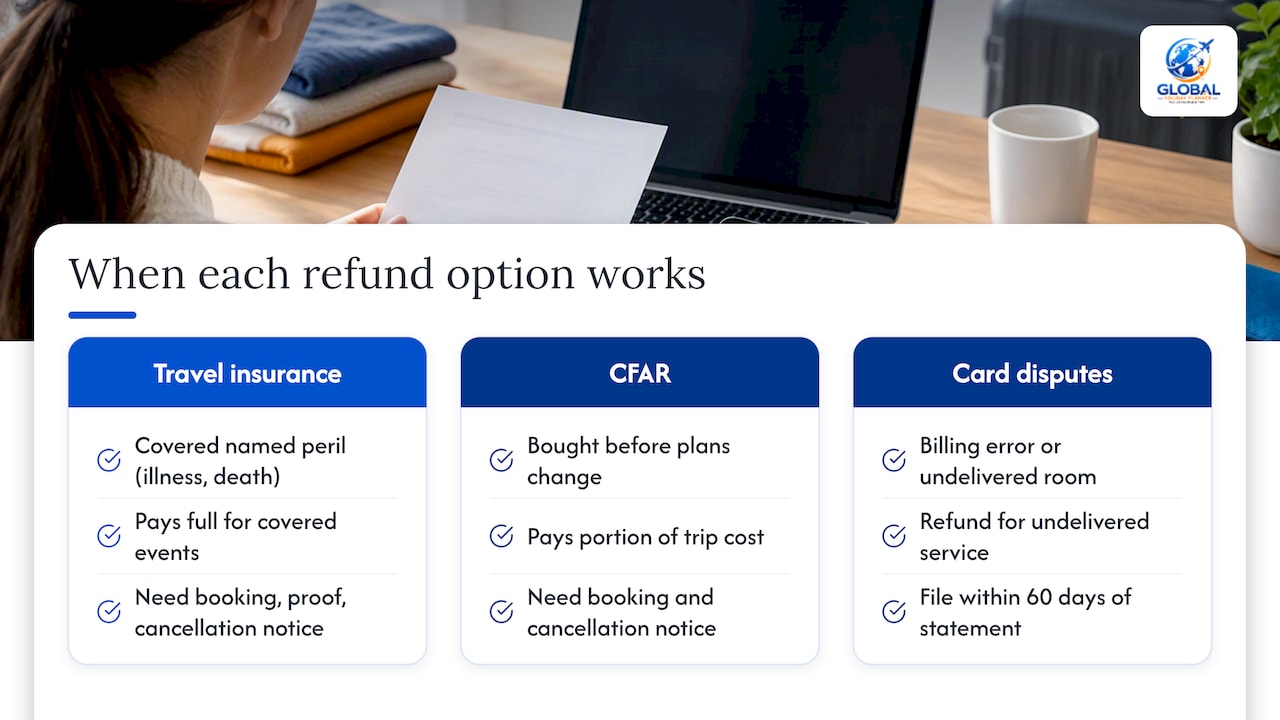
Standard travel insurance policies reimburse named perils only, things like a covered illness, a death in the family, or a natural disaster that forces cancellation. Cancel-for-any-reason (CFAR) coverage is the exception that often reimburses nonrefundable costs regardless of the reason, when purchased before plans change, according to Squaremouth. CFAR usually pays back a portion of your trip cost rather than the full amount, so check the details before you rely on it.
To file a claim, insurers expect your booking confirmation, proof of the qualifying event, and your cancellation notice to the hotel or OTA.
Credit-card disputes are not built for a change of heart. The CFPB explains that chargebacks address billing errors or services not delivered as agreed, not voluntary cancellations, and you have 60 days from the statement date to file a billing-error notice. If a hotel simply never delivered the room you paid for, that falls squarely in dispute territory. If you just changed your mind, it likely does not.
Resell the room or request a name change: mechanics and risks
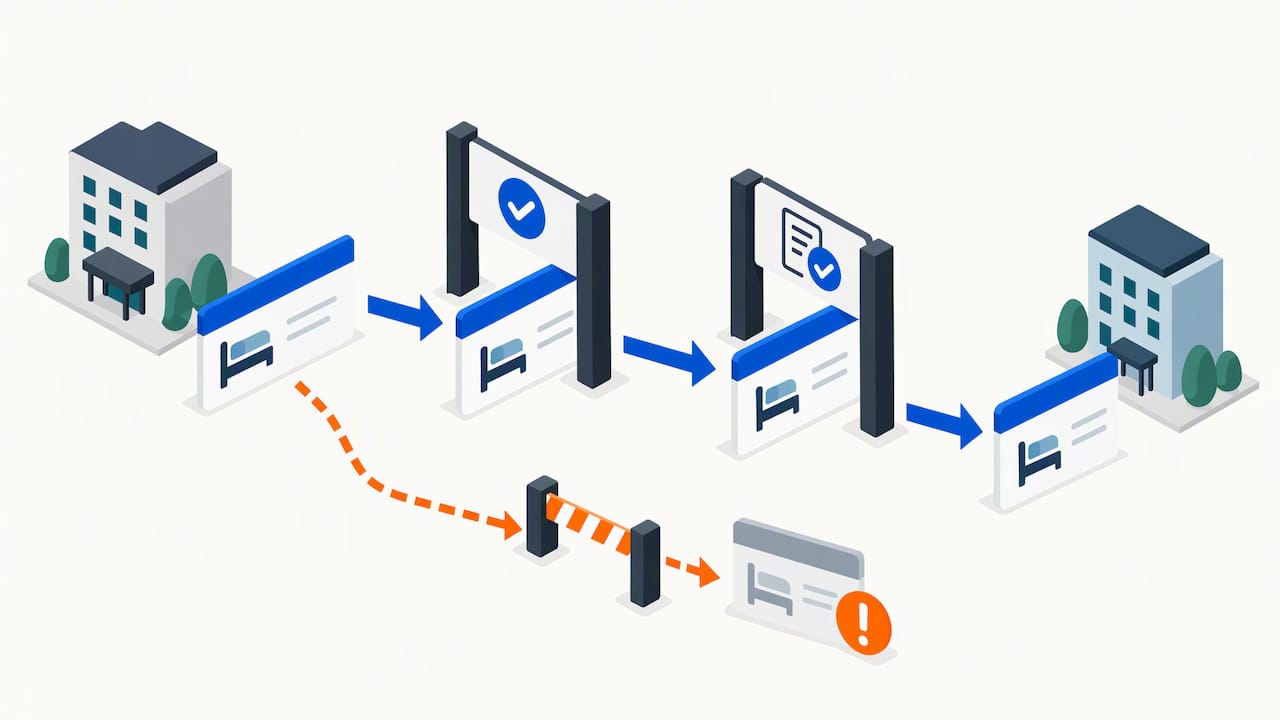
Before listing a nonrefundable reservation anywhere, call the hotel directly and ask whether name changes or transfers are permitted. Some properties allow it freely; others, especially those booked through certain OTAs, block transfers even when the hotel itself would say yes, a distinction worth confirming according to CoverTrip.
Resale marketplaces connect you with another traveler willing to buy your dates, typically for a listing fee and some verification steps to confirm the booking is genuine and transferable.
- Confirm transfer permission with the property before listing anything.
- Expect a service fee on most resale platforms.
- Have your confirmation number and ID ready for verification.
Pro Tip: If the OTA’s terms block transfers, ask the hotel directly. A property-level manager sometimes has authority the OTA’s policy does not.
Step-by-step script and documentation checklist to request an exception or refund
Call the property, not just the OTA’s general line, and ask for a manager or supervisor. Say: “I have a nonrefundable reservation under [your name], confirmation number [number]. Before I cancel, I’d like to ask about a date change or credit due to [your situation].”
If email is your only option, include:
- Your booking confirmation number and dates.
- A clear, specific request: date change, credit, or refund.
- Any supporting documents attached directly to the message.
- A reasonable deadline for a reply, such as five business days.
- A polite request for written confirmation of whatever they agree to.
Keep a documentation folder with your booking confirmation, proof of disruption, a copy of your ID, screenshots of the cancellation terms as they appeared when you booked, and a log of every call and email with dates and names.
What not to do and escalation: disputes, consumer agencies, and small-claims
Don’t cancel before asking. Once the reservation is closed, your negotiating position often disappears.
If a hotel or OTA refuses a reasonable request backed by solid documentation, you have a few paths left:
- Contact a national consumer-protection agency or, in the EU, your local European Consumer Centre, bringing your booking confirmation, correspondence log, and proof of the disrupting event.
- Prepare a credit-card dispute only if the hotel failed to deliver the service you paid for, not simply because you changed plans.
- Consider small-claims court or an alternative dispute resolution service for larger amounts where direct negotiation and card disputes have both failed.
Global Holiday Planner’s take on avoiding nonrefundable losses
Our hotel comparison tools allow you to see refundable and nonrefundable rates side by side before you book, not after you’re stuck. Pairing that with the right travel insurance, including CFAR options, lets you weigh the discount on a nonrefundable rate against the real cost of losing that money if plans change.
— Global
Compare rates and insurance before you book again
The cheapest rate is not always the cheapest outcome. A nonrefundable price looks appealing until plans shift, and then the savings disappear along with your deposit.

Through our hotel reservations search, you can compare refundable and nonrefundable rates for the same room side by side, so the tradeoff is visible before you commit. Pair that booking with coverage from our travel insurance comparison, including CFAR options where available, and you’re covered whether your plans change for a listed reason or just because life got in the way. Check rates and insurance together next time you plan a trip, and skip the stress of chasing a refund after the fact.
FAQ
Why would a hotel be non-refundable?
Hotels offer nonrefundable rates at a discount because the booking locks in revenue regardless of whether you show up, shifting cancellation risk to you. In exchange, you typically pay less than the flexible rate for the same room.
Is a non-refundable hotel worth it?
It depends on how confident you are in your plans. If your dates are firm and you want the lowest price, nonrefundable can save money, but if there’s any chance of a change, a flexible rate or added travel insurance often costs less than losing the full nonrefundable amount.
What is the refundable hotel trick?
One tactic some travelers use is modifying a nonrefundable reservation to new dates, then canceling within that new booking’s cancellation window to see if more favorable rules apply. This carries real risk and depends entirely on how the property or OTA controls modifications, according to Squaremouth.
Can you cancel a non-refundable trip?
You can always cancel, but canceling does not reverse the charge automatically. Ask about a date change or credit first, since canceling usually closes off those options once the room is released back to the hotel.
Sources
- How do I dispute a charge on my credit card bill? | CFPB
- What Happens If You Cancel a Non-Refundable Hotel Booking? — Travel Fine Print
- FAQ on cancellations of individually booked accommodations due to COVID-19 — European Commission / ECC-Net
[…] how different a non-airline policy can look. If a hotel booking turns out to be nonrefundable, our five step refund script shows how to ask for your money […]
[…] math rule helps you decide. And if the savings tempt you toward a nonrefundable rate, read how to recover money from a nonrefundable hotel booking […]