

If you bought a ticket for a flight to, from or within the United States, you can usually cancel it within 24 hours of booking and get your money back. The catch is in the conditions: the flight has to be at least seven days away, and the airline can choose between two ways of complying. Below, we cover who is protected, who is not, how fast the refund arrives and what to do if you booked through a third party.
TL;DR
- The U.S. Department of Transportation requires airlines to let you cancel for a full refund within 24 hours of booking, or hold the fare for 24 hours without payment. This applies when you book at least seven days before departure.
- It is a U.S. rule for flights to, from or within the country. It is not a worldwide law.
- It does not legally cover tickets bought through travel agencies or online agencies. Their own terms apply.
- It covers cancelling the original booking, not changing dates or names. If you made a mistake, cancel and rebook.
- Refunds go back to the original form of payment: within 7 business days for credit cards, 20 business days for cash or check.
Table of Contents
- What the 24 hour rule actually says
- The seven day condition
- What the rule does not cover
- How fast the refund arrives
- How to cancel within 24 hours, step by step
- Using the 24 hours as a planning tool
- Pair it with the right protection
- Our perspective
- Booking with us
- Common mistakes to avoid
- FAQ
- Sources
What the 24 hour rule actually says
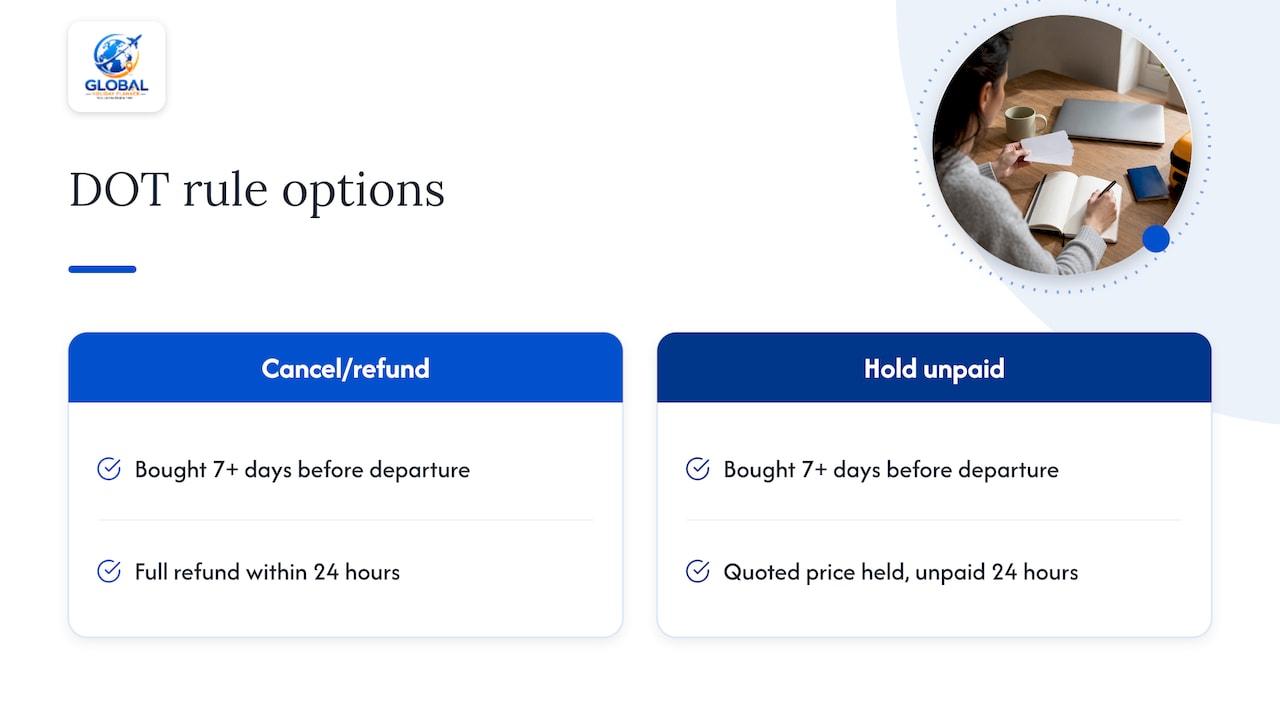
The DOT states that for tickets bought at least seven days before the scheduled departure, an airline must do one of two things. It can let you cancel the reservation and receive a full refund within 24 hours of booking, or let you hold the reservation at the quoted price for 24 hours without paying. The DOT has also published guidance to U.S. and foreign carriers on how to comply with this requirement.
Two details trip up most people.
It is an either/or rule. An airline does not have to offer both options. If a carrier chooses the hold option, a traveler who has already paid has no right to a refund under this rule. Many large airlines do offer the refund, but check the fare conditions for the airline you are buying from before you rely on it.
The clock starts at purchase. The 24 hours run from the moment you first buy, not from the moment you receive a confirmation email or the next morning. If you booked at 9:40 p.m. on Tuesday, plan to cancel before 9:40 p.m. on Wednesday, and do it earlier than that to leave room for a slow website or a long phone queue.
The seven day condition
The rule applies only when you buy at least seven days before the scheduled departure date and time. Book a flight that leaves in five days and the federal protection does not apply. The airline’s ordinary fare rules take over, and those are often strict.
Some airlines are more generous than the minimum. Alaska Airlines, for example, allows cancellation within 24 hours of booking for travel starting more than 24 hours away, according to The Points Guy. That is a carrier policy, not a federal requirement, so confirm the current wording on the airline’s own site at the time you buy. Meanwhile, American Airlines’ FAQ describes the 24 hour refund as available for tickets booked at least seven days before departure.
A quick way to test your own case:
| Your situation | Does the federal rule cover it? |
|---|---|
| Booked directly with the airline, flight in 3 weeks, cancelling after 6 hours | Yes, if the airline offers the refund option |
| Booked directly, flight in 4 days | No, the airline’s own policy applies |
| Booked directly, 30 hours ago, flight in 2 months | No, the 24 hours have passed |
| Booked through a travel agency or online agency | Not by this rule, check the agency’s terms |
| Booked a Basic Economy or other nonrefundable fare directly, flight in 2 weeks, within 24 hours | Yes, the rule is not limited to refundable fares |
The last row surprises people. The rule is about the timing of the cancellation, not the fare class. A fare that is nonrefundable after day one is still refundable on day one, provided the other conditions are met.
What the rule does not cover
Changes to an existing booking
The rule is about cancelling the original purchase. Airlines are not required to give you free changes to dates or names inside that window. If you typed the wrong date or misspelled a passenger name, the most reliable fix is to cancel for the full refund and book again correctly. Do it in that order only if the new fare is acceptable: fares can move between your cancellation and your rebooking, so check the price before you cancel.
Tickets bought through an agency
The DOT’s 24 hour requirement does not legally apply to tickets purchased through travel agents or online travel agencies. If you bought that way, you contact the agency and follow its terms. Some agencies match the 24 hour window voluntarily and some do not. Read the cancellation terms before you pay, not after.
This is also why we recommend that any comparison, ours included, be used to find the right flight, and that you then read the final booking page for cancellation terms before you pay. Our own platform compares options and refers you to the providers who sell the ticket, so the provider’s conditions are what govern your refund. The terms are shown at the booking stage, and you should read them there.
Flights outside the U.S. system
The rule is a U.S. regulation covering airlines on flights to, from or within the United States. A trip between two other countries is governed by those countries’ rules, or by none. If you are reading this from outside the U.S., do not assume the same protection exists on your route.
Hotels, cars and other parts of the trip
The rule is about airline tickets only. Your hotel, rental car, tour or transfer each has its own cancellation terms, and these vary widely. Activity providers can be very specific: see, for instance, how camp cancellation rules in Portugal are laid out, to get a sense of how different a non-airline policy can look. If a hotel booking turns out to be nonrefundable, our five step refund script shows how to ask for your money back.
How fast the refund arrives
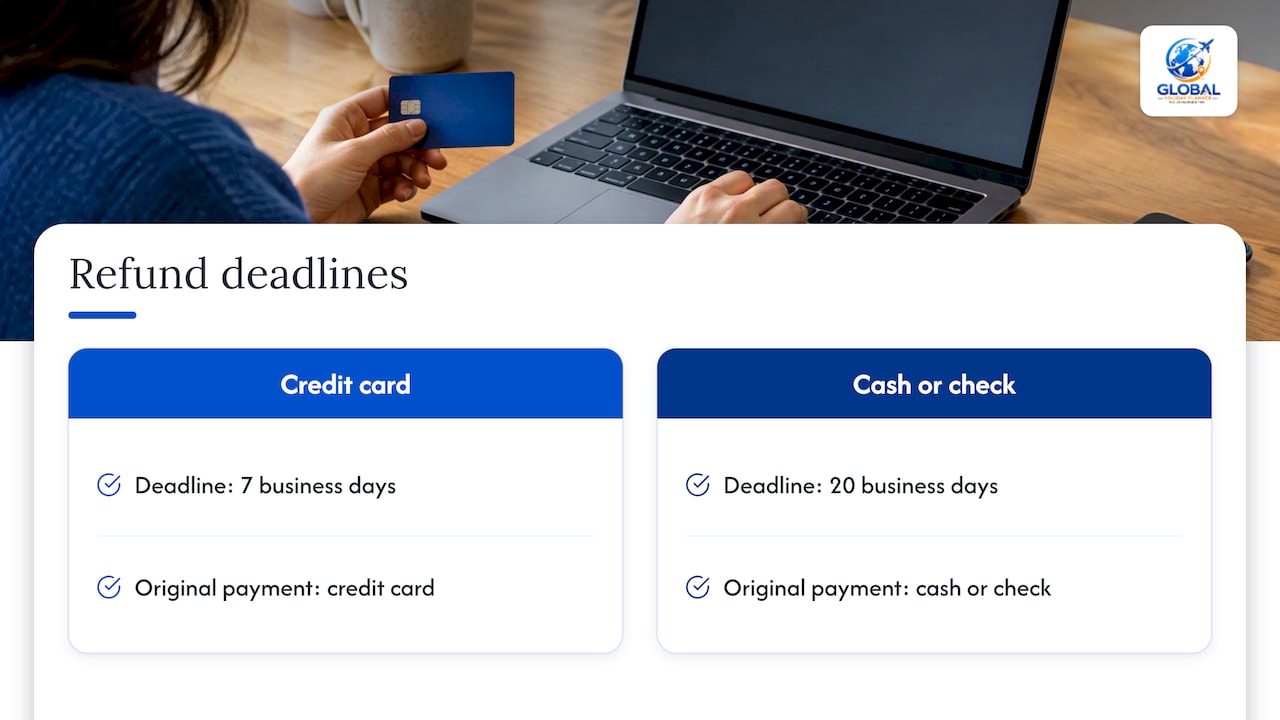
When a refund is due, the DOT’s guidance says it must go back to the original form of payment. The stated limits are 7 business days for credit card purchases and 20 business days for cash or check payments.
One practical wrinkle: Delta says that it processes refunds for tickets cancelled within 24 hours, but that some banks or card issuers may place a hold on the funds. That pending hold is on the bank side and can make the money look missing for a few days. Check your card statement before you call the airline.
How to cancel within 24 hours, step by step
- Note your purchase time. Find the confirmation email and the timestamp. Count 24 hours from that moment.
- Check the departure date. It should be at least seven days after you bought. If it is closer, call the airline anyway and ask about its own policy.
- Use the airline’s cancel tool first. Most airlines let you cancel in Manage Trips with your confirmation code and last name. Look for the option labeled as a 24 hour cancellation or refund, not a plain cancel that issues a credit.
- Choose refund to original payment, not a voucher. Credits are easy to accept by accident. If the system only offers a credit, call.
- Save proof. Take a screenshot of the cancellation confirmation and keep the email. Write down the date, time and reference number.
- Watch the statement. If nothing has arrived after 7 business days on a card, contact the airline with your confirmation and, if needed, your card issuer.
If the airline cancelled the flight itself, that is a different situation with separate refund rights. The DOT refund page lays out when you are entitled to a refund for a cancelled flight, and Capital One’s guide summarizes the steps if a refund does not arrive on its own.
Using the 24 hours as a planning tool
The window is more useful than most travelers realize. It is not just a way out of a mistake.
Lock a fare, keep looking. If you see a price you like but are not sure about your plans, a flight bought at least a week out can be a risk-free hold for a day, as long as your airline offers the refund option. Use that day to check with family, your calendar or your employer.
Catch a drop. If the fare falls shortly after you buy, you can cancel and rebook within the window. We explain how to do this safely, and how changeable fares work, in our guide to capturing flight price drops with the DOT 24 hour rule.
Test an unusual fare. Very cheap fares sometimes turn out to be pricing errors. The 24 hour window is one reason travelers feel comfortable booking them quickly, but airlines can still cancel an error fare, so read how mistake fares work and our note on keeping the 24 hour rule handy with error fares before you rely on one.
Fix a booking error. Wrong dates, wrong airport, wrong passenger. Cancel for the full refund and rebook, as above.
Pair it with the right protection
The 24 hour window ends quickly. After that, your ticket is governed by fare rules, and a nonrefundable fare is generally just that. If you want protection beyond day one, there are two main routes: a flexible fare, which usually costs more up front, or travel insurance.
Insurance is not one thing. Trip cancellation covers listed reasons before you leave, and trip interruption covers listed reasons after you leave. Our checklist on trip cancellation versus interruption helps you see which one fits. If you want to cancel for any reason at all, read how cancel for any reason coverage works, including the buying window it typically requires. And if your credit card offers coverage, check its caps first, then decide with our insurance versus card coverage steps.
Our perspective
We run a comparison platform, so we see the same mistake from the other side: travelers compare prices carefully and then skip the cancellation terms. A cheaper fare that cannot be cancelled is not cheaper if your plans shift. That is why our approach is to put the real total cost and the fit for your trip in one place, covering flights, hotels, car rentals, transfers and insurance side by side.
Our view on the 24 hour rule is simple. Treat it as a safety net, not a strategy. It is valuable when you book directly with an airline at least a week out. It is not a promise that travels with you to every seller or every route. Before you pay, ask three questions: how far away is the flight, who is actually selling the ticket, and does the airline offer the refund or only the hold? If you can answer all three, you can book with confidence.
We also suggest booking the pieces of a trip in a sensible order. If you are unsure whether to commit to the flight or the room first, our simple rule on booking flights or hotel first is a good start, because the cancellation terms of each part determine how much risk you carry.
— Global
Booking with us
When you are ready to book, you can compare flights from several providers in one place, then add hotels, a rental car or an airport transfer so you see the full cost of the trip. We refer you to the provider that sells each service, so check that provider’s cancellation terms on the booking page before you pay. If you are organizing a group of ten or more, our group flight playbook covers how to lock seats.
Traveling for work? Our business travel booking tips cover how to avoid delays and keep costs in check.
Common mistakes to avoid
- Waiting until the last hour. Websites fail and phone lines back up. Cancel as early as you can.
- Assuming every ticket qualifies. Flights under seven days away and agency bookings can fall outside the rule.
- Accepting a credit. A voucher is not a refund. Ask for the refund to the original form of payment.
- Trying to change instead of cancel. The rule covers cancellation of the original booking, not a free change.
- Forgetting other bookings. Your hotel and car have their own deadlines. Cancel those separately if the trip is off.
- Cancelling before checking the new fare. If you plan to rebook, look at the current price first.
FAQ
Can I cancel a flight within 24 hours for a full refund?
Often yes, if the flight is to, from or within the U.S., you booked at least seven days before departure, and the airline offers the refund option rather than the hold option. Cancel within 24 hours of the original purchase. Booking through an agency can change the answer.
What airlines allow 24 hour cancellation?
The DOT rule applies to airlines serving the U.S. market, and each chooses refund or hold. Many large carriers publish a refund policy, and some, such as Alaska Airlines, go beyond the seven day minimum according to The Points Guy. Always check the airline’s current policy page before you book.
Does the 24 hour rule apply to tickets bought from a travel agency?
Not as a federal requirement. The DOT says the requirement does not legally extend to tickets bought through travel agents or online agencies, so you follow the agency’s own cancellation terms. Read them before paying, and contact the agency directly to cancel.
Are free cancellation flights the same as the 24 hour rule?
No. The 24 hour rule is a short, legally required window under specific conditions. Free cancellation on a fare is a feature of that fare or ticket type, set by the airline, and it usually lasts longer or follows different rules. Compare the fare conditions on each option.
How long does the refund take?
Under DOT guidance, refunds go to the original form of payment within 7 business days for credit cards and 20 business days for cash or check. Your bank may show a temporary hold, so check your statement before contacting the airline.
Sources
- Refunds, U.S. Department of Transportation
- Buying a Ticket, U.S. Department of Transportation
- Guidance on the 24-hour reservation requirement, U.S. Department of Transportation
- Customer service FAQs, American Airlines
- Guide to canceling flights and getting a refund with US airlines, The Points Guy
- How To Get a Refund on a Flight Cancellation, Capital One
- Delta Air Lines
[…] If your plans are shaky, use the same discipline you would for a flight: our explainer on the US 24-hour flight cancellation rule shows why knowing the rule before you pay […]