

An error fare is an unintended, unusually low airline price, and it can be deeply discounted but is rare and often short-lived. If you spot one, book quickly but protect yourself: use the 24-hour cancellation rule on U.S. routes or choose a refundable option. Hold off on nonrefundable hotels and rentals until your ticket is confirmed.
TL;DR:
- Check the full total across channels when a fare has a missing digit, currency error, omitted taxes, or a premium cabin priced near economy.
- For flights to or from the U.S. booked at least seven days before departure, airlines must allow cancellation or a reservation hold for one day.
- Under U.S. rules, an airline that cancels must prove the fare was mistaken, issue a full refund, and reimburse reasonable, documented expenses you incurred.
- Airline cancellation refunds must return to the original payment method within seven business days for credit cards or 20 calendar days for other payments.
- Accepting a rebooked flight or continuing the trip generally removes your refund entitlement, so decide before agreeing to alternate travel.
Table of Contents
- What are error fares and how do you recognize one?
- Why do error fares happen?
- Will airlines honor error fares? The U.S. legal view
- How long do error fares last?
- How to find and book error fares safely
- What should you do if the airline cancels?
- Why we cover error fares, and how we think you should treat them
- Compare legitimate fares with us before you commit
- FAQ
- Sources
What are error fares and how do you recognize one?
You will see this idea under several names: error fare, mistake fare and glitch fare. They all describe the same thing, a price the airline never meant to publish. Reporting on the topic says these mistake fares are unpredictable but occasionally offer steep discounts, with discounts reaching up to 90% in rare cases according to industry reporting.
Some patterns show up again and again:
- Typos: a fare keyed in with a missing digit, so a long-haul ticket prices like a short hop.
- Currency-conversion mistakes: a fare filed in one currency and converted wrongly in another market.
- Omitted taxes or fees: a base fare that loads without the surcharges that normally double the total.
- Wildly off route pricing: a business-class seat priced near economy, or a premium route priced like a regional one.
A good rule of thumb: if the price looks wrong for the route, the cabin and the season, treat it as a possible error fare and read on before you pay.
Why do error fares happen?
Airlines do not sell a seat at one price. Each cabin is split into multiple fare buckets, and revenue-management software shifts seats between buckets continuously as demand moves. That creates a huge number of prices to file, update and distribute every day, and every handoff is a place where something can slip.
Fares are typically filed through industry systems such as ATPCO, then pushed to global distribution systems and cached by online travel agencies. A fare can be corrected at the source and still appear elsewhere for a while because of propagation delays. Industry experts told Forbes that increasingly complex, AI-driven pricing and more airline partnerships mean fare anomalies are more likely, since pricing involves millions of dynamic data points and distributed publishing.
Reporting from 2025 and 2026 points to a few recurring failure modes:
- Human data-entry mistakes when a fare is filed by hand.
- Currency or tax errors when fares are converted between markets.
- Automated-pricing glitches between revenue-management software and fare-filing systems.
- Communication problems between systems that publish a fare no one approved.
Travel experts say ultra-low-cost mistake fares come from pricing or publishing issues: human error, technical glitches and system miscommunication. They are rare, but the discounts can be very large when one appears.
Will airlines honor error fares? The U.S. legal view
Sometimes yes, sometimes no. Outcomes vary by airline and by fare, so you should never assume a ticket is safe until it is confirmed. Here is the U.S. framework that sets the floor for your protection:
- No obligation to honor: under the May 8, 2015 Mistaken Fare Policy Statement, airlines are not legally required to honor a mistaken fare.
- Burden of proof: a carrier can cancel only if it can demonstrate the fare was a genuine mistake.
- What you get if it cancels: a full, penalty-free refund plus reimbursement of reasonable, verifiable, actual out-of-pocket expenses you incurred in reliance on the purchase.
- The 24-hour buffer: for tickets bought at least seven days before departure, airlines flying to or from the U.S. must let you cancel within 24 hours for a full refund or hold a reservation for 24 hours, as the DOT refunds guidance explains.
Together, these rules mean the downside is limited if you book carefully: you can walk away within a day, and a cancellation by the airline comes with your money back. Outside U.S. routes, check the rules of the relevant country before relying on any of this. For more on the 24-hour rule, see our piece on capturing price drops with the DOT 24-hour rule.
How long do error fares last?
Usually not long. Many disappear quickly after being published, once the airline notices or an audit cycle catches the fare. Treat that as practitioner insight, not a guarantee: some fares linger longer, and others vanish before you finish typing your passport details.
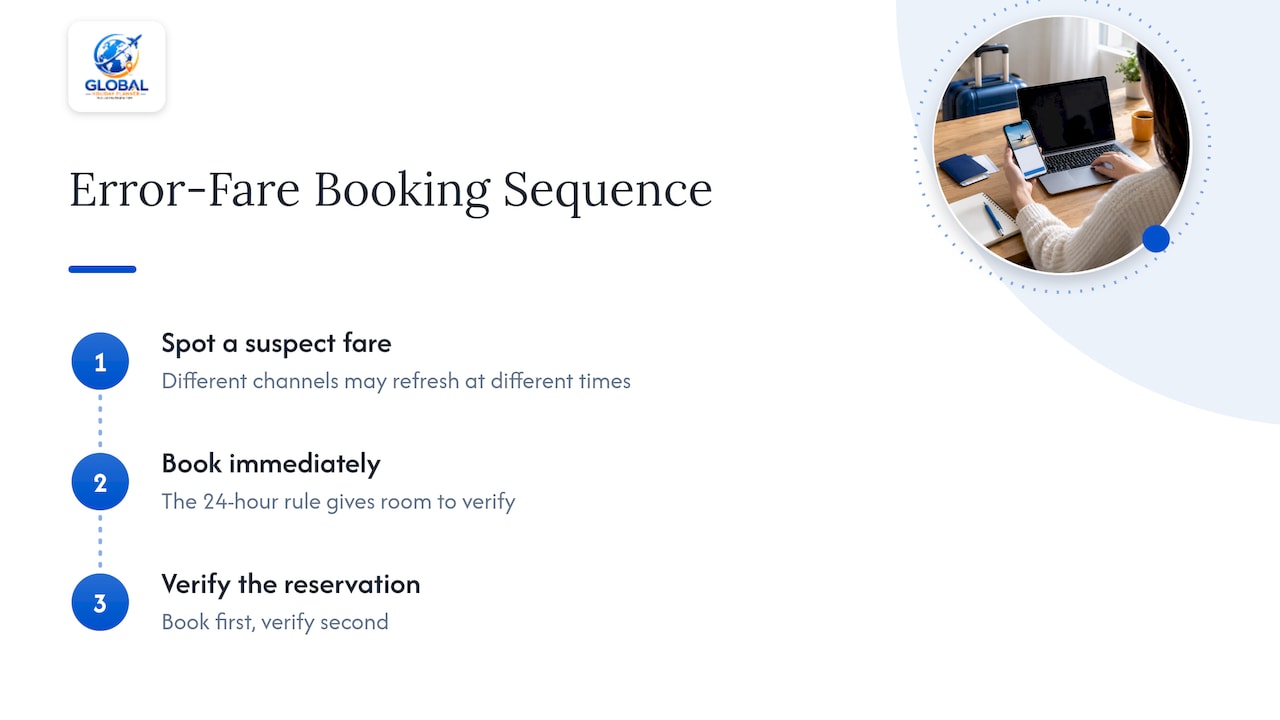
Practitioners often describe a “glitch window” created by propagation and caching. Because different booking channels refresh at different times, the fare may still show in one place after it has gone from another. If you see a suspect price, act at once rather than waiting to think it over: the practical window is short, and the 24-hour rule gives you the room to book first and verify second.
How to find and book error fares safely
You will not find these by luck alone. Here is a workable routine:
- Set up alerts. Use deal-alert services, fare-spotting communities and flight-search tools that track unusual drops.
- Search flexibly. Run flexible-date grids and compare several channels to confirm the fare is actually bookable. Our guide to flexible date flights shows how.
- Be payment-ready. Keep passenger names exactly as on your passport and a card at hand so you can book quickly.
- Check the fare rules. Confirm the route, dates and total price including taxes before you pay.
- Choose protection. Prefer a fare you can cancel or use the 24-hour rule where it applies, and consider a card with solid purchase protection.
- Wait on add-ons. Delay nonrefundable hotels and rentals until the airline confirms your ticket.
- Save your confirmation. Screenshot the fare, the total and the confirmation email.
Pro Tip: Book with the airline directly when you can. Where you buy changes who is the merchant of record for refunds, and the 24-hour rule is easiest to use with a single clear seller.
Booking directly with an airline versus through an online travel agency also changes who handles a refund. For more search tactics, see How to Find Cheap Flights: Insider Tips. Travelers who like deal hunting beyond mistake fares may also enjoy this guide to last-minute flight deal types.
What should you do if the airline cancels?
A cancellation is frustrating, but the rules favor you. Work through these steps:
- Confirm the cancellation in writing and check whether the airline has already started an automatic refund.
- Keep every receipt for nonrefundable expenses you paid in reliance on the ticket, since reimbursement requires verifiable costs.
- Know the refund clock. Under the automatic refund rule, refunds must go back to the original form of payment, within 7 business days for credit cards and 20 calendar days for other payment methods.
- Escalate if it stalls. Contact the airline in writing first, then file a complaint with the DOT.
- Decide on rebooking. If you accept a rebooked flight or continue traveling, you are generally not entitled to a refund, so choose deliberately.
Why we cover error fares, and how we think you should treat them
We help travelers compare and book flights, and we write about error fares because they are tempting. Our view: they are opportunistic savings, not a plan. Use comparison tools to weigh the total cost of a trip, and never commit to nonrefundable arrangements until a ticket is confirmed.
— Global
Compare legitimate fares with us before you commit
If chasing glitches feels too risky, we make the lower-risk route simple. Compare flights on Global Holiday Planner to see total fare costs side by side and book.

- Check a suspect price against trusted comparison results before arranging anything nonrefundable.
- Read our mistake fares guide for examples and ways to lower your booking risk.
FAQ
Do airlines have to honor mistake fares?
In the United States, no. A carrier can cancel a fare it can show was a genuine mistake, but it must give a full, penalty-free refund and reimburse reasonable, verifiable out-of-pocket expenses under the DOT’s mistaken fare policy.
Will airlines refund you if the price drops or a fare is cancelled?
If an airline cancels a ticket, you are owed a refund to your original form of payment. DOT says refunds are due within 7 business days for credit cards and 20 calendar days for other payment methods, as the automatic refund rule explains.
Can you cancel a flight within 24 hours of booking?
Often yes. For tickets bought at least seven days before departure on flights to or from the U.S., airlines must let you cancel within 24 hours for a full refund or hold the reservation, according to the DOT refunds page.
How can you tell an error fare from a normal sale?
A sale usually follows a pattern: it is advertised, limited by dates and priced within reason. An error fare looks wrong for the route, cabin or season, appears with little warning and tends to vanish quickly, so verify it across channels before you pay.
Sources
- Mistaken Fare Policy Statement – May 08, 2015 | US Department of Transportation
- Refunds | US Department of Transportation
- What Are Mistake Fares? How To Score These Ultra-Cheap Flights