
A mistake fare is an airline ticket priced far below what the airline intended, usually by accident, and the single biggest factor in whether you keep it is speed: book within minutes, choose the operating carrier when you can, and hold off on hotels, tours, or seat upgrades until the reservation survives a quiet stretch with no cancellation notice. Treat the savings as a bonus, not a guarantee.
TL;DR:
- Confirm an unusually low fare across multiple search or booking channels, then check the currency, taxes, fees, and routing before paying.
- Book immediately through the operating carrier when possible, save the confirmation and fare details, and avoid calling or requesting changes while the reservation settles.
- Wait about two weeks before committing to nonrefundable hotels, tours, or rental cars, and book the flight separately rather than in a prepaid package.
- For eligible U.S. bookings made at least seven days before departure, the DOT rule permits cancellation for a full refund within 24 hours.
- Airlines cancel an estimated 10% to 20% of mistake fares, so avoid trips tied to fixed events or travel plans that cannot absorb disruption.
Table of Contents
- What Mistake Fares Are and Why They Happen
- How to Find Mistake Fares: Channels, Alerts, and Signals
- How to Book a Potential Mistake Fare: A Step-by-Step Checklist
- If the Airline Cancels: DOT Guidance and How to Recover Costs
- Publisher Workflow: Chasing Mistake Fares Without the Guesswork
- How to Verify the Legitimacy of a Mistake Fare Before Booking
- Strategies to Maximize Savings Using Mistake Fares With Other Discounts
- Legal and Ethical Considerations When Booking Mistake Fares
- Tips for Modifying or Upgrading Bookings Made With Mistake Fares
- Common Scams Related to Mistake Fares and How to Avoid Them
- When Chasing Mistake Fares Is (and Isn’t) Worth It
- Compare Total Cost Before You Chase the Next Deal
- FAQ
- Sources
What Mistake Fares Are and Why They Happen
A mistake fare, sometimes called a glitch or error fare, is a ticket sold at a price well below what the airline meant to charge. These fares show up for a handful of predictable reasons, and understanding the cause often tells you how risky the booking actually is.
- Human error during fare loading, such as a typo that drops a digit from the price.
- Currency conversion mistakes when a fare is filed in one currency and displayed in another.
- Fuel surcharges or taxes left out of the published price entirely.
- Fare-rule misapplication, where a discount meant for one route or cabin applies broadly.
- System glitches during fare updates or airline website migrations.
Savings can range from steep to almost unbelievable, and Forbes reporting notes discounts up to roughly 90% off the normal price in some cases. These fares are genuinely rare, and pricing engines have gotten better at catching them before they reach the public, according to Thrifty Traveler’s mistake fares guide.
How to Find Mistake Fares: Channels, Alerts, and Signals
Mistake fares rarely announce themselves, so finding one is mostly a matter of watching the right places and recognizing an unusual price when it appears.
- Subscribe to one reputable deal-alert service that specializes in error fares, since paid tiers often surface fares faster than casual browsing.
- Track routes you care about on Google Flights and set price alerts so a sudden drop stands out immediately.
- Use date-grid or flexible-date search tools to scan a wide window of travel dates at once, which increases your odds of catching an anomaly.
- Watch community deal forums and social feeds as a secondary check, since they often confirm whether a fare is spreading or already dead.
- Look for pricing and routing oddities: a fare priced at a fraction of nearby dates, or a route with illogical layover cities, often signals a misapplied fare rule rather than a genuine sale.
Pro Tip: Pair one free tool, like Google Flights tracking, with one paid alert service rather than chasing five sources at once; speed matters more than breadth once a fare surfaces.
How to Book a Potential Mistake Fare: A Step-by-Step Checklist
Once you spot a likely mistake fare, the window to act is usually measured in minutes to a few hours, not days. Deal hunters commonly report fares disappearing within an hour of being publicized, so hesitation is the biggest risk to the booking itself.
- Book immediately, before researching reviews or comparing seat maps.
- Book directly with the operating carrier when possible, since The Points Guy notes this generally simplifies refunds and disputes if the airline later cancels; a reputable travel agency or online booking site is the next best option.
- Use the DOT’s 24-hour reservation rule as a safety net: for most U.S.-jurisdiction bookings made at least seven days before departure, you can cancel within 24 hours for a full refund if you have second thoughts.
- Save your confirmation email and screenshot the fare details, then wait. Avoid calling the airline, since SmarterTravel’s reporting notes that contacting the carrier draws attention to the booking and can increase the chance of cancellation.
- Delay buying nonrefundable hotels, tours, or rental cars until the reservation has survived a reasonable waiting period.
Pro Tip: A common rule of thumb among frequent deal hunters is to wait about two weeks after booking before committing to nonrefundable add-ons tied to the trip.
If the Airline Cancels: DOT Guidance and How to Recover Costs
The regulatory backdrop matters here. The DOT’s 2015 mistaken fare policy statement allows carriers to cancel a fare they can demonstrate was a genuine mistake, but it also requires them to refund the ticket price and reimburse reasonable, verifiable out-of-pocket expenses for fares under U.S. jurisdiction.
Mistake fares get canceled an estimated 10% to 20% of the time, according to Forbes reporting on error fares, which means most survive, but cancellation is common enough to plan around.
If your fare does get pulled:
- Request a refund of the ticket price first, since this is required when the airline cancels a mistake fare under DOT jurisdiction.
- Document any nonrefundable costs you already incurred, such as a hotel deposit, with receipts and dates.
- Submit a reimbursement request to the airline for those verifiable expenses before escalating further.
- File a complaint with the DOT or pursue a credit card chargeback if the airline denies a refund it owes.
Publisher Workflow: Chasing Mistake Fares Without the Guesswork
We built our comparison tools around the same total-cost thinking this guide recommends. Before you commit to any fare, you can compare total landed price across airlines rather than a headline number that excludes seat and baggage fees.
- Run your route through our flight comparison page to see the full fare, not just the base price.
- Use our flexible-date flights tool to scan a date grid and catch pricing anomalies across a wider window.
- Check how DOT 24-hour protections apply to your booking before you decide whether to lock in extras.
- Compare travel insurance options on our platform if you want to protect nonrefundable hotel or tour costs while you wait to see if the fare holds.
How to Verify the Legitimacy of a Mistake Fare Before Booking
Not every suspiciously cheap fare is a true mistake fare, and some are simply promotional pricing, a seasonal sale, or a fare in a different currency that looks lower than it is.
Confirm the fare appears consistently across more than one search engine or booking channel rather than a single screenshot circulating on social media, since screenshots can be altered or outdated by the time you see them. Check whether the routing makes sense: a fare from a major city to another major city with a reasonable connection is more believable than one routed through an unrelated country with no obvious reason.
Look at the currency and total price breakdown closely. A fare that looks absurdly cheap sometimes reflects a currency conversion error where the airline’s system displayed a price in the wrong currency symbol or failed to multiply correctly. Cross-check the base fare against taxes and fees; if the taxes alone exceed the base fare, that mismatch is itself a signal something was misfiled.
Finally, treat urgency as a feature, not a red flag, of a real mistake fare. If a deal is still bookable after circulating widely for a day or two, it is more likely a legitimate sale than an unnoticed error, since airlines typically correct true mistakes fast once they are flagged internally.
Strategies to Maximize Savings Using Mistake Fares With Other Discounts
A mistake fare on its own is already a deep discount, but a few habits can stretch the value further without adding risk to the booking. Pay with a credit card that offers purchase protection or travel credit insurance, since this gives you another layer of recourse if the airline cancels and is slow to refund.
Hold off on redeeming loyalty points or miles toward a mistake fare unless the program specifically allows cash-and-points bookings with easy refund terms, since award tickets booked with miles can be harder to unwind if the fare disappears. If your loyalty program offers fee waivers for same-day changes or free seat selection at your elite tier, those benefits stack cleanly on top of the mistake fare price with no added exposure.
Avoid combining a mistake fare with a bundled package deal, such as a prepaid vacation package, since the nonrefundable bundle increases your financial exposure exactly where the mistake fare is supposed to reduce it. Instead, book the flight alone through the carrier or a reputable agency, then layer on hotel and car rental separately once the fare looks stable, comparing total cost across providers before committing to either.
Legal and Ethical Considerations When Booking Mistake Fares
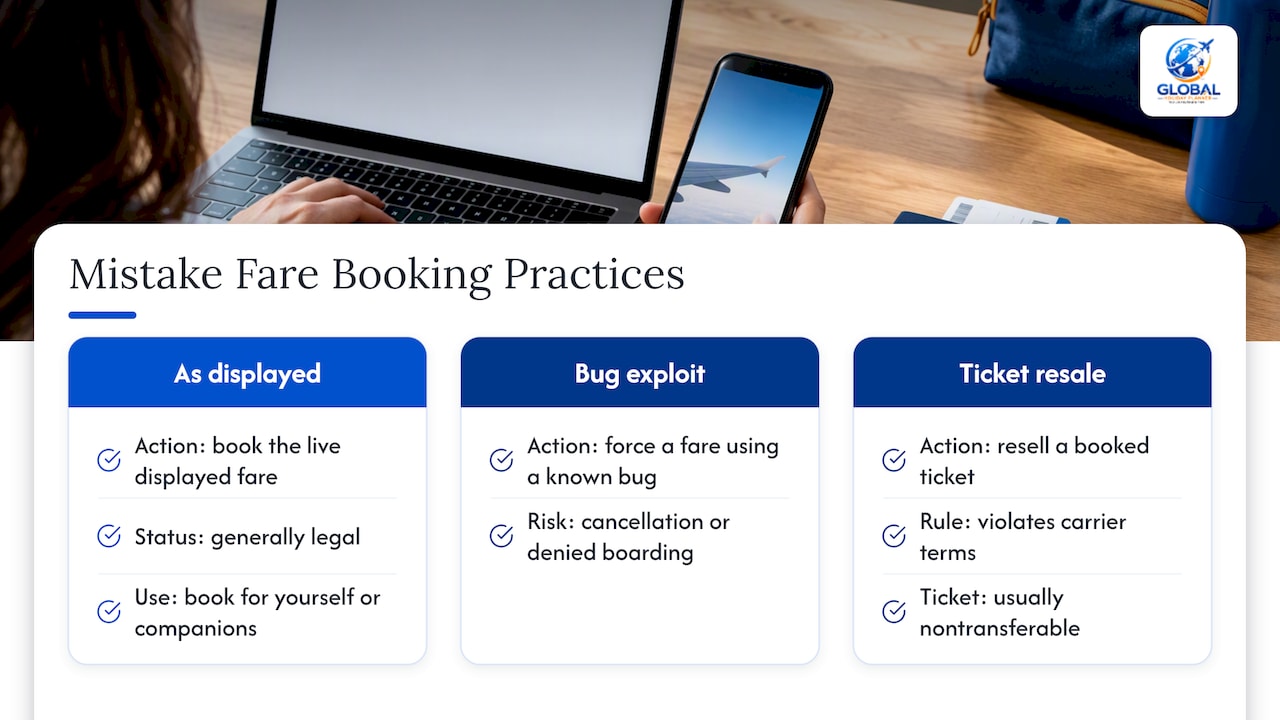
Booking a fare you know is priced in error is generally legal: you are accepting the price the airline displayed and charged you, and airlines treat this as a normal commercial risk rather than fraud. The DOT’s consumer guidance requires airlines to display the total ticket price prominently, and that requirement exists precisely because pricing errors happen on the airline’s side, not the traveler’s.
That said, there is a meaningful difference between booking a fare as displayed and attempting to manipulate a booking system, such as exploiting a known technical bug to force a fare rather than simply taking advantage of one that is already live. The former is an ordinary consumer transaction; the latter edges toward the kind of deliberate system abuse that can expose you to account cancellation or denied boarding.
Reselling a ticket booked under a mistake fare to someone else, or booking multiple tickets with the intent to resell them, raises separate concerns since most airline tickets are nontransferable and reselling violates the carrier’s terms of service regardless of how the fare was priced. Stick to booking for yourself or immediate travel companions listed on the reservation, and avoid any temptation to monetize the error itself.
Tips for Modifying or Upgrading Bookings Made With Mistake Fares
Mistake fares almost always come with the airline’s most restrictive fare rules attached, so changes and upgrades deserve extra caution. Wait until the booking has survived the waiting period before requesting any changes, since contacting the airline to modify a reservation draws the same attention that a cancellation call would.
If you need to correct a minor error, such as a misspelled name, most airlines allow small corrections without flagging the booking as a change request; check the airline’s name-correction policy first rather than calling customer service directly. Avoid upgrading your cabin or adding a stopover through a separate request, since fare rules on error fares are typically locked and any modification request gives the airline a reason to re-audit the booking.
If you want a better seat, consider waiting until check-in opens and using the standard seat-selection process rather than asking an agent to amend the ticket, since this keeps your request separate from the underlying fare. For connecting ground transportation booked around the flight, check cancellation windows before locking in rigid plans; some providers, including partners like Airport Transfers Ireland, allow amendments up to 24 hours ahead, which gives you room to adjust if your flight timing shifts.
Common Scams Related to Mistake Fares and How to Avoid Them
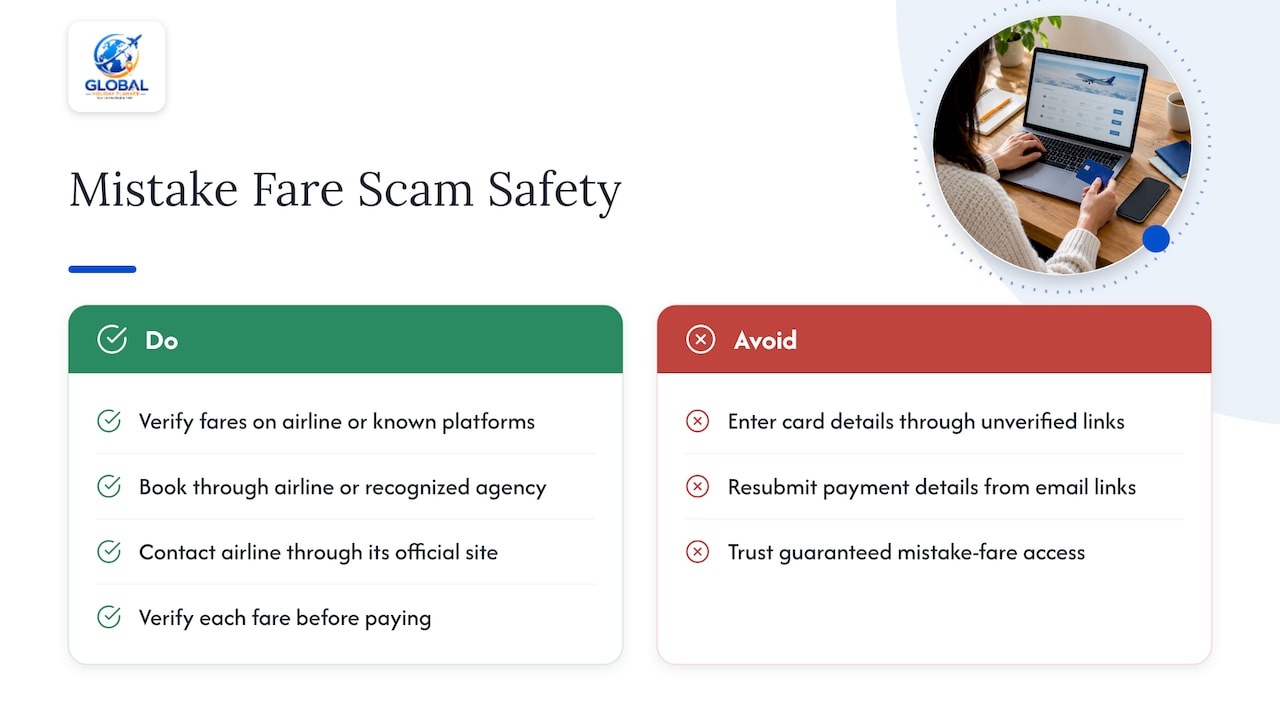
Because mistake fares attract attention fast, they also attract bad actors looking to exploit the excitement. Fake deal alerts are common: a post or email claims an outrageous fare exists, links to a third-party site instead of the airline or a known booking platform, and asks for payment information upfront with no verifiable fare displayed first. Always verify the fare directly on the airline’s own site or a recognized booking platform before entering payment details anywhere else.
Phishing attempts sometimes follow a real mistake fare story, with scammers sending emails that claim to be from the airline asking you to “confirm” your booking by clicking a link or resubmitting card information. Airlines do not need you to resubmit payment information to confirm a ticket that already charged successfully; treat any such request as a red flag and contact the airline through its official site instead of a link in the email.
Fake travel agencies sometimes advertise “guaranteed” mistake fare access for a subscription fee, promising insider deals that do not materialize. No legitimate deal-alert service can guarantee you will catch a mistake fare, since these fares are unpredictable by nature, and any service that claims otherwise is overselling what it can deliver. Stick to well-known deal services with a public track record, book through the airline or a recognized agency, and verify every fare independently before paying.
When Chasing Mistake Fares Is (and Isn’t) Worth It
Mistake fares suit flexible travelers who can delay booking hotels and tours until a fare proves stable. They are a poor fit for fixed-event trips, business travel, or large groups where a cancellation would be disruptive. Ask yourself: can I wait two weeks, can I absorb a cancellation, and can I book fast right now?
— Global
Compare Total Cost Before You Chase the Next Deal
Finding a mistake fare is only half the job. The other half is knowing what it actually costs once seats, bags, and insurance are added, and that is where comparing total price across providers pays off.

- Check our flights page for side-by-side pricing before you commit to any fare.
- Set a flexible-date search on our date-grid tool to catch price anomalies on routes you watch.
- Compare travel insurance options if you plan to book nonrefundable hotels or tours while waiting for a fare to settle.
Start with our flight comparison tool the next time a deal catches your eye, and see the full price before you decide.
FAQ
Do Airlines Honor Mistake Fares?
Airlines honor most mistake fares, with industry estimates putting cancellation rates at roughly 10% to 20%. Under DOT guidance, carriers can cancel a fare they demonstrate was a genuine error, but they must refund the ticket price and reimburse reasonable, documented expenses for fares under U.S. jurisdiction.
How Do You Search for Mistake Fares?
Track routes on Google Flights with price alerts, use flexible-date or date-grid searches to scan a wide window at once, and subscribe to a reputable deal-alert service that specializes in error fares. Checking multiple channels at once increases the odds of catching a fare before it disappears.
How Do You Catch an Error Fare Quickly?
Book the moment you spot a fare that looks far below normal pricing for that route and date, since these fares often vanish within hours. Prefer booking directly with the operating carrier when possible, and avoid calling the airline afterward, since SmarterTravel notes that contacting the carrier can draw attention to the booking.
What Is the Best Way to Get Cheap Flights Generally?
Beyond mistake fares, the most reliable approach is comparing flexible travel dates, tracking price history, and checking total fare rather than just the base price. Our guide to finding cheap flights covers routine tactics that work even when no error fare is available.
Sources
- What Are Mistake Fares? How To Score These Ultra-Cheap Flights — Forbes
- Buying a Ticket | U.S. Department of Transportation
- How to find and book mistake fares — SmarterTravel
[…] our mistake fares guide for examples and ways to lower your booking […]
[…] U.S. Mistake Fares: Up to 90% Off, Lower Your Booking Risk […]