
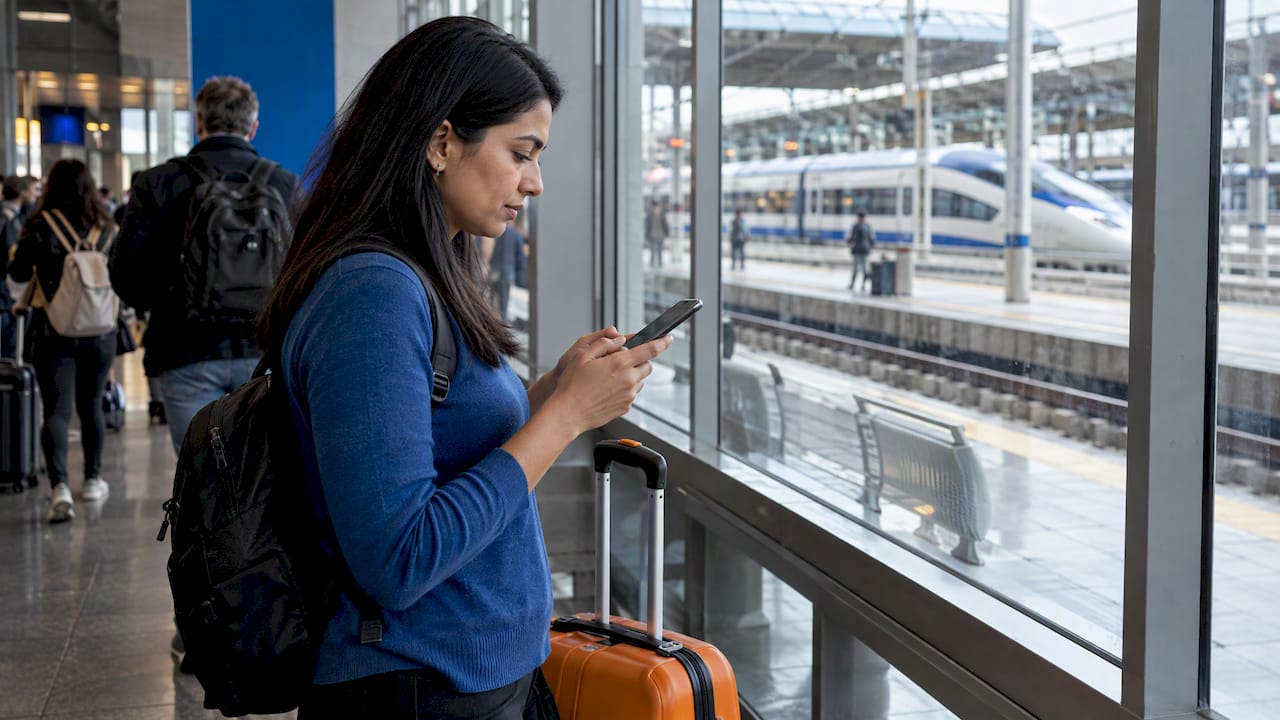
Booking high-speed train tickets comes down to four moves. Find the route on an official journey planner. Buy on the operator’s own site or a booking platform you trust. Buy as early as the booking window allows. Check the reservation fee, the fare’s change and refund terms, and the seat options before you pay. The details differ by country and by train, so this guide shows where each rule applies instead of treating rail as one system.
TL;DR
- Search first on an official planner such as National Rail’s Journey Planner or Deutsche Bahn’s travel information service, then compare prices.
- Low fares are limited in number. Book as early as you can and avoid peak times, because the cheapest fares go first.
- Booking windows differ: Eurostar opens 7 to 12 months ahead, and ICE and other Deutsche Bahn trains usually open 180 days ahead.
- Before paying, check whether a seat reservation is included, what the fare allows for changes and refunds, and whether you can choose your seat.
- For multi-leg trips, plan the whole journey in one place and book each section where it is sold.
Table of Contents
- Step 1: Find the train and the route
- Step 2: Decide where to buy
- Step 3: Book at the right time
- Step 4: Check fees, reservations and fare types
- Step 5: Pay, receive and use your ticket
- Step 6: Know the change and refund rules before you need them
- Booking for families and groups
- Overnight high-speed legs
- Business travelers
- Our perspective
- Plan the whole trip in one place
- FAQ
- Sources
Step 1: Find the train and the route
Start with the timetable, not the shop. An official planner shows what actually runs, and it is the quickest way to learn which services are the fast ones.
In Britain, National Rail’s Journey Planner asks for your starting point, your destination and your preferred travel time. It then lists route and schedule options, including the fastest direct services and connections, with ticket prices.
In Germany, Deutsche Bahn’s travel information service works from A to B. You can change its settings to favor the fastest connections, allow slower services, take a bicycle, minimize transfers, or set your own transfer times. If something is disrupted, it can show alternative connections for the next 72 hours. That is useful when you are standing on a platform with a changed plan.
On a multi-country trip, one planner can cover the whole chain. A common approach is to use Deutsche Bahn’s all-Europe planner to find a workable journey, then book each part on the relevant operator’s website. If you are new to piecing together a route from several timetables, how journey scheduling works explains the general logic of putting legs in a sensible order.
What to note before you leave the planner
Write down four things: the train number or name, the departure and arrival times, the station names (big cities often have several), and the connection time if you change trains. Those four details make the booking step fast and protect you from picking the wrong station.
Step 2: Decide where to buy
There are two kinds of places to buy high-speed train tickets: the operator’s own site or app, and a booking platform that sells tickets from several operators.
The operator’s site is the source of truth for fares, fare conditions and its own changes. A booking platform can be easier when your trip crosses borders or uses several carriers, because you pay once and keep the tickets together. Either way, read what you are buying. Platforms can add service fees or paid extras, and regulators have noticed. In 2026, China’s market regulator and other departments interviewed seven third-party ticketing platforms over misleading “rush-buy” claims, paid seat selection and improper handling of personal information. The lesson travels well: check what is optional, what is paid, and what data you are asked to give.
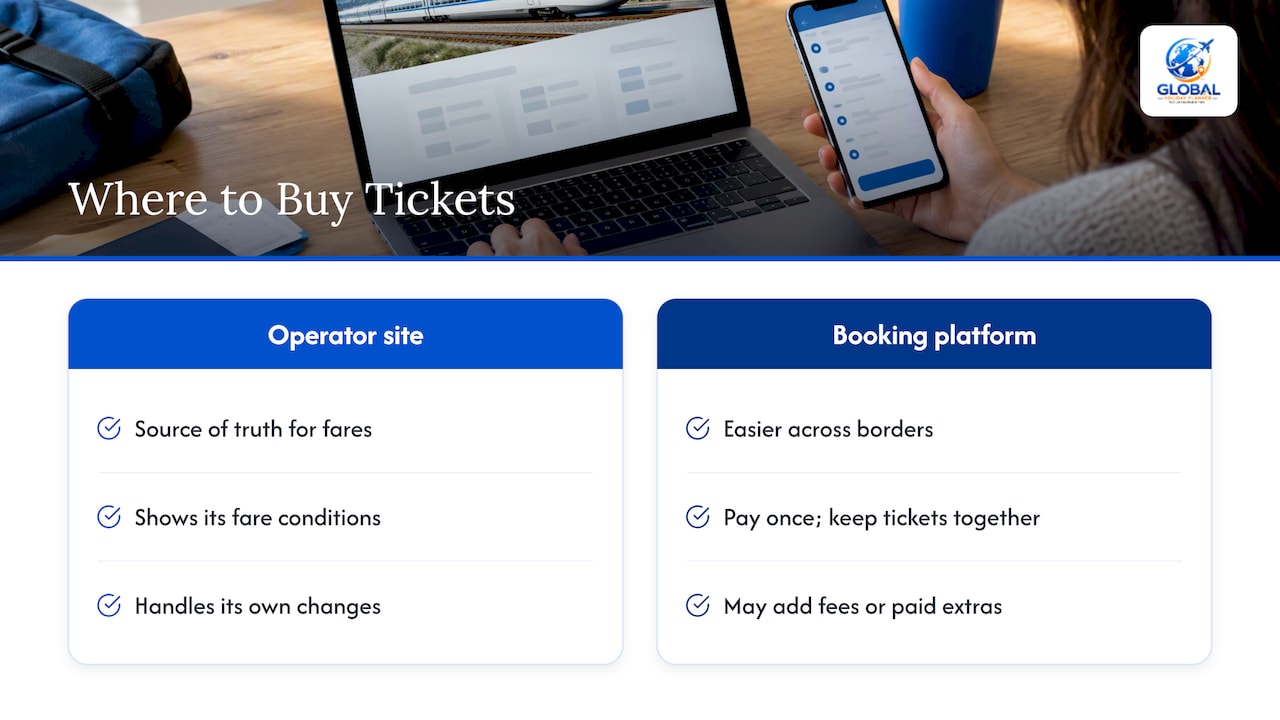
For complex journeys, the practical advice is to split the trip into sections and book each part with the relevant operator. A simple single-operator trip, such as one TGV between two French cities, rarely needs more than one booking.
A quick way to choose
| Your trip | Usually the better route |
|---|---|
| One operator, one country | The operator’s own site or app |
| Several operators in one country | The national operator for the main leg, plus a check of the others |
| Several countries, several legs | Plan on one planner, then book each section where it is sold |
| You want one itinerary and one payment | A booking platform, after you read its fees and conditions |
If you want a plain walkthrough of the buying steps, our guide on how to book trains online in six steps covers it from search to confirmation.
Step 3: Book at the right time
The cheapest high-speed fares are limited-quantity fares. The advice from the international rail ticket information published by SNCB International is to book as far ahead as possible and avoid peak times to benefit from them on many high-speed trains.
How far ahead you can book depends on the train. According to the same source, Eurostar tickets are available 7 to 12 months ahead, depending on the time of year, while ICE and other Deutsche Bahn trains usually open 180 days ahead. Other operators have their own windows, so check the operator’s page for the current rule instead of assuming.
A few habits make this easier:
- Set a reminder for the day your booking window opens on the route you want.
- Travel at off-peak times when you can. Early mornings, midday and mid-week departures are the ones that usually sit outside the rush.
- If your dates are flexible, compare a few days before committing.
- If your plans are not firm, pick a fare you can change, even if it costs more.
For trips that mix flights, hotels and trains, travel deal alerts let you track dates and recheck rates without searching daily.
Step 4: Check fees, reservations and fare types
The ticket price is not always the whole price. The first thing to check is whether a seat reservation is required and what it costs. According to the SNCB International guidance, a reservation is included free on Eurostar, TGV INOUI, OUIGO, TGV Lyria, overnight trains and Trenitalia trains. On ICE, reservations are optional: they cost €6 with a Sparpreis or Supersparpreis fare, and are free with a Flexpreis fare when booked together with the ticket.
That means two tickets with the same sticker price can end up costing different amounts. Read the full line items before you pay.
Then look at the fare conditions. Each fare has its own exchange and refund terms and its own seat-choice options. A cheap fare often trades flexibility for price, and a flexible fare costs more but forgives a change of plan. Neither is better in general. The right one depends on how certain your plans are.
Seat classes
First and second class can differ a lot between countries and trains, in legroom, layout and what is included. Our guide to train seat classes worldwide explains how to read them before you pick, so you are not paying for a difference that is small on your particular train.
Rail passes versus point-to-point tickets
If you will ride several trains in a short time across Europe, a pass can look attractive. Whether it beats single tickets depends on how many journeys you take and how they are priced. Use the 1.5× rule for rail passes versus point-to-point tickets to test it with your own itinerary. If a pass is on the table, Eurail versus Interrail turns on where you live, not on the brand name.
Step 5: Pay, receive and use your ticket
After payment, tickets usually arrive as a digital ticket by email, in an app, or as a code you collect at a station. Before you leave the booking page, confirm four things:
- The names on the ticket match each traveler’s travel document.
- The date, time and stations are correct.
- You know how the ticket is delivered: PDF, app wallet or collection at a machine.
- The ticket is saved where you can open it without a signal. Screenshots help, and so does a download in the operator’s app.
Some operators require you to collect the ticket before a deadline if you chose station pickup, and that deadline is tied to your train. Look at your confirmation for the exact rule, because it differs by operator and country.
At the station, check the departure board for the platform, then board the carriage shown on your reservation if you have one. A seat reservation on the ticket usually means your seat is held for you for the booked train only.
Step 6: Know the change and refund rules before you need them
The time to read the rules is before you pay. Take JR-Kyushu in Japan as an example of how specific they can be. Its terms say online changes and refunds are accepted before ticket collection, but not after the reserved train departs. The deadline is hard, and it is tied to the departure time and the ticket’s status.
Your own trip will be covered by the operator’s rules, not by any general one. A short checklist:
- Can the ticket be exchanged, refunded or both?
- Is there a fee, and does it change closer to departure?
- Does the rule stop applying once you collect the ticket, or once the train leaves?
- If you bought through a platform, who handles the change: the platform or the operator?
If you booked a nonrefundable hotel next to a train you can no longer catch, our nonrefundable hotel refund script lays out the steps. And when a trip has many prepaid parts, a look at trip cancellation versus interruption cover shows which protection answers which problem.
Booking for families and groups
Families and groups should check two things first: group fares and child fares.
Ask whether the operator offers group fares, including for groups of 3 to 5, and look at child fares, which vary by operator. Some carriers offer options for 10 or more passengers. SNCB International asks that group bookings be made at least three weeks before travel, so do not leave a big party to the last week.
Seat reservations matter more as the group grows. Where seats are not guaranteed, a family can end up split across a carriage. Where a reservation is included free, as on several of the trains above, take it. Where it is optional and costs a few euros, as on ICE, the fee is usually small next to the cost of everyone standing in different rows.
If the group is flying part of the way, the group flight playbook covers locking seats for 10 or more travelers.
Overnight high-speed legs
Some journeys let the train replace a hotel night. If your route allows it, see our list of overnight trains in Europe. The savings come from skipping a room and gaining a day at your destination. The checks are the same as for daytime trains: reservation, fare terms and ticket delivery.
Business travelers
A traveler who needs a fixed arrival time should pick a fare that can change, book early and keep the ticket in an app. Corporate trips also involve hotels and cars around the train leg, so the business travel booking tips are worth a read before the next trip.
Our perspective
Most people who struggle with train booking do not struggle with the train. They struggle with the pieces around it: a flight that lands at the wrong time, a hotel with a strict cancellation rule, a car that sits unused, and a ticket window that opens months before they have made up their mind.
We built Global Holiday Planner around that problem. Our approach is to put the parts of a trip side by side, so you can see the real cost and the best fit for your itinerary before you commit. For rail, that means looking at the train together with the airport transfer, the hotel night you may save, and the insurance that covers a missed connection.
Our advice is to settle the route first, book the long-lead items early, and keep the flexible parts flexible. A high-speed ticket is often the cheapest part of a trip when it is bought early, and the most expensive when it is bought in a hurry.
Global
Plan the whole trip in one place
Trains rarely stand alone. You arrive by plane, sleep in a hotel, and sometimes need a car or a transfer at the end. Global Holiday Planner lets you compare flights, hotels, car rentals and airport transfers alongside rail tickets and travel insurance, so the pieces fit before you pay for any of them.
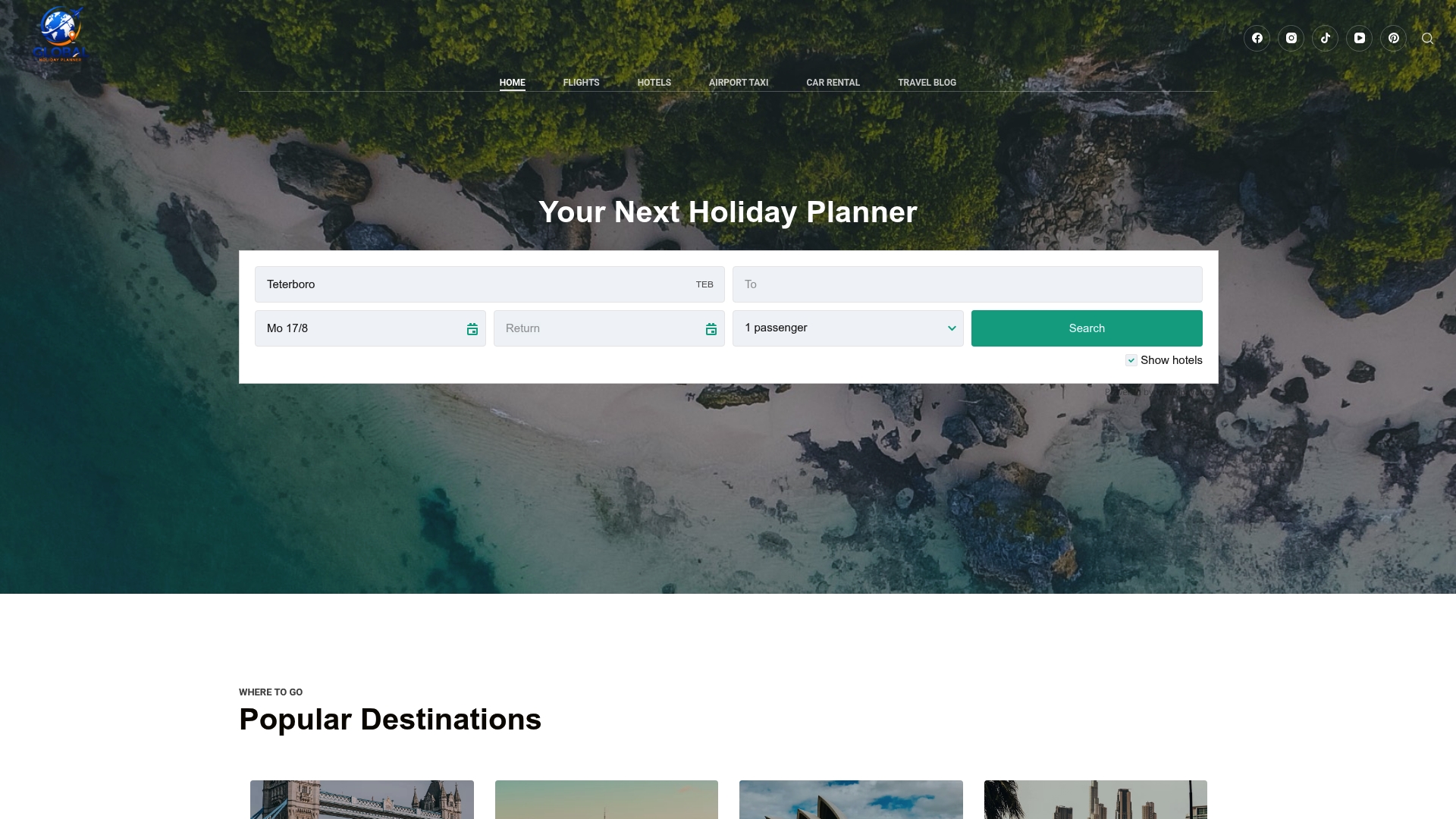
Start on our home page with your route and dates, and compare options for the whole journey side by side.
FAQ
How early should I book high-speed train tickets?
As early as the operator allows, and away from peak times. Low fares are limited in number on many high-speed trains. Eurostar opens 7 to 12 months ahead, and ICE and other Deutsche Bahn trains usually open 180 days ahead. Check the operator’s page for the current window.
Do I need a seat reservation on a high-speed train?
It depends on the train. A reservation is included free on Eurostar, TGV INOUI, OUIGO, TGV Lyria, overnight trains and Trenitalia trains. On ICE it is optional, and costs €6 with Sparpreis or Supersparpreis fares, or nothing with Flexpreis when booked with the ticket, according to SNCB International.
Can I change or cancel a high-speed train ticket?
Only if the fare allows it, and each operator sets its own rules. At JR-Kyushu, for example, online changes and refunds are accepted before ticket collection but not after the reserved train departs. Read the fare conditions before you pay and note any deadline.
Is it better to use the operator’s site or a booking platform?
For one operator and one route, the operator’s site is simple and direct. For trips with several legs or countries, a planner plus separate bookings with each operator, or a platform that combines them, can save effort. Whichever you pick, read the fees and optional extras before you pay.
Sources
- Journey Planner, National Rail
- Travel information service, Deutsche Bahn
- Info about international rail tickets, SNCB International
- How to buy European train tickets 2026, Seat61
- Terms of Use for JR-KYUSHU Train Reservation
- China market regulator on third-party train ticket platforms
- What Is Journey Scheduling?
[…] If you are riding in the U.S., the British method does not map onto how fares are sold, and for most trips you will simply book the through journey. If you are planning rail in Europe or Asia, your better question is usually pass or point-to-point, which our 1.5× rule guide walks through, and how to book fast trains well, covered in our high-speed train booking guide. […]
[…] conditions for each option, not just the headline price. For fast intercity services, our guide to booking high-speed train tickets explains how fare tiers on those routes usually stack […]