

A train refund depends on three things: the fare type you bought, how far ahead of departure you cancel, and whether the operator or you caused the change. Cheap advance fares are often refundable only in a short window or for a fee, while a train that is cancelled or badly delayed usually entitles you to your money back no matter what fare you hold. The smart move is to compare the refund terms along with the price before you pay, which is what we built our rail ticket search to make easy.
TL;DR
- Your refund right comes from the fare rules you accepted at purchase, so read them at checkout, not after plans change.
- If the operator cancels your train, or it runs more than 60 minutes late, European rules give you a full or partial refund, paid within 30 days.
- Fees are real: the UK operator GWR may charge £5, and Deutsche Bahn charges €19 or €30 per ticket once validity begins.
- Free-cancellation windows can be as short as 3 hours after purchase, and the deadline is often the day before travel, not the departure time.
- Always request the refund from the seller you booked with, keep the confirmation, and file the claim before the deadline.
Table of Contents
- The three situations that decide your refund
- Refundable vs. non-refundable train tickets
- Real examples of what operators charge
- When the train is cancelled or late
- How to request a train ticket refund, step by step
- Refund rules for passes and other ground transport
- Protect the trip, not just the ticket
- Our point of view
- Find fares with the terms you need
- Quick checklist before you buy any train ticket
- FAQ
- Sources
The three situations that decide your refund
People search for “train refund policy” in very different moments, and the rules differ for each.
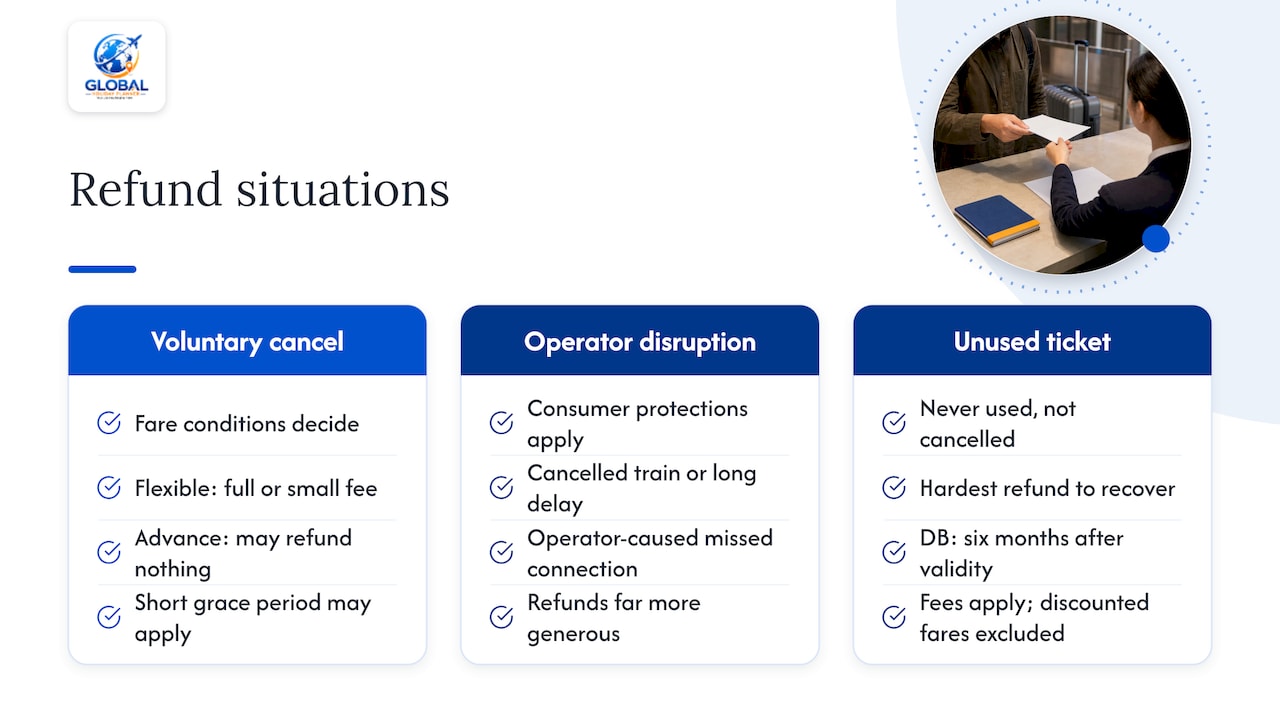
You change your mind. This is a voluntary cancellation. Here the fare conditions rule. A flexible fare may refund in full or minus a small fee, a discounted advance fare may refund nothing, and some operators give a short grace period right after purchase.
The railway changes your trip. A cancelled train, a long delay or a missed connection caused by the operator. This is where consumer-protection rules apply, and refunds are far more generous.
You simply don’t travel. You bought a ticket, never used it and never cancelled. In most systems an unused ticket that you did not cancel before the deadline is the hardest to recover. Some operators still allow reimbursement for a limited period after the validity ends, usually for flexible or standard fares only. Deutsche Bahn, for example, reimburses flexible and standard fare tickets up to six months after the validity period expires, though fees apply. Discounted fares generally are not covered by that kind of late claim.
Knowing which of the three you are in tells you what to ask for and how fast to move.
Refundable vs. non-refundable train tickets
Most operators sell the same seat at several price levels. The difference between them is mostly the refund terms.
| Fare type | Typical price | Typical refund terms |
|---|---|---|
| Flexible or open fare | Highest | Refund or change allowed close to departure, sometimes with a small admin fee |
| Standard fare | Middle | Refund with a fee, or only up to a cutoff such as the day before travel |
| Advance or saver fare | Lowest | Often non-refundable after a short grace period, though a cancelled or delayed train still qualifies you for a refund |
The exact terms are set by each operator, so treat the table as a pattern, not a promise. The reliable habit is to look at the cancellation line next to the price before you book.
Why the cheapest fare is not always the cheapest
Suppose you book a $60 non-refundable fare and a $95 flexible fare for the same trip. If there is a 20% chance your plans change, the flexible fare can be the better value on a trip with a family, a wedding or a business meeting attached to it. If your dates are fixed, the non-refundable fare wins. The point is to decide on purpose.
That is where seeing fares side by side helps. When you book trains online, look at the full fare conditions for each option, not just the headline price. For fast intercity services, our guide to booking high-speed train tickets explains how fare tiers on those routes usually stack up.
Real examples of what operators charge
Rules differ by country, so these examples show the range you may meet abroad. All figures come from the operators’ own pages and can change, so check the current page before you rely on them.
Germany: Deutsche Bahn
For tickets bought through its website or app, Deutsche Bahn allows free cancellation within 3 hours of purchase, as long as it is at least a day before the first day of validity. After that, cancelling a long-distance ICE, IC or EC ticket costs €30 per ticket from the first day of validity, and a local DB Regio ticket costs €19 per ticket.
United Kingdom: Great Western Railway
For tickets bought on or after 1 April 2026, GWR says you must request a refund before 23:59 on the day before the ticket becomes valid. A £5 administration fee may apply unless the train was cancelled or delayed. GWR aims to process refunds within 28 days, and the money can take up to 10 more days to show on your card statement after the confirmation email.
Japan: Shinkansen reservations
Members of the Shinkansen online reservation service can request a refund until the departure time of the first train, subject to the stated conditions. If you have already collected a paper ticket, you must take it to a JR station by the boarding day. During a typhoon or a severe delay or cancellation, refunds are available at no charge, and a collected ticket must be handled at a JR station ticket booth within one year of the boarding date.
Three patterns appear across all three: a free grace period right after you buy, a hard deadline that is often the day before travel, and a fee that jumps once the ticket becomes valid. If you are a U.S. traveler booking rail abroad, assume the deadline is earlier than you would guess.
When the train is cancelled or late
This is where you have the strongest rights, and many travelers never claim them.
The EU rule: refund and compensation are separate
In the European Union, Regulation 2021/782 on rail passengers’ rights has applied since 10 June 2023. If your train is cancelled, or you will arrive more than 60 minutes late at your destination, you can ask for a full refund, or for a partial refund covering the part of the journey you did not make. The refund must be paid within 30 days of the request. The operator may offer vouchers instead, but only if their terms are flexible enough and you agree. The ticket price also cannot be reduced by transaction costs such as fees.
Delay compensation is a second, separate right. Under Article 19, compensation is at least 25% of the ticket price for a delay of 60 to 119 minutes and 50% for 120 minutes or more. It is payable within one month of your request, in money if you ask for it, and a country may set a minimum payout threshold no higher than €4 per ticket.
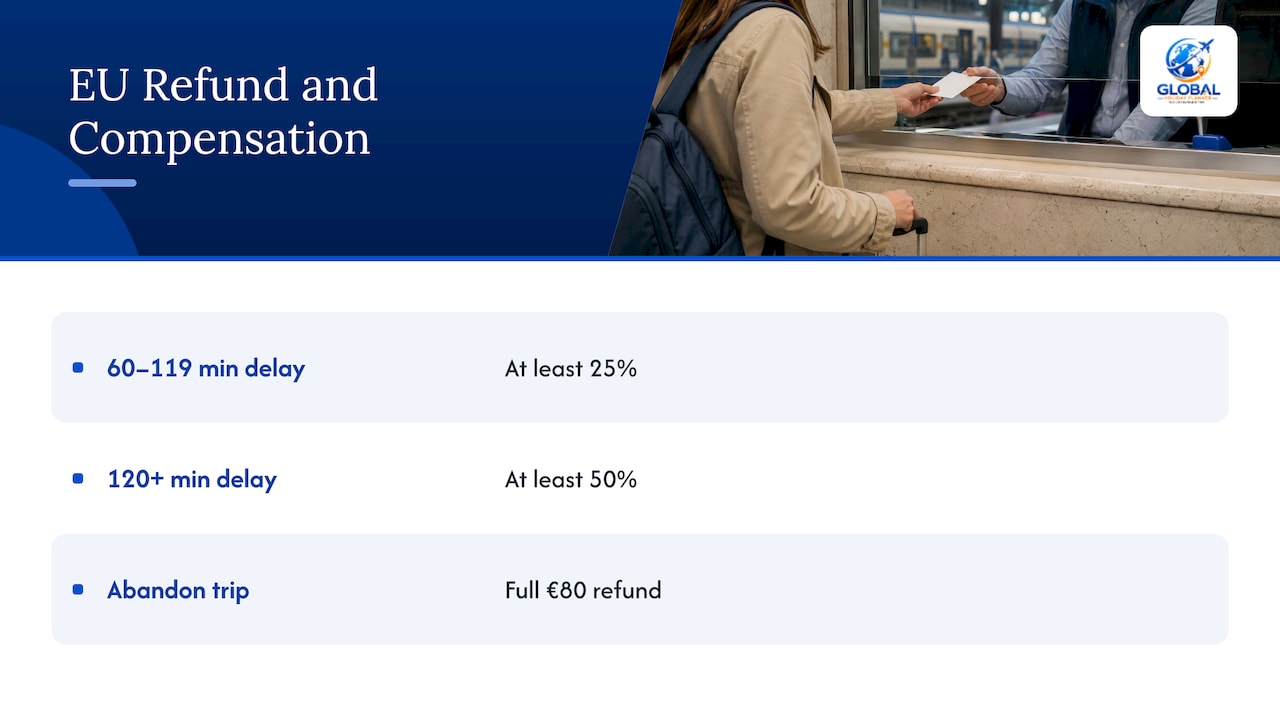
A worked example: you hold a €80 ticket and the train reaches its destination 90 minutes late. You can claim at least 25% of the fare, so €20. If you instead give up the trip because the delay is expected to exceed an hour, you can ask for the full €80 back.
The rule applies to journeys within the EU. For trips outside it, the operator’s own conditions apply.
The Deutsche Bahn version
Deutsche Bahn states that if your train is expected to arrive at least 60 minutes late, you can withdraw from the journey and get the full fare back. If you already travelled part of the route, you get the unused portion. If you broke off the trip and went back, you can get the used and unused portions. In the withdrawal case, the refund goes by bank transfer only, not as a voucher.
Delays in the U.S. and elsewhere
There is no single worldwide rule. Outside the EU and the UK, the operator’s own conditions of carriage usually define what happens after a cancellation or long delay. Before a trip, find the operator’s “conditions of carriage” or “refunds” page and read the sections on cancellations and delays. Screenshot them when you book so you have the terms that applied on your purchase date.
How to request a train ticket refund, step by step
- Find your booking confirmation. It shows the fare type, the seller and the refund conditions you agreed to.
- Check the deadline. Look for the exact time: it may be the day before the ticket becomes valid, not the departure time. A GWR-style cutoff of 23:59 the day before is a good reminder of how early some deadlines fall.
- Use the channel you booked through. A ticket bought online is usually refunded online, in your account or the app. A ticket bought at a station is usually refunded at a station. Paper tickets that were already collected generally need to be returned or presented in person, as the Japanese rules show.
- Choose the right reason. A voluntary cancellation, a cancelled train and a delay are processed differently. Say clearly which applies, and give the train number, date and delay length.
- Ask for money, not a voucher. Where the rules allow vouchers only with your consent, you are free to ask for payment to the original method.
- Save proof. Keep the confirmation email, any screenshots of the delay, and receipts for any extra costs.
- Watch the clock. Operators quote processing times, such as 28 days in the GWR case and 30 days in the EU rule. Allow extra days for your bank to post the credit, then follow up in writing if the deadline passes.
If you are booking several rail legs for one trip, each ticket has its own conditions. That matters most when you split a journey into separate tickets, because a cancellation or missed connection on one leg does not automatically refund the others. Our guide to split ticketing on trains covers when the savings are worth that extra exposure.
Refund rules for passes and other ground transport
Rail passes follow their own conditions, usually tied to the first validity date or activation. If you are weighing a pass against single tickets, our rail pass vs. point-to-point comparison includes the 1.5× rule to help you decide, and the refund terms are one more factor to compare.
Bus, shuttle and transfer services are built on the same cutoff logic as rail, with a refund that shrinks or vanishes as departure approaches. If your trip mixes trains with road transport, it is worth seeing how bus cancellation cutoffs of 24 or 48 hours work, so you can line up your deadlines across the whole itinerary.
Protect the trip, not just the ticket
A refund policy only covers what the operator is obliged to give back. It does not cover a prepaid hotel, a rental car or a golf tee time that you lose when a train falls through. For a trip with several nonrefundable pieces, travel insurance is the layer that sits above any single ticket. Policies differ in what reasons they accept and what they reimburse, so read the cancellation terms against your own trip. Our guide to whether travel insurance is worth it for U.S. travelers walks through how to map those risks.
If a hotel is the nonrefundable part, there is a process for that too: see our 5-step refund script for nonrefundable hotel bookings. And if flights are in the mix, the 24 hour flight cancellation rule explains the grace period U.S. travelers get on air tickets.
Our point of view
Most refund disputes start at checkout, not at the ticket office. Travelers compare price, time and seat class, then accept whatever cancellation terms come attached. By the time plans change, the decision has already been made.
Our view is that the refund line deserves the same attention as the fare. We built our platform around side-by-side cost and feature comparisons for flights, hotels, car rentals, rail tickets, transfers and travel insurance, so you can see the real total cost and the best fit for your itinerary in one place. For a family with three generations travelling together, a couple planning a romantic trip or a business traveler with a fixed meeting, the right fare is not always the lowest one. It is the one whose terms match how certain your plans are.
Compare the conditions, pick the fare that fits your risk, and keep every deadline in your calendar.
Global
Find fares with the terms you need
When you are ready to book, our platform lets you compare rail tickets alongside flights, hotels, car rentals, airport transfers and travel insurance in one place, with scenario-based recommendations for different trip types. Start with the rail tickets on Global Holiday Planner and read the fare conditions for each option before you choose.

Building a longer itinerary? You can also line up flights, hotels and airport transfers in the same session, so your cancellation deadlines are visible together.
Quick checklist before you buy any train ticket
- Is the fare refundable, partly refundable or not at all?
- What is the deadline, and is it a date or a time on the day before travel?
- Is there a free cancellation window after purchase, and how long is it?
- What fee applies, and does it change once the ticket becomes valid?
- Is the refund paid in money or as a voucher?
- What happens if the operator cancels or the train is more than an hour late?
- Are other bookings on the trip tied to this ticket?
FAQ
Will I get a full refund if my train is cancelled?
Under EU rules, yes: if your train is cancelled or you will arrive more than 60 minutes late, you can ask for a full refund, or a partial refund for the part of the trip you did not make. It must be paid within 30 days of the request. Outside the EU, check the operator’s conditions of carriage, because the rules differ by country.
What happens if I buy a train ticket and don’t use it?
That depends on the fare. Flexible and standard fares are sometimes reimbursable for a limited time after validity ends, as Deutsche Bahn allows for up to six months, usually with a fee. Discounted fares are often forfeited, so cancel before the deadline if your plans change.
Are refundable train tickets worth the extra cost?
They are worth it when your plans are uncertain, such as a trip tied to an event, a family gathering or a work meeting. Compare the price gap with the fee you would pay to cancel a cheaper ticket. If your dates are fixed, the cheaper fare usually makes more sense.
How long does a train refund take?
Operators quote their own timelines. GWR aims to process refunds within 28 days, and the credit can take up to 10 days more to reach your statement. The EU rule requires payment within 30 days of the request for refunds and within one month for delay compensation.
Sources
- Regulation (EU) 2021/782 on rail passengers’ rights (full text)
- Regulation (EU) 2021/782, Article 19 delay compensation
- Deutsche Bahn: exchanging or cancelling tickets or reservations
- GWR: train ticket refunds
- Shinkansen Reservation Guide: refund reservations
- Bus cancellation cutoffs of 24 or 48 hours