
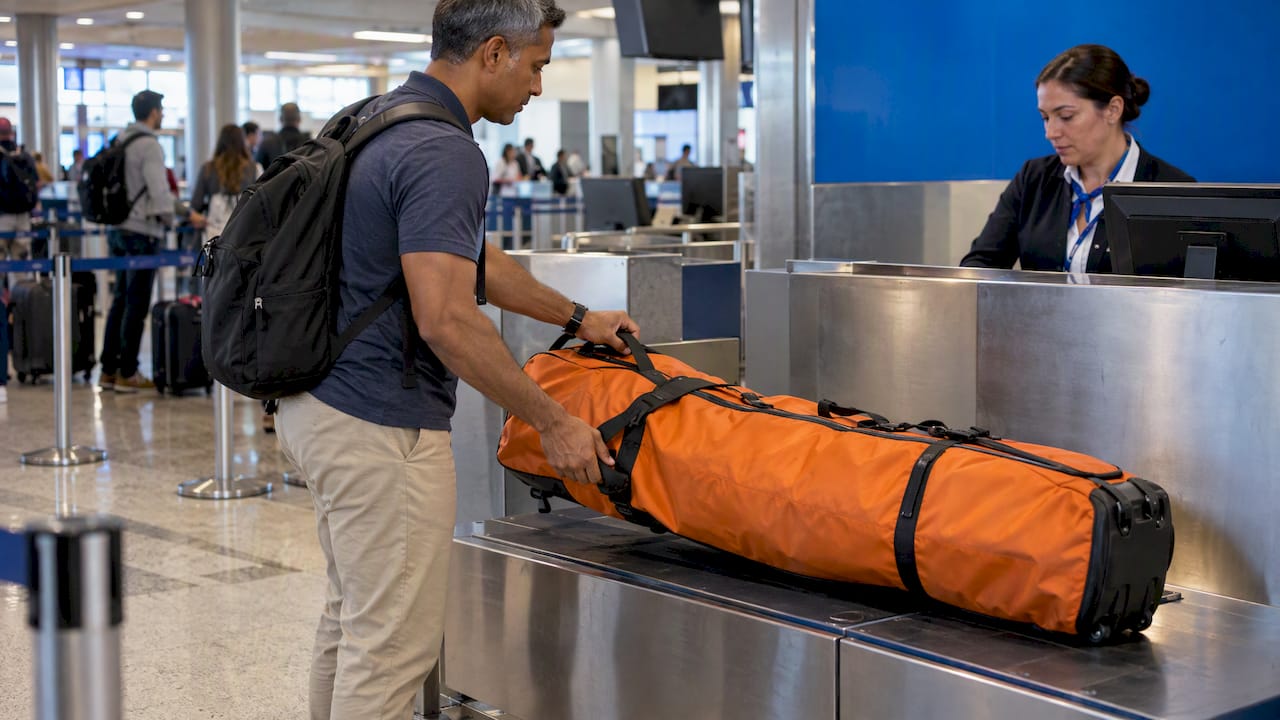
Golf travel insurance is a regular travel policy with extra protection for the things that make a golf trip different: your clubs, your prepaid tee times and green fees, and sometimes the cost of renting replacement gear. The core cover (emergency medical care, trip cancellation, baggage) comes from the base policy. The golf-specific part is usually an add-on, so the work is in reading what that add-on actually lists.
TL;DR
- Golf travel insurance is trip insurance plus golf extras. Medical and cancellation cover come from the base plan, while equipment and green fee cover is often an optional add-on.
- Insurers generally treat golf as a low-risk activity, so injuries on the course are rarely the issue. Forbes Advisor notes that protection for the gear itself is often the optional part.
- Before you buy, check four things: the per-item limit for clubs, what happens when a bag is delayed, whether prepaid green fees are refundable, and what the plan excludes (unattended gear, alcohol, undisclosed conditions).
- Buy when you book the trip, not the week before. Some benefits only work if you buy before a problem appears.
- Put every prepaid piece on one list: flights, hotel, rental car, tee times. Then match the cover to the list.
Table of Contents
- What golf travel insurance actually is
- Protecting your clubs: the part most golfers underestimate
- Prepaid green fees, tee times and golf packages
- The rest of the policy: medical, repatriation and baggage
- Do your credit card and existing policies already cover this?
- How to choose a golf travel policy: a short method
- When to buy and what to keep for a claim
- What we think about golf trip protection
- Plan the whole golf trip in one place
- FAQ
- Sources
What golf travel insurance actually is
Think of a golf trip as a normal vacation with a few expensive, easily damaged or easily lost extras. A standard travel policy is built around the traveler: your medical bills abroad, a canceled flight, a lost suitcase. Golf cover adds the sport’s own exposures.
In practice that means a plan, or an add-on to a plan, that can include:
- Equipment cover: clubs, bag, trolley or push cart and shoes, against loss, theft or damage.
- Delayed equipment cover: money toward renting clubs if the airline holds your bag.
- Green fee and tee time cover: reimbursement of prepaid, non-refundable fees when a covered event forces you to cancel or cut the trip short.
- Personal liability: protection if you injure someone or damage property while playing.
- Extras: some policies abroad even mention a hole-in-one bar tab, which tells you how much these plans vary.
The variation is the point. Two products both labeled “golf travel insurance” can differ sharply in what they list, so the label alone tells you very little. The same Forbes Advisor piece makes the broader point: medical treatment for a course injury is usually included as standard, while covering the equipment is commonly a paid extra.
How it differs from regular travel insurance
Regular travel insurance does not ignore your clubs, but it often treats them like any other baggage. That can mean a modest overall baggage limit, a cap on any single item, and conditions about how the bag was left. A set of clubs, a rangefinder and a good driver can exceed those numbers fast.
Golf-specific cover raises or separates those limits and adds the pieces regular plans don’t think about, such as rental clubs and tee times. If your trip is a long weekend with rented clubs at the resort, a regular plan may be enough. If you fly with your own bag to play prepaid rounds, the add-on starts to earn its price.
Note that this is different from a standalone annual golf policy sold to members, which mainly covers clubs and golf liability year-round and has nothing to do with a trip. For travel, you want the trip-based kind.
Protecting your clubs: the part most golfers underestimate
Clubs are the most common reason people start searching for this. Airlines lose, delay and damage golf bags, and you may be traveling with several thousand dollars of equipment in a soft or hard case.
A useful golf equipment benefit should answer these questions in writing:
- Which items count? Clubs, bag, trolley and shoes are the usual list. Check whether a rangefinder, GPS watch or electric cart is included.
- What is the total limit, and what is the limit per item? A policy can have a decent overall number but a low cap on any single club or bag. A single driver can cost several hundred dollars.
- Are loss, theft, damage and delay all covered? Some plans cover loss and theft but handle a delayed bag only through a separate benefit.
- Is there a delayed bag trigger? Plans often pay for replacement rental after a waiting period of several hours. Read the number of hours and the daily rental cap.
- How is value paid? Replacement cost and depreciated value can produce very different payouts.
Typical exclusions to read before you buy
The research across insurer documents points to the same recurring conditions:
- Unattended equipment. If clubs are left unwatched in a public place, a claim may be denied.
- Vehicles. Loss from an unattended car is often excluded unless the items were stored in a secure, out-of-sight compartment such as a locked trunk.
- Alcohol or drugs. Loss or damage linked to intoxication is a common exclusion.
- Wear and tear. A shaft that fails from age is not an insurable event.
- Carelessness. Leaving a bag on the course while you went inside can be treated as carelessness.
None of these is hard to follow. They simply decide whether a claim is paid, so build them into your trip habits. Keep the bag with you in the terminal, lock it in the trunk rather than the back seat, and keep receipts or photos of the gear before you leave.
Shipping versus flying with your clubs
Many golfers ship their clubs ahead with a specialist carrier, which comes with its own transit protection. Whether you ship or fly, the principle is the same: know who is responsible at each stage, and know what your travel policy adds on top. If you do fly with the bag, take a photo of the clubs and the case before check-in and keep your baggage claim tag until the clubs are back in your hands.
Prepaid green fees, tee times and golf packages
On a golf trip, your biggest nonrefundable costs are often not the flight. They are the resort package, the tee times at a famous course, the caddie, and the lodging attached to the course.
Cover for these costs normally works through the trip cancellation and trip interruption parts of the policy, with the golf add-on listing green fees as a protected item. A typical logic is that if you cannot travel or must return early because of a covered reason, such as sudden illness, injury or a family emergency, you can claim prepaid costs that you cannot get back from the provider. Weather and course closures are the grey zone. Some plans address them; many do not. If rain-outs worry you, find the exact wording before paying.
The Maryland Insurance Administration describes trip cancellation insurance as covering nonrefundable prepaid expenses when you cannot travel because of illness or death, weather, or a tour operator’s default or bankruptcy. It also warns that cancellation waivers offered by tour operators are not insurance and are not regulated, so read their terms thoroughly. On a golf package sold by a tour operator, that warning matters: a waiver and a policy are different products.
Cancellation versus interruption
These are two separate benefits and golfers often mix them up. Cancellation applies before you leave; interruption applies once you are on the trip and have to cut it short or miss part of it. Each has its own triggers and limits. Our checklist on trip cancellation versus interruption walks through how to tell which one you need.
If you want the freedom to cancel for any reason
Standard cancellation cover only pays for listed reasons. Golfers planning a big trip with friends often want more flexibility, and that is the job of an optional upgrade known as cancel for any reason cover. It usually has strict purchase timing and reimburses only part of your costs, so see how cancel for any reason insurance breaks even before assuming it is worth the extra premium.
Hotels and lodging that are already nonrefundable
Resort lodging is often prepaid. If a stay is already nonrefundable, insurance may be only one path to your money. Our 5 step refund script for nonrefundable hotel bookings shows what to ask the property before you file anything, and this guide on winning a hotel cancellation refund with proof shows how documentation can strengthen a refund request.
The rest of the policy: medical, repatriation and baggage
The golf extras get the attention, but the base policy does the heavy lifting if something serious happens. Forbes Advisor lists the usual golf-trip contents as emergency medical expenses, repatriation, trip cancellation or curtailment and baggage cover, with optional equipment hire and liability.
Three base-policy points deserve attention:
- Emergency medical limits. A round of golf is a long walk in heat, sun and uneven ground. If you are headed abroad, confirm that the medical limit is high enough for the country, because your regular health insurance may offer little or no cover outside the U.S.
- Medical evacuation and repatriation. This is the benefit that pays to move you to better care or home when the insurer’s assistance service judges it medically necessary. Policies commonly require you to contact that service early, often when you are admitted to hospital or when treatment will be costly. Save the assistance number in your phone before you travel.
- Pre-existing conditions. Conditions not declared, or not accepted by the insurer, are commonly excluded. If you have a heart condition, a bad back or a joint replacement, read our guide to pre-existing conditions travel insurance before you buy, and ask about the purchase window for waivers.
One more point on timing: claims generally depend on you not knowing about the disrupting circumstance when you bought the policy. A sore elbow that flares up a week before departure is a different claim from an elbow you had treated before buying.
Do your credit card and existing policies already cover this?
Many golfers assume a premium card covers the trip. Some card benefits do include trip delay, baggage or cancellation protection, but they come with caps and conditions, and golf equipment or green fees may not fit neatly in them. Check three things: whether the benefit is primary or secondary, the per-item cap on baggage, and whether you paid the full trip with that card.
Our pages on credit card travel insurance caps and on choosing travel insurance or card coverage will help you make that comparison with your own numbers. If you are still weighing whether to insure at all, map your trip risk first.
How to choose a golf travel policy: a short method
You can do this in about twenty minutes with your booking confirmations in front of you.
- Add up what is prepaid and nonrefundable. Flights, lodging, rental car, package fees, tee times, caddies. This total is your trip cost, and it sets the cancellation limit you need.
- Value your gear. Estimate the replacement cost of clubs, bag, shoes and any devices. Compare that with the per-item and total equipment limits.
- Decide who is traveling. A group trip raises the stakes: one person’s cancellation can ripple into the whole booking. If you organize groups, see our group flight playbook and make sure each traveler has their own policy.
- Check the destination. Remote courses far from hospitals make the medical and evacuation benefits more important.
- Read the exclusions. Unattended gear, alcohol, undisclosed conditions, and unattended vehicles are the common ones.
- Confirm the golf cover is shown on your documents. In some policy documents the golf benefit is available for an additional premium and must appear on the certificate or schedule. If it is not on the paperwork, assume it is not there.
- Compare at least a few plans side by side. Our comparison of travel insurance plans shows how to line up benefits instead of just price.
A quick worked example
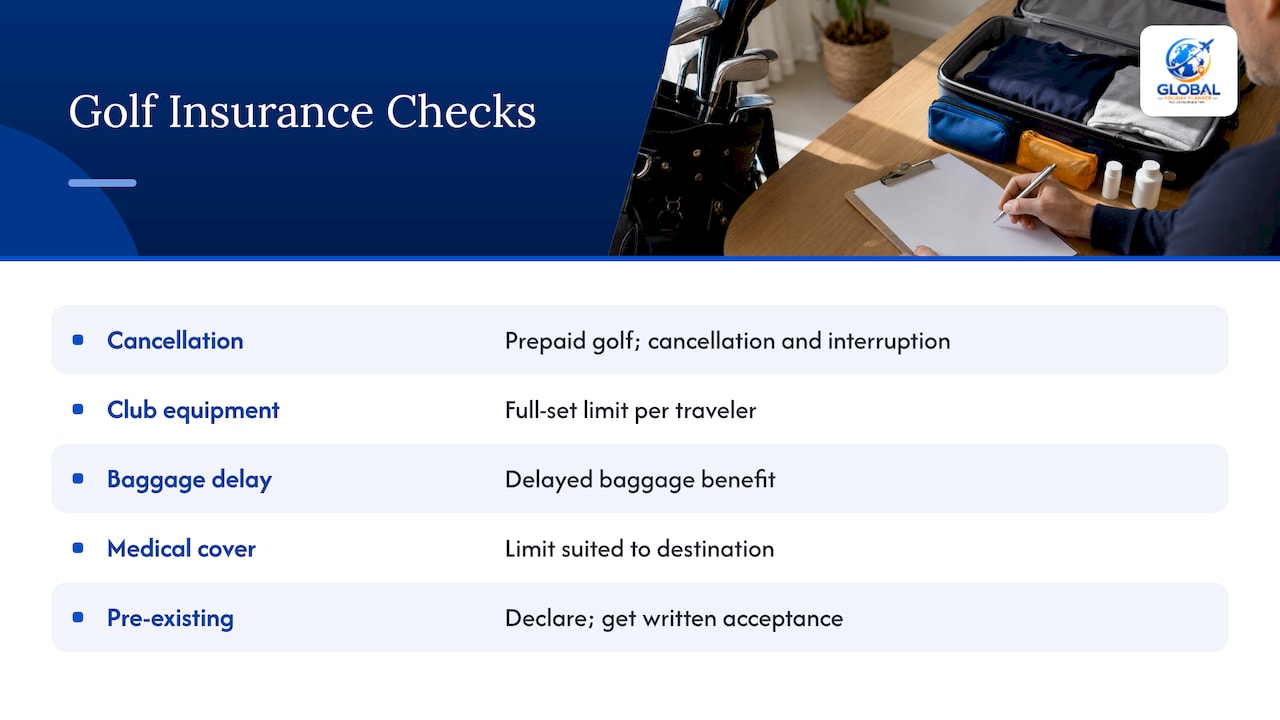
Say you and three friends are flying to a coastal resort for five rounds. Everyone pays separately for flights, and one person books the resort package. Your list shows flights, a four-night stay, a rental car and prepaid tee times. Each person also carries a set of clubs. Your needs, then, are cancellation and interruption cover that includes prepaid golf, an equipment limit that covers a full set per traveler, a delayed baggage benefit, and a medical limit suited to the destination. If one friend has a pre-existing condition, that person should declare it and confirm acceptance in writing. This is a checklist, not a quote; the specific numbers come from the plan documents you are comparing.
When to buy and what to keep for a claim
Buy soon after your first big payment. Coverage for trip cancellation generally starts at purchase, and upgrade options can have time-limited windows after your first deposit. Waiting until the week before leaves you uninsured against anything that happens in the meantime, and anything known before purchase is typically excluded.
Keep a claim folder from the start, on your phone and in the cloud:
- Booking confirmations and receipts for green fees, lodging and flights
- Proof the fees are nonrefundable (the provider’s written policy or a denial of refund)
- Photos of your clubs and their case before departure, with purchase receipts if you have them
- The airline’s written report for a lost, delayed or damaged bag
- A police report for theft, filed where it happened
- Medical records and itemized bills for any treatment
For medical events, call the insurer’s emergency assistance line as early as you can, especially for hospital admission or costly treatment. Late contact is a common reason for reduced payouts.
What we think about golf trip protection
Golf trips are unusual because the money is spread across many separate bookings: air, lodging, car, transfers and tee times. Most travelers only discover the gaps when something goes wrong.
That is why we built Global Holiday Planner around side-by-side comparison. When flights, hotels, car rentals, transfers and insurance sit in one place, you can see the real total of the trip and decide what deserves protection. Our approach is scenario-based: a golf group, a couple’s getaway and a family vacation each need a different mix of cover.
Our advice is simple. List what you have paid, compare plans against that list, and buy cover when you book rather than when you worry.
Global
Plan the whole golf trip in one place
Your insurance should match the rest of the trip, so it helps to book the pieces side by side. On Global Holiday Planner you can compare flights, hotels, car rentals and airport transfers, and add travel insurance from our main page, so the numbers you protect are the numbers you actually paid.
If your group needs a lot of seats or a long transfer from the airport to the course, book those early and let your insurance list follow.
FAQ
Does regular travel insurance cover golf clubs?
Often only as ordinary baggage, with an overall limit and a cap per item that may not match a full set. Golf-specific cover usually raises these limits and adds delayed equipment hire. Check the per-item cap and the exclusions on unattended gear before assuming your clubs are protected.
Will golf trip insurance refund prepaid green fees?
It can, when a covered reason such as sudden illness or injury forces you to cancel or cut the trip short and the fees cannot be recovered elsewhere. Weather and course closures are less consistent between plans. Read how your plan words them and keep proof that the fees were nonrefundable.
Is playing golf a risky activity for insurers?
Insurers generally see golf as low risk, so medical treatment for common course injuries is usually included as standard, according to Forbes Advisor. The extra cost typically comes from protecting equipment, not from the sport itself.
Should I buy cover now or closer to departure?
Buy shortly after you make your first major prepayment. Cover for cancellation depends on events happening after purchase, and anything you already knew about is typically excluded. Some upgrades also have a short purchase window.
Do I need separate insurance for each person in the group?
Each traveler should have their own policy or be named on one, because medical history, gear values and prepaid costs differ. This also keeps one person’s claim from affecting everyone else.
Sources
- Forbes Advisor: Golf Travel Insurance
- Maryland Insurance Administration: Travel insurance types and consumer FAQs