
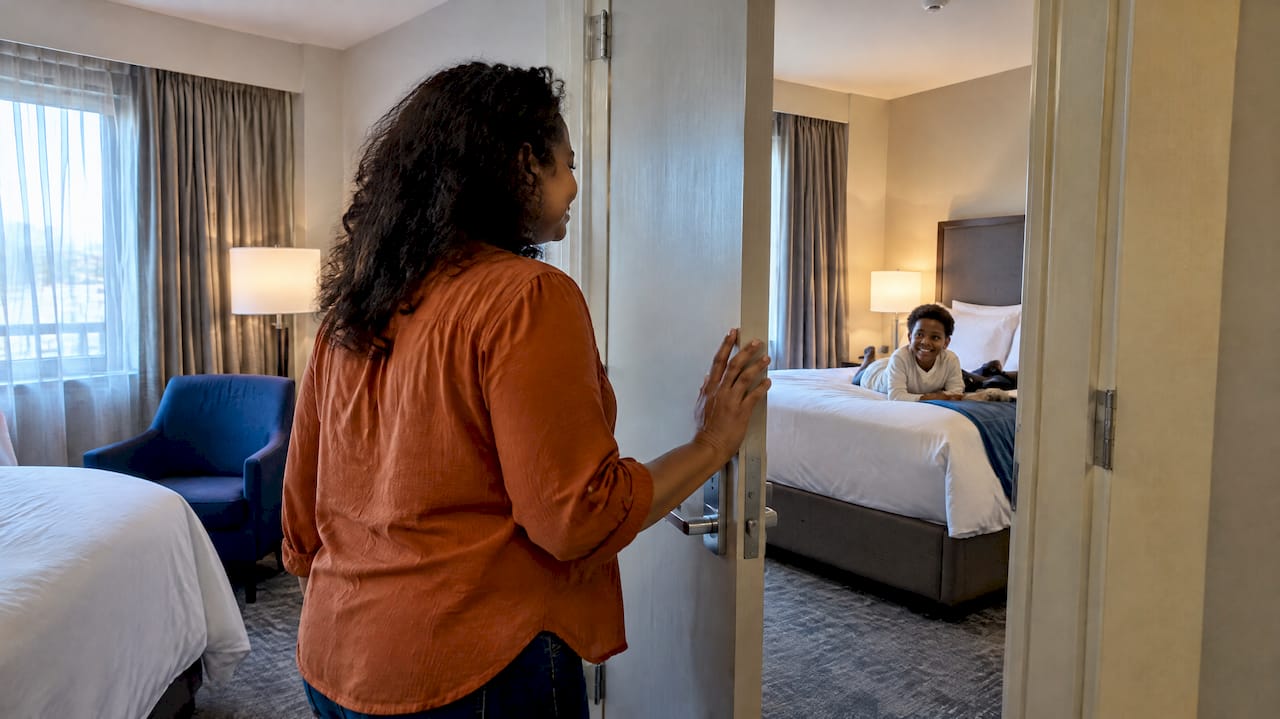
Connecting rooms are two hotel rooms joined by an interior door, so your group can move between them without stepping into the hallway. Most hotels offer them, but only a few sell them as a guaranteed product. At everywhere else, a “connecting room” on your reservation is a request, not a promise. This guide shows you how to tell the difference, where to book, what to ask, and what to do if the door isn’t there when you arrive.
TL;DR
- Connecting rooms share a private interior door. Adjoining rooms may or may not have one. Adjacent rooms are simply near each other.
- Hotels hold few connected rooms, usually under 10 percent of inventory, so they go fast.
- A guarantee exists only when the hotel’s system sells it as a product. Everywhere else you are making a request.
- Book directly with the hotel or chain when the door matters, then confirm in writing and call again on check-in day.
- Have a backup: a suite, two rooms on the same floor, or a vacation rental.
Table of Contents
- Connecting, adjoining and adjacent rooms: what the words mean
- Do hotels still offer connecting rooms?
- Guaranteed or just requested: the difference that matters
- How to book connecting rooms, step by step
- Which booking channel works best
- What to check in your confirmation
- Costs to expect
- If connecting rooms aren’t available
- Safety and supervision
- Our perspective
- Plan the whole family trip in one place
- FAQ
- Sources
Connecting, adjoining and adjacent rooms: what the words mean
The three terms are used loosely, and that is where most booking mistakes start. Here is the practical version.
| Term | What you get | Interior door? | Private access between rooms? |
|---|---|---|---|
| Connecting | Two (or more) rooms side by side | Yes, a lockable door | Yes |
| Adjoining | Rooms that share a wall; some hotels use it as a synonym for connecting | Sometimes | Only if the hotel means “connecting” |
| Adjacent | Rooms close together, often across the hall or down the corridor | No | No |
The confusion is real. Frommer’s notes that hotels commonly say “adjoining” for independent rooms linked by an interior door, and that once the door is unlocked, guests can pass between rooms without using the public corridor. Other properties use “adjoining” for rooms that merely touch at a wall. Because the vocabulary isn’t standard, never assume. Ask the hotel: “Is there a door between the two rooms that we can open from either side?”
A connecting door is normally locked on both sides. Each room has its own lock, so you keep privacy until both sides choose to open it. That is the point for families: parents can leave the door open while kids are awake and close it when they want quiet.
What this means for “adjoining vs connecting” searches
If a listing says “adjoining rooms,” treat it as “possibly connecting” and get the detail in writing. If a listing says “connecting,” it should mean a door. If it says “adjacent,” or “rooms together,” expect no door at all, and be glad if they are at least on the same floor.
Do hotels still offer connecting rooms?
Yes, but in limited numbers. Frommer’s reports that hotels typically have a small share of connected rooms, usually less than 10 percent of their total rooms. The shortage is worst in city-center, historic and older properties that were never built with interior doors. A newer suburban or resort property is more likely to have them than a boutique hotel in a converted townhouse.
That scarcity shapes everything else in this guide. Connecting rooms sell out because the same few pairs suit families, groups of friends, colleagues traveling together and multi-generational trips. When a hotel looks full for a holiday weekend, its connecting pairs are usually the first to go.
The typical request is modest. Most guests want two rooms linked, sometimes three. Some systems can link far more for unusual layouts, but you should plan around two or three rooms unless the hotel tells you otherwise.
Room types you may see
Hotels package connected inventory in different ways:
- Two standard rooms with a door. Usually two queens or a king plus a queen-queen. This is the classic family setup.
- A suite with a separate bedroom. One door, one booking, often more space. It isn’t a connecting pair, but it solves the same problem.
- Family or interconnecting room types. Some hotels, especially in Europe and Asia, publish a guide to which room categories pair up with which. Check the hotel’s own room pages before you pick categories, because only certain pairings link.
- Apartment-style or extended-stay layouts. Often two bedrooms with a shared living space, sold as one unit.
If you’re deciding between a connecting pair and a suite, read our five-step comparison of hotels and vacation rentals, which covers when extra space under one lock beats two rooms.
Guaranteed or just requested: the difference that matters
This is the part most guides skip over. When you book a hotel room, the booking confirms a room type on a date. It does not automatically confirm which room number. Door connections are tied to physical room numbers, and those are normally assigned close to arrival. So a note saying “connecting rooms requested” tells the front desk what you’d like. It does not reserve a specific pair.
There are two scenarios.
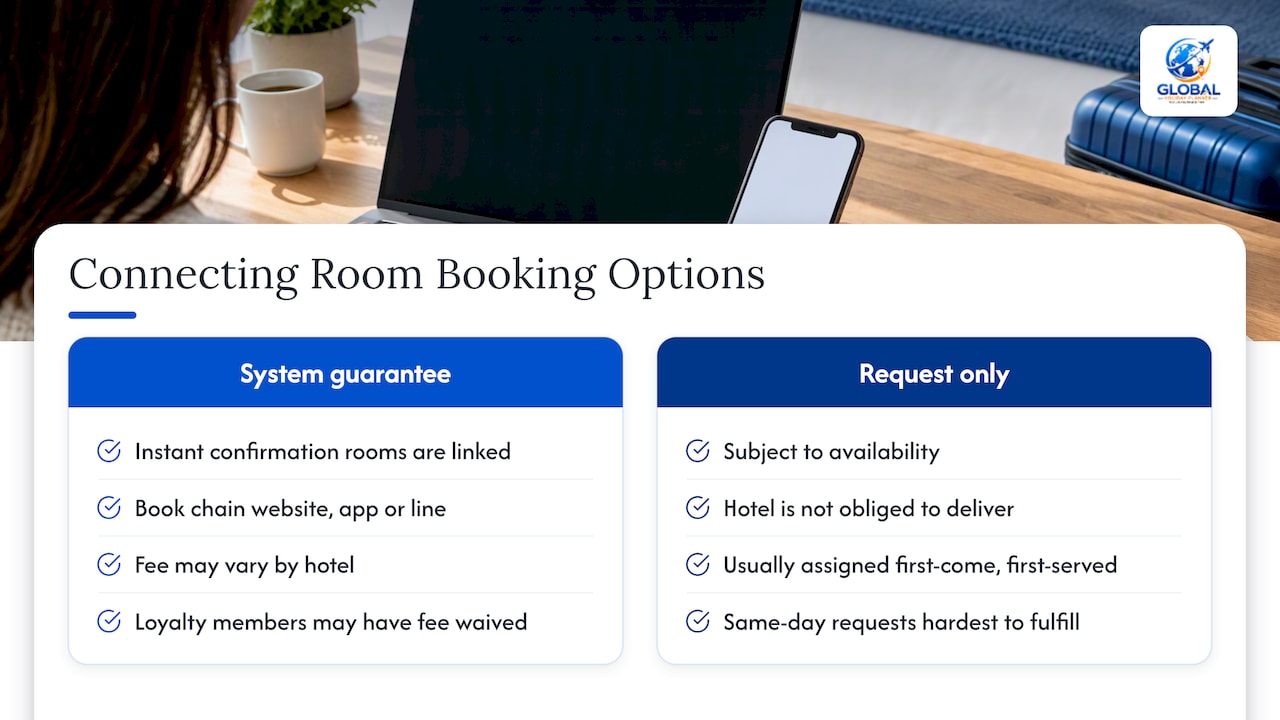
1. System-level guarantee. A few large chains have built connecting rooms into their booking engines. You pick two rooms that are known to connect, pay for both, and receive an instant confirmation that they are linked. Some of these programs add a fee, and the fee can differ by hotel. Some waive it for loyalty members who are logged in when they book. The guarantee generally applies only when you book on the chain’s own website, app or reservation line. Policies and fees change, so read the terms on the hotel’s current page before you rely on them.
2. Request only. Most other hotels treat connecting rooms as a special request, subject to availability. You can enter it in the notes at booking, but the hotel is not obliged to deliver. The Points Guy explains that connecting rooms are generally assigned on a first-come, first-served basis, and same-day requests are the hardest to fulfill.
A Miami hotel manager quoted by Frommer’s draws a useful line: adjacent rooms are almost always possible, while adjoining rooms depend on what is open on the day you check in. That’s an honest summary of how it works on the ground. If your trip would be seriously disrupted without a door, for example when young children need a parent within earshot, choose a product with a real guarantee or book a layout that doesn’t depend on one.
How to book connecting rooms, step by step
- Decide how many rooms and which beds. Write down who sleeps where. “Two queens plus a king” is more useful to a hotel than “a family room.” Hotels that match beds to guests have fewer reasons to say no.
- Look for a guarantee first. On the hotel’s own site, check whether there is a connecting-room option in the booking flow. If there is, use it. You will see the rooms and rate before you pay.
- If there is none, book the two rooms anyway. Reserve the two room types you want in a single reservation, or two linked reservations, so they are on the same dates.
- Add the request at booking. Use the special-requests field: “Two connecting rooms, please, with a door between them. Not adjacent.”
- Call the hotel directly. Don’t rely on the central reservation number alone. Ask for the front desk or reservations team at the property, and ask them to note the request against both bookings.
- Get it in writing. Ask for an email that says the rooms are assigned or guaranteed to connect, with the bed types listed. A phone promise is easy to lose between shifts.
- Follow up. The Points Guy recommends calling again after you book and once more on the day you check in. Do both. On arrival day, front desks assign rooms, and a friendly call that morning often decides the outcome.
- Have your details ready. Multi-room reservations may ask for names and ages of children, so keep them to hand.
Timing
Book early, and book the connecting pair before you book flights if your dates are flexible. Connecting inventory is tiny, so it drives the dates more than airfare does. Our short guide on whether to book flights or the hotel first explains the rule we use. If you’re arriving early after a long flight, the tips for getting early hotel check-in also help you secure rooms before the front desk reassigns them.
Which booking channel works best
The channel you book through matters more than most travelers expect.
- Booking direct with the hotel or chain gives you the best chance of a guarantee, because the connecting product, where one exists, lives in the hotel’s own system. Hotels can also see and annotate your reservation with no middleman.
- Third-party sites usually pass a request along but rarely promise a result. If you book there, treat the request as unconfirmed and contact the hotel directly after you book.
- Specialist family booking sites curate suites and multi-room layouts and confirm them as part of the stay. They can be a useful route for a hotel that won’t guarantee a door.
- Phone bookings are often best for three or more rooms, unusual bed combinations or children with specific needs. An agent can see the room map.
At Global Holiday Planner we compare hotel options side by side so you can see room types, cancellation terms and total cost before you decide. Once you’ve found the property, confirm the connecting detail with the hotel itself. Don’t assume a comparison page, ours included, can promise a door. Use our hotel search to shortlist properties, then follow the steps above.
Also check the payment terms. If you book connecting rooms on a prepaid rate and the hotel then can’t deliver, you may be locked in. Our math rule for prepaid versus pay-at-hotel rates helps you decide when a discount is worth the flexibility you give up. For connecting rooms, a refundable rate is often worth a little extra until the door is confirmed.
What to check in your confirmation
Before you consider the booking safe, look for these lines:
- The room types for both rooms, with bed configurations.
- The words “connecting” or “interconnecting” (not just “adjacent” or “near”).
- Whether both rooms are on one reservation or two, and whose name each is under.
- Any fee per night for the connecting feature, and whether it is included in the total.
- The cancellation terms for each room. If one room is cancelled, does the other stay?
- Occupancy limits: each room has its own cap on guests, and the door doesn’t change it.
If any of that is missing, email the hotel and ask. If the answer is vague, treat the rooms as a request and plan accordingly.
Costs to expect
Connecting rooms are priced like two ordinary rooms, since you are booking two rooms. Where a chain sells a guaranteed connecting product, there may be a per-night surcharge or a higher rate for the confirmed inventory, and the amount differs by hotel and brand. We can’t quote a general figure, because it isn’t one number. Check the rate and any fee on the hotel’s own booking page for your dates.
Two rooms usually cost more than one suite. That’s the trade-off: two rooms with a door give you separate bathrooms and bed pairs, while a suite gives you shared space at a lower total in many cases. Compare the totals, including taxes and resort fees, before you decide. Our guide to hotel star ratings helps you check that the quality level matches what you’re paying for.
If connecting rooms aren’t available
The hotel may call or write to say the pair isn’t there. Or you might arrive and find rooms on opposite sides of the building. Here is a sequence that works.
- Ask for the next best layout: two rooms on the same floor, side by side, or across the hall. Adjacent rooms are far easier for a hotel to give than doors.
- Ask about a suite or a two-bedroom unit. Many hotels hold a few and will move you if you ask politely and early.
- Ask about a swap. If a connecting pair opens up after a cancellation, can you be moved? Request that the desk note it.
- Ask for a floor and corridor plan if you are traveling with small children, so you can pick rooms with a shared route to the elevator and no stairs.
- Switch properties early if the hotel can’t help. It is much easier to rebook a week before than on arrival night.
If the stay is built around a theme park or a big event, look at lodging types beyond the standard hotel. A guide to family-friendly hotels near Disneyland shows how families in that area compare their options, which is useful when connecting inventory is thin.
For larger groups, say 10 or more people, the logic changes. You’ll want a group block with the hotel and an agreed room list. Our group flight playbook covers how organizers lock seats, and the same approach of one point of contact and early commitment carries over to rooms. If you’re moving the whole group from the airport, check airport transfers with a car seat so the youngest travelers arrive safely too.
When a vacation rental is the better fit
If you need three bedrooms, a kitchen or a shared living space for grandparents, parents and kids, a rental or apartment-style suite may work better than a pair of doors. It’s a different product with different rules on cleaning fees and check-in. The hotel versus vacation rental checklist walks through that choice.
Safety and supervision
If your plan depends on being able to reach a child at night, don’t treat the door as a certainty. Pick a product with an explicit guarantee, or choose a suite with a separate bedroom. Also ask whether the connecting door locks from both sides, and keep it locked when it should be. Hotels vary in how they handle the door lock, so ask what it looks like in your room. A hotel that cannot guarantee a pair should say so plainly, and you can then decide before you travel rather than at midnight in the lobby.
Our perspective
We built Global Holiday Planner around one idea: people shouldn’t have to piece a trip together from ten tabs. For connecting rooms, that idea matters more than usual, because the right answer depends on the whole trip, not just the room.
A guaranteed pair at a slightly higher rate can be a better deal than a cheaper room that falls through on arrival night. The reverse is also true: when a suite with a separate bedroom costs less than two rooms, it may be the smarter pick. We think families should see those totals side by side, including taxes, fees, cancellation terms and transfers, before they commit.
Our comparison tools are designed to put hotels, flights, car rentals and transfers in one place, with recommendations that fit the kind of trip you are taking, whether that’s a family reunion, a romantic weekend or a business trip. Use them to shortlist properties, then lock down the connecting detail directly with the hotel. That combination gives you the best chance of a calm arrival.
Global
Plan the whole family trip in one place
Once you know which hotel and layout you want, the rest of the trip should be easy. Global Holiday Planner lets you compare hotels, flights, car rentals and airport transfers together, so you can see the real total for your group before you book. Start with our hotel reservations page to shortlist family-friendly properties, then add flights and a ride from the airport.

If your group is landing late with luggage and children, airport transfers are worth booking before you leave, so you aren’t hunting for a vehicle large enough for everyone.
FAQ
What are hotels with connecting rooms called?
There is no single name. Hotels use “connecting,” “interconnecting,” “adjoining” and “family rooms” for rooms that link through an interior door, and “adjacent” for rooms that are only nearby. Search for connecting or adjoining rooms and confirm the door with the hotel.
Do hotels have connecting rooms anymore?
Yes, but only a small share of rooms are built that way, usually under 10 percent, and older city properties often have none. Newer hotels, resorts and family-oriented brands are the likeliest to have them. Book early, because they sell out first.
What is the difference between adjoining and connecting rooms?
Connecting rooms have a door between them that you can unlock from inside. Adjoining rooms share a wall, and some hotels use the word to mean connecting too. Ask whether there is a door between the rooms rather than relying on either word.
How do I guarantee connecting rooms?
Use a booking flow that sells connecting rooms as a confirmed product, normally on a hotel or chain’s own website, app or reservation line. If none exists, book directly, add the request, call the property, get written confirmation, and call again on check-in day.
Will booking through a travel site guarantee connecting rooms?
Usually not. Most third-party sites pass the request to the hotel without a promise. Use them to compare options, then contact the hotel to confirm the connection before you rely on it.
Sources
- What’s the Deal with Connecting Hotel Rooms, and How Can You Book Them More Easily (Frommer’s)
- Why Is It So Hard to Book Connecting Rooms? (The Points Guy)
- Family Friendly Hotels Near Disneyland: 2026 Guide