
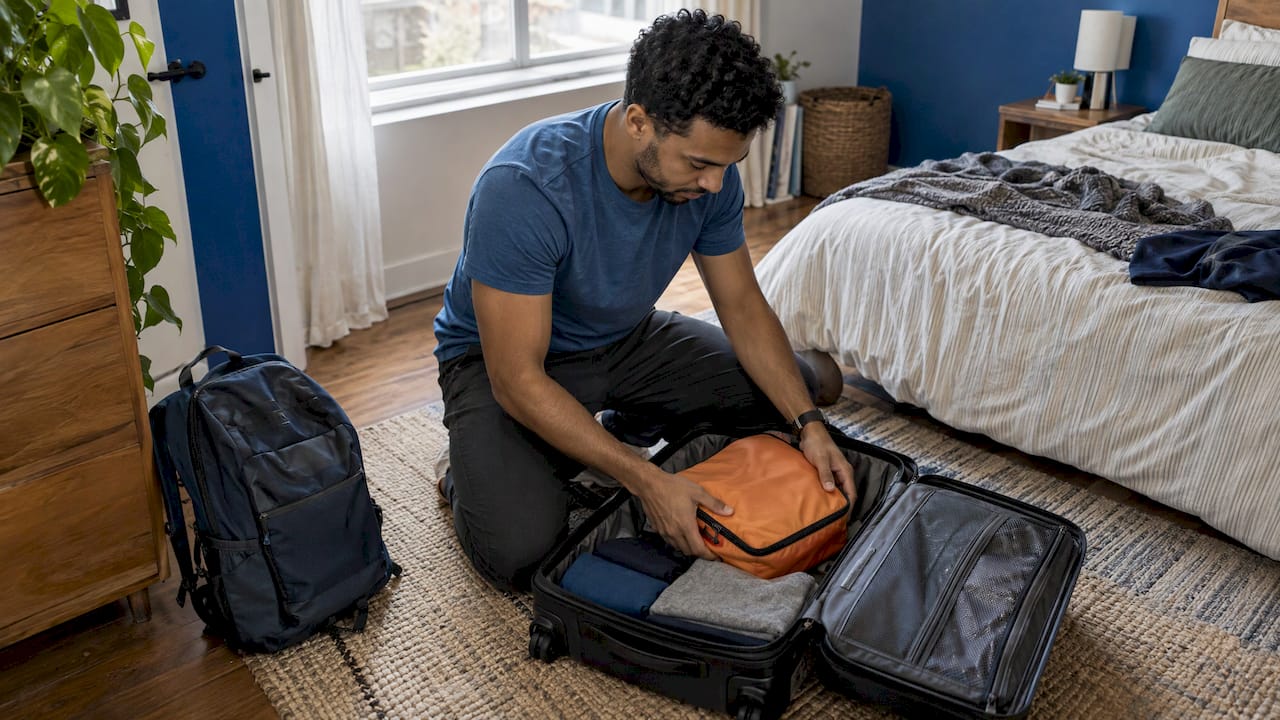
Carry-on only travel means you board with one bag that fits in the overhead bin and one personal item that fits under the seat, and nothing goes in the hold. It works when you do three things: confirm your airline’s exact bag limits before you pack, choose a bag that fits them, and pack in a fixed order so everything you need rides with you. This guide covers all three, plus the screening rules and what to do if a gate agent says your bag is too big.
TL;DR
- Most U.S. airlines allow one carry-on plus one personal item. Delta, for example, allows both free of charge, but rules differ by airline and fare, so check yours.
- The FAA’s general guidance is a maximum of 45 linear inches (height + width + depth) on most airlines. Delta also caps individual dimensions at 22 x 14 x 9 inches, including handles and wheels.
- Lay everything out first, cut it down, then roll clothes into cubes and wear your bulkiest items on the plane.
- Liquids must be 3.4 ounces or less per container, inside one quart-size clear bag per passenger.
- If your bag gets gate-checked, move valuables, medicine and battery-powered devices into your personal item first.
Table of Contents
- What carry-on only travel actually means
- Check your airline’s carry-on rules before you buy or pack
- Choose the right bag
- How to pack a carry-on for a one-bag trip
- A carry-on travel checklist that clears security
- What to do if your bag is turned away
- Our perspective on traveling carry-on only
- Plan the rest of your carry-on trip
- FAQ
- Sources
What carry-on only travel actually means
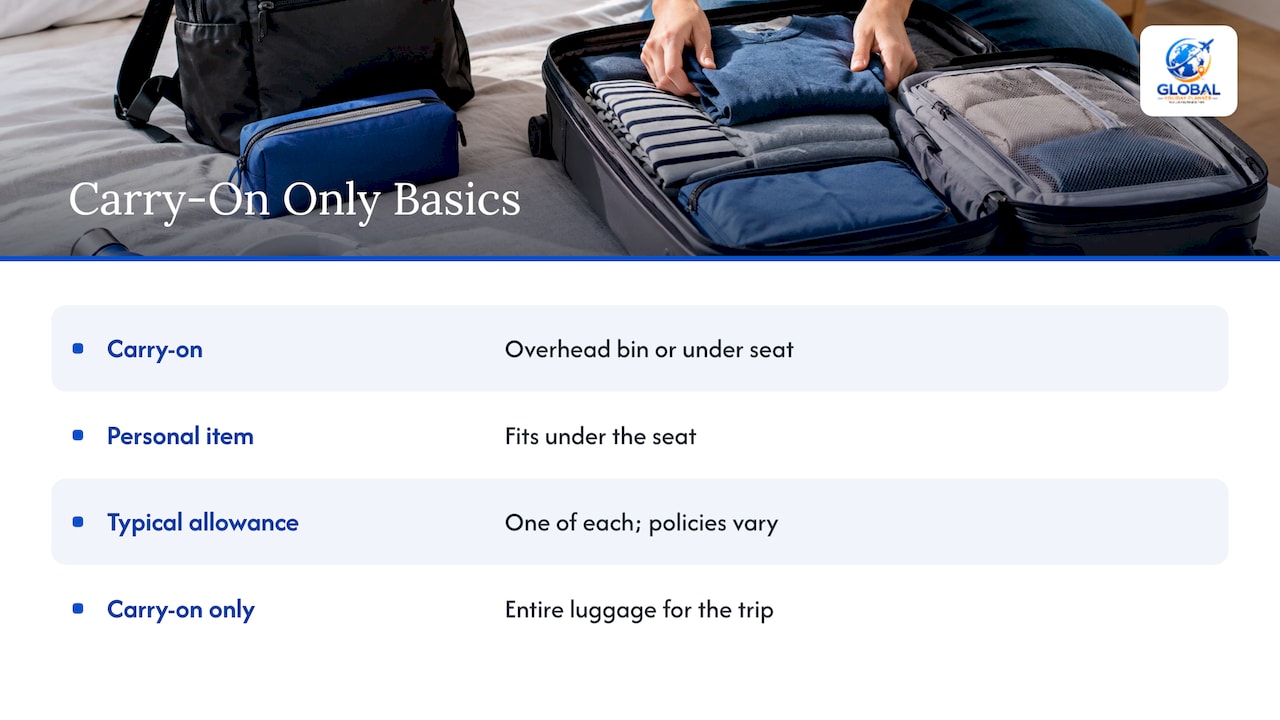
The idea is simple: carry-on baggage is luggage that goes on board and fits either in the overhead bin or under the seat in front of you. Most airlines allow one of each, though policies vary. Carry-on only means that is your entire luggage for the trip.
That is two bags, not one. Many travelers forget that the personal item counts as usable space. A Delta passenger gets one carry-on and one personal item at no charge, and the personal item must fit under the seat in front. A backpack or tote that slides under the seat holds your daily essentials. The roller or duffel in the bin holds the rest.
Traveling this way has real practical benefits. You skip baggage claim, you can’t have a bag lost in transit, and you can change flights or catch an earlier departure without worrying about where your suitcase is. It also keeps your trip cost predictable, which matters if you are comparing fares. Our breakdown of baggage fees and landed cost for U.S. travelers shows how much a checked bag can change the price you actually pay.
Check your airline’s carry-on rules before you buy or pack
Bag limits are set by each airline, and they are the rules that count at the gate. Start with the baseline, then confirm your own carrier.
The 45-inch baseline and where it changes
The FAA advises that on most airlines the maximum carry-on size is 45 linear inches, meaning height plus width plus depth. Anything bigger should be checked. The FAA also notes that airline rules can be stricter than general regulations, so treat 45 inches as a ceiling to stay under, not a promise.
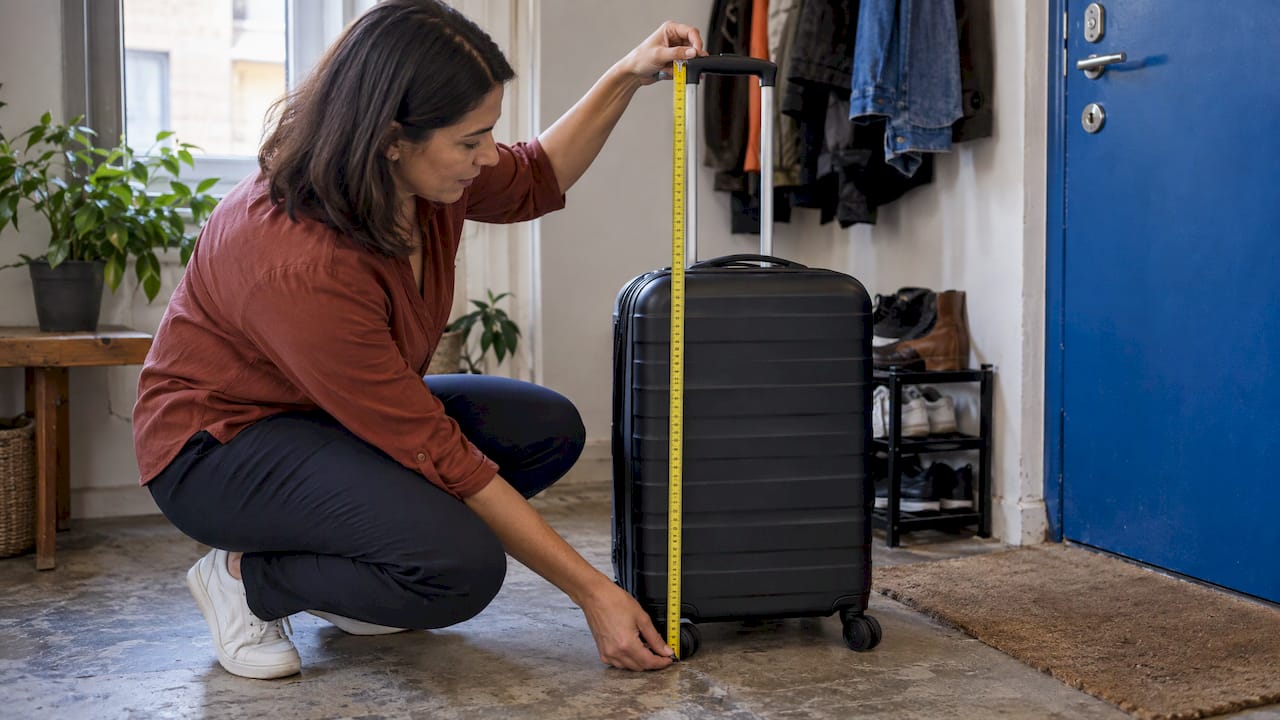
Delta publishes both the 45-inch total and individual dimensions of 22 x 14 x 9 inches, including handles and wheels. That last part trips people up. Measure the bag as it actually stands, wheels and handles included. Qantas uses the same approach: height, width and depth including wheels and packed-away handles, and a bag over the limit has to be checked.
International flights change the numbers
Outside the U.S., limits often include weight and quantity as well as size. China Eastern, for instance, publishes carry-on quantity and weight limits by cabin and says items over the limits must be checked. If your itinerary mixes carriers, which is common on multi-stop trips, you need to satisfy the strictest airline on the route.
A quick way to confirm your limits
- Open the baggage page of every airline on your itinerary, including the operator of any regional or partner flight.
- Write down the maximum size, any weight limit, and the personal item size.
- Check your fare type. Some basic fares restrict what you can bring, so read the fare conditions before you pay.
- Pack to the smallest limit across all your flights.
- Weigh and measure the packed bag at home.
If your airline doesn’t appear in a baggage-allowance lookup tool, that tool simply has no data for it, and Amadeus’s baggage tool says to contact the airline directly. Don’t assume a number.
One more caution on regional flights: on certain Delta Connection flights, only personal items may be allowed because overhead space is limited. If your trip includes a small regional jet, plan for the possibility that your roller is tagged at the gate.
If you are still deciding whether to go carry-on only at all, our guide to choosing between a checked bag and a carry-on walks through the trade-offs, and the add-on fee explainer shows how a $30 bag changes your total.
Choose the right bag
The bag is the constraint that makes the whole system work. Tortuga’s packing guide makes the point that choosing a carry-on-sized bag from the start keeps you from exceeding airline size limits, because there is simply no room to overpack past them.
What to look for:
- Dimensions with margin. Buy a bag comfortably within your airline’s published size, measured including wheels and handles. A bag that is exactly at the limit leaves no room for a slightly overstuffed day.
- A personal item that fits under the seat. A backpack or soft tote compresses; a stiff bag does not.
- Easy access to the top. You will open the bag at security and again in the cabin. A clamshell or wide-opening layout saves time.
- Low empty weight. On airlines with weight limits, a heavy empty bag eats your allowance.
- Straps that tuck away. The FAA asks passengers to tuck bag straps so they don’t become a tripping hazard in the aisle.
A soft-sided bag gives you a little squeeze room in a tight bin or sizer. Hard shells look sharp but can’t flex.
How to pack a carry-on for a one-bag trip
The method below follows what packing specialists recommend and what the research shows works in practice.
Step 1: Stage everything, then cut
Pack Hacker suggests laying out everything you plan to bring in one staging area and keeping that area limited to items you intend to pack. Seeing it all at once exposes the duplicates. Then remove about a quarter of it. Most people find they cut easily once the pile is visible.
Step 2: Build outfits around a few colors
A capsule approach means every top works with every bottom. Five tops, three bottoms, one layer and one pair of extra shoes cover most week-long trips. Washing something in a sink or using a laundry service midway beats carrying a second week of clothes. Adjust for climate and for how formal your plans are.
Step 3: Roll, cube and compress
Rolling clothes tightly reduces wrinkles and packs more efficiently than folding, since folded shirts stack with trapped air while rolls compress into cylinders. Packing cubes keep those rolls organized so you can find a shirt without unpacking everything.
Compression cubes use a second zipper to squeeze clothes flatter. According to Cubey, compression helps most with soft, fabric-heavy items that hold more air, and gives less benefit with solid materials such as jeans or shells. Use compression cubes for T-shirts, knitwear and underwear, and regular cubes for the rest. If you use compression, remember the weight stays the same, so check it against any weight limit.
Step 4: Fill the gaps
Shoes and other bulky items leave dead space. Stuff shoes with socks, underwear or small rolled items, a tip also in Travel + Leisure’s expert packing list, which notes it protects shoe shape too. Coiling a belt along the edge of the bag works the same way. Gap-filling can recover roughly the equivalent of one or two packing cubes of wasted space.
Step 5: Wear your bulkiest items
Put on the heaviest shoes, the jacket and the sweater at the airport. Wearing bulkier outerwear on the plane frees a lot of room, as the Travel + Leisure experts point out. A jacket with deep pockets can hold a charger, a passport holder and a paperback through security.
Step 6: Load by weight
Put heavier items near the wheels and against the back panel so a roller stands steady. In the cabin, the FAA says to stow heavy items under the seat in front of you instead of overhead, so a heavy personal item is a sensible place for your laptop and books if it fits.
A carry-on travel checklist that clears security
Use this as a base list, then adjust for your destination and trip length.
Documents and money
- Passport or ID, boarding passes, hotel and transfer confirmations
- A card, a little cash and your insurance details
- A travel wallet or passport holder kept in your personal item
Clothing (for roughly a week)
- 4 to 5 tops, 2 to 3 bottoms, one warm layer, one lightweight rain layer
- Underwear and socks for the number of days between washes, plus two
- One pair of shoes worn, one packed, sleepwear, swimwear if needed
Toiletries
- Everything liquid in containers of 3.4 ounces or less, in one clear quart-size bag
- Solid versions (shampoo bars, toothpaste tablets, solid deodorant) save bag space
- Prescription medications in your personal item, never in a bag that might be gate-checked
Electronics
- Phone, charger, adapter, headphones
- Laptop or tablet, kept easy to pull out
In-flight comfort
- Glasses case, a refillable water bottle to fill after security, a light scarf or travel pillow
TSA rules to pack around
The TSA’s travel checklist starts with a simple instruction: start with an empty bag. It then lays out the liquids rule: liquids, gels and aerosols in your carry-on must be 3.4 ounces or less per container, all fitting in one quart-size clear zip-top bag per passenger. Keep that bag where you can pull it out quickly, keep your pockets empty, and make larger electronics easy to reach for screening.
On international flights, expect a metric version of the same idea. China Eastern, for example, requires containers of no more than 100 ml in one transparent resealable bag of up to 1 liter, one per passenger. That is close to the U.S. rule, but check the departure airport’s rules, because the screening rules at your airport apply as well as the airline’s.
For trips with long travel days, think about food too. A little planning, such as eating healthy on holiday, keeps you from relying on airport snacks, and solid snacks take no liquid allowance.
What to do if your bag is turned away
Even careful packers get caught: a full flight, a smaller aircraft, or a bag that measures slightly over. It is manageable if you prepare.
- Know it can happen at the gate. If your bag is oversized or the overhead bins are full, a Delta gate agent can check it for you at the gate.
- Keep essentials in your personal item. Lufthansa advises that a non-compliant carry-on may be moved to the hold at your expense, with fees varying by route, and that you should take valuables, needed medicines and battery-powered devices into the cabin before it is loaded.
- Pack a small essentials pouch. Medication, a charger, a change of underwear, glasses and documents should be able to move into your under-seat bag in under a minute.
- Board earlier if you can. Overhead space goes first. If your fare includes early boarding, your bag has a better chance of staying with you.
If a checked bag is ever delayed or lost, our guide to U.S. lost luggage compensation deadlines explains when to file.
Our perspective on traveling carry-on only
We build trips around total cost and fit, and baggage is one of the easiest places for that cost to drift. A fare that looks low can look different once a bag is added, which is why we compare the components of a trip side by side instead of looking at the ticket alone.
Carry-on only is not for everyone and every trip. A golf group, a family with young children and a business traveler on a two-night trip all pack differently, and our trip-type planning is designed around those differences. For many short and medium trips, one bag keeps the plan simple and the budget clear.
Our advice: choose the airline and fare first, confirm the bag rules for each flight, then pick the bag. Doing it in that order avoids the most common surprise at the gate. We also suggest pairing your flight with the rest of the trip in one place, hotel, ground transport and cover, so changes don’t ripple through separate bookings.
Global
Plan the rest of your carry-on trip
Once your bag is sorted, the surrounding bookings decide how smooth the trip feels. With Global Holiday Planner you can compare flights across airlines in one place and see the options side by side, then add hotels, car rentals, airport transfers, rail tickets and travel insurance from the same platform. A hotel close to the airport and a pre-booked transfer mean your single bag never has to wait on a curb.

Looking for your next trip? Start on the Global Holiday Planner home page and compare the whole itinerary before you book. For the details that come before packing, our trip planning checklist covers documents, timing and bookings, and if seat choice matters to you, see window versus aisle seats.
FAQ
Can I bring both a carry-on and a personal item?
On most U.S. airlines, yes. Delta, for example, lets each passenger bring one carry-on and one personal item free of charge. The personal item must fit under the seat in front of you. Confirm your own airline and fare, since some fares and regional flights restrict what you can bring.
What size is a carry-on bag?
The FAA says the maximum on most airlines is 45 linear inches, the sum of height, width and depth. Delta’s individual limits are 22 x 14 x 9 inches including wheels and handles. Always check the exact numbers for each airline on your itinerary.
How many liquids can I bring in a carry-on?
Under the TSA liquids rule, each container must hold 3.4 ounces or less, and all of them must fit in one quart-size clear zip-top bag per passenger. Keep the bag accessible for screening. Solid toiletries do not count toward the limit.
How do I pack more into a carry-on?
Stage your items and cut the pile, then roll clothes into packing cubes, fill gaps inside shoes and wear your bulkiest layers on the plane. Compression cubes help most with soft fabrics. The step-by-step section above shows the full order.
What if the airline makes me check my carry-on?
A gate agent can check an oversized or overflow bag. Before you hand it over, move medicine, valuables and battery-powered devices into your personal item, as Lufthansa advises. Fees for a non-compliant bag vary by airline and route.
Sources
- What Is Carry-On Luggage? Meaning, Size, and More
- Carry-On Baggage | Delta Air Lines
- Carry-On Baggage Tips | Federal Aviation Administration
- Carry-on baggage allowances | Qantas US
- China Eastern Carry-on Baggage
- Baggage Charges and Allowances | Amadeus
- How To Pack A Carry-On For One Bag Travel | Pack Hacker
- 12 Best Carry-on Packing Tips, According to an Expert | Travel + Leisure
- The Ultimate Carry On Packing List | Tortuga
- Compression vs Regular Packing Cubes | Cubey
- How to Maximize Space in a Carry-On | Organizing.TV
- Travel Checklist | Transportation Security Administration
- Carry-on baggage | Lufthansa
- Tips for Eating Healthy on Holiday: 2026 Guide
[…] what to bring, our guide on checked bag versus carry-on covers when each option saves money, and carry-on only travel shows how to pack light for longer […]
[…] travelers. If you are flying light, a phone-only routine keeps your hands free. Our guide to carry-on only travel pairs well with […]
[…] extra allowance as a bonus. If you are building a family trip on one carry-on each, our guide to carry-on only travel shows how to pack light, and our 2026 baggage fee comparison helps you see what an extra bag costs […]