

Choose single-trip insurance if you take one or two trips a year, especially an expensive one with prepaid, nonrefundable costs. Choose an annual (multi-trip) policy if you travel often on shorter trips and mainly want dependable medical cover. The catch is that annual plans can be thinner on trip cancellation, baggage and evacuation, so the cheaper-looking option is not always the better fit. This guide shows how to decide with your own trip list in hand.
TL;DR
- A single-trip policy covers one specific trip, matched to its dates and destination. An annual policy covers multiple trips over 12 months.
- A common rule of thumb: annual cover tends to pay off from about two trips a year, but a single big trip usually deserves its own policy.
- Annual plans cap the length of each trip, and some leave out or limit cancellation, interruption and baggage cover unless you upgrade.
- Price a $10,000 trip at roughly 4% to 10% of the insured cost for a single-trip comprehensive plan, then compare the annual quote against your real trip list.
- Write down every trip you expect this year, with its length and prepaid cost, before you compare quotes.
Table of Contents
- What each policy type actually is
- Side-by-side comparison
- How the cost compares
- What annual plans can leave out
- Which one fits which traveler
- Do you already have cover from a credit card?
- Compare and book your trip protection in one place
- A practical order of operations
- FAQ
- Sources
What each policy type actually is
A single-trip policy protects one journey. MoneySavingExpert explains that cover runs from the day you buy the policy until the day you come home from that trip. Because it is built around one itinerary, you tell the insurer your dates, destination, travelers and trip cost, and the price reflects them.
An annual policy, often called multi-trip, covers many trips in a 12-month period under one purchase. The European insurance regulator’s 2019 review of travel insurance draws the same line: single-trip cover is matched to a trip’s duration and destination, while annual cover spans multiple trips during a year. The same review found that in 2017 the participating insurers collected €2.9 billion in travel-insurance premiums, 58% from multi-trip and 42% from single-trip policies. So annual cover is a mainstream choice, not a niche product.
The difference is not only how many trips you cover. It is also how much you customize. A single-trip plan lets you set the insured trip cost, add cancellation protection and pick upgrades for that journey. An annual plan gives you a standard package that applies to every trip.
Side-by-side comparison
| Feature | Single-trip policy | Annual (multi-trip) policy |
|---|---|---|
| Trips covered | One specified trip | Multiple trips in 12 months |
| Cover starts | When you buy, for that trip | Usually from the policy start date, trip by trip |
| Trip length | Often much longer allowed, commonly up to 90 to 180 days depending on provider | Each trip capped, often at a few weeks up to 60 or 90 days |
| Cancellation and interruption | Typically included in comprehensive plans, set to your trip cost | Often limited by an annual cap, optional or absent |
| Customization | High: tailored to destination, dates and travelers | Lower: a standard package for all trips |
| Best for | One or two trips, big prepaid costs, long stays | Frequent, shorter trips, business travel, regular weekend getaways |
The trip-length figures come from MoneySavingExpert’s single-trip guide (a maximum of 90 to 180 days depending on the policy) and its annual-cover guide, which says per-trip limits are usually 17 or 31 days, with 60 and 90 days not uncommon. Those are UK market figures. U.S. plans differ by insurer and by state, so always read the limit in the plan documents you are quoted.
How the cost compares
Single-trip pricing starts from your trip cost. NerdWallet’s 2024 U.S. analysis put the average premium for a $10,000 trip at $599.63, or 6.87% of the trip cost, with a possible range of 4.15% to 15.8%. It lists coverage type, trip length, destination, traveler age, total trip cost and coverage limits as the main price drivers. Older travelers, pricier trips and higher limits all push the premium up.

Annual pricing works differently. You pay one premium for a year, and it depends less on how much each trip costs, because annual plans usually emphasize medical cover rather than reimbursing prepaid costs. That is why a family with several modest trips can see annual cover come out cheaper, while a traveler with one $12,000 trip often finds a single-trip plan better value and better protection.
Where the break-even sits
There is no universal number. MoneySavingExpert’s rule of thumb is that annual cover usually offers the best value for two or more trips, and single-trip cover is generally better value for one. That is a UK guide, so treat it as a starting point.
The most detailed test we found is Australian. In July 2026, consumer group CHOICE compared more than 300 annual scenarios in 4,648 comparisons. Annual cover was cheaper than repeated single-trip cover in every tested scenario only when travelers took at least eight international trips a year. It could still be cheaper for two to five longer trips. The lesson carries over to the U.S.: the answer depends on how many trips, how long they run and how much cover you want on each.
Here is a simple way to test your own year:
- List every trip you expect, including domestic ones, with dates and prepaid, nonrefundable costs.
- Get a comparable single-trip quote for each trip, with the cancellation and medical limits you actually want.
- Add them up.
- Get an annual quote with the same limits for the same travelers.
- Compare the totals, then compare what each option leaves out.
Step 5 matters most, as the next section shows.
What annual plans can leave out
A lower price often means a narrower package. NerdWallet’s guide to annual plans says they commonly emphasize medical coverage and may omit, or make optional, benefits such as baggage, rental-car damage, trip cancellation, trip interruption and travel delay cover. Single-trip comprehensive plans more commonly include them.
Check these points before you buy an annual plan:
- Trip-length cap. Each trip has a maximum. A long stay, a sabbatical or a snowbird winter may fall outside it.
- Home-distance rule. Many annual plans cover only trips that take you a minimum distance from home, so a close getaway may not count.
- Cancellation and interruption. Look for both the per-trip limit and any annual total. A cap shared across the year can be used up by a single claim.
- Medical and evacuation limits. Confirm the amounts, and whether medical cover is primary or secondary to your health plan.
- Pre-existing conditions. Waiver options can differ between plan types. Our guide to pre-existing conditions travel insurance explains how to qualify.
- Cancel For Any Reason. This upgrade is usually a single-trip add-on that must be bought soon after your first trip payment. See how Cancel For Any Reason insurance breaks even.
If cancellation protection is the reason you want insurance, read our checklist on trip cancellation vs. interruption first. It tells you which events each benefit covers and what proof you will need.
Special cases: golf and gear
If you travel with expensive equipment, check how baggage and equipment limits work on any plan, annual or single. Golfers in particular should read about golf club travel insurance gaps, because per-item and total baggage limits are often lower than the value of a full set of clubs.
Which one fits which traveler
One big trip a year. A family booking a $9,000 holiday with flights, hotels and a rental car has a lot of money at stake in one place. A single-trip comprehensive plan sized to that cost gives you cancellation, interruption and delay protection tied to the trip. Annual cover rarely makes sense here unless you also take several other trips.
Two to four trips a year. This is the zone where you must run the numbers. If the trips are short and cheap, annual cover can win. If one of them is a pricey international vacation, you may do better with a single-trip policy for that trip and either nothing or a cheaper plan for the rest.
Frequent short trips. Regular weekend travelers and people who visit family often are the classic annual buyers. One purchase covers them without a new quote every time, provided each trip fits the length and distance rules.
Business travelers. If your employer already covers you, check what that policy includes before buying your own. For booking habits that cut costs, see our business travel booking tips.
Multigenerational groups. Different ages mean different premiums and different medical needs, and one policy may not suit everyone. Our multigenerational travel planning guide helps you set costs before you insure them.
Long-stay travelers. If you will be away for months, a single-trip policy generally allows longer journeys than an annual plan, whose per-trip cap is shorter.
Do you already have cover from a credit card?
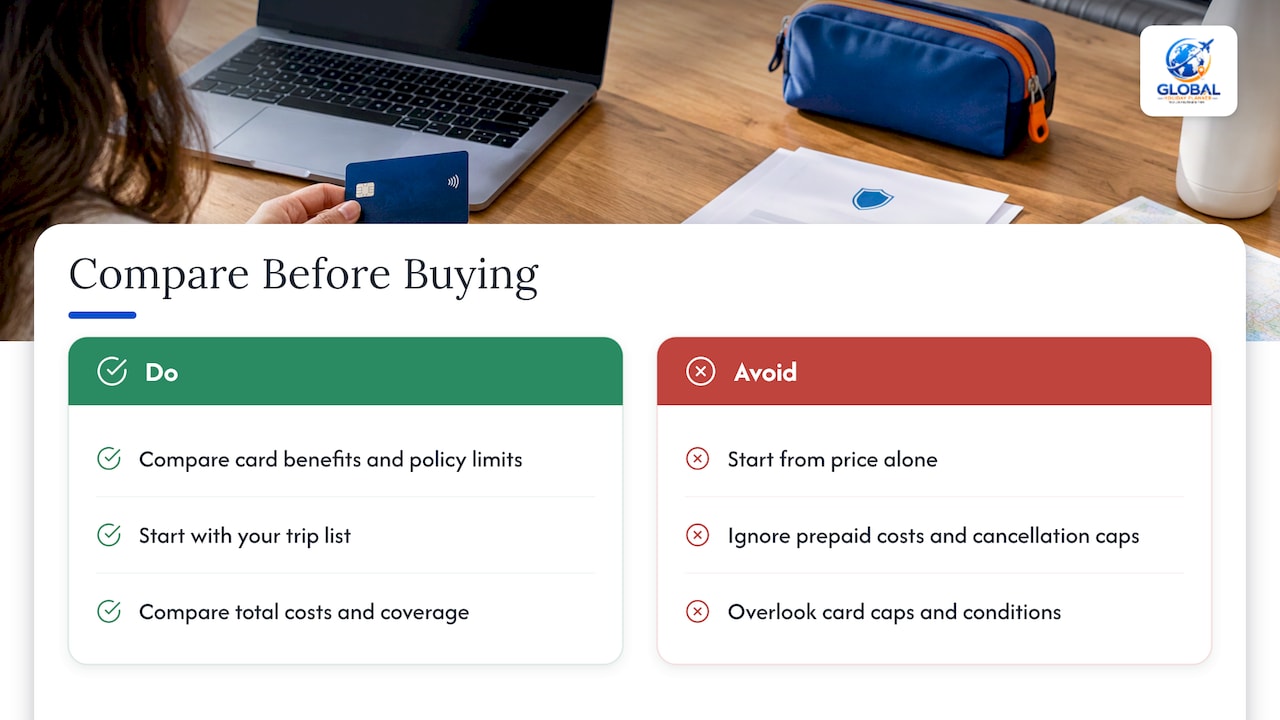
Many travelers hold some protection through a card, and it can change the math. Card benefits usually have caps and conditions, and they rarely match a standalone comprehensive plan. Before you buy either policy type, compare it with your card benefits using our five steps for choosing travel insurance or card coverage, and check the limits explained in our guide to credit card travel insurance caps.
If you are still deciding whether to insure at all, our guide on whether travel insurance is worth it for U.S. travelers walks through the risks by trip type.
Our perspective
We built Global Holiday Planner around one idea: travelers decide better when they see the whole cost of a trip in one place. Insurance is part of that cost, and the annual-versus-single question is a good example. The cheapest premium is not the real price if the policy leaves out the thing that is most likely to go wrong on your trip.
That is why we recommend starting from your trip list instead of from a price. Put the flights, hotels, car rental and transfers beside the insurance quote, and the picture changes. A $400 saving on premium means little if the plan caps cancellation at an amount below what you have prepaid.
Our approach is scenario-based. For one large family holiday, we point travelers toward a plan sized to that trip. For a year of short trips, we point them toward comparing annual options against the sum of separate policies. Either way, we want you to see the side-by-side numbers and the coverage differences before you commit.
Global
Compare and book your trip protection in one place
Once you know how many trips you are insuring, put the whole plan together. At Global Holiday Planner you can compare flights, hotels, car rentals, airport transfers, rail tickets and travel insurance side by side, so the insurance you choose matches what you have actually booked.
Start on our travel insurance and trip planning page, or browse our roundup of travel insurance plans to compare. When your trip is set, you can also compare flights and hotels before you insure the final total.
A practical order of operations
Timing affects what you can buy. Cancellation protection is tied to when you make your first trip payment, and some upgrades must be bought within a set window afterward. So the sequence matters:
- Decide your trips for the next 12 months, even roughly.
- Book the big trip first, and insure it as soon as you have paid a deposit.
- Decide whether the remaining trips justify an annual plan, or whether you will insure them one by one.
- Check each trip against the plan’s maximum days and home-distance rule.
- Keep the policy documents where you can reach them offline.
If you are planning a first trip abroad, our guide to the essential steps for your first international trip puts insurance in its place in the sequence.
FAQ
What does single-trip travel insurance mean?
It is a policy for one specific journey. According to MoneySavingExpert, cover runs from the day you buy it until you return from that trip. You set the dates, destination and trip cost, and the premium reflects them.
Is annual travel insurance always cheaper than buying single-trip policies?
No. It tends to be cheaper when you take several trips and each one fits the plan’s length and distance limits. In CHOICE’s Australian comparison, annual cover beat repeated single-trip policies in every tested scenario only at eight international trips a year. Price your own trips both ways.
How much is travel insurance for a $10,000 trip?
NerdWallet’s 2024 U.S. analysis found an average premium of $599.63 for a $10,000 trip, within a range of 4.15% to 15.8% of trip cost. Your own price depends on age, destination, trip length and the limits you choose.
Does annual insurance include trip cancellation?
Not always. NerdWallet notes that annual plans often focus on medical cover and may leave out or make optional cancellation, interruption, baggage and delay benefits. If prepaid costs are your main worry, check the cancellation limit before you buy.
Can I combine both?
Yes. Many travelers insure one expensive trip with its own single-trip policy and rely on an annual plan, or on other cover they already hold, for smaller trips. Check for overlaps and gaps so that you know which policy answers which claim.
Sources
- Consumer Protection issues in travel insurance: a thematic review (EIOPA, 2019)
- Single-trip travel insurance (MoneySavingExpert)
- Cheap annual and multi-trip travel insurance (MoneySavingExpert)
- How Much Is Travel Insurance? (NerdWallet)
- How Annual (Multi-Trip) Travel Insurance Works (NerdWallet)
- Is it worth buying annual multitrip travel insurance? (CHOICE)
[…] flyers should compare annual and single-trip options. Our guide to annual versus single-trip policies shows how to pick based on how many trips you take. AARP says annual travel insurance for someone […]