
Minimum connection time (MCT) is the shortest gap an airline or booking system will accept between two connecting flights at a given airport. It is a scheduling floor, not a promise that you will make the second flight. For a safe layover in the U.S., most advisers suggest 60 to 90 minutes between domestic flights and two to three hours when an international arrival is involved. Add more if you change terminals, travel in a busy season or book two separate tickets.
Below, we explain where MCT numbers come from, why they differ so much from airport to airport, and how to turn a published minimum into a layover you can trust.
TL;DR
- MCT is the shortest transfer time a booking system will sell on one itinerary. It assumes your first flight arrives on time.
- IATA defaults, used when an airport has no specific rule, are 30 minutes (domestic to domestic), 60 (domestic to international) and 90 (both international cases).
- In the U.S. there is no federal rule on connection times. Airlines set their own.
- For a comfortable buffer, aim for 60 to 90 minutes domestic and 2 to 3 hours with customs, immigration or a terminal change.
- Separate tickets remove your protection if the first flight runs late, so allow a much longer gap or book one itinerary.
Table of Contents
- What minimum connection time means
- How MCTs are set
- How much time to allow between flights
- What eats up your layover
- Single ticket or separate tickets
- Domestic vs international in the U.S.
- A simple method to pick your layover
- What to do if you miss the connection
- Our perspective
- Compare flights with the layover you want
- FAQ
- Sources
What minimum connection time means
IATA, the airline trade body, defines the station standard MCT as the official shortest interval needed to transfer a passenger and luggage between flights at a location, based on the scheduled arrival and departure times. That is the key phrase: scheduled times. The number says nothing about how late your plane might be.
OAG, which supplies schedule data to the industry, describes MCTs as standardized, agreed data sets that give the minimum time for passengers and their bags to make a connection. They are also reflected in airlines’ contracts of carriage as legal connection times. When you search for flights and see a 45-minute layover offered, it is because that itinerary clears the MCT for that airport and flight pair.
Think of MCT as the shortest time the system considers physically possible under standard conditions. A safe layover is a different question. It depends on how likely your first flight is to be late, how far you must walk, and what happens if you miss the next flight.
How MCTs are set
There is no single number. OAG explains that MCTs differ according to physical distances, whether passengers may need security or customs control, and what it takes to prepare an arriving aircraft for its next departure. Its examples run from as little as 30 minutes for a domestic connection to around 1.5 hours for an international transfer onto an international carrier.
IATA’s data covers a lot of ground. Its station standard MCT publication includes over 400 of the most connected airports, representing 90% of international connections. Airports and airlines can then layer on exceptions, for example for terminal changes, baggage handling, immigration or check-in for the second flight.
IATA’s technical guide describes three kinds of record: station standard MCT, suppression MCT (where a connection is not allowed at all) and exception MCT. When no station standard exists, the guide falls back on global defaults:
| Connection type | Default MCT |
|---|---|
| Domestic to domestic | 30 minutes |
| Domestic to international | 1 hour |
| International to domestic | 1 hour 30 minutes |
| International to international | 1 hour 30 minutes |
Airlines also differ on whether the onward flight is their own or a partner’s. Ethiopian Airlines says its MCT is not a fixed, single number and varies by airport, by connection type and by whether the next flight is operated by the airline itself (online) or handed to a partner (offline). Its published range runs from 20 minutes for a simple domestic transfer to 3 hours when immigration, customs or a terminal change is involved. Japan’s ANA publishes a similar table, with Narita transfers from 45 minutes (domestic to international) to 75 minutes (international to domestic) on its own flights.
Who regulates it in the U.S.
Nobody, at the federal level. The Department of Transportation does not set minimum connection times, and USA Today reports that airlines are free to sell connecting itineraries with whatever time between flights they consider reasonable. That is why the same two cities can show very different layover options depending on the carrier.
How much time to allow between flights
Here is a practical way to read the numbers. Start from the published MCT, then add buffer for the things the MCT does not cover.
| Situation | Published floor (typical) | A comfortable buffer |
|---|---|---|
| Domestic, same terminal, carry-on only | 30 to 45 minutes | 60 to 90 minutes |
| Domestic, different terminals | Often 60 minutes or more | 90 minutes to 2 hours |
| International arrival to a U.S. domestic flight | Varies, often 90 minutes or more | 2 to 3 hours |
| Separate tickets, any route | No protection | 3 hours or more, bags and terminals permitting |
The comfortable-buffer column draws on the general rule of thumb USA Today quotes from travel advisers: 60 to 90 minutes between domestic flights and at least two to three hours for international itineraries. Airports say much the same. London Gatwick advises at least 60 minutes within one terminal and 90 minutes between terminals, and warns that ignoring this puts you at serious risk of missing the onward flight. San Francisco International recommends 2 to 3 hours for connections that involve immigration, customs, re-checking bags and security, and asks you to alert your airline if your connection is under one hour.
The other numbers in the table are our own planning guidance built on those sources, not published rules. Always check the airport and airline for your specific route.
Is a 45-minute connection bad?
Not automatically, but it leaves little room. It can work when you are on one ticket, staying in the same terminal, in the U.S., with carry-on bags, and your first flight lands on time. Once any of those conditions fails, 45 minutes becomes a gamble.
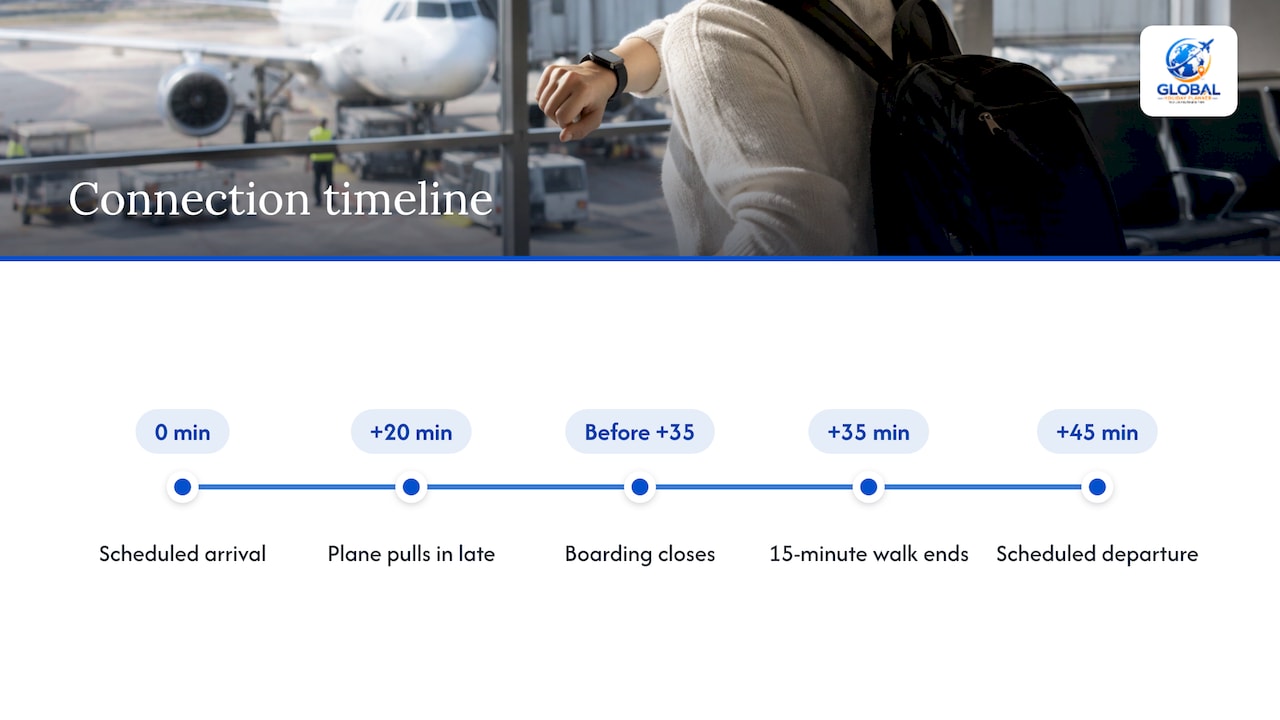
The risk is easy to see in the schedule. If your plane pulls in 20 minutes late and the gate is a 15-minute walk away, you arrive after boarding has closed. Airlines typically close the boarding door well before departure, so the real window is shorter than the printed gap.
What eats up your layover
The MCT assumes standard conditions and an able-bodied traveler. Real trips add friction. Plan for these:
- Customs and immigration. On international arrivals into the U.S., SFO explains that you must complete CBP entry procedures, claim baggage, exit the Federal Inspection Area and pass through security again before your connecting flight. There is no airside transfer for most international arrivals in the U.S.
- Terminal changes. JFK notes that with multiple terminals, you may arrive in one and depart from another, so you should budget extra travel time because TSA screening will be needed again.
- Checked bags. On a single ticket, bags are normally transferred for you. Heathrow says most connecting passengers do not need to collect baggage because the airline moves it. On separate tickets, you will most likely have to collect bags and check them in again.
- Gate distance and late arrivals. A delay on the ground, a long taxi or a back-row seat can burn 10 to 15 minutes before you start walking.
- Assistance needs. ANA notes that additional time may be required for passengers who need assistance. Ask the airline to arrange help and allow extra time.
If your layover includes a long security or customs line, a paid shortcut may help. Our guide to airport fast track explains what it covers and when it pays off.
Single ticket or separate tickets
This is the choice that changes your risk most. On one ticket (one booking reference), the airline sold you the connection, and if a delay makes you miss it, the airline is responsible for getting you to your destination. The U.S. Department of Transportation frames connection planning as risk management: check the gap, ask what happens if the first flight is late, and if the answer is not acceptable, choose a different itinerary or ask an agent to build a more time-tolerant one.
On separate tickets, you are not a connecting passenger. Heathrow says separately booked travelers are not technically connecting passengers: you pass immigration, collect bags, check in again, drop bags and clear security again. British Airways’ through check-in rules for oneworld say that customers with separate tickets in separate booking records are not accepted for through check-in, and that the first carrier is not liable for rebooking or extra costs on the other booking if disruption occurs.
So when two tickets are cheaper than one, count the real price of the risk. Allow at least three hours, preferably more, and avoid tight same-day links to a flight that cannot be replaced easily, such as a once-daily long-haul departure or a cruise sailing.
A note for Europe-bound trips: EU rules can compensate a missed connection only when the final delay exceeds three hours, the trip is on a single reservation and the EU rules apply, and extraordinary circumstances are absent. Security delays or missing the boarding time exclude compensation.
Domestic vs international in the U.S.
A domestic-to-domestic connection in the U.S. is the easy case. You stay inside security, bags go through, and you only need to find the next gate. Even so, large hubs with multiple concourses can add a train ride or a long walk.
International arrivals are different. Everyone on an international flight arriving in the U.S. goes through CBP, and then re-enters security. Add peak arrival waves, when several wide-body flights land together, and 90 minutes disappears quickly. That is why airports and advisers point to two to three hours as the practical minimum for these itineraries, regardless of what the booking engine allows.
If you land late at night or on a long-haul red-eye, think about your own state too. A tired traveler walks slower, and a mistake at passport control costs more. Giving yourself a longer layover is usually cheaper than rebooking.
A simple method to pick your layover
- Find the type of connection. Domestic or international on each leg, same airline or partner, same or different terminals.
- Look at the published minimum. Use it as the floor, never the target.
- Add buffer for the first flight’s lateness. Routes through busy hubs, winter storm regions or summer thunderstorm corridors need more. Morning flights tend to run closer to schedule than late-day ones, as delays accumulate through the day.
- Add time for the extras. Customs, terminal change, bag re-check, or a family with young children each justify 30 minutes or more.
- Check the replacement options. If you miss the connection, how many flights a day serve the route? A busy route gives you a safety net. A once-daily route does not.
- Protect the trip. Consider whether your insurance or card coverage handles missed connections. Our guide to trip cancellation versus interruption shows what each usually covers.
What to do if you miss the connection
The first minutes matter. Here is a sequence that works on most single-ticket itineraries:
- Act before you land. If you see the delay building, open the airline app and look at the next flights. Alert a crew member if your connection is tight.
- Go to the gate or the transfer desk. If the aircraft is still there, gate agents can sometimes help. If not, head to the airline’s service desk, or call or message the airline while you queue.
- Ask for rebooking on the next available flight. On one ticket, the airline that sold the connection is expected to get you to the destination. Ask about the most direct options, and consider nearby airports.
- Keep receipts. Meals, a hotel night and ground transport may be reimbursable depending on the airline’s policy and the cause of the delay.
- Check your bag. If your luggage does not arrive, file a report before leaving the airport. Our guide to U.S. lost luggage compensation lists the filing windows.
On separate tickets, the second airline has no obligation to rebook you and may charge for a new seat. That is the difference a single booking makes.
Our perspective
We built Global Holiday Planner around one idea: the price on the screen is not the whole cost of a trip. A cheap itinerary with a 40-minute connection can turn expensive the moment the first flight is late.
That is why we encourage travelers to compare flights side by side, with the layover length, the airport, the number of tickets and the baggage rules in view. A connection that clears the minimum is a starting point. A connection that fits your trip type is the goal.
A family with a toddler needs more time than a solo carry-on traveler. A business traveler who must reach a meeting needs a backup flight on the same route. A couple on a honeymoon wants an itinerary on one ticket so a delay is the airline’s problem, not theirs. Our comparison tools are designed to help you see these differences before you book.
When you pair your flight with an airport transfer, hotel or car rental, we suggest leaving slack for the day you land. It costs little and protects the rest of the trip.
Global
Compare flights with the layover you want
When you search for flights on Global Holiday Planner, you can compare itineraries side by side and weigh the layover against price, so you choose a connection time that fits your trip instead of the shortest one on offer. Once your flights are set, you can add an airport transfer so your arrival is planned too.

If you are choosing between a cheaper fare with a tight connection and a slightly higher one with breathing room, our guide to airline extra fees shows how bags and add-ons change the real total, so you compare like with like.
FAQ
What is a safe layover time?
For domestic U.S. flights on one ticket, 60 to 90 minutes is a common rule of thumb. For international arrivals connecting to another flight, plan for at least two to three hours. Add more for terminal changes, busy seasons or separate tickets.
How much time do you need between flights?
It depends on the airport and the type of connection. The industry default floor is 30 minutes for domestic to domestic and 90 minutes for international to international when no airport rule exists. A comfortable gap is well above those numbers.
Is a 45-minute connection enough?
It can be on a single ticket, in the same terminal, with carry-on bags and an on-time arrival. It is risky if any of those change, and not realistic on separate tickets. If the first flight is delayed, you may have no time left.
Do MCT rules apply to separate tickets?
No. MCT applies to connections sold on one itinerary. With separate tickets, you are treated as a new arrival, so you may need to collect your bags, check in again and clear security, and the second airline is not obliged to rebook you.
Can I see the MCT for my flight?
Airlines and airports publish their own guidance, and booking systems apply it automatically when they show you connecting options. If an itinerary appears, it already meets the MCT. For the practical amount of time, check your airport’s connection page and add buffer.
Sources
- IATA: Station Standard Minimum Connecting Time(s)
- IATA: Minimum Connecting Time technical guide
- OAG: What are Minimum Connection Times (MCTs)?
- Ethiopian Airlines: Swift Connections Guidelines
- ANA: Transit Information
- KHOU: Who establishes the minimum connection time
- USA Today: How much time do you need between connecting flights?
- London Gatwick: Flight Connections
- San Francisco International Airport: Connecting Flights FAQ
- JFK Airport: Flight Connections Guide
- Heathrow: Connecting flights
- British Airways: Changes to Accepting Customers with Separate Tickets
- US DOT: Plane Talk, Coping with Flight Delays
- Your Europe: Air passenger rights