

The single best first step is to settle the funding model and lock overlapping dates before anything else gets booked. A small decision-making core, typically one organizer per household, should run this process instead of the whole family debating every detail. Agreeing on money and dates first removes the two biggest sources of friction and lets everyone book with confidence.
TL;DR:
- Ask households to mark unavailable weeks rather than propose preferred dates, then confirm the overlap by a firm deadline before fares and lodging prices rise.
- Half of families book lodging with a kitchen to cut dining costs; confirm accessible entrances, elevator access, and bathroom grab bars directly with each property.
- Book flights and the main lodging first, then arrange transfers and rentals; compare flexible dates before booking to catch lower fares.
- Compare group coverage with separate policies, and check cancellation limits and medical evacuation coverage because age and preexisting conditions can change both needs and price.
- Limit shared plans to one or two anchor activities, build in rest points, and let households split off for outings matching their pace or energy.
Table of Contents
- Agreeing on budget and funding model
- Coordinating dates and availability across households
- Choosing accommodations that balance privacy and togetherness
- Picking anchor activities and leaving room for downtime
- Booking flights, transfers, car rentals and insurance for the group
- Accessibility, health and medication planning
- Communication strategies that keep everyone on the same page
- Dietary considerations and meal planning across generations
- Handling travel documents and ID for every generation
- Emergency planning for medical needs and travel insurance
- Packing tips for every age group in the family
- Using apps and technology to keep the group coordinated
- Organizer’s checklist and quick lessons learned
- How Global Holiday Planner helps you book a multigenerational trip
- FAQ
- Sources
Agreeing on budget and funding model
Money is usually the most awkward part of planning a trip across generations, so naming the model early prevents hurt feelings later. Three approaches tend to work: grandparents gift the trip as a one-time present, households split costs proportionally based on income or ability to pay, or everyone covers their own expenses and only splits shared items like a rental home. The first suits families where grandparents want to create a specific memory; the second works when the group values fairness over a fixed structure; the third fits groups who prefer independence.
Run a short survey asking each household what they can spend and what they expect covered, set a firm reply deadline, then consolidate the answers into one shared spreadsheet everyone can see.
- Grandparents cover the trip as a gift, often for a milestone anniversary or birthday.
- Households split costs proportionally so no one family carries an unfair share.
- Everyone pays their own way and splits only the shared lodging or car.
Cost-saving habits matter here too. 50% of families book lodging with a kitchen to cut dining costs, and limiting paid attractions to one or two per trip keeps the budget predictable, since affordability is the top challenge cited by parents planning family travel.
Pro Tip: Put the agreed funding model in writing in the shared spreadsheet before anyone books a single flight.
Coordinating dates and availability across households
Instead of asking everyone to propose a single week, flip the process: ask each household to mark the weeks they cannot travel. This flipped-date method surfaces the real overlap window far faster than waiting for separate proposals to collide.
- Send each household a simple form asking only for unavailable dates, not preferred ones.
- Compare the blackout dates to find the weeks where every household is free.
- Confirm the window with a hard deadline, then move straight to booking flights and lodging.
For larger groups, start this process well ahead of time. That lead time gives everyone room to request time off work, save for their share, and lets the organizer catch cheaper fares before prices climb. A shared spreadsheet, a simple poll app, or a dedicated group scheduling tool all work fine for collecting responses, as long as one person owns the final decision.
Choosing accommodations that balance privacy and togetherness
A practical formula for multigenerational lodging is one private bedroom per household unit, enough bathrooms for the group, and a shared kitchen and living area big enough for the whole group to gather. This arrangement keeps people from tripping over each other in the morning while still giving everyone a common space in the evening.

Vacation rentals and hotels each solve different problems. A rental home typically offers more private space and a full kitchen, which matters given that 50% of families specifically choose kitchen-equipped lodging to manage food costs. Hotels, by contrast, often provide connecting rooms, daily housekeeping, and more consistent accessibility features for travelers who need them.
Almost 50% of people aged 60 and older live with a disability, and Seniors and travelers with specific access needs represent up to 33% of the global travel market, so accessibility deserves a direct conversation with any property before booking.
- Confirm step-free entry and elevator access in writing, not just in photos.
- Ask specifically about grab bars in bathrooms, not just “accessible” branding.
- Request ground-floor sleeping or a dedicated accessible suite for anyone who needs it.
Our hotel booking guide walks through the exact questions to ask a property before you pay a deposit.
Picking anchor activities and leaving room for downtime
Trying to do everything together all day is the fastest way to exhaust a multigenerational group. A better structure is choosing one or two shared “anchor” activities for the whole trip and leaving the remaining days open for each household to do its own thing.
Good anchor activities tend to work across a wide age range: a beach day, a gentle nature walk, an accessible museum visit, or a short scenic cruise. These give grandparents, parents, and kids a shared memory without requiring everyone to match pace or stamina for an entire week.
- Pick activities with built-in rest points, shade, and seating for older travelers.
- Let subgroups peel off for higher-energy options like hiking or water sports.
- Keep the group connected with a shared photo album and a short nightly check-in over dinner.
Our itinerary planning guide covers how to map a trip around one or two anchors instead of overscheduling every day.
Booking flights, transfers, car rentals and insurance for the group
Once dates and lodging are locked, booking logistics follow a clear order: flights and the main accommodation first, then transfers, car rentals, and insurance as add-ons. Doing it in reverse often means losing the cheaper fares or the lodging that fits your group size.
- Lock overlapping dates, then book flights and your home base lodging together.
- Block seats early for larger groups, and confirm car seat needs before travel day.
- Use a flexible-date search grid to compare a few days in either direction for cheaper fares.
- Shop insurance last, once you know final headcount and trip cost.
For groups large enough to need blocked seating, our group flight booking guide walks through how to lock seats for ten or more travelers while keeping your preferred departure time, and the flexible-date flights guide shows how a date grid can trim costs for the whole group.
Insurance for a multigenerational group needs a closer look than a solo trip would. Check trip cancellation limits and medical evacuation coverage specifically, since older travelers may need higher evacuation limits than a standard family plan includes. Compare a single group policy against separate per-person policies, since a group plan isn’t automatically cheaper once ages and pre-existing conditions vary across the party.
Pro Tip: Book refundable or flexible fares for the oldest and youngest travelers in the group first, since their plans are the most likely to shift.
Planning covered in another step-by-step guide pairs well here too: our family vacation planning guide walks through steps that apply to any family trip, multigenerational or not.
Accessibility, health and medication planning
Confirm any mobility, hearing, vision, or medical needs in writing well before you book anything, not after arrival. A quick written list avoids the awkward surprise of discovering a grandparent needs a ground-floor room only after check-in.
- Arrange enough medication for the full trip plus a few extra days, and note the nearest pharmacy at the destination.
- Rent mobility aids like wheelchairs or walkers in advance if a hotel or rental company doesn’t provide them.
- Carry physical medical cards and emergency contact information for every traveler, not just a phone note.
- Agree in advance on who drives in an emergency and identify the nearest hospital to your lodging.
These steps take an afternoon to sort out and remove one of the biggest sources of stress once the group is actually traveling.
Communication strategies that keep everyone on the same page
Multigenerational groups run into friction less often from bad planning and more from assumptions that never got said out loud. A grandparent might expect daily group outings while a teenager wants free time; neither preference is wrong, but both need to be heard before the trip starts, not during it.
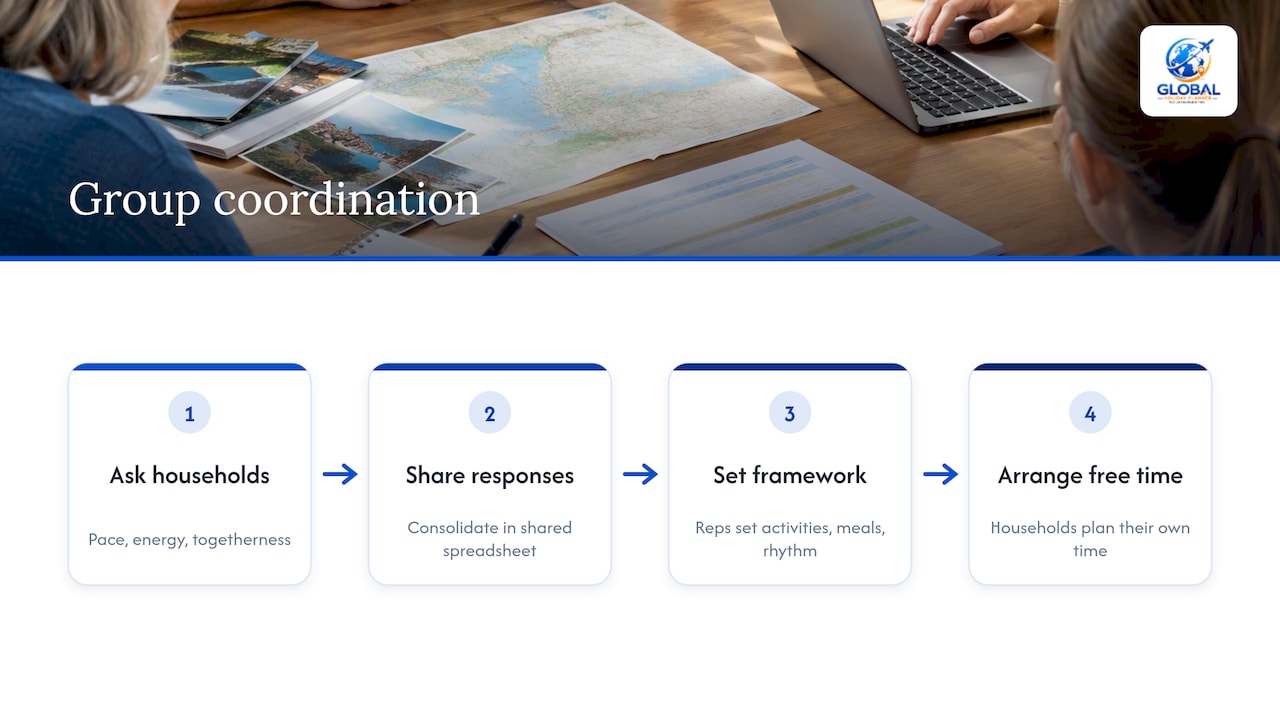
The survey-and-spreadsheet approach used for budget and dates works here too. Ask each household directly about pace, energy level, and how much togetherness they want, then share the consolidated answers so nobody is surprised later. Running this as an online survey and consolidating responses into a shared spreadsheet is a method travel organizers use specifically to catch preferences and restrictions early.
Keep the final decisions limited to a small core, usually one representative per household, rather than opening every choice to the full group. A large group debating restaurant options every night can spend too long making a decision. Instead, let the core group set the framework (anchor activities, meal plan, daily rhythm) and let individual households fill in their own time around it.
A brief check-in over coffee or in a group chat can catch small frustrations before they become real ones. If a plan needs to change because someone is tired or a grandparent needs a rest day, saying so early is far easier than pushing through and causing a bigger blowup later in the week.
Dietary considerations and meal planning across generations
Multigenerational trips almost always mean juggling different diets: a grandparent managing a low-sodium diet, a parent avoiding gluten, a toddler who eats five foods total. Planning meals around the most restrictive diet in the group, rather than the least, tends to avoid last-minute scrambles at restaurants that can’t accommodate everyone.
Lodging with a kitchen helps here beyond just saving money. Cooking some meals at the rental lets you control exactly what goes into each dish, which matters more with food allergies or medical diets than with simple preference. A quick grocery run on arrival day covering breakfast staples and a few easy dinners takes the pressure off finding a restaurant that works for a large party with varied dietary needs.

For restaurant meals, book ahead and call to confirm the kitchen can handle specific allergies rather than trusting a menu description alone. Splitting into smaller groups for some meals, rather than forcing every dinner to seat the whole party, also makes it easier to match a restaurant to who’s actually eating there that night.
Handling travel documents and ID for every generation
Every traveler needs a valid passport or ID appropriate to the destination, but the lead time to renew or obtain one varies widely by age and by country, so check requirements for each nationality in your group separately rather than assuming one rule covers everyone. A grandparent’s passport might be expired, a child might need their first one, and processing times differ enough that this should be one of the very first items checked once dates are locked.
Keep a simple shared document, physical or digital, listing each traveler’s passport number, expiration date, and any visa requirements for the destination. For children traveling without both parents, some countries require notarized consent letters, so confirm this well ahead of departure rather than at the airport.
It helps to photograph or scan every document and store a copy separately from the originals, in case anything is lost mid-trip. A grandparent who manages their own documents independently still benefits from the organizer having a backup copy on hand.
Emergency planning for medical needs and travel insurance
A short written emergency plan removes guesswork if something goes wrong mid-trip. Identify the nearest hospital or urgent care to your lodging before you arrive, note which household member will drive or coordinate transport in an emergency, and share this plan with every adult in the group, not just the organizer.
Travel insurance deserves particular attention for mixed-age groups because coverage needs differ sharply between a toddler and a grandparent. Check the policy’s limits on trip cancellation and especially on medical evacuation, since older travelers may need higher evacuation coverage than a standard family plan provides. Our guide on whether travel insurance is worth it breaks down how to weigh the cost against your group’s actual risk, and our trip cancellation versus interruption checklist clarifies what each type of coverage actually pays for.
Decide early whether to buy one group policy or separate per-person policies, since combining ages and pre-existing conditions under one plan isn’t always cheaper than buying individually. Confirm whether your destination has reliable English-speaking medical care nearby, or whether you need coverage that includes translation or medical evacuation to a larger facility.
Packing tips for every age group in the family
Packing for a multigenerational trip works best when each age group gets its own short checklist instead of one generic list for the whole family. Grandparents often need to prioritize medications, compression socks for long flights, and any mobility aids; parents are usually managing snacks, entertainment, and spare clothes for younger kids; teenagers can largely pack for themselves with a reminder about weather and activity-specific gear.
A shared packing list in the group spreadsheet, with a column per household, helps avoid duplicate bulky items like beach umbrellas or first-aid kits that everyone assumes someone else is bringing. Pack a basic first-aid kit and a few over-the-counter medications centrally, since finding a pharmacy in an unfamiliar destination on day one is an avoidable hassle.
For infants and toddlers, confirm whether a car seat is needed for transfers or rental cars well before travel day. Our guide on renting a child car seat covers the common seat types and where to arrange one if you’d rather not check one at the airport.
Using apps and technology to keep the group coordinated
A single shared tool for scheduling and communication saves most multigenerational groups from a dozen overlapping group chats and missed messages. A shared spreadsheet or document works for budget, dates, and packing lists, while a dedicated group chat app keeps day-to-day logistics separate from planning details.
Simple polling apps make the flipped-date method easier to run than email threads, since responses land in one place automatically. A shared calendar, updated once the itinerary is set, lets every household see anchor activities, free days, and transport times without asking the organizer repeatedly.
For in-destination coordination, a basic location-sharing feature built into most phones helps subgroups reconnect after splitting off for different activities. None of this requires anything elaborate: the goal is one shared source of truth that every generation in the group, including grandparents less comfortable with newer apps, can actually use.
Organizer’s checklist and quick lessons learned
If you remember nothing else: settle the money, lock the dates, book flights and your home base, confirm accessibility needs in writing, and pick one or two anchor activities. Keep final decisions with a small core group and run surveys instead of open debates to avoid hurt feelings. The planning itself feels like extra work in the moment, but it’s what lets multiple generations actually enjoy being in the same place at once.
— Global
How Global Holiday Planner helps you book a multigenerational trip
Once your group has settled the budget, dates, and accessibility needs, we make it straightforward to turn that plan into confirmed reservations. We compare flights, hotels, car rentals, airport transfers, and travel insurance in one place, so you can see real costs side by side instead of checking five different sites.
- Our group flight playbook walks through locking seats for larger groups.
- Our flexible-date flight grids help you find cheaper fares around your locked overlap window.
- Our hotel and car rental comparisons show total costs together.
Once your core group has a date and a budget, compare flights for your whole party and start locking in the trip.
FAQ
What is the best way to plan a family vacation?
The most reliable approach is to settle the budget model and find overlapping dates before researching destinations, since those two decisions shape everything else. Running a short survey of each household’s availability and consolidating the answers into a shared spreadsheet, a method recommended by organizer guides, keeps the process efficient and reduces conflict.
What are the stages of travel planning?
Travel planning generally moves through research, budgeting, booking, pre-trip preparation, and the trip itself. For multigenerational groups, the research and budgeting stages matter most, since they determine whether dates, lodging, and accessibility needs align across every household before any bookings happen.
What are some ideas for a multigenerational holiday?
Beach destinations, gentle nature trips, and accessible city breaks with museums and short cruises tend to work well because they offer activities for a wide range of energy levels and mobility needs. Choosing a destination with lodging that includes a kitchen and shared living space, rather than separate hotel rooms only, also makes it easier for the group to gather and cook together.
What are some good travel planning apps?
A shared spreadsheet or document works well for budgets, packing lists, and availability polling, while a group chat app keeps day-to-day communication separate from planning details. For comparing and booking flights, hotels, car rentals, and travel insurance together, our flight search and hotel comparison tools let you see options side by side once your group has agreed on dates.