

Family vacation planning is really just the art of juggling destinations, hotels, activities, and a hundred tiny logistics so that everyone (toddlers, teenagers, and yes, the grandparents you talked into coming) actually comes home happy instead of wrecked. Get it right and you land somewhere between adventure and rest, inside a budget that doesn’t make you sweat, with enough flexibility for the wildly different energy levels crammed into one family. Get it wrong and it becomes a blur of skipped naps, meltdowns triggered by an overstuffed schedule, and money spent on stuff nobody wanted to do in the first place.
I’ve watched both versions play out. This guide walks through the whole thing, start to finish, from picking a place that works for every age to booking the right room and packing without losing your mind. And it doesn’t matter if you’re planning a big international trip you’ve dreamed about for years or just a weekend somewhere two hours away. The bones of it are the same.
Table of Contents
- What Family Vacation Planning Actually Is (And Why It Matters)
- How Do You Pick a Place That Works for Everyone?
- Where Should Your Family Actually Stay?
- What Does a Family Trip Really Cost?
- Building an Itinerary Nobody Hates
- Packing and Logistics Without the Last-Minute Panic
- Booking Smart: Flights, Transfers, and Insurance
- Questions Parents Actually Ask
What Family Vacation Planning Actually Is (And Why It Matters)
Family vacation planning means deliberately organizing every part of a trip (dates, lodging, activities, transport, budget) around an entire household rather than one person’s wishlist. And it matters because families are basically a negotiation waiting to happen. Little kids need routine and sleep. Older kids want stimulation and a little freedom. Parents, if we’re honest, just want a few hours where nobody needs anything. Ignore any one of those groups and the whole thing tends to fall apart by day three.
Solo travel and couples’ trips are simple by comparison. Family trips carry way more moving parts: nap schedules, food allergies, stroller logistics, the school calendar, and the sheer emotional load of managing several personalities in a place none of you knows well. A bit of structure up front cuts down the guesswork and heads off the single regret I hear from parents over and over, which is that they crammed too much in and left zero room to breathe. The goal was never a perfect trip. Nobody gets that. The goal is a realistic one with space for the good accidents and less of the avoidable stress.
How Do You Pick a Place That Works for Everyone?
The best family destination is one with a mix of structured attractions, safe walkable areas, reasonable travel time, and something for kids of different ages. It is almost never the fanciest or most famous spot on your bucket list. A place that’s magic for a honeymoon or a solo backpacking run can be a genuine nightmare with a toddler and a ten-year-old in tow.
Match the Place to Your Kids’ Ages
Little ones under six do best with shorter flights, food they recognize, and somewhere with beaches or green space to run off steam. The 7-to-12 crowd loves interactive stuff, theme parks, aquariums, hands-on museums, anything they can touch and mess with. Teenagers? They want autonomy, decent Wi-Fi, and at least one thing that reads as “cool” instead of educational. So if your family spans that whole range, hunt for places with layered appeal. A city with a world-class theme park and a walkable old town, say. That way everybody’s got something to look forward to instead of just tolerating everybody else’s day.
Think About Flight Time and Jet Lag
Long-haul flights with young kids are doable, but you have to plan around sleep and give yourself recovery days. A rule of thumb a lot of travel planners lean on: build in one low-key recovery day for every three to four hours of time difference before you throw yourself at a packed itinerary. If you’re newer to international travel, honestly, start with something a moderate flight away instead of leaping straight into a 15-hour marathon. And if this is your first trip abroad at all, the tips in How to Plan Your First International Trip: A No-Panic Guide are worth a read before you commit to wrangling a whole family through customs.
The Kinds of Places That Tend to Work
A few categories just keep working for families because they check the boxes that matter: safety, variety, and logistics that won’t break you. Tropical beach spots with calm, shallow water and resorts built around kids’ clubs and family pools. Big cities with solid public transit, stroller-friendly sidewalks, and a mix of museums, parks, and theme parks. Mountain destinations with easy trails, wildlife, and cooler air that active kids handle better. And all-inclusive resort regions where meals, activities, and entertainment come bundled, which quietly saves you from a dozen small decisions a day.

If budget is really the thing steering the ship rather than the type of place, compare your options before you lock in dates. The roundup of 15 Best Budget Travel Destinations for 2026 Travelers is a good place to start when you’re trying to stretch a limited fund without cheaping out on the actual experience.
One more thing before you finalize anything. Actually ask everyone what they want instead of guessing. Some parents run a quick informal poll, having each person rank destinations, activities, or must-do stuff, using something simple like Curio Surveys to collect it all before committing. Even five questions can surface a strong preference (or a total dealbreaker) you’d never have seen coming.
Where Should Your Family Actually Stay?
There’s no single “best” place for families to stay. It comes down to your kids’ ages, how much you value private space versus built-in entertainment, and whether you want meals included or a kitchen you can cook in. The three usual suspects are hotels, all-inclusive resorts, and vacation rentals, and each one asks you to trade something.
Hotels near the big attractions win on convenience, and plenty have connecting rooms or family suites, but space gets tight fast with a bigger group. All-inclusive resorts fold meals, drinks, and activities into one price and usually run supervised kids’ clubs, which is basically a free break for you, though they can quietly discourage you from ever leaving the property. Vacation rentals give you the most room and a kitchen, which is a lifesaver with picky eaters and a real dent in your food costs, but you lose daily housekeeping and there’s no on-site entertainment to fall back on when it rains.
| Accommodation Type | Best For | Typical Pros | Typical Trade-Offs |
|---|---|---|---|
| Hotel | City trips, short stays, families wanting proximity to attractions | Central location, daily housekeeping, front-desk support | Limited space; extra beds or connecting rooms may cost more |
| All-inclusive resort | Beach vacations, parents wanting built-in downtime | Meals/activities bundled, kids’ clubs, predictable daily cost | Less flexibility to explore outside the resort |
| Vacation rental (house/apartment) | Longer stays, larger families, picky eaters | More space, kitchen access, often cheaper per person for groups | No daily housekeeping, entertainment not included |
| Multi-generational villa or large rental | Extended family trips, reunions | Everyone under one roof, shared common spaces | Requires more coordination on schedules and chores |
When you’re actually comparing specific places, read the amenities instead of assuming. Check whether cribs, high chairs, or pack-and-plays come free. Whether the pool has a shallow end or a lifeguard. And how far the place really is from the stuff you want to see, versus how the listing photos make it look. Read the recent reviews from other families too, not just the star rating, because that’s where you find out the truth about noise levels and whether the Wi-Fi actually works.
What Does a Family Trip Really Cost?
There’s no universal number, and anyone who gives you one is guessing. It swings wildly with destination, dates, group size, and how much of the trip is bundled versus paid piecemeal. What matters more than some magic figure is building your estimate from every major category before you book a single thing, so nothing ambushes you mid-trip.
The Buckets You Need to Budget For
Break the total into distinct piles: flights or transport, accommodation, food, activities and tickets, travel insurance, and a contingency fund for the stuff you can’t predict. A lot of experienced family travelers set aside somewhere in the 10 to 15 percent range of the total as a buffer, for the lost item, the surprise taxi, the souvenir your kid absolutely will not leave the store without. Build that cushion in from the start and budget anxiety stops leaking into the actual vacation.
How Families Actually Cut Costs
Shoulder season is your friend. Traveling just before or after school holidays (where the rules let you) usually knocks a noticeable amount off flights and hotels compared to those peak weeks when everyone else is booking. A kitchen in your rental cuts food costs more than you’d think, because even one home breakfast a day for a family of four adds up fast against restaurant prices over a week. And bundling flights, lodging, and a car rental through one trusted platform makes price comparison simpler and saves you from juggling confirmation emails from six different companies.
When to Actually Hit “Book”
Airlines and hotels move their prices around constantly, so there’s rarely one perfect day to book that works for every route. My honest advice? Once your dates are firm, lock in flights and accommodation instead of waiting forever for a fare that might never drop. It’s less stressful, and for family trips it really matters, because connecting rooms and larger units tend to vanish well before the trip date.
Building an Itinerary Nobody Hates
A good family itinerary mixes the must-see stuff with genuine, unscheduled downtime instead of trying to cram in everything. The single most common mistake I see is over-scheduling, treating a week like a checklist to clear rather than a thing to enjoy. Don’t do that.
Leave Room to Breathe
Plan one big activity a day. Just one. A morning at a theme park or aquarium or museum, then a relaxed afternoon at the pool or a nearby park, tends to keep both moods and energy in a survivable range. And with little kids especially, protecting nap time or even just a quiet midday break is the difference between a great day and a 4 p.m. meltdown that torches the whole evening.
Let Everyone Claim Something
Give each family member, including any kid old enough to have opinions, one activity or meal that’s entirely theirs to choose. This does two jobs at once. Kids get a sense of ownership over the trip, and the whole itinerary stops being dictated by whatever the parents find interesting. For blended-age groups, alternating “kid-led” and “parent-led” days is a dead-simple way to keep things fair.
Pad Your Transitions
Getting a family of four or five out the door, through security, or onto a train takes longer than it does for one person. Way longer. Add at least 30 to 45 minutes to every transition point, checking out, catching a train, arriving before an attraction opens, so one delay doesn’t snowball into a stressful chain reaction that eats your whole afternoon.
Do the Boring Research First
Before you commit to an attraction, check the annoying practical stuff: minimum height or age for rides, stroller access, whether you can bring your own food, and where the nursing or changing facilities are. A two-minute search or a quick call ahead saves you from showing up with a thrilled kid and running straight into a restriction at the gate. Nothing sours a morning faster.
Packing and Logistics Without the Last-Minute Panic
Good family packing happens category by category, well ahead of departure, not in a frantic pile the night before. Starting early also gives you time to catch the gaps, the outgrown swimsuit, the sunscreen that expired last summer, before they turn into a problem at 11 p.m.
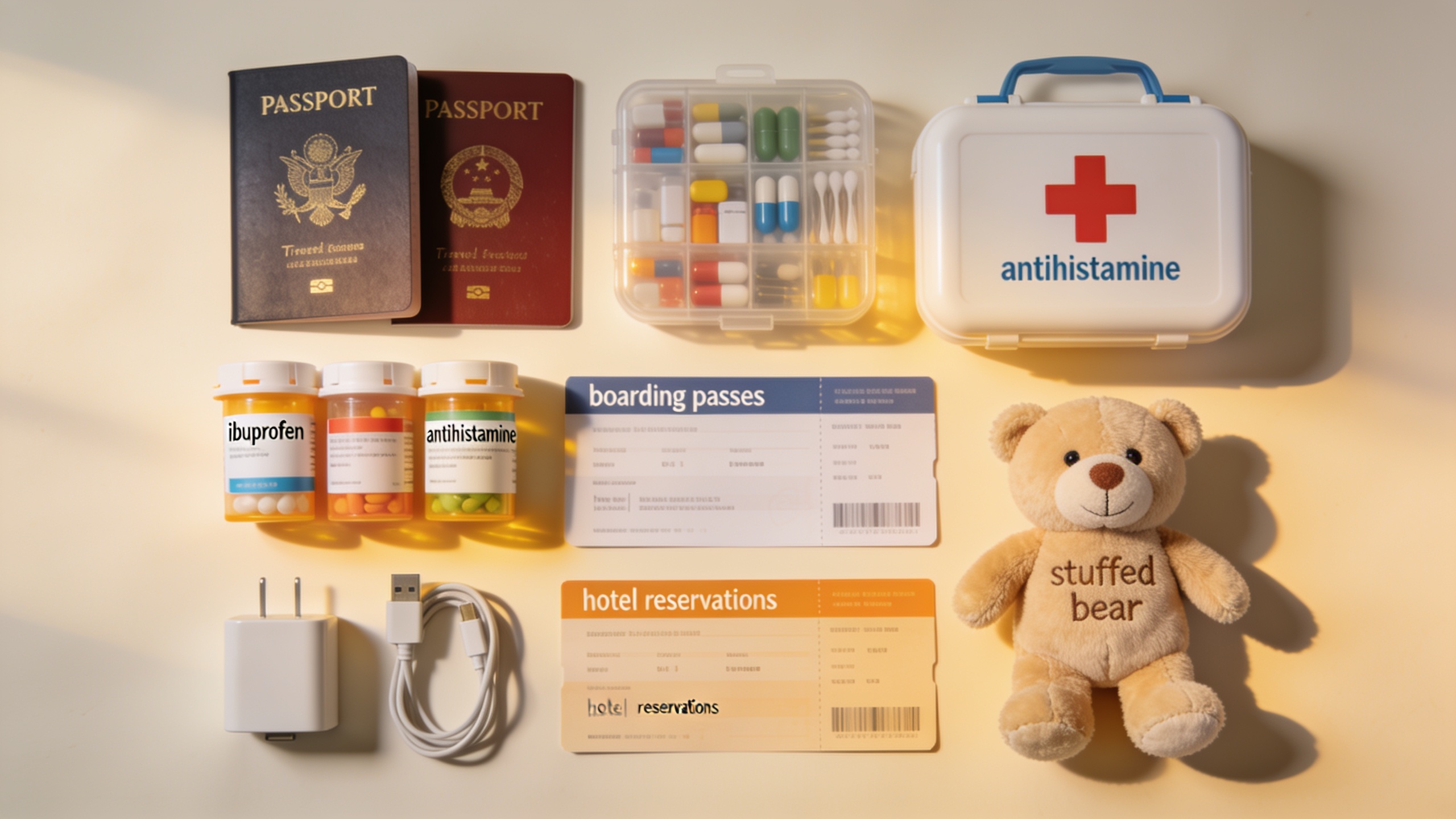
Start with documents and health essentials. Check every passport’s expiration date at least a few months out, since plenty of countries want passports valid for a set stretch beyond your travel dates. Keep prescriptions in your carry-on, never checked, and pack a basic first-aid kit with kids’ pain reliever, bandages, and motion sickness stuff if anyone in the family needs it.
Pack by category, not by kid. A lot of families find it easier to pack one bag for all the sleepwear, one for swimwear, one for shared toiletries. Sounds fussy, but it makes finding things faster and repacking way less painful when you’re moving between places.
Build a carry-on survival kit. For flights or long drives, pack one dedicated bag with snacks, a change of clothes for the little ones, headphones, a portable charger, and a comfort item or two (a stuffed animal, a favorite book). Keep it separate from your checked luggage so it’s right there when a flight gets delayed or a bag goes wandering.
Reconfirm everything 48 hours out. In the last two days, re-check every booking, flights, hotel, transfers, pre-booked activities, and look at the weather forecast while there’s still time to swap out clothing choices.
Booking Smart: Flights, Transfers, and Insurance
Booking a family trip well means looking at flights, ground transport, and insurance together instead of in isolation, because a decision in one spot quietly reshapes the others. That cheap flight with the brutal layover? It might cost you far more in the end, in the form of an overtired toddler and a missed connection.
When you’re comparing flights for a family, look past the headline fare. Check the seat selection policy, the baggage allowance for the number of people you’ve got, and whether the airline lets families with young kids board early (a small thing that feels enormous in the moment). For ground transport, pre-booking an airport transfer removes the whole gamble of scrounging for a taxi with car seats and enough room for the luggage and strollers, which matters most right after a long-haul flight when everyone’s patience is already gone.
Travel insurance is the one I’d tell you not to skim on. It usually covers a lot more than parents expect: trip cancellation because a kid got sick, emergency medical care abroad, delayed or lost bags. Compare the actual coverage, not just the price, and confirm that all your kids fall under a single family policy rather than needing separate plans. That’s ten minutes that can save you a genuinely bad day. A platform that puts flights, hotels, car rentals, transfers, and insurance side by side in one place cuts down the hours you’d otherwise burn ping-ponging between booking sites.
Questions Parents Actually Ask
How long should a family vacation with young kids be?
No hard rule, but a lot of parents find 5 to 8 days hits the sweet spot: long enough to justify the cost and travel time, short enough that routine-loving little ones don’t burn out. Shorter 2-to-3-day trips work great for regional getaways that skip the long flights entirely.
How far ahead should I start planning?
For international trips or peak-season travel (school holidays, big festivals), start the process 3 to 6 months out for the best shot at flight availability, family-sized rooms, and popular activity bookings. Domestic or off-peak trips? You can usually get away with a lot less lead time.
How do I keep the costs from spiraling?
Set category-by-category budgets before you book (flights, lodging, food, activities, insurance, and a contingency fund), look at rentals with a kitchen to bring down food costs, and compare shoulder-season dates against peak ones, since flight and family-room prices shift noticeably once you’re outside the school holiday windows.
What do parents always forget to pack?
The usual casualties: backup chargers for the devices keeping kids sane in transit, a printed copy of your key documents for when a phone dies, motion sickness remedies, and a change of clothes in the carry-on instead of the checked bag, for the inevitable spill or delay.
All-inclusive resort or vacation rental, which is better?
Depends entirely on what your family cares about. All-inclusives are great if you want kids’ clubs, bundled meals, and a predictable daily cost. Rentals win for bigger families or longer stays where the extra space, a kitchen, and lower per-person costs beat out daily housekeeping and on-site entertainment.
Every family’s idea of a great vacation looks a little different, and that’s the whole point. But the process underneath it, picking a place that fits your kids’ ages, choosing lodging that matches your priorities, budgeting by category, and leaving actual breathing room in the schedule, holds up no matter where you’re headed. Do a bit of the boring work up front, keep your booking tools in one place, and the trip itself finally gets to be about the memories instead of the logistics.
[…] Ultimate Family Vacation Planning: 15 Easy Steps for Parents […]
[…] up with when you actually land or check in. If you’re building out a longer family itinerary, our family vacation planning guide covers the packing and logistics side in more depth, and the Wild Foodz family travel planning […]
[…] Ultimate Family Vacation Planning: 15 Easy Steps for Parents […]
[…] Ultimate Family Vacation Planning: 15 Easy Steps for Parents […]
[…] Ultimate Family Vacation Planning: 15 Easy Steps for Parents […]
[…] Ultimate Family Vacation Planning: 15 Easy Steps for Parents […]
[…] Ultimate Family Vacation Planning: 15 Easy Steps for Parents […]
[…] Ultimate Family Vacation Planning: 15 Easy Steps for Parents […]