

Buy standalone travel insurance when your trip is international, expensive, or complex, or when you need medical evacuation protection, Cancel For Any Reason coverage, or a preexisting condition waiver. Rely on your credit card’s travel protections for short, low-cost domestic trips if you already have solid health insurance. Either way, credit card benefits usually only kick in when you book and pay with that specific card.
TL;DR:
- Standalone travel insurance is essential for international, high-cost, or complex trips where evacuation and cancellation are significant risks.
- Policies typically cost 3% to 8% of total trip expenses, with optional coverage like CFAR adding 40% to 60% more, but only partially reimbursing costs.
- Credit card protections are usually limited, secondary, and often exclude coverage for medical evacuation, preexisting conditions, or CFAR, requiring careful verification of benefits.
- If trip costs exceed $2,000, or you face remote destinations, complex itineraries, or higher medical risks, buying a dedicated policy is more reliable than relying on credit card benefits.
- Combining targeted standalone plans with credit card protections offers the most comprehensive coverage while avoiding unnecessary costs for low-risk, short domestic trips.
Table of Contents
- What standalone travel insurance covers (and what it costs)
- How credit card travel protections work
- When to buy standalone travel insurance: practical trip scenarios
- When credit card protections are likely enough
- Decision checklist: step-by-step process to decide for your trip
- Perspective: combining card benefits and standalone policies
- Use Global Holiday Planner to compare travel insurance and booking costs
- Sources
- FAQ
What standalone travel insurance covers (and what it costs)
A standalone policy bundles protections that most credit cards either skip or cap tightly. The core components are:
- Trip cancellation and interruption, which reimburses prepaid costs if you cancel or cut a trip short for a covered reason.
- Emergency medical coverage, which pays for treatment abroad when your regular health plan does not.
- Medical evacuation, which covers transport to a hospital or home when local care is not adequate.
- Baggage and personal item loss, covering theft, damage, or delayed delivery of your belongings.
- Trip delay benefits, covering meals and lodging when you are stuck waiting.
- Cancel For Any Reason (CFAR), an optional upgrade that lets you cancel for a reason the base policy would not otherwise cover.
Standalone policies typically cost 3% to 8% of your total trip cost, and adding CFAR can raise that by 40% to 60%, though CFAR usually only reimburses a portion of your costs rather than the full amount.
Department of State. That single figure explains why evacuation coverage matters more than almost any other line item on a policy, particularly for travel far from major hospitals.
Timing affects what you can buy. Preexisting condition waivers and CFAR eligibility generally require purchase within 14 to 21 days of your first trip deposit. Wait longer and you may still get a policy, but those two features are often off the table.
How credit card travel protections work
Many travel rewards cards bundle in protections that cost nothing extra as long as you use the card correctly. Typical benefits include:
- Trip cancellation and interruption insurance, often capped at a set dollar amount per trip.
- Trip delay reimbursement for meals and lodging after a set delay threshold.
- Baggage delay coverage for essentials while your luggage catches up with you.
- Rental car collision damage waiver, covering damage to a rental you charged to the card.
- Limited travel accident insurance, paying out in the event of accidental death or dismemberment during the trip.
- Travel assistance services, which typically help you locate care or get information rather than pay your bills.
To trigger any of this, you generally have to charge all or most of the eligible trip cost to that specific card. According to Forbes Advisor, failing to meet that payment requirement, or skipping an enrollment step some issuers require, can void the benefit entirely. Coverage is also usually non-transferable: it protects the cardholder and sometimes immediate family, but not a friend you are traveling with who paid separately.
The gaps matter as much as the benefits. Card protections rarely include meaningful medical evacuation coverage, almost never include CFAR, and commonly exclude preexisting conditions. Payout caps are often lower than what a standalone policy offers, and coverage is frequently secondary, meaning you may need to file with other insurers first before the card issuer pays anything. The Points Guy notes that this secondary status can stretch out claims considerably when you need money fast.
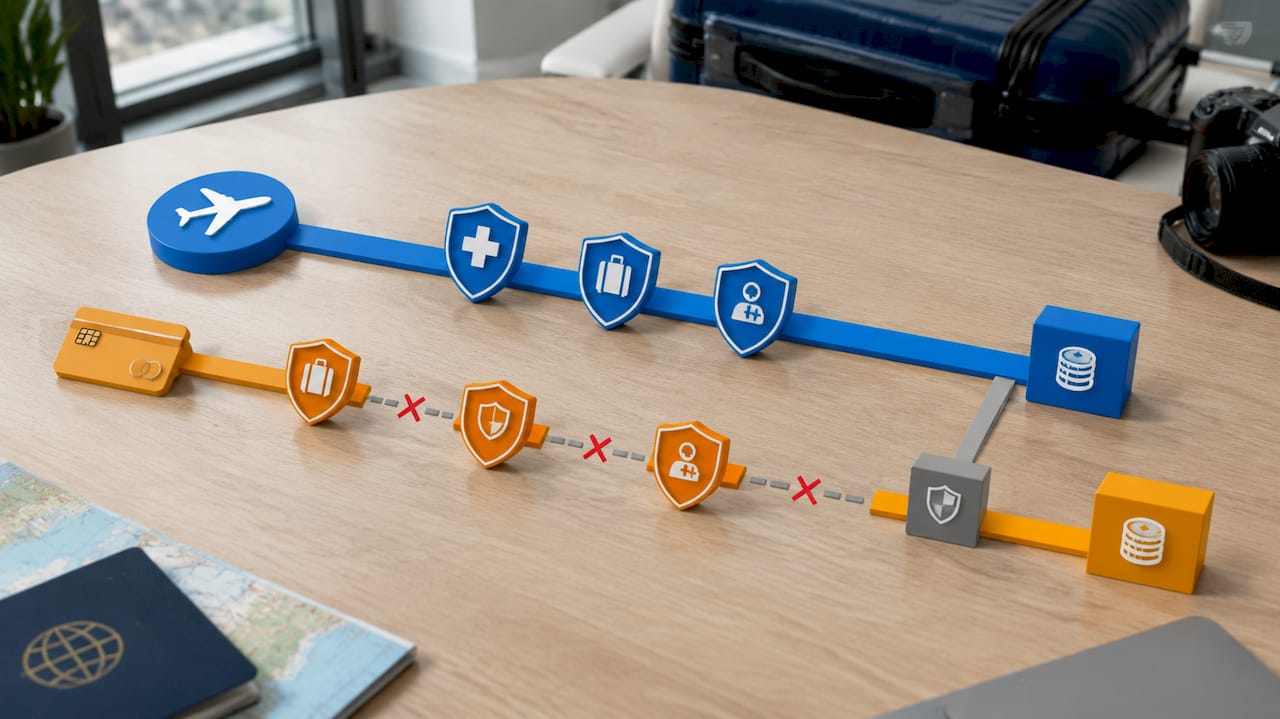
Pro Tip: Pull your card’s benefit guide before you book, not after something goes wrong: the eligibility rules are more specific than the marketing page suggests.
When to buy standalone travel insurance: practical trip scenarios
A handful of trip characteristics should push you toward a purchased policy rather than card benefits alone.
- International travel, especially to remote or hard-to-serve destinations, where evacuation logistics and costs climb fast.
- Multi-stop or complex itineraries, where one disruption can cascade through several bookings.
- High prepaid, nonrefundable costs, commonly cited at more than $2,000 per person as the point where the financial exposure outweighs the premium.
- Long lead times between booking and departure, which widens the window for something to go wrong before you even leave.
- Limited or no out-of-country health coverage, including Medicare, which the State Department confirms does not pay for care outside the United States.
- Older travelers or anyone with higher medical risk, where the odds of needing care abroad are higher.
- High-risk or adventure activities, from diving to backcountry skiing, which many base policies exclude without an add-on.
- Any need for CFAR or a preexisting condition waiver, since cards almost never offer either.
Industry guidance generally agrees: buy coverage for international trips or journeys more than 100 miles from home once prepaid costs become significant. If two or more of these scenarios apply to your trip, a standalone policy is worth pricing out.
When credit card protections are likely enough
Card benefits can cover you adequately in lower-risk situations. A short domestic trip, a fully refundable hotel and flight, or a rental car you are only driving a few miles from home all carry limited financial exposure. If your health insurance already extends solid coverage internationally, and your destination has reliable medical infrastructure, you may not need to layer on a policy.
A quick verification checklist before you decide to skip standalone coverage:
- Read your card’s actual benefit guide, not just the marketing summary.
- Confirm who is covered: you alone, immediate family, or anyone traveling on the same reservation.
- Confirm the booking trigger: did you pay for the flight, hotel, or tour with that card?
- Check the payout limits against your actual trip cost, not an assumed average.
- Confirm whether the evacuation benefit, if any, is realistic for your destination.
If your card explicitly includes adequate evacuation benefits and you booked everything on it, that combination can be enough for a routine trip.
Decision checklist: step-by-step process to decide for your trip
Run through these steps for any trip where you are unsure:
- Add up your nonrefundable costs. If losing that money would hurt financially, especially above the $2,000 per person mark often used as a rule of thumb, lean toward buying a policy.
- Assess destination risk and evacuation exposure. Remote or medically underserved locations carry the $20,000 to $200,000 evacuation range as a real possibility, not a hypothetical.
- Check who your card actually covers. Cardholder only, family, or traveling companions can change the calculation significantly.
- Identify special needs. CFAR, a preexisting condition waiver, or adventure-activity coverage all point toward a standalone policy.
- Check your timing. Buying within 14 to 21 days of your deposit keeps waiver options open; past that window, some benefits disappear even if you still buy a policy.
Pro Tip: Price a standalone policy before you dismiss it: at 3% to 8% of trip cost, it is often cheaper than the evacuation bill it is meant to prevent.
Perspective: combining card benefits and standalone policies
The strongest approach is rarely one or the other. Lean on your card’s trip delay, baggage, and rental car protections where they are genuinely solid, then buy targeted coverage for the gaps: medical evacuation, CFAR, or a preexisting condition waiver. Comparison tools let you weigh insurance options against total trip cost in one view, so you can see where a card already has you covered and where a policy earns its premium. For deeper reading on matching coverage to a specific trip, see our guide to choosing a travel insurance plan.
— Global
Use Global Holiday Planner to compare travel insurance and booking costs
A travel booking platform compares flights, hotels, car rentals, and travel insurance side by side, so you see the full price of a trip, not just the ticket cost, before you decide what coverage to add.
- Compare several insurance options against your actual itinerary cost instead of guessing at averages.
- See whether booking a flight or hotel on a particular card changes what protection you already have.
- Check refundable versus nonrefundable fares before you commit, since that single choice shapes how much insurance you actually need.
Run your upcoming trip through our travel insurance comparison to see coverage and pricing side by side for your exact dates and destination.
Sources
- U.S. Department of State — Your health abroad
- MoneyGeek — Is travel insurance worth it & should you buy?
FAQ
What are the disadvantages of travel insurance?
Standalone travel insurance adds cost on top of your trip, typically 3% to 8% of the total, and most policies still carry exclusions for preexisting conditions or high-risk activities unless you pay extra. Filing a claim also requires documentation, which can be a hassle for a minor loss.
What isn’t covered by travel insurance?
Standard policies commonly exclude preexisting medical conditions unless you buy a waiver within the 14 to 21 day purchase window, along with high-risk activities, reckless behavior, and cancellations for reasons outside the policy’s named list. CFAR, if not added separately, is never included by default.
Will my credit card cover travel insurance?
Many travel rewards cards include some trip cancellation, delay, and baggage protection, but only if you charged the trip to that card and you meet the issuer’s specific eligibility terms, according to Forbes Advisor. Coverage is often secondary and non-transferable, so it may not extend to companions who paid separately.
What will travel insurance not cover?
Beyond preexisting conditions and high-risk activities without an add-on, standard policies will not pay for losses caused by your own negligence, travel to destinations under certain advisories, or cancellations for reasons not listed in the policy. Reading the policy’s exclusions section before buying avoids surprises at claim time.
Does my credit card cover medical evacuation?
Most travel rewards cards offer little or no medical evacuation coverage, and when they do, limits are often far below the real cost of an air ambulance, which can run $20,000 to $200,000. For international trips to remote areas, a standalone policy with dedicated evacuation coverage is the more reliable option.