
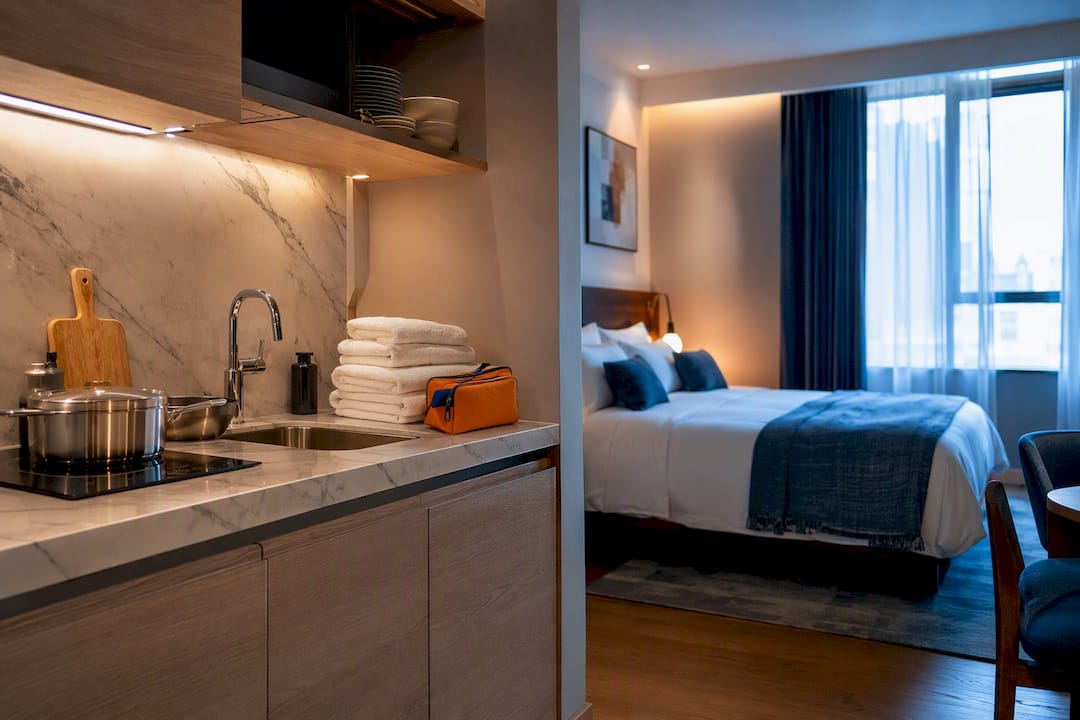
For stays longer than a week, or for families who need a kitchen and separate living space, an aparthotel is usually the smarter pick. For short trips where round-the-clock staff and on-site facilities matter more than square footage, book a hotel. The real trade-off is space and self-sufficiency versus staffed service, so verify the operational details before you commit either way.
TL;DR:
- Aparthotels offer lower per-night costs for stays longer than a week, especially when booked monthly or weekly, due to significant discounts.
- They typically provide a separate living area, kitchen appliances, and laundry options, which are often unavailable in standard hotel rooms.
- Verification of reception hours, housekeeping frequency, kitchen inventory, and security features is essential before booking to avoid surprises.
- Location plays a key role, with aparthotels often in residential neighborhoods requiring commutes, unlike hotels near tourist or business centers.
- The decision should be driven by stay length and service needs rather than category labels, as operational details heavily influence value and experience.
Table of Contents
- Aparthotel vs Hotel: The Quick Comparison
- What Is an Aparthotel, Exactly?
- Who Should Book an Aparthotel, and Who Should Book a Hotel?
- How Much Does an Aparthotel Cost Compared to a Hotel?
- What Should You Verify Before You Book?
- How Do You Book Smart and Avoid Surprises on Arrival?
- Beyond the Kitchen: How Do Amenities Compare?
- Are Aparthotels as Secure and Private as Hotels?
- Does Location Change the Aparthotel vs Hotel Decision?
- Our Take: Stop Choosing by Label, Start Choosing by Stay Length
- Let Global Holiday Planner Compare Your Options for You
- Sources
- FAQ
Aparthotel vs Hotel: The Quick Comparison
The fastest way to see where these two diverge is to line up what actually changes your day-to-day experience, not just the brochure copy.
- Usable space: Aparthotels typically give you a separate living area and bedroom; hotel rooms pack sleeping, sitting, and storage into one footprint. Check this if you’re traveling with kids or working remotely.
- Kitchen and laundry: Aparthotels usually include a stovetop, refrigerator, and often an in-unit or shared washer; hotels rarely offer more than a minibar. Confirm exact appliances before booking if cooking matters.
- Housekeeping frequency: Hotels clean daily by default; aparthotels often clean weekly or on request, sometimes at an added cost. Ask about the schedule and whether it’s included.
- Reception and service hours: Hotels tend to staff the front desk 24/7; aparthotel reception can close in the evening, with a phone line for emergencies. Verify hours if you might arrive late or need help at night.
- Pricing pattern: Hotels charge nightly; aparthotels often drop the effective rate sharply with weekly or monthly bookings. Compare the total cost across your full stay length, not just the nightly rate.
- Ideal trip length: Hotels suit one to five nights; aparthotels earn their keep from about a week onward.
One data point worth remembering: Booking.com for Business cites an example where a monthly serviced-apartment rate worked out to roughly $76 a night against a $120 hotel average for a comparable stay. That gap is why the “aparthotel vs hotel” decision often comes down to how many nights you’re actually booking.
What Is an Aparthotel, Exactly?
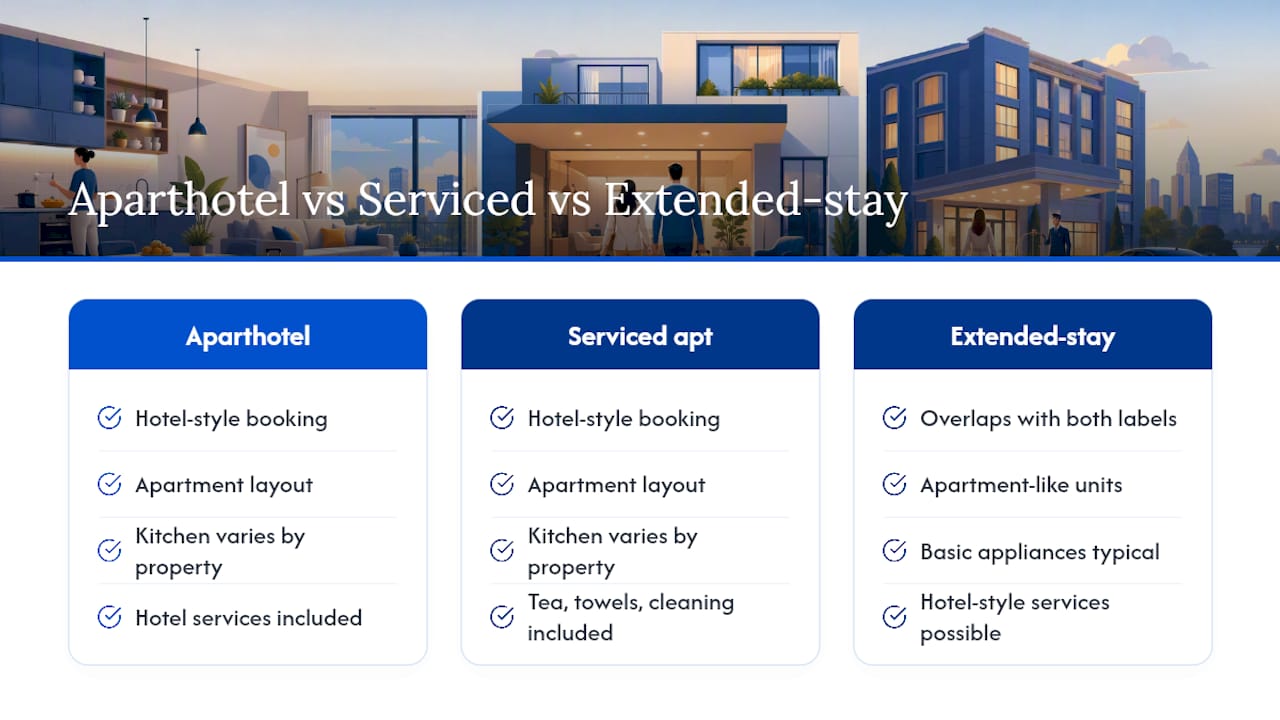
An aparthotel, also called a serviced apartment, is a property that runs on hotel-style booking and check-in but gives you an apartment layout instead of a standard room. The Cambridge Dictionary defines it plainly: a set of apartments you can stay in for a short time that still offer services like a hotel, including tea and coffee supplies, towels, and cleaning. Wikipedia’s entry on apartment hotels describes the same concept as a serviced apartment complex using hotel-style reservations, built for both short and extended stays.
Here’s where it gets messy: “extended-stay hotel” is a third label that overlaps heavily with both terms. These properties typically include basic kitchen appliances like a sink, refrigerator, microwave, and stovetop. They often trigger discounted rates once you book past five to seven nights, according to Wikipedia’s aparthotel entry. But the exact inventory varies property to property. One listing’s “kitchen” is a two-burner cooktop; another’s is a full range with an oven.
The takeaway: dictionary and industry definitions overlap enough that the label alone won’t tell you what you’re getting. Treat “aparthotel,” “serviced apartment,” and “extended-stay hotel” as loosely related categories, then check the actual listing for appliances, layout, and service hours before you decide anything.
Who Should Book an Aparthotel, and Who Should Book a Hotel?
Certain travelers gravitate toward aparthotels almost automatically, and others are better off with a standard hotel room no matter how appealing the extra space looks.
Aparthotels tend to work best for:
- Families who want a separate space for kids to sleep while adults stay up, plus a kitchen to cut restaurant costs and cook around picky eaters.
- People relocating for a new job or apartment hunt who need weeks, not nights, of housing with real storage and laundry.
- Extended business travelers on multi-week assignments who want a desk, a kitchen, and enough routine to avoid burnout on hotel food.
- Budget-conscious long-stay travelers who can absorb one weekly cleaning in exchange for a lower nightly rate.
Hotels make more sense for:
- Short-trip tourists who spend most of their waking hours out sightseeing and just need a bed and a shower.
- Anyone who wants guaranteed, immediate service, since hotel duty managers are typically on-site and staffed continuously, which matters if something breaks at 2 a.m.
- Travelers who value on-site amenities like a gym, pool, restaurant, or bar as part of the trip itself, not just the accommodation.
Mixed cases exist, like a two-week family trip split between sightseeing and downtime. In that scenario, book the aparthotel for the back half of the stay once the novelty of restaurants wears off, and a hotel near the airport for the first night or two.
How Much Does an Aparthotel Cost Compared to a Hotel?
Hotels price by the night, full stop. Aparthotels usually offer nightly rates too, but the real value shows up in weekly and monthly discounts that hotels rarely match unless you’re a loyalty program member with elite status. That’s the mechanic behind the Booking.com for Business comparison showing roughly $76 a night for a monthly serviced-apartment stay versus $120 for a comparable hotel booking.
The savings compound in ways that don’t show up on the room rate at all. A kitchen means fewer restaurant meals. A washer means you pack less and skip the hotel’s per-load laundry fee. Those avoided costs often matter more over a two- or three-week trip than the headline nightly price.
Watch for the costs that erase the discount, though:
- Cleaning fees charged once at checkout, sometimes $50 to $150 depending on unit size and property.
- Utility caps or overage charges on properties that meter electricity separately.
- Security deposits held on your card for the length of the stay.
- Parking that’s included at some aparthotels and a $20 to $40 daily add-on at others.
Run the full total, not the nightly rate, before deciding which side of the aparthotel vs hotel question wins for your trip.
What Should You Verify Before You Book?
Booking blind on the label alone is how travelers end up disappointed. Work through this sequence before you pay a deposit.
- Confirm reception hours and the emergency contact. If the front desk closes at 8 p.m., find out who you call if the lock jams at midnight.
- Identify who handles repairs after hours. Some properties use an on-call maintenance line; others route everything through a booking platform with a 24 to 48 hour response window.
- Measure the usable layout. If you need a separated bedroom for kids or a private space for calls, don’t assume “one-bedroom” means what you think. Ask for square footage or a floor plan.
- Check the exact kitchen inventory. A stovetop and microwave is not the same as a full range and oven. Confirm cookware is included, too, since some units supply none.
- Confirm housekeeping frequency and cost. Weekly is common; daily is rare and sometimes charged separately.
- Review cancellation terms, extra fees, parking, and Wi-Fi. Aparthotel cancellation windows tend to run longer than flexible hotel rates.
- Read recent reviews for repeated complaints. One bad review about slow maintenance is noise; five in the last six months is a pattern worth taking seriously, according to guidance from Vertu’s long-stay comparison.
Pro Tip: Keep a short written log of what the listing promises, room measurements, appliance list, reception hours, and maintenance contact, before you book. If any of it turns out to be false on arrival, you have a paper trail for a refund request instead of a memory of what the listing “seemed to say.”
How Do You Book Smart and Avoid Surprises on Arrival?
Once you’ve picked a lane, a few habits during booking and check-in keep the experience matching what you expected.
Ask the property manager directly about reception coverage, the exact stove type, and any noise policy, especially in converted residential buildings where aparthotels sometimes operate under shared-building rules. Time your arrival around the property’s staffed hours whenever possible. A self-check-in aparthotel at 11 p.m. with a finicky lockbox is a rough start to a two-week stay.
For groceries, ask whether the neighborhood supports delivery apps or whether you’ll need a car. For cleaning, agree on the schedule upfront so you’re not surprised by a housekeeper letting themselves in mid-stay. For self-catering more broadly, Wild Foodz’s self-catering guide covers what to expect from kitchen setups and shopping logistics in serviced accommodations.
Business travelers should test the Wi-Fi speed and workspace setup before the first workday, not during it. Families should confirm sleeping arrangements match headcount exactly. A “sleeps four” listing sometimes means a sofa bed in the living room, not two real bedrooms.
Beyond the Kitchen: How Do Amenities Compare?
Hotels generally win on amenities that require staff and square footage most apartment buildings don’t have. Think 24-hour gyms, pools, spa services, room service, and a restaurant or bar downstairs. If your trip includes “swim before breakfast” or “order room service after a late flight,” a hotel delivers that without extra planning.
Aparthotels vary widely here. Some larger serviced-apartment complexes include a gym or communal lounge; smaller boutique buildings offer none of it. According to Booking.com for Business, serviced apartments generally provide more privacy and space than hotels but come with less continuous staffing and fewer on-site amenities like gyms or restaurants.
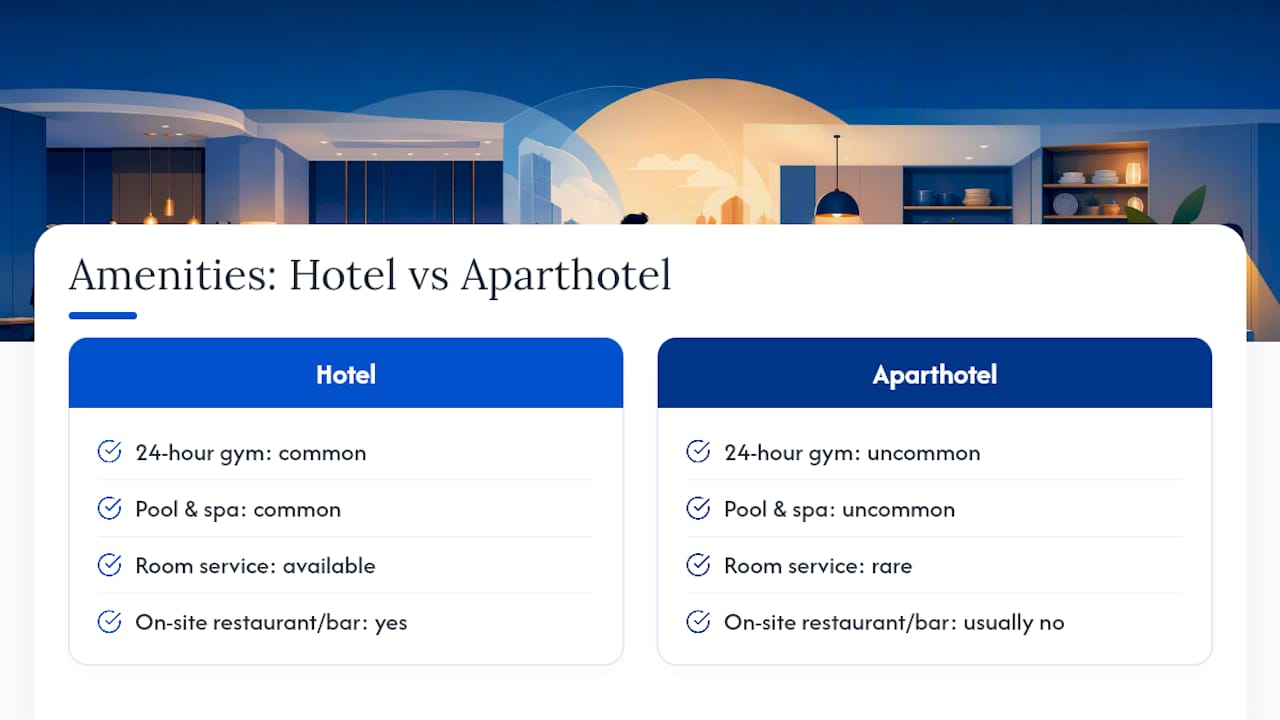
On-site dining is the clearest divide. A hotel restaurant means breakfast is handled without a plan. An aparthotel with a kitchen means breakfast is whatever you buy and cook, which some travelers prefer and others find like an extra chore on vacation. Neither is objectively better. It depends on whether cooking feels like a feature or a task on your specific trip.
Check listings for exceptions before assuming either category applies uniformly. Some newer aparthotel brands are closing this gap by bundling gym access or breakfast service into serviced-apartment stays, blurring the amenities line further and reinforcing why you check the specific property rather than the category label.
Are Aparthotels as Secure and Private as Hotels?
Security operates differently, not necessarily worse, in an aparthotel. Hotels typically have staffed lobbies, keycard-only elevator access, and someone watching the front entrance for most of the day. That constant presence deters casual intrusion and gives you a person to flag concerns to immediately.
Aparthotels often trade that visible staffing for more privacy. You get your own entrance or apartment-style door instead of a hallway room, fewer staff walking through common areas, and housekeeping that shows up on a schedule instead of daily. For travelers who value not having strangers in their space, that’s a genuine upside. For travelers who want someone always nearby, it’s the opposite.
The practical fix is checking specifics rather than assuming a category-wide standard. Ask whether the building has secured entry, whether reception (even if not 24/7) monitors who enters, and whether the unit has its own lock separate from a shared building door. Extended-stay business travelers handling sensitive work should also ask about in-unit safes, since not every serviced apartment includes one the way most hotel rooms do.
Does Location Change the Aparthotel vs Hotel Decision?
Hotels cluster in tourist cores and business districts, built specifically for foot traffic to attractions, convention centers, and airports. That proximity is often the entire point of paying a premium nightly rate.
Aparthotels frequently sit in residential or mixed-use neighborhoods, which cuts both ways. You get a more local, quieter setting and often better grocery access, but you may need a car, rideshare, or longer transit ride to reach major sights. For a family staying two weeks and treating the trip like temporary living, that residential feel is an asset. For a three-day sightseeing sprint, it’s friction you don’t need.
Before booking, map the actual commute from the property to where you’ll spend most of your time, not just the neighborhood name on the listing. A “downtown” aparthotel and a “downtown” hotel can sit fifteen minutes apart in walkability.
Our Take: Stop Choosing by Label, Start Choosing by Stay Length
The conventional wisdom treats “aparthotel vs hotel” like a taste preference, boutique versus corporate, quirky versus reliable. That framing misses the actual decision driver, which is almost always trip length combined with how much you value staffed service versus space and self-sufficiency.
A family booking four nights in a new city gains little from an aparthotel’s kitchen; they’ll be out sightseeing at every mealtime anyway. A consultant on a six-week assignment loses real money and sanity eating hotel restaurant food every night when a $76-per-night serviced apartment with a stove sits nearby. The label matters less than the math and the operational checklist behind it.
An approach that helps travelers compare the total cost and the concrete facts, kitchen inventory, housekeeping cadence, reception hours, side by side, rather than picking a category and hoping it works out. Use the hotel booking guidance to compare listings against your actual stay length before you commit.
— Global
Let Global Holiday Planner Compare Your Options for You
Manually cross-checking kitchen inventories, housekeeping schedules, and cancellation terms across a dozen listings eats up hours you’d rather spend planning the trip itself. A platform that compares hotels and aparthotels side by side and surfaces the filters that actually matter for longer stays, kitchen availability, laundry access, and housekeeping terms, so you’re not digging through fine print on five different booking sites.

Whether you’ve landed on a hotel for a short city break or an aparthotel for a month-long relocation, start your search on the hotels page and filter by the exact amenities your trip needs. If you’re still weighing platforms for the full trip, including flights and car rental, the main planning site pulls it all into one comparison so you book with the total cost in view, not just the nightly rate.
Sources
- Apartment hotel — Wikipedia
- Serviced Apartments vs Hotels | Booking.com for Business
- Cambridge Dictionary — aparthotel
- Serviced Apartment vs Hotel: Which stay fits longer trips? — Vertu
FAQ
Are Aparthotels Legit?
Yes. Aparthotels are a recognized accommodation category with hotel-style booking systems, and platforms like Booking.com for Business treat them as a standard lodging option. Legitimacy issues usually trace back to a specific property’s management, not the category itself, so check reviews and verify operational details before booking.
How Long Can You Stay in an Aparthotel?
Stays typically range from a few nights to several months, since aparthotels are built for both short visits and extended residencies. Many properties offer discounted rates once a booking passes five to seven nights, according to Wikipedia’s aparthotel entry.
Are Aparthotels More Expensive Than Hotels?
Not usually, for longer stays. Nightly rates can be similar, but weekly and monthly aparthotel pricing often comes in well below equivalent hotel costs. Illustrative examples cited by Booking.com for Business put a monthly serviced-apartment rate around $76 a night versus a $120 hotel average, before counting the money saved by cooking instead of eating out.
Can You Live in an Aparthotel?
Many people do, particularly during relocations, extended work assignments, or apartment searches. Because aparthotels combine hotel-style booking with kitchen and laundry access, they function as a practical bridge between short-term hotel stays and a signed apartment lease.