
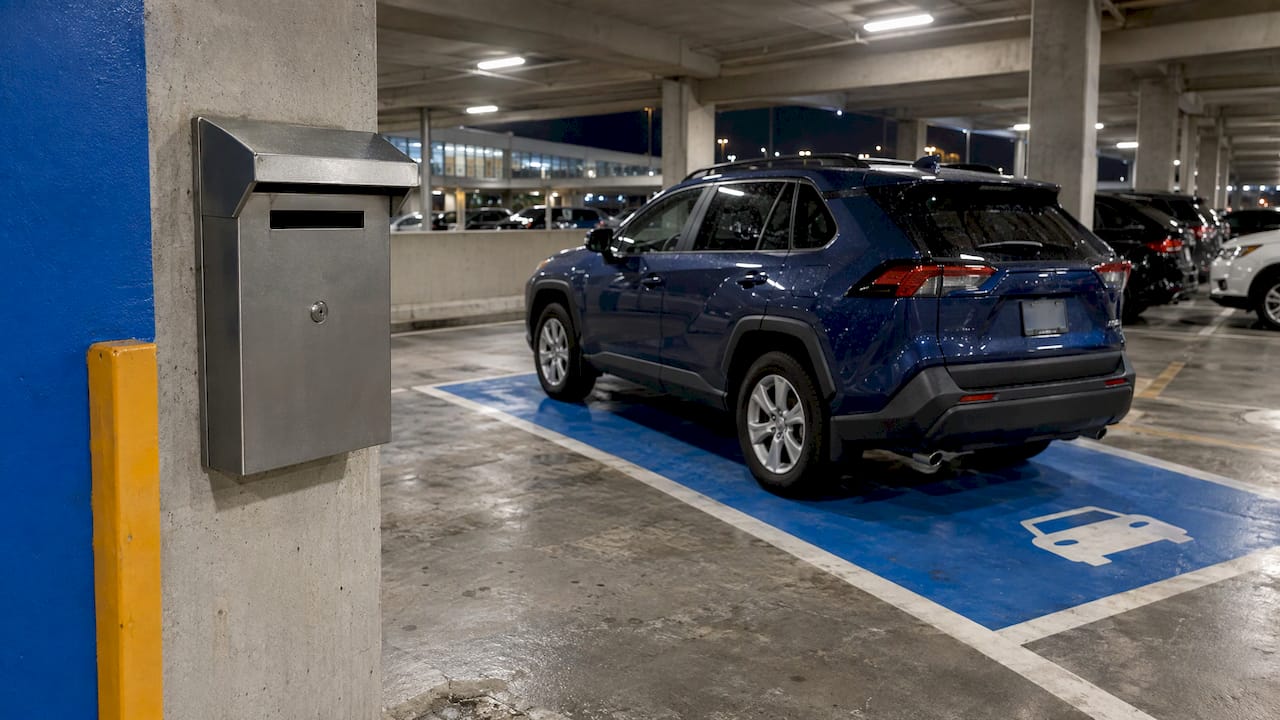
You can return a rental car when the counter is closed at many U.S. locations, usually by parking in the designated area and leaving the key in a drop box. The catch is that the rental is not over when you walk away. Until staff inspect the car on the next business day, you can stay responsible for damage and for charges that keep running. Book a location that clearly offers after-hours returns, confirm the process at pickup, and document the car well. That is the whole plan, and the rest of this guide shows how to carry it out.
TL;DR
- After-hours returns are common at airports, many of which are open around the clock. Non-airport branches often require a drop box, and not all have one.
- The rental usually ends only when staff check the car in at reopening. Until then you can be liable for damage, and daily charges can keep accruing.
- Confirm the drop box, any after-hours fee and the exact parking spot when you pick up, not when you arrive at midnight.
- Photograph all sides, the interior, the dashboard (mileage and fuel) and the parking spot, and keep the originals until the final bill is correct.
- If your flight or plans may make you late, tell the company before the return time. Advance notice is usually cheaper than a surprise late return.
Table of Contents
- What an after-hours return actually means
- Airport or neighborhood branch: where after-hours returns are easiest
- What to confirm before you leave the counter
- The after-hours return, step by step
- What to photograph
- Late returns: how fees work
- Coordinating the return with checkout and your flight
- If you cannot find the drop box or the lot is closed
- Book it right: a quick checklist for budget-minded renters
- Our view: compare the whole trip, not the daily rate
- Plan the car and the arrival together
- FAQ
- Sources
What an after-hours return actually means
An after-hours return means you bring the car back when the rental counter is closed or no agent is available to inspect it. Instead of a handover, you park, lock the car and leave the key in a secure drop box or key return area.
That sounds like a convenience, and it is. A red-eye landing, an early-morning flight or a long drive home can all make business hours impossible. But the contract treats it differently from a staffed return. Enterprise’s FAQ says a car returned while the branch is closed is not checked in until the next business day, so the renter stays responsible until a satisfactory check-in. We are not naming rental brands as our recommendation here; the point is that this wording is standard across the industry, and you should expect it in your own agreement.
A rental agreement published on Iowa’s state bid site shows how this looks in a real contract: for an after-hours return, the renter is responsible for any damage until the company inspects and accepts the car on the next open business day, and time charges and optional coverage charges may keep accruing until the location reopens.
The practical meaning: your return time is not when you drop the key. It is when staff take possession. Plan the money and the evidence around that gap.
Airport or neighborhood branch: where after-hours returns are easiest
Location type decides almost everything.
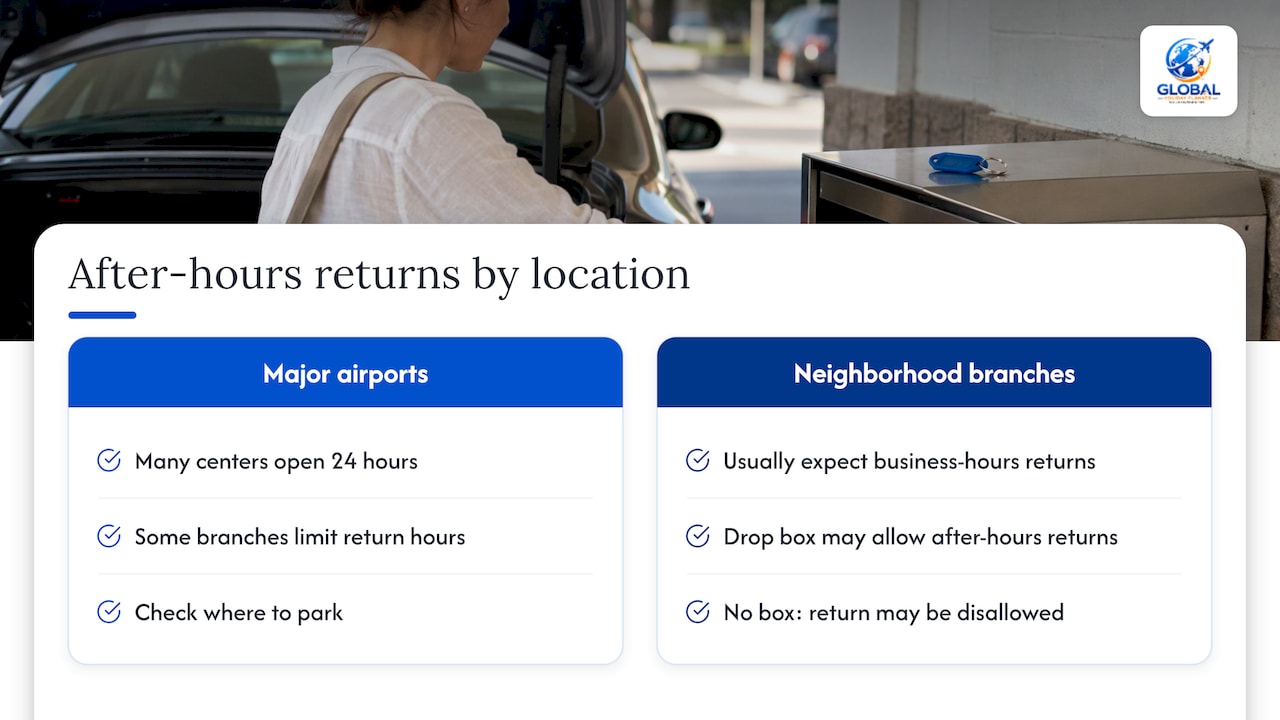
Major airports. Many large airport rental centers are open 24 hours, so the question is often not whether you can return, but where to park. Enterprise’s FAQ says airport locations generally allow after-hours returns, and many major-airport branches are staffed around the clock. Some smaller airports are not, and some limit the hours. One Hertz terms page for Tallahassee, for example, lists a window around 00:00 to 04:00 when after-hours return is unavailable. Treat every airport as its own case.
Neighborhood and hotel branches. These generally expect returns during business hours unless the branch has an after-hours drop box. If there is no box, a closed-hours return may not be allowed at all.
Different return location. Dropping the car somewhere other than where you picked it up can trigger extra fees. Enterprise notes that vehicles should be returned to the original location unless you arranged otherwise, and that a drop fee may apply at an airport you did not start from. If your trip is a one-way route, price it before you book with our guide to one way car rental fees by route.
What to confirm before you leave the counter
The cheapest time to solve an after-hours problem is at pickup, when you are standing next to someone who knows the answer. Ask these five questions and write down the answers (or take a photo of the agreement):
- Is there a drop box at this exact location? Not the brand in general, this branch.
- Is there an after-hours fee? Some locations charge a small flat fee, shown on the booking page. One U.S. independent operator, for instance, lists a one-time $45 after-hours fee. Fees vary widely, so read yours.
- Where exactly do I park? A designated bay, a numbered lane or a specific lot level.
- What time does the location reopen, and when is the car inspected? That is when charges stop.
- What is the 24-hour phone number if the drop box is locked, missing or hard to find?
If your plan depends on a late return and the location cannot confirm a drop box, change the booking rather than hope. It is far easier to switch pickup branches before you travel.
When you compare cars on our car rentals page, check the location details for hours before you pick the lowest price. A cheap rate at a branch that closes at 6 p.m. is no bargain if your flight lands at 11.
The after-hours return, step by step
The sequence below follows the process rental companies describe in their help pages: park in the designated area, photograph the car, lock it, drop the key. We have added the details that prevent the usual disputes.
1. Refuel and clear the car first
Finish fuel and cleaning before you reach the lot. If your agreement is full-to-full, keep the fuel receipt from a station close to the return location. Our guide on avoiding full-to-full fuel fees covers photos and receipts in detail. Remove everything personal, including charging cables, parking tickets and toll transponders you added.
2. Park only where the company says to
Use the marked return area or bay. Do not leave the car on the street, in a hotel space or in a spot you guessed unless the company approved it in advance. If you must park elsewhere, a Swiss branch’s instructions give a sound general rule: leave a note describing the location with the key, lock the car and never hand the key to anyone who claims to work for the company. The same page states that fees continue until the car is found at opening.
3. Document the car before you lock it
This is the step that protects you most. See the next section for the full list.
4. Lock the car and drop the key
Check the doors, windows and trunk. Put the key (and the key fob, any spare, any envelope) into the drop box. If there is a return envelope or form, fill it in with your name, agreement number, time and mileage.
5. Record the drop itself
A photo of the drop box shows where it is, but it does not by itself prove your keys went in. PickupLens makes this point in its after-hours photo guide: note the time yourself and save any confirmation message or email the company sends. A short video of you dropping the key, with the box and signage in frame, is a strong addition.
6. Keep everything until the bill is right
Save photos, video, receipts and the emailed final invoice until the charge on your card matches the agreement. Keep the original files, not edited copies, so the time and location data stays attached.
What to photograph
Think of it as proving two things: the condition of the car and the time you left it. A condition photo with no fixed time is, as one checklist puts it, only half an argument. Here is a practical shot list:
| Shot | Why it matters |
|---|---|
| Front, rear and both sides, with the plate visible | Shows overall condition and identifies the car |
| Four corners at an angle | Catches bumper and panel scratches |
| All four wheels | Wheel and rim damage is a common dispute |
| Windshield and glass | Chips and cracks |
| Interior and cargo area | Shows cleanliness and nothing left behind |
| Dashboard with ignition on | Mileage and fuel level in one frame |
| Car in its bay, with the bay number or return sign | Proves where you left it |
| Drop box and posted instructions | Shows the process you followed |
| Receipt or app confirmation screenshot | Adds a timestamp |
The list draws on the DamagePacket checklist. A few extras make it stronger:
- Check the images, not the preview. At night a photo can show only a dark silhouette, which cannot establish the bodywork’s condition. PickupLens warns about this and suggests reviewing saved images before you walk away, retaking any that are dark. Use the flash or a flashlight.
- Stack timestamps. Photo metadata, the app confirmation, a gas receipt from minutes before arrival, even a shuttle or boarding record all help you show the car left your hands at a specific time.
- Re-photograph pickup marks. If the car had a scratch when you collected it, shoot the same spot at return.
Late returns: how fees work
After-hours is not the same as late, but the two collide. If you drop the car at 11 p.m. and the rental period ended at 5 p.m., you are both late and after hours.
Typical U.S. rules, as shown in published agreements:
- A short grace period. The Iowa-published agreement lists a 30-minute grace period, after which extra-hour or extra-day charges apply. Other companies publish 29 minutes.
- Hourly, then daily. National’s page says that returns within 2½ hours late on a later day get hourly charges, and 2½ hours or more usually means a full extra day. Thrifty states that a return 1 hour 30 minutes or more late usually costs another day.
- Charges that continue while closed. Thrifty adds that when you return to a closed location, all charges continue until it reopens.
- A separate late fee. The Iowa-published agreement describes a late return fee of up to $15 per day (maximum $75 over five days) when you return more than 12 hours late without 24-hour advance notice.
A worked example. You rent a car on a daily rate, due back Monday at 9 p.m. The location closes at 6 p.m. and has a drop box. You leave the key at 9 p.m. If the company treats possession as starting at Tuesday morning’s check-in, the rental clock may run until then, as one terms page describes: a Monday 9 p.m. return accrues charges until Tuesday morning. Depending on the company’s late rules, that could mean hourly charges or a full extra day. The fix is simple: ask at pickup how time is counted for an after-hours return, and if you plan to return Monday night, consider setting the return time earlier or choosing a 24-hour location.
Tell them if you will be late. Extending in advance is normally cheaper. One major company says that extending beforehand through its app or website costs only a small handling fee, while an unannounced late return adds a service fee on top of the extension days. Always check your own agreement, since terms differ by company and location.
Other costs show up around returns too. If you booked with extra drivers, our piece on additional driver fees explains how they are charged, and the car rental deposit page covers how long a hold may stay on your card. A drop-box return can delay deposit release because the check-in happens later, so budget for that if your card limit is tight. If you pay with a debit card, see how holds work with a debit card.
Coordinating the return with checkout and your flight
After-hours returns most often come from stacked schedules: hotel checkout, a long drive, a late flight, a morning meeting. Work backward from departure.
- Fix the departure time of your flight or train.
- Subtract the time to clear airport security. Allow for the return process, the shuttle to the terminal and a buffer for finding the drop box in the dark.
- Compare that return time with the location’s hours and the rental’s due time.
- If the two do not match, change the rental end time or the pickup location before the trip, not at the counter.
If your trip mixes a rental with other plans, such as a day of sightseeing, think about whether you need the car on the last day at all. A comparison of a rental car versus a guided tour in Los Angeles shows how dropping the car a day early can simplify a departure day when parking and returns are awkward.
If you are arriving rather than leaving after hours, the pickup problem is the mirror image. Many travelers book a ride from the terminal to the hotel and collect the car the next morning. Our guides on airport transfer options and airport transfers versus taxis cover that choice.
If you cannot find the drop box or the lot is closed
Stay calm and keep records.
- Walk the whole counter area. Boxes are often in an unexpected spot, near the exit, behind a pillar or on a side wall.
- Call the number in your agreement. Most agreements include a 24-hour roadside or support line. Tell them you cannot find the box, and ask them to note the time on your account.
- Do not give the key to anyone. Not to a stranger, a valet or someone claiming to be staff, unless the company has told you to in writing or by phone. One hotel-return arrangement exists in some cities, but it should be confirmed in advance.
- Photograph everything. The car, the area, any closed gates or signs, your call log.
- Email the company the same night with the time, the location and the photos. Written proof beats memory.
There is a real cost to a mistake here. A Swiss branch’s terms state that the agreement ends only when staff take possession after opening, so damage liability continues until then. Another contract says that returning when the company is closed leaves your responsibility for damage or loss in place until the car is recovered. Those are different countries and companies, but the principle matches U.S. terms: the car is yours to protect until someone checks it in.
Check your own protection as well. A rental insurance or card coverage can matter during the gap between drop-off and check-in, so read how your policy treats the car after you leave it. Our guide to travel insurance versus credit card coverage helps you work through it.
Book it right: a quick checklist for budget-minded renters
- Pick a 24-hour airport location when your arrival or departure is late.
- Read the after-hours fee on the booking page and add it to the total.
- Choose an end time you can meet. A cheap rate loses its edge if one late hour becomes a full extra day.
- Confirm unlimited mileage if you are driving far to reach the return point, as our unlimited mileage guide explains.
- Pick the right class so you do not pay for upgrades at return; see car rental classes explained.
Our view: compare the whole trip, not the daily rate
Most renters compare daily rates. The costs that surprise people come later: the after-hours fee, the extra day, the one-way charge, the fuel top-up, the deposit that stays on a card. A low sticker price at a branch that closes before your flight lands is not a low price.
That is why we built our comparisons around the real total cost and the fit to your itinerary, side by side, across flights, hotels, car rentals and transfers. When you can see a late arrival, a hotel checkout and a pickup branch together, it is much easier to choose a car and a location that match your schedule.
For a couple on a late-night getaway, a family with a long drive home or a business traveler with a morning meeting, the right answer is rarely the cheapest daily rate. It is the plan that has no gap between the last mile and the drop-off.
Global
Plan the car and the arrival together
If you need a car that fits your schedule, start on our car rentals page, where you can compare rental options alongside the rest of your trip. Need a ride for the part of the journey the car does not cover? Our airport transfers page lets you line up a ride to or from the airport.

You can also compare flights and hotels in the same place, so your arrival time, your checkout and your car return fit together from the start.
FAQ
Can you return a rental car when the location is closed?
Often yes. Many major airport locations are open 24 hours or accept after-hours returns, and some other branches provide a drop box. Others require returns during business hours. Confirm the specific branch when you pick up the car.
Am I still responsible for the car after I drop the key?
Usually, yes. Published rental terms say your responsibility for damage continues, and charges may keep accruing, until staff inspect the car when the location reopens. That is why dated photos and a clear time record matter.
Is there an extra fee for an after-hours return?
Some locations charge one, and some do not. It is typically a small flat fee, and one company says it appears on the booking page. Check the fee before you book, and ask again at pickup.
What happens if I return the car late?
Most companies allow a grace period of about 30 minutes. After that, hourly charges apply, and a return a few hours late usually costs a full extra day. Telling the company before your return time is generally cheaper than being late without notice.
What should I do if I can’t find the key drop box?
Walk the whole counter area first, since boxes are sometimes in an odd spot. If you still cannot find it, call the 24-hour number in your rental agreement, photograph the car and the area, and email the company that night with the time.
Sources
- Enterprise: returning a rental car when the location is closed
- Rental agreement terms and conditions published on Iowa’s bid site
- Rental terms for after-hours return, Tallahassee location
- Return outside opening hours, Swiss branch instructions
- After-hours and late returns, help center
- Grace period for returning a car late
- Early or late returns
- Frequently asked questions, after-hours fee example
- Rental car return photo checklist
- Returning a rental car after hours: what to photograph