
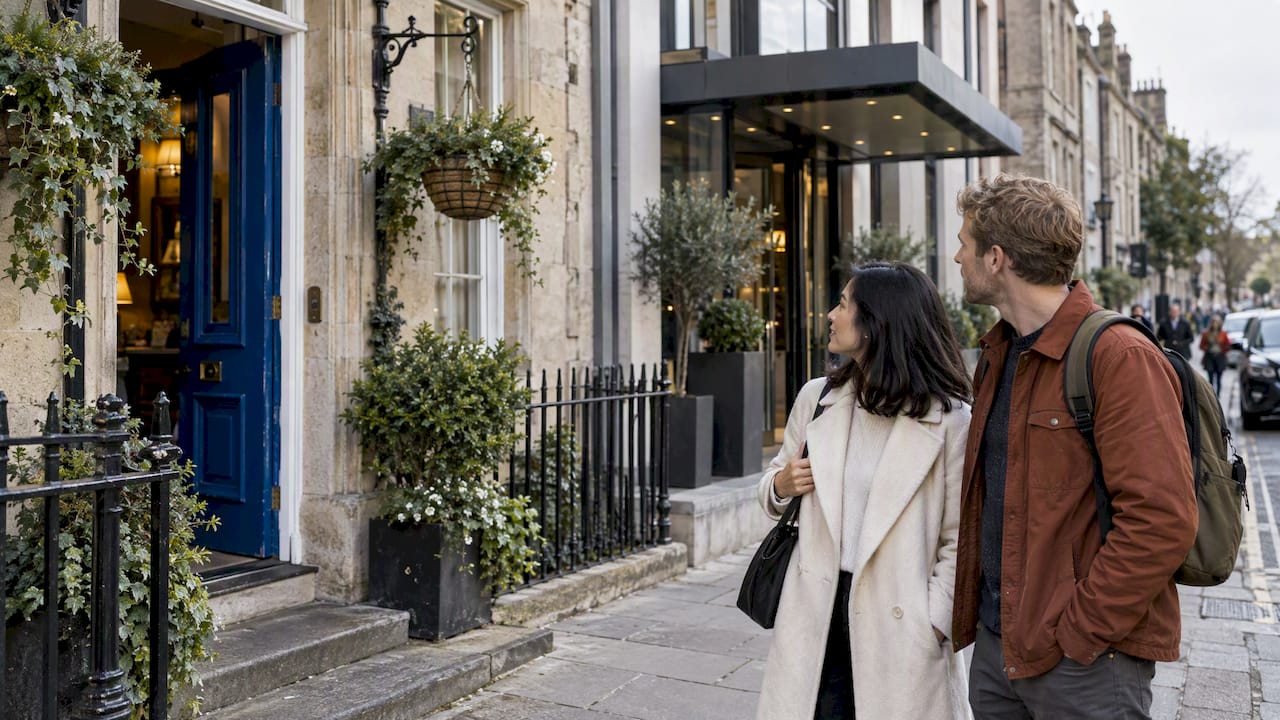
Choose a B&B when you want a quiet, personal stay with a host who knows the area and a cooked breakfast included. Choose a hotel when you want 24-hour service, your own private space, and facilities like a pool, gym or restaurant on site. The rest of this guide covers what actually separates the two, what each costs once you count everything, and which one suits the trip you are planning.
TL;DR
- A B&B is small and host-run, with breakfast included. A hotel is larger and more standardized, with round-the-clock service and more facilities.
- An inn sits in between: a small property, usually with a restaurant or bar attached.
- Neither is always cheaper. Compare the total: taxes, parking, breakfast, cancellation terms and extra-guest fees.
- Couples and slow-travel visitors tend to prefer B&Bs. Families, business travelers and larger groups usually do better at hotels.
- Check policies before you book a B&B, because each one sets its own rules on children, pets, payment and cancellation.
Table of Contents
- What actually separates a B&B from a hotel
- B&B or inn: where the line falls
- What you get in each, and what you give up
- Cost: which is cheaper?
- Which one fits your trip
- Our perspective
- Compare and book your stay
- A short checklist before you book
- FAQ
- Sources
What actually separates a B&B from a hotel
The dictionary keeps it simple: a bed-and-breakfast is an establishment offering lodging and breakfast. In practice the difference is scale and style of service.
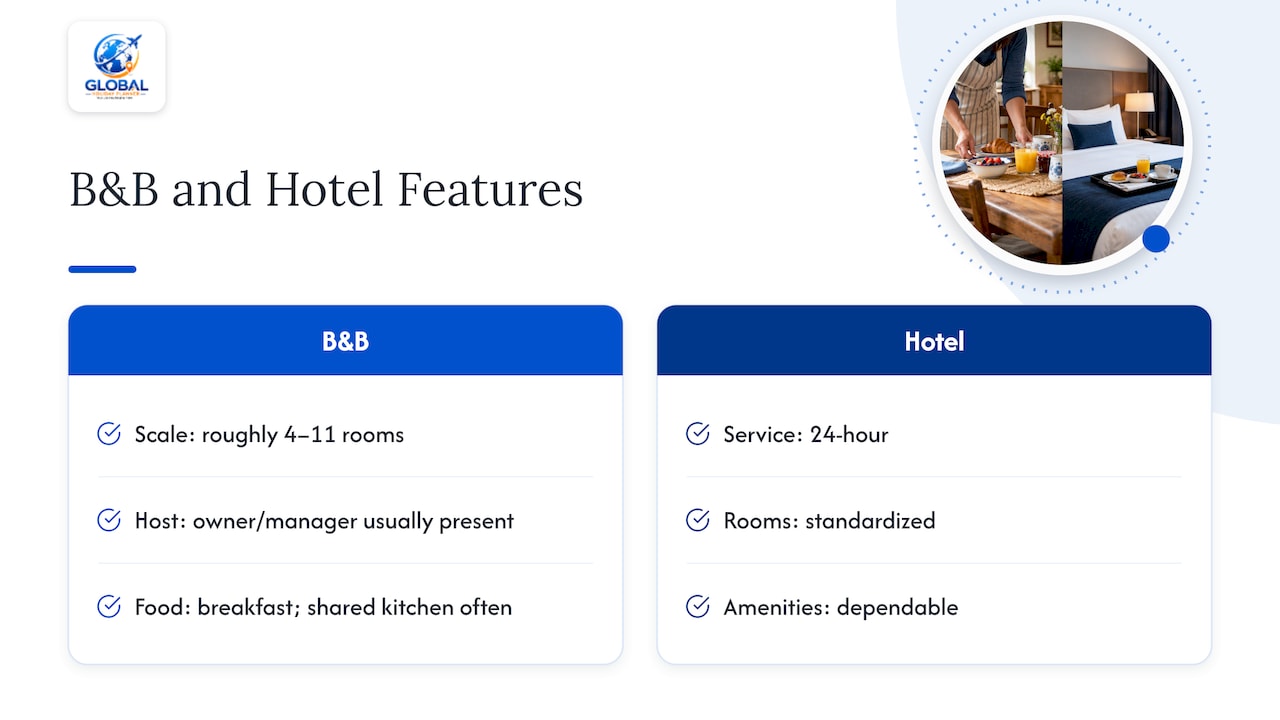
Google’s own lodging categories describe a B&B as a private or small commercial property where the owner or manager is usually present, often with a shared kitchen or home-cooked meals. Industry sources typically put a B&B at roughly four to eleven rooms, run by owners or innkeepers who live on site. Hotels, by contrast, are built around consistency: 24-hour service, standardized rooms and dependable amenities, which is why they suit travelers who value efficiency.
There is no single legal definition in the U.S. Some states and counties define a bed-and-breakfast inn by number of guest rooms, and the cutoffs differ from place to place. So treat the labels as a guide to the experience, not a guarantee. Always read the listing.
The quick comparison
| B&B | Hotel | |
|---|---|---|
| Size | Small, often under a dozen rooms | Dozens to hundreds of rooms |
| Who runs it | Owner or innkeeper, often on site | Staff teams, often a brand or management company |
| Breakfast | Included, usually cooked and served to order or at a shared table | Optional or extra, often a buffet |
| Front desk | Limited hours, sometimes by arrangement | Often 24 hours |
| Privacy | Shared spaces, more contact with hosts and guests | More anonymity |
| Facilities | Lounge, garden or courtyard, sometimes a shared kitchen | Pool, gym, restaurant, room service, business center |
| Consistency | Varies widely room to room and property to property | Standardized within a brand |
| Location | Residential streets, small towns, countryside | Central districts, airports, business hubs |
| Best for | Couples, slow travel, local flavor | Families, business trips, groups, short stopovers |
B&B or inn: where the line falls
Readers often ask about the difference between an inn and a hotel, and the answer shows why labels blur. In Google’s lodging classification, an inn primarily operates as a restaurant, pub, cafe or brewery that also offers lodging, generally with fewer than 20 rooms for guests. So an inn has a food-and-drink business at its heart and rooms upstairs.
An inn is usually smaller than a hotel and has fewer recreational facilities, such as gyms, pools and spa areas. Many American B&Bs call themselves inns, and many inns serve breakfast, so the practical test is this: who greets you, how many rooms are there, and is there a restaurant on the property you can eat dinner in? If you want dinner downstairs, look for an inn. If you want a host at a shared breakfast table, look for a B&B.
What you get in each, and what you give up
The case for a B&B
- A personal touch. Hosts can tell you where locals eat, which trail is open and which road to avoid. Rick Steves says European B&Bs trade hotel conveniences for personal service and cultural intimacy, and that holds for good American inns too.
- Breakfast is part of the deal. You skip the hunt for a cafe on your first morning, and the food is often a highlight rather than a chore.
- Quiet. Fewer rooms means fewer doors slamming at midnight and fewer elevators and hallways to hear.
- Character. Many occupy historic houses, farms or converted homes, so no two are alike.
The case for a hotel
- Reliability. A brand-name room in one city looks much like one in another. That is boring when you want charm and priceless when you land at midnight.
- Round-the-clock service. Late check-in, a front desk at 3 a.m., luggage storage and a concierge are normal.
- Facilities. Pools, gyms, restaurants, meeting rooms and kids’ activities sit under one roof.
- Privacy. You can come and go without conversation. For some travelers, that alone settles the question.
- Capacity. Large hotels often offer connecting rooms and multi-room options, while B&Bs can be hard to find with enough space for large groups.
The downsides of a B&B
The honest drawbacks matter more than the charm, so check these before you click “book”:
- Stairs and access. Rick Steves warns that rooms may sit in attics or up several flights of stairs, which rules out many guesthouses for travelers with mobility limits. Ask whether there is a ground-floor room.
- Missing conveniences. Frommer’s notes that B&Bs may lack room service, in-room telephones, pools and recreation areas, and bathrooms are sometimes shared. Air-conditioning, TVs and en-suite bathrooms are not guaranteed everywhere, so confirm each.
- Rules on kids and pets. Some properties restrict children by age, and some have resident pets, which matters for allergies.
- Fixed breakfast times. Some ask you to choose your breakfast the night before, and a 7:30 to 9:00 window does not suit everyone.
- Policies that differ from hotel norms. Deposits, cancellation fees and payment methods vary. Frommer’s practical advice is to contact the property directly about special needs and confirm policies before booking.
The downsides of a hotel
Hotels can feel impersonal, charge for breakfast, parking and “resort” fees, and place you near the busy center or an airport rather than on a quiet street. Their breakfast may be a buffet line rather than something made for you. And the hotel’s star level is not universal: grading systems are national, so a four-star rating in one country can describe facilities another would call three-star. That matters if you are booking abroad.
Cost: which is cheaper?
Neither, reliably. A B&B rate tends to land in the range of a local mid-range hotel, and it includes breakfast. Hotels cover a wider range, from budget chains to luxury towers. Older European surveys did show B&Bs undercutting hotels in capital cities, but those figures date from 2014 and should not be read as a current rule, least of all in the U.S.
The nightly rate is only the starting number. Build the real total this way:
- Start with the nightly rate for your exact dates. Weekends, holidays, local festivals and peak seasons move both types.
- Add taxes and fees. Hotels often add resort, destination or parking fees. B&Bs may add cleaning or extra-guest charges.
- Subtract what you would pay for anyway. A full breakfast for two can be a real saving. If you would skip breakfast, it is not.
- Add transport. A cheaper B&B in a village may mean a rental car and parking, while a central hotel may let you walk or take transit.
- Check cancellation terms. Many B&Bs ask for a deposit or enforce stricter rules with fewer rooms to resell. If your plans might change, a flexible hotel rate can be worth the premium.
- Count extra guests. A third person in a B&B room can cost more than a roll-away bed at a hotel, or may not be allowed.
If you are comparing offers and wondering whether to pay now or at the property, our prepaid vs pay-at-hotel math rule helps you decide. And if the savings tempt you toward a nonrefundable rate, read how to recover money from a nonrefundable hotel booking first.
Which one fits your trip
Couples and romantic getaways
B&Bs usually win here: a quiet room, a cooked breakfast, a garden or porch, and a host who can recommend a dinner reservation. Michelin’s inspectors point out that couples may value spas and romantic cottage-style accommodations, and a good inn can supply both. Pick a hotel instead if you want a spa, a bar and room service in one building.
Families
Families often do better at hotels. The same Michelin guidance notes that families may value multiple restaurants, a kids’ club and a pool. Hotels also offer connecting rooms, cribs and later breakfast hours. Many B&Bs do welcome children, but some restrict them by age, so ask before you reserve. For a longer family stay with a kitchen, see our guide to hotel vs aparthotel by stay length or the hotel vs vacation rental checklist.
Business travelers
Hotels are the default: a desk or workspace, reliable Wi-Fi, a late front desk, a location near meetings or the airport, and the loyalty and corporate rate options. Michelin suggests business travelers check for a private workspace. Our business travel booking tips and guide to better hotel corporate rates cover the rest. A small inn can still work for a quiet working week if it offers a desk and strong Wi-Fi.
Golf trips and group travel
Groups with early tee times need flexible breakfast hours, enough rooms under one roof and parking for several cars. Hotels or resorts with on-site courses handle that more easily. A B&B can be a lovely base for a smaller foursome if the host can start breakfast early and the property has the rooms. Ask about both before you commit. Larger groups should also read our group flight booking playbook.
Scenic and wine-country weekends
When the setting is the reason for the trip, a small property in the countryside or a historic town can beat a city hotel. Picking where to stay in a destination like Niagara-on-the-Lake comes down to the same trade-off, and a look at hotels in Niagara-on-the-Lake shows how setting shapes the choice. Remember that rural B&Bs are often far from transit, so plan how you will arrive. Our airport transfer options guide and rental car deposit explainer help with that.
Longer stays and self-catering
If you will be somewhere for a week or more, a B&B’s daily breakfast stops being a perk and starts being a limit. Many travelers then prefer a place where they can cook, and it helps to know how to enjoy self-catering stays before you commit.
Our perspective
We compare flights, hotels, car rentals, transfers, rail and insurance for travelers every day, and the same pattern shows up in accommodation: people rarely regret choosing the right type for the trip, and often regret choosing on a nightly rate alone.
Our view is simple. Decide what the trip is for first. If it is about the place and the pace, a B&B is often the better memory. If it is about logistics, a hotel removes friction. Then compare the real total, not the headline price, and read the cancellation terms before you pay. Keep your transport in mind too: a charming property that needs a car you have not booked is not a bargain. That is why we put cost and feature comparisons for every part of a trip side by side.
— Global
Compare and book your stay
Once you know the type of stay you want, compare options for your dates in one place. Our hotel reservations page lets you look at properties side by side, and you can line up flights, a rental car and an airport transfer for the same trip.

If you are flying, our flight bookings page covers the other half of the plan, and our guide on whether to book flights or hotel first gives you a simple rule for the order.
A short checklist before you book
- Confirm the number of rooms and whether the host lives on site.
- Ask what breakfast includes, when it is served and how dietary needs are handled.
- Check bathroom type, stairs, air-conditioning and parking.
- Read the rules on children, pets, deposits and cancellation.
- Ask about check-in hours if your arrival may be late.
- Add up taxes, fees, parking and transport for the true total.
- Compare reviews for recent stays, not only the overall score.
If you are also weighing a cheaper option, our hostel vs hotel guide and luxury vs budget travel choices show the trade-offs.
FAQ
What is included in a B&B?
A B&B includes a room and breakfast, and often access to shared spaces such as a lounge, courtyard or kitchen. Breakfast style differs: some serve a cooked meal at set times, others leave items for self-service. Confirm the details, bathroom type and parking when you book.
What are the disadvantages of a B&B?
The common ones are fewer facilities, stairs, shared or limited bathroom arrangements in some properties, set breakfast times and stricter rules on children, pets and cancellation. Each B&B is run individually, so policies vary. Contact the property about any special needs before you book.
Is a B&B cheaper than a hotel?
Not always. B&B rates usually sit in the range of a local mid-range hotel and include breakfast, while hotel prices span a wider range. Compare the full cost, including taxes, parking, extra-guest fees and cancellation terms, for your dates and destination.
What is the difference between an inn and a hotel?
An inn is generally smaller and built around a restaurant or pub with rooms attached, with fewer than 20 guest rooms in Google’s classification. A hotel is larger and usually has more facilities, such as a pool, gym and 24-hour service.
Is Airbnb the same as a hotel?
No. Airbnb-style rentals are usually whole homes or rooms hosted by individuals, with no front desk or daily service. A hotel is a commercial property with staff and standardized service. Our hotel vs vacation rental checklist walks through the decision.
Sources
- Categories for lodging businesses, Hotel Center Help
- Bed-and-breakfast, Merriam-Webster
- What is a bed and breakfast? Mews
- What’s the difference between a hotel and an inn? Cvent
- Bed & Breakfasts in Europe, Rick Steves
- To B&B or Not to B&B, Frommer’s
- B&Bs vs. Hotels Comparison, TRVL Guides
- Hotel guides for every destination, Open Travel Guide
- Inspector Tips on the Best Hotels for Everything, MICHELIN Guide