

Yes, almost every car rental requires a deposit in the form of an authorization hold, not an actual charge. Expect the rental company to block your rental estimate plus roughly $200 to $500 in incidental funds on your card. The smartest move at pickup: pay with a credit card and ask the agent to state the exact hold amount before you sign anything.
TL;DR:
- Incidental holds at rental pickup generally range from $200 to $500, depending on vehicle class and pickup location, with airport branches and luxury vehicles triggering larger holds.
- Hold amounts on credit cards usually clear within two to ten days, but debit card holds can take five to fifteen days or longer to release due to different processing times.
- Paying with a credit card offers better dispute protection and prevents actual cash from being withdrawn, unlike debit or cash payments, which can complicate refunds.
- Most deposit issues stem from late information or unanticipated holds, making it essential to compare deposit policies before booking through transparent search tools.
- A standard authorization hold does not impact your credit score but can momentarily reduce your available credit if the hold is large relative to your card limit.
Table of Contents
- What Is a Car Rental Deposit, Exactly?
- How Much Should You Expect to Pay?
- Hold vs. Charge: When Does Your Money Actually Come Back?
- Which Payment Methods Actually Work at the Counter?
- What Can Get Deducted, and How Do You Fight It?
- How to Keep Your Hold as Small as Possible
- Does a Car Rental Deposit Affect Your Credit Score?
- Do Deposit Rules Change From Country to Country?
- What Happens if Your Deposit Gets Declined?
- Global Holiday Planner’s Take on Deposit Surprises
- Book Smarter: Compare Deposit Terms Before You Commit
- Sources
- FAQ
What Is a Car Rental Deposit, Exactly?
A car rental deposit is really a pre-authorization hold, not a payment. The rental company asks your card issuer to set aside funds it might need to cover something that happens during your trip. That money isn’t transferred anywhere. It just becomes temporarily unavailable to you, sitting in reserve until the company releases it at drop-off.
Companies use these holds to cover a handful of predictable risks:
- Vehicle damage discovered at return
- Missing fuel or incorrect fuel type
- Toll violations or traffic fines processed after you’ve left
- Extra days if you return the car late
- Cleaning fees for anything beyond normal wear
The distinction between a hold and a charge matters because a hold reduces your available balance without actually moving money. On a credit card, that just eats into your credit limit temporarily. On a debit card, it eats into your actual cash, which is where most of the frustration starts.
How Much Should You Expect to Pay?
Deposit amounts swing more than most first-time renters expect, and the number depends heavily on vehicle class and pickup location. Economy and mid-size cars typically carry incidental holds in the €150 to €700 range, while SUVs, minivans, and premium vehicles push considerably higher because the company’s financial exposure is bigger.
A worked example makes this concrete. Say you book a mid-size car for a week at $50 a day. Your rental estimate comes to $350. Add a typical $200 incidental hold, and your card shows $550 to $850 in blocked funds the moment you drive off the lot, even though you’ll likely only pay the $350 rental fee in the end.
Several variables push that number higher:
- Airport pickup locations almost always carry larger holds than downtown or suburban branches, since airport locations face higher operating costs and greater one-way rental risk.
- Vehicle group matters. A luxury SUV or a 12-passenger van will trigger a much bigger hold than a compact sedan.
- Rental length extends exposure, so a three-week rental holds more than a three-day one.
- Local rules in certain countries add mandatory insurance or tax holds on top of the standard deposit.
Vehicle group and pickup location together are the biggest swing factors. One major agency’s own policy documentation notes that higher-value vehicle groups and airport branches routinely trigger larger authorization amounts than the same rental booked at a neighborhood office.
Hold vs. Charge: When Does Your Money Actually Come Back?
The counter transaction and the bank’s release are two separate events, and confusing them is where most deposit complaints come from. Here’s the sequence that actually happens:
- At pickup, the agent runs your card for the rental estimate plus the incidental hold. You’ll see this as a “pending” transaction, not a completed charge.
- During your rental, that pending amount just sits blocked. Nothing else happens unless damage or extra charges get added at return.
- At drop-off, assuming the car comes back clean and on time, the rental company submits a release request to your card issuer.
- After release, your bank processes the actual removal of the hold, and that’s where timing varies by card type.
Credit card holds typically clear in two to ten business days. Debit card holds often stretch to five to fifteen business days or longer, because debit transactions move through a different clearing process and banks are more conservative about releasing actual cash reserves versus credit availability.
If your hold hasn’t dropped after those windows, don’t call your bank first. Contact the rental company and ask for written proof that they submitted the release, usually an email or a receipt showing a $0 balance. Banks often need that documentation before they’ll investigate on their end.
Pro Tip: Screenshot or photograph your final rental receipt the moment you return the car. If a hold lingers past the typical window, that timestamped receipt is your fastest proof that the rental company already released its claim on the funds.
Which Payment Methods Actually Work at the Counter?
Credit cards remain the standard for a reason: the hold reduces your available credit line, not your actual cash, and issuers offer stronger dispute protections if something goes wrong. Debit cards and cash get accepted at many locations, but often on different terms.
- Some companies treat a debit card payment as an actual charge rather than a hold, meaning your money genuinely leaves your account and a refund, not a release, has to process afterward, which typically takes longer.
- Debit and cash renters frequently face extra verification: a soft credit check, proof of return travel, or a utility bill confirming your address.
- Almost every rental agreement requires the card used for the deposit to be in the renter’s name, and that person must be physically present at pickup with the card in hand.
- Prepaid cards and virtual cards are rejected outright by most major companies for deposit purposes, regardless of the balance available.
If you’re weighing payment methods before you book, a credit card hold breakdown from rental specialists walks through exactly how issuers process these pre-authorizations behind the scenes.
What Can Get Deducted, and How Do You Fight It?
Rental companies can legitimately deduct several things from your deposit: documented repair costs, refueling fees if you return the tank low, unpaid tolls or fines, cleaning charges for excessive mess, and occasionally a loss-of-use fee if the car needs repairs before it can rent again.

The single best defense is boring but effective: photograph the car from all four sides, the interior, and the fuel gauge at pickup, then do it again at return. A timestamped photo set beats a verbal disagreement every time a disputed scratch shows up on your statement.
If a charge appears that you believe is wrong, work through it in order:
- Request the final inspection report, the original rental agreement, and any repair invoices tied to the charge.
- Compare those documents against your own pickup and return photos.
- If the company won’t reverse an unsupported charge, dispute it directly with your credit card issuer, citing your documentation as evidence.
Pro Tip: Ask for a copy of the signed condition report before you drive off the lot, not after. Agents sometimes rush this step, and a report you never actually saw is much harder to contest later.
How to Keep Your Hold as Small as Possible
You have more control over your deposit than most renters realize. A few habits consistently keep holds smaller and refunds cleaner:
- Ask the counter agent to state the exact authorization amount out loud and confirm it matches your printed receipt before you sign.
- Consider rental company damage protection if it genuinely lowers your incidental hold. Since it reduces the company’s own financial exposure, some locations shrink the hold accordingly. Compare that cost against a standalone travel insurance plan, which sometimes covers the same risks for less.
- Always use a credit card for the authorization itself, even if you plan to pay the final bill with something else.
- Photograph the vehicle at pickup and return, every time, regardless of how minor the rental seems.
Pro Tip: If you’re picking up at an airport, budget extra time. Higher holds at airport counters sometimes come with extra ID or address verification that slows down the line, and a rushed pickup is when renters skip the photo step.
Does a Car Rental Deposit Affect Your Credit Score?
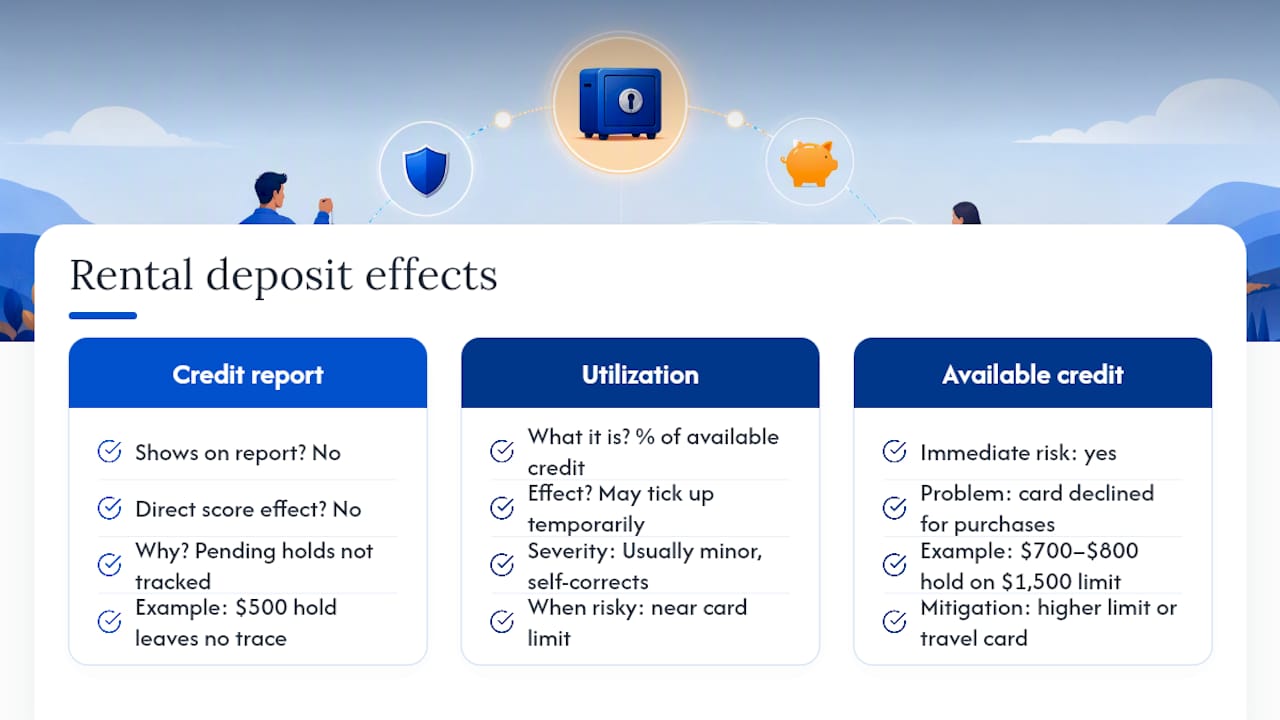
A standard authorization hold does not appear on your credit report and does not affect your credit score directly. Credit bureaus track accounts, balances, and payment history, not temporary pending transactions, so a $500 rental hold vanishing a week later leaves zero trace on your credit file.
Where it can matter is your credit utilization in the short term. If a large hold pushes you close to your card’s limit while it’s pending, and your issuer reports your statement balance during that window, your utilization ratio could tick up temporarily. That’s the percentage of available credit you’re using, and it’s one factor in your score calculation. The effect is usually minor and self-corrects once the hold releases, but it’s worth knowing if you’re renting a premium SUV on a card with a modest limit.
The more immediate risk isn’t your score. It’s your available credit. A $700 or $800 hold on a card with a $1,500 limit can leave you without enough breathing room for gas, hotels, or an emergency purchase mid-trip. That’s a cash-flow problem, not a credit-reporting one, but it feels identical when your card gets declined at a restaurant three states from home.
If you rent frequently, requesting a higher credit limit before a big trip, or dedicating one card specifically to travel holds, keeps this from becoming a recurring headache. It also means one large rental hold won’t collide with hotel deposits or other travel charges hitting the same card in the same week.
Do Deposit Rules Change From Country to Country?
Deposit policies vary noticeably by region, and the differences go beyond just currency. European rentals frequently bundle mandatory insurance or tax holds into the deposit itself, which is part of why ranges there commonly run from €150 up past €700 depending on vehicle class, a wider spread than many North American renters expect walking in.
Some countries also apply stricter age-related surcharges that increase the hold rather than just adding a flat young-driver fee. Others require an International Driving Permit alongside your standard license before the counter will even process a deposit, regardless of payment method.
Currency conversion adds its own layer of confusion. If your home card is billed in dollars but the local hold posts in euros, pounds, or another currency, the exact dollar amount blocked on your statement can shift slightly by the time it clears, depending on the exchange rate your issuer applies that day. That’s normal, but it explains why a $400 hold you expected sometimes shows up as $408 or $394 on your statement.
Local rules about debit cards differ sharply too. Some countries’ rental branches simply won’t accept debit for the deposit at all, credit only, while others accept debit but tack on a mandatory insurance purchase to offset the added risk. If you’re renting internationally, confirm the specific location’s payment policy before you land, not after you’re standing at the counter with jet lag and a flight to catch.
What Happens if Your Deposit Gets Declined?
A declined authorization is more common than renters expect, and it’s rarely about your creditworthiness. It usually means your available credit or checking balance simply isn’t large enough to absorb the rental estimate plus the incidental hold at the same time.
Start by checking your own numbers before assuming the counter made an error. Log into your banking app and confirm your actual available balance or credit limit, not just what you think it should be. A pending hotel charge or a recent big purchase can eat into your headroom without you realizing it.
If the decline is real, you have a few practical options right there at the counter:
- Try a second card. Many renters carry a backup credit card specifically for situations like this, and it’s the fastest fix.
- Ask about a lower-tier vehicle. Downgrading to a smaller car often reduces the required hold enough to clear on your existing balance.
- Call your card issuer on the spot. Sometimes a temporary credit limit increase or a fraud-alert flag is the actual problem, and a five-minute call resolves it.
- Ask if the location accepts a different payment structure, since some branches offer reduced holds with proof of return airline tickets or additional ID.
What you should not do is walk away assuming you can’t rent at all. Most locations have some flexibility, but only if you ask before you’re already frustrated and the line behind you is getting long. Building in a buffer of at least $200 to $300 above your expected rental cost when budgeting for a trip avoids this scenario almost entirely.
Global Holiday Planner’s Take on Deposit Surprises
Most deposit frustration comes from information showing up too late, at the counter, under time pressure, instead of during the comparison stage where a traveler actually has options. That’s a search-experience problem more than a policy problem.
We built our car search results to surface accepted payment methods and deposit expectations before you commit to a location, not after. Comparing that detail alongside price the same way you’d compare a flight’s baggage policy or a hotel’s cancellation window tends to prevent the worst surprises entirely.
— Global
Book Smarter: Compare Deposit Terms Before You Commit
There are other ways to shop for a rental car: calling agencies directly, comparing individual brand sites one by one, or just booking whatever pops up first at the airport. All of them share the same flaw. You don’t see the deposit terms until you’re already deep into checkout or standing at the counter.

Global Holiday Planner’s car rental comparison page puts payment methods and deposit expectations next to price from the start, so you can rule out a location that demands cash-only deposits or a hold bigger than your card can absorb, before you’ve wasted time on a booking you’ll cancel anyway. If you’re also sorting out airport pickup logistics, our airport transfer guide covers the timing details that pair naturally with a rental pickup. Search your dates now and compare deposit terms side by side before you book.
Sources
- Rental Car Security Deposit: Amounts, Holds, and Refunds – LegalClarity
- Car Rental Security Deposits: How They Work (2026 Guide) | Nomora
FAQ
Why Is There a $300 Deposit at Enterprise?
Enterprise, like most major rental companies, places a hold covering your rental estimate plus an incidental security amount, and $300 falls within the typical $200 to $500 range used to cover possible damage, fuel, or fines.
What Is a Normal Deposit for Renting a Car?
A normal incidental hold runs roughly €150 to €700 for economy and mid-size vehicles, on top of your rental estimate, with SUVs, vans, and premium cars running considerably higher.
Can I Rent a Car With a $500 Credit Card Limit?
It depends on the vehicle and location, since your available credit needs to cover both the rental estimate and the incidental hold combined. A smaller economy car at a non-airport location is your best chance of fitting within a $500 limit.
How Much Deposit Do You Pay for a Car Rental?
You don’t actually pay the deposit. It’s a temporary authorization hold, typically your rental cost plus $200 to $500 in incidental funds, that releases back to you after a clean return.
Does a Rental Deposit Hurt My Credit Score?
No. A standard hold doesn’t get reported to credit bureaus and doesn’t appear on your credit report, though a large hold can temporarily reduce your available credit while it’s pending.