
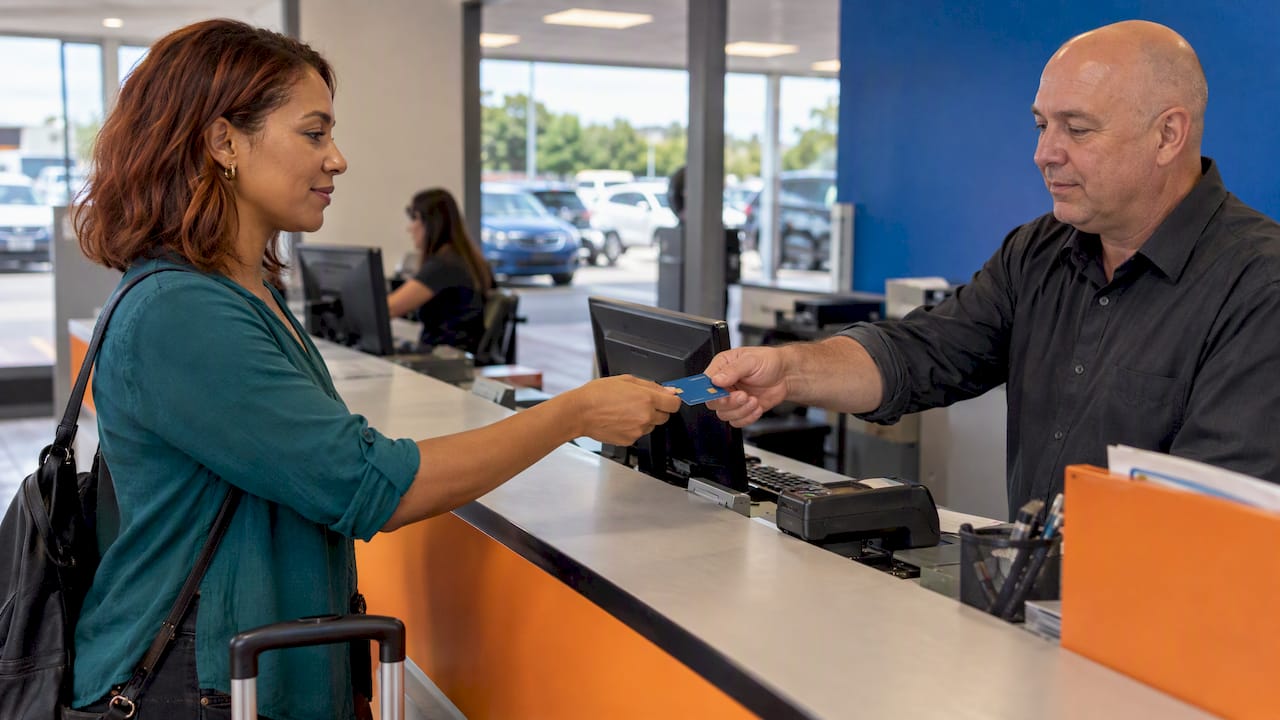
Yes, you can rent a car with a debit card in the United States, but not at every counter and not on every car. Most major rental companies accept a Visa, Mastercard or Discover debit card at many U.S. locations. They usually add conditions: a minimum age, a ticketed return trip at airports, a limited choice of vehicles and a hold on your bank balance that can reach $500 on top of the rental cost. This guide shows what those conditions look like, how to budget for them and what to do if a location says no.
TL;DR
- Most U.S. rental companies accept bank-issued Visa, Mastercard or Discover debit cards at many locations. Prepaid, gift and payroll cards are generally refused.
- Expect a hold of the estimated rental cost plus up to $500 in some cases. That money is frozen in your account until the rental closes.
- Airport counters are stricter: expect to show a ticketed return itinerary, a license with your current address and sometimes two forms of ID.
- Debit renters are usually limited to compact through full-size cars, so SUVs, premium cars and convertibles are often off the table.
- Rules are set per location and per country. Confirm with the exact pickup branch before you pay for anything.
Table of Contents
- What “debit card accepted” really means
- Which debit cards usually work
- Age limits
- How big is the hold?
- Airport counters: the strictest case
- Which cars you can rent
- Outside the United States
- No credit card at all? Your options
- Checklist before you book
- Our perspective
- Compare rentals in one place
- FAQ
- Sources
What “debit card accepted” really means
When a rental company’s website says it takes debit cards, that is the start of the conversation, not the end. Three separate questions apply to every booking:
- Reservation: can you book and prepay with the debit card?
- Pickup: will the counter accept it as your qualifying card and place the hold?
- Return: can you pay the final bill with it?
The answers can differ. One major rental brand lets you prepay online with a debit card, yet notes that some locations may still require a credit card at pickup, and that some accept debit only for payment at return. Consumer guidance from a large U.S. bank makes the same point: debit often works for deposits and final payment, but deposit rules vary by company and location.
So a booking confirmation is not proof that the counter will hand over keys. Read the branch’s own terms.
Which debit cards usually work
The card needs a major network logo and must draw directly from your own bank account. A typical U.S. policy accepts non-credit Visa, Mastercard or Discover debit and check cards. Prepaid cards and other non-credit cards without those logos are not accepted, and Discover is not accepted in Canada.
Another U.S. brand requires that a qualifying debit card be a physical Visa, Mastercard or Discover card. That rules out a phone wallet alone, so bring the plastic. The same policy says a credit check may be performed, which is worth knowing if you are rebuilding your credit.
In short:
| Card type | Typical result at U.S. counters |
|---|---|
| Bank debit card, Visa/Mastercard/Discover logo | Often accepted, with conditions |
| Prepaid or stored-value card | Generally refused for qualification |
| Payroll or loadable card | Refused at many locations |
| Gift card | Not accepted as the qualifying card |
| Card in someone else’s name | Not accepted, the card must match the renter |
Age limits
U.S. debit rentals generally require the renter to be at least 25, or 18 in New York. A hold may be placed on the account in either case. If you are 18 to 24 and renting in New York or Michigan, young-renter surcharges can change the math, so see our guide to renting a car at 18 in New York or Michigan before you compare prices.
How big is the hold?
This is where debit renters get surprised. With a credit card, the hold reduces your credit limit. With a debit card, it takes real cash out of your available balance. Policies from major U.S. brands, as published:
| Policy | Debit hold described |
|---|---|
| One major brand, U.S. rental terms | Up to $500 in addition to estimated charges |
| Value-focused brand | Typically the estimated rental cost, can be higher or lower, minimum $100 |
| Discount brand | Estimated charges plus up to $500 for additional charges |
| Budget sister brand | Estimated charges plus an incremental $500 for non-Blue-Chip members |
| Airport-focused brand, no ticketed return | Credit card plus a $300 to $400 deposit |
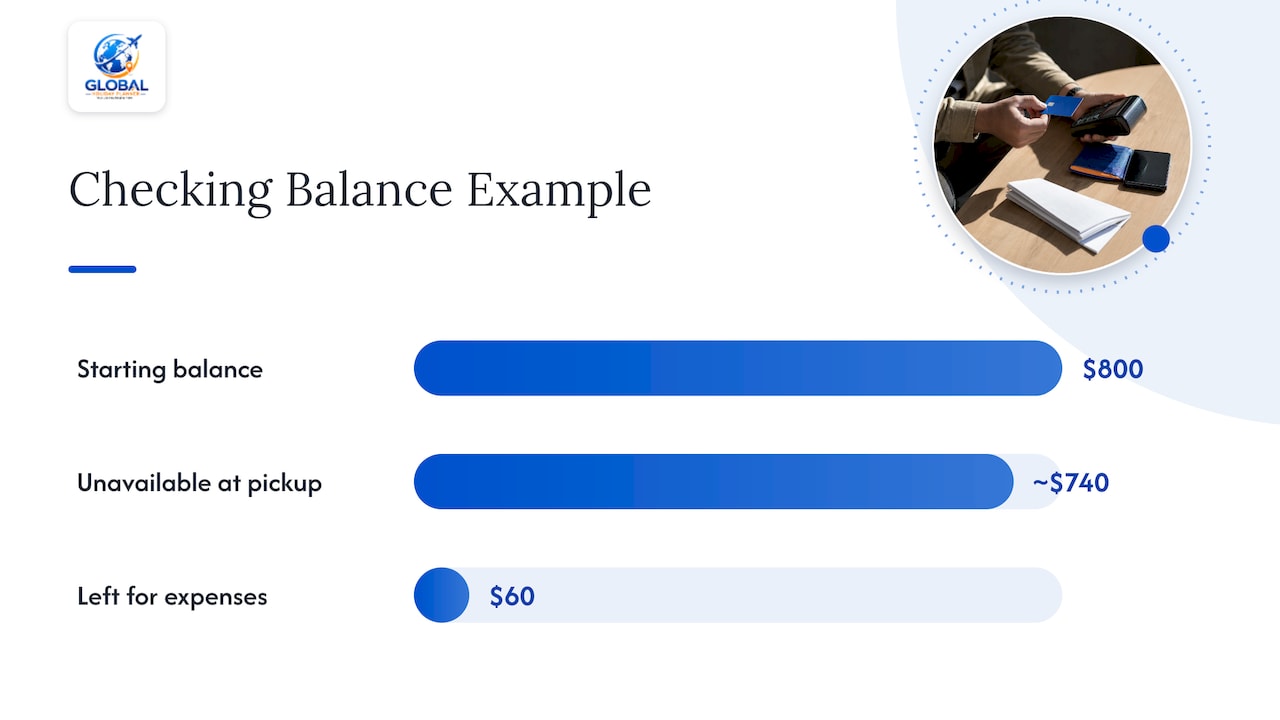
A worked example: a four-day compact rental estimated at $240 with a $500 debit hold means roughly $740 unavailable in your checking account at pickup. If your balance is $800, you have $60 left for gas, food and anything else, and a single unexpected charge could overdraw you. National warns that the renter is responsible for overdraft fees when debit charges reduce available funds.
The hold is released after the car is returned and all fees are paid, but release timing depends on your bank. Plan on several days rather than minutes. For a wider look at why companies ask for deposits at all, read do car rentals really require a deposit.
Airport counters: the strictest case
Airport locations are where most debit renters hit a wall. At U.S. airport branches, one brand accepts debit deposits at pickup only with a ticketed return itinerary, and the name and address on your driver’s license must match your current home address, with an exception for active-duty military. A sister brand lists the same conditions, along with sufficient debit funds and limits on additional drivers other than a spouse or domestic partner.
Another U.S. policy says airport debit renters must show a return-travel ticket and two valid forms of identification.
What to bring to an airport counter:
- A driver’s license in your name, with your current address
- The debit card, physical, in your name
- Proof of return travel, such as a flight or train confirmation
- A second form of ID, in case the branch asks
- Enough available balance for the estimate plus the hold
If you are driving into town from a non-airport branch, the rules are often looser, though still set per location. Renting off-airport can also cost less, but weigh that against the taxi or shuttle to get there. Our airport transfer page covers that leg.
Which cars you can rent
Acceptance of the card does not mean acceptance of every vehicle. One U.S. policy normally limits debit renters to Compact through Fullsize vehicles. Another says premium vehicles and convertibles are excluded. Hertz’s U.S. terms exclude debit cards at pickup for Large SUV, Prestige SUV, Adrenaline and Dream Collection vehicles.
If you need a minivan for a family or an SUV for mountain roads, a debit card may force a different plan. Vehicle type changes the rules everywhere, and that includes specialty vehicles: if you are planning a trip in Europe with a camper, ask the operator what payment and deposit they accept before you commit, as you would with campervan rental in Ljubljana.
Outside the United States
Do not carry U.S. assumptions abroad. Avis’s U.S. page notes that Canada locations do not accept bank debit cards as credit identification at pickup, and outside the U.S. it sends renters to the specific location’s terms or to the location itself. In Canada, Discover is also not accepted by one brand, as noted above.
In Australia, one major brand says most locations accept Visa or Mastercard debit cards that draw directly from the account for qualification, but prepaid or stored-value cards are not accepted for qualification, though both debit and prepaid cards may be used for payment at return.
Crossing the border in a rental has its own paperwork. Our cross-border rental checklist for the U.S. and Canada walks through it.
No credit card at all? Your options
If a branch refuses your debit card, you still have routes:
- Call the branch. Policies are set locally. Ask about the card, your age, the vehicle class, the hold and the documents, and get the answer before you travel.
- Switch locations. An off-airport branch may take debit at pickup where the airport counter will not.
- Pay at return. Some locations accept debit only for the final payment, so a credit card or other method secures the car and debit settles the bill. The bank guidance above confirms debit can be used for final payment even where a credit card secured the hold.
- Use a cash deposit program where it exists. In Australia, a renter with no credit or debit card in their own name can apply for a cash deposit ID card. Applicants must be 18 or older, the process takes about 30 days and the nonrefundable fee is USD 15. Do not assume the same program exists in your country.
- Ask someone with a credit card to rent. The renter must be the cardholder and the driver. Additional drivers can carry extra fees, so check our guide to additional driver fees.
We go deeper on the U.S. options in 3 debit card workarounds to rent a car and avoid big holds.
Checklist before you book
- Confirm the exact branch. Search for the pickup address, not just the brand.
- Check your age. Debit rules usually start at 25, with 18 in New York.
- Choose a eligible car class. Stick with compact through full-size unless the branch confirms otherwise.
- Price the hold. Add the rental estimate and up to $500, then check your balance.
- Gather documents. License, physical card, return ticket and a second ID.
- Warn your bank. A travel notice can prevent a fraud block on the hold.
- Check insurance. Without a credit card you may lose card-based rental coverage, so see whether you actually need car rental insurance.
- Look at one-way fees. Drop-off charges can be significant, see one-way rental fees by route.
Our perspective
We compare travel services for a living, and the debit card question is a good example of why the sticker price is not the real price. A $35-a-day compact looks cheap until you add a $500 hold you cannot spend, an airport that wants a flight ticket and a counter that quietly caps you at smaller cars.
Our advice is simple. Compare total cost and total cash tied up, not only the daily rate. Match the vehicle to what a debit card is allowed to rent. Confirm with the branch, in writing if you can, and keep that confirmation on your phone at pickup. If your trip is flexible, an off-airport pickup or a different company can solve the problem entirely.
We would rather you arrive with the right documents than argue at a counter with a family waiting.
— Global
Compare rentals in one place
Once you know your card, age and car class, compare car rentals on Global Holiday Planner side by side, then check each branch’s payment terms before you book. If you are flying in, you can also line up your flights so your return itinerary is ready to show at the counter.
FAQ
Which rental car company can I use a debit card for?
Most major U.S. rental companies accept debit cards at many locations, but each sets its own conditions on age, vehicle class, documents and holds. The policy that matters is the one at your pickup branch. Confirm it directly before you travel.
Can I rent a car if I only have a debit card?
Often yes, in the U.S., if the card carries a Visa, Mastercard or Discover logo, draws from your own account and you meet the age rule. Expect limits on vehicle type, and a ticketed return itinerary at airports. Some locations will still insist on a credit card.
How much is a rental car deposit with a debit card?
Published U.S. policies range from a hold equal to the estimated rental cost, with a $100 minimum at one brand, to the estimate plus up to $500 at others. Another requires a $300 to $400 deposit where there is no ticketed return itinerary. The money is frozen in your account until the rental closes.
What happens if I do not have a credit card for a car rental?
You can try a branch that accepts debit, choose an eligible car class, or use a debit card only for final payment where allowed. Know that debit holds can leave you short of cash, and overdraft fees are your responsibility. If a branch refuses, ask a credit-card-holding companion to rent, or pick another location.
Sources
- Debit card policy, U.S. and Canada, from a major rental company
- Payment methods and airport debit rules, U.S., Canada and Puerto Rico
- Rental terms and debit authorization, U.S.
- Rent with a debit card, U.S. value brand
- Car rental debit card policy, U.S. discount brand
- Car rental debit card policy, U.S. budget brand
- Renting with debit cards, U.S. and Canada airport conditions
- Do you need a credit card to rent a car? Bank consumer guidance
- Car hire FAQs and cash deposit ID card, Australia