

For most trips, booking online wins on price and control, as long as you compare every part of the trip side by side and not one booking at a time. Independent research keeps pointing the same way: when the same holiday was priced both ways, booking online was almost always cheaper. The exceptions are big, unusual, many-part itineraries, and even there the best results come from doing your own comparison first. That is what we built Global Holiday Planner for: flights, hotels, car rentals, transfers, rail tickets and travel insurance, compared in one place.
TL;DR
- Independent mystery-shop research found the same package holiday was almost always cheaper online than through a high-street agent.
- Agents now charge fees on flights, often $30 to $100 each, so a quote is only comparable once you see the total.
- Complex trips (big groups, many border crossings, spend of $5,000 or more) are where planning help matters most. A structured comparison and a clear plan cover most of it.
- Who you book through decides who fixes a change or a cancellation, so check that before you pay.
- Whichever route you pick, check the real total, the change rules and the seller’s legitimacy.
Table of Contents
- What the two routes actually are
- What the price evidence shows
- Agent fees: what you pay for the service
- Where complex trips need more planning
- When something goes wrong
- Which route fits which traveler
- How to check that a seller is legitimate
- Compare everything in one place
- Our view
- FAQ
- Sources
What the two routes actually are
A travel agent is a person who researches and books for you, and is paid by you, by suppliers, or both. Booking online means you do the searching and the booking yourself, either on a supplier’s own site (an airline or a hotel) or on a comparison and booking platform that lists many suppliers at once.
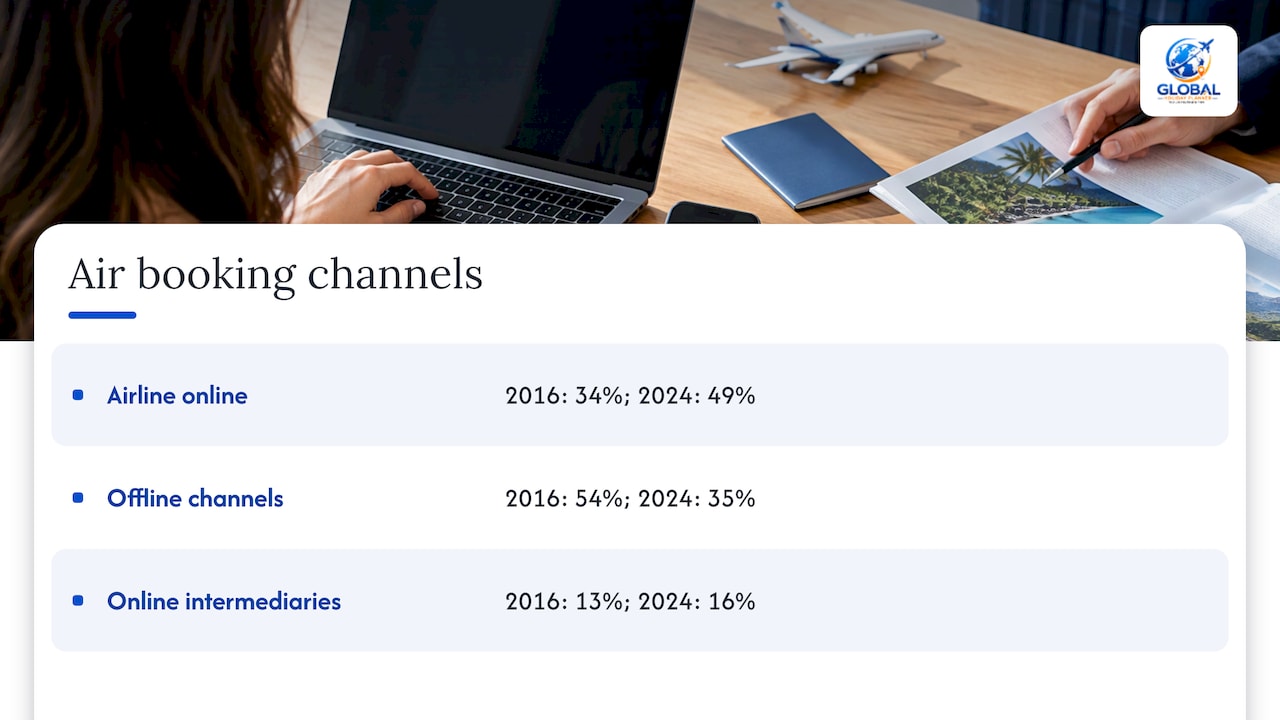
The line has been moving for years. In a 2025 McKinsey survey of 7,000 travelers, the share of global air bookings by value made through airlines’ own online channels rose from 34% to 49% between 2016 and 2024, while offline channels such as physical agencies and ticket offices fell from 54% to 35%. Online intermediaries rose from 13% to 16%. Most people now plan and book on a screen, and the real question is how to do it well.
What the price evidence shows
Price is the top booking criterion for 33% of travelers in the same McKinsey survey, so it is the right place to start.
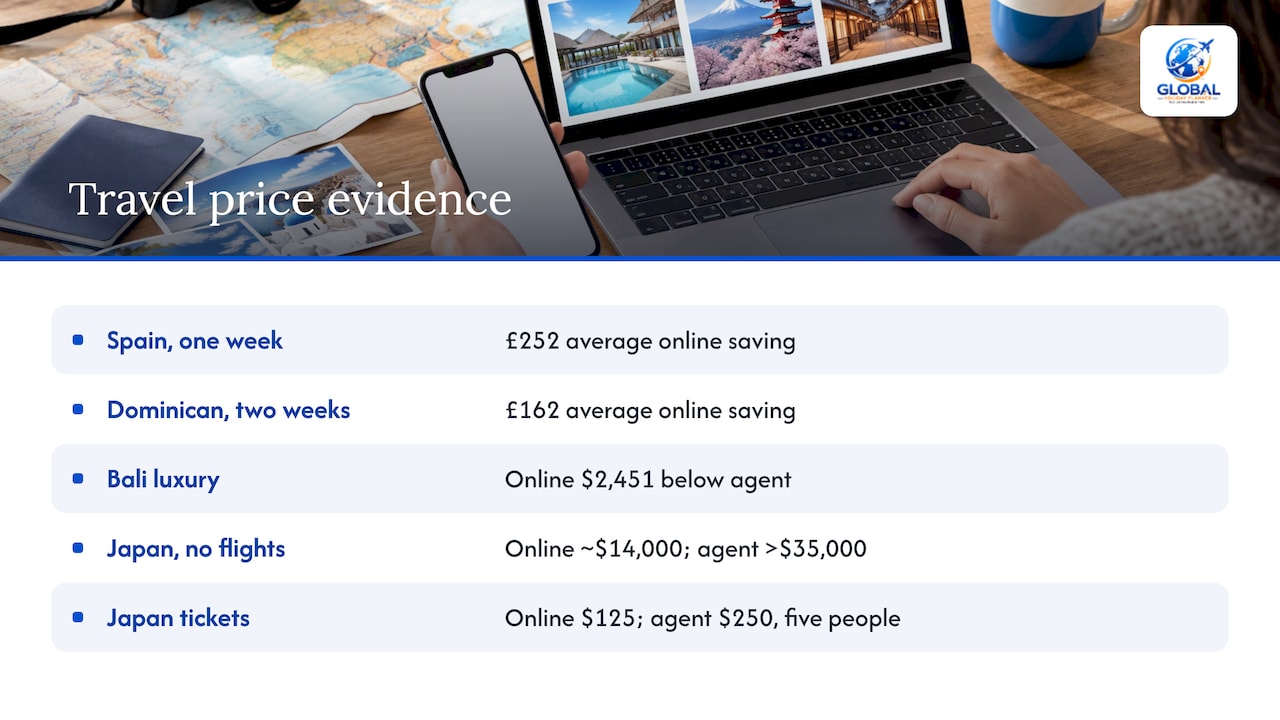
Package holidays. Which?, the UK consumer organization, sent mystery shoppers on 16 visits to 12 high-street stores in 2023. A couple could have saved on average £252 on a one-week Spain holiday and £162 on a two-week Dominican Republic holiday by booking the identical trip online. The biggest gap was £887 for seven nights in Spain. Haggling closed the gap only sometimes: one agent cut £319 off a quote and was still £50 above the online price.
Bali, three ways. Choice, the Australian consumer group, priced three Bali scenarios in 2020: a luxury couple, a solo adventurer and a family with young children. Doing it yourself online was cheaper in all three, and the luxury trip came out $2,451 lower, more than a third less than the agent’s price.
A family itinerary. A 2025 consumer.org.nz case study describes a New Zealand family whose agent-built Japan itinerary came to more than $35,000 without flights, against a budget of about $25,000. They found the same components, flights excluded, for about $14,000 online. Attraction tickets alone showed the pattern: $125 against $250 for a family of five.
These studies come from the UK, Australia and New Zealand, so the exact dollar gaps will differ in the United States. The direction, though, is consistent.
Choice also found that prices on hotel comparison sites came in higher than both the agent’s quote and the hotel’s own website. The lesson is to compare more than one source, including the supplier’s own price, and to look at the full cost, not the headline rate. Side-by-side cost and feature comparison across the whole trip is what we designed our platform around.
Agent fees: what you pay for the service
Airlines no longer pay ticket commissions to agents, except on corporate travel. So agencies charge you directly. According to Consumers’ Checkbook, typical fees run:
| Service | Typical agent fee |
|---|---|
| Domestic flight | $30 to $50 |
| International flight | $30 to $100 |
| Cruise | $0 to $150 |
| Research and planning advice | $75 to $150 per hour |
Complex overseas trips can carry fees of $300 or more. Agencies also still earn commissions from suppliers on hotels (5% to 10%), cruises (10% or more), car rentals (2% to 5%) and tour packages (10% or more). Some of the cost is therefore built into the price you are quoted, which is why asking for an itemized breakdown matters. Online, you see the price of each piece and decide what to include.
Where complex trips need more planning
Consumer Reports says hiring a travel professional is most worthwhile for expensive trips of $5,000 and up with complicated itineraries or large groups, where logistics such as airport transfers and hard-to-get reservations pile up. That tells you what the work is, and the work can be done online with the right tools.
- Many moving parts. List every leg, night, transfer and rental on one sheet and price each. Our flights, hotels, car rentals and airport transfers pages let you compare each component in the same place.
- Large groups. Seats for ten or more travelers need a plan. Our group flight playbook explains how to lock them in. On the ground, a large party needs vehicles sized to match, and some operators offer group transfers in Iceland for parties up to 49 passengers, which shows how far in advance that piece should be settled.
- Several generations. Different budgets, mobility needs and school calendars are the hard part. Our multigenerational planning guide starts by setting costs and then flexing dates.
- Unpublished fares. The head of the Travel Agents’ Association of New Zealand has said some airline fares are not published online. Flexible-date searching is the online answer: our date grid method shows how to scan a range of dates in about 15 minutes.
When something goes wrong
Cancellations and changes are where the route you booked through matters most.
NerdWallet explains that airlines and hotels generally send you back to the intermediary you booked with, and that airlines and hotels themselves tend to offer more flexibility when you book direct. Booking fees from an intermediary can also erase a saving. Australia’s eSafety Commissioner adds that booking flights directly with the airline is often the safest option and makes swapping flights easier.
So before you pay, read the change and cancellation terms on the final screen, and note who you would contact. That is a ten-second check that saves hours later. Refund difficulty is a widespread worry: Which? found that 60% of UK consumers felt a refund for package holiday problems would be difficult, and 57% felt the same for cancelled holiday flights.
Two practical tools help:
- Know your refund options. If a nonrefundable hotel stay falls through, our five-step refund script shows what to ask for and in what order.
- Cover the risk. Cancellation and medical cover is a booking-time decision. Our guide on whether travel insurance is worth it helps you map your trip’s risk, and you can add cover when you book.
In the EU, a European Commission study notes that passengers who booked through an intermediary and cannot get reimbursed can request a refund from the airline directly. That is an EU rule and does not apply everywhere, so check the rules of the country your flight departs from.
Which route fits which traveler
| Traveler | What matters most | Best approach |
|---|---|---|
| Budget-conscious | Lowest real total | Compare flights, hotels and extras together, and use flexible dates |
| Family or multigenerational | Rooms, seats together, shared costs | Price every leg first, then book rooms and seats in one sitting |
| Couple on a getaway | Fit and value, not just price | Compare by trip type and check what each stay includes |
| Golf traveler | Tournament dates, equipment, cover | Book flights and stays early, and add golf travel insurance |
| Corporate | Speed, rates, changes | Use the business travel tips and corporate hotel rates |
How to check that a seller is legitimate
Online sellers vary. Which? travel editor Rory Boland has advised watching for prices well below the market average, treating a bank-transfer-only payment option as an alarm bell, looking for official industry logos, and searching reviews for the same complaint repeated. When in doubt, book direct with the airline or hotel. Paying by credit card is a sensible habit on any large booking.
Compare everything in one place
Our platform compares flights, hotels, car rentals, airport transfers, rail tickets and travel insurance side by side, with scenario-based recommendations for family vacations, romantic getaways, golf trips and business travel. The aim is to show your real total cost and best fit for your itinerary before you commit. Start with flight comparison or browse the full platform at Global Holiday Planner.
If your trip has more than one stop, start with the hotel and ground plan, then fit the flights around it. Our hotel comparison is the place to begin.
Our view
Most travelers do not need to choose between an expert and a screen. They need the whole trip on one page: flights, hotel, car, transfer, rail and cover, each with its price and its rules.
That is why we built Global Holiday Planner around side-by-side cost and feature comparisons for every major part of a trip. When the numbers sit together, the real total becomes visible, and so does the best fit for a family, a couple, a golf group or a business trip.
Our scenario-based recommendations are designed to do the thinking that makes a complex trip feel manageable, and our partnerships with trusted providers are designed to keep prices competitive. Try one trip end to end and see the total for yourself.
Global
FAQ
Do I need a travel agent?
For most trips, no. Flights, hotels, cars and rail are straightforward to compare and book online, and independent studies found online prices were usually lower. Consumer Reports suggests professional help mainly for trips of $5,000 and up with complicated itineraries or large groups, and a structured comparison covers much of that work.
Is it cheaper to book a trip online or through an agent?
In the studies above, online was cheaper for the same holiday in most cases. Agents may add fees, such as $30 to $100 for an international flight according to Consumers’ Checkbook. Compare the full total, including the supplier’s own site, before you decide.
Who handles problems if I book online?
The seller you booked with usually handles changes and refunds, and airlines and hotels often refer you back to them. Read the change terms before paying, and keep your confirmation details together.
How do I know an online booking site is legitimate?
Be wary of prices far below the market, payment by bank transfer only, missing industry logos and repeated identical complaints in reviews. Paying by credit card adds a layer of protection on large bookings.
Sources
- Which?: Is it cheaper to book my holiday online or with a travel agent?
- McKinsey: Eight myths of airline retailing debunked
- Choice: Travel agent vs do it yourself bookings
- Consumer NZ: Travel agent vs booking yourself
- Consumers’ Checkbook: Travel Agencies
- Consumer Reports: Guide to Do-It-Yourself Travel Planning
- NerdWallet: The Pros and Cons of Online Travel Agencies
- eSafety Commissioner: Travel agent or DIY?
- Which?: Consumer difficulty navigating holiday protections
- European Commission: CPC case study on air travel
- Which? warns holidaymakers over dodgy online travel agents
- Group travel in Iceland: large party transfers