

Choose a guided tour when transport links, language or a tight schedule make planning on your own slow and stressful. Go independent when your destination is well connected, you want full control and you have time to plan. The sections below weigh cost against convenience and match each style to the kind of destination you are visiting.
TL;DR:
- Guided tours do not carry a universal price premium; compare the full itinerary, including excluded airfare, meals, optional excursions, independent transfer costs, and planning time.
- A self guided package prebooks hotels and transport without a guide; a private tour adds a guide and gives your party more control over pace.
- Independent travel offers freedom only when transport cooperates; frequent trains support spontaneous changes, while sparse rural buses can leave you bound to schedules.
- Guides add the most value at ruins, historic sites, and culturally complex places; beaches and easy to navigate towns rarely need expert interpretation.
- Whichever format you choose, book your first night, use licensed transport, share your itinerary and insurance details, and save emergency numbers offline.
Table of Contents
- What are the main trade-offs between guided and independent travel?
- How do you compare the true cost of each option?
- How much control do you actually get with each option?
- What do tours take off your to-do list?
- Which destinations favor a guided tour, and which favor going solo?
- What do the different travel formats actually mean?
- What safety and preparation steps apply either way?
- How do you decide, and what should you ask before booking?
- What does the data say about how people travel?
- Our view: plan the whole trip, then decide who does the work
- Compare flights, hotels, transfers and insurance in one place
- FAQ
- Sources
What are the main trade-offs between guided and independent travel?
Before getting into detail, here is the short version. Each style wins on different things, and most travelers care about three or four of them, not all.
What guided tours do well:
- Logistics are handled for you, from intercity moves to hotel choices.
- A local guide supplies context that signs and guidebooks often skip.
- Many departures include transfers and admissions in the headline price.
- Built-in companions make the trip easier if you are traveling solo.
What independent travel does well:
- You control the itinerary, so you can drop a stop that disappoints and linger where you are happy.
- Slow travel and detours become possible, because nobody is waiting for you at the bus.
- You choose your own lodging and pace, from a budget guesthouse to a boutique hotel.
- Spending follows your priorities, not a package’s.
Where the middle ground sits: the choice is not binary. A private tour keeps the arranged logistics but lets you set the pace. A self-guided package pre-books hotels and transport while you explore without a guide, which UN Tourism’s own framing of the trade-off places between the two. Hybrid products work well when you want certainty on the hard parts, such as long transfers, and freedom everywhere else.
If you are weighing a hybrid, ask yourself which single part of the trip you dread planning. That is usually the part worth paying someone else to handle.
How do you compare the true cost of each option?
A tour’s headline price rarely tells the whole story, and neither does a cheap flight plus a nightly hotel rate. You have to compare whole trips.
A typical tour bundles transport between cities, many admissions, some meals and a local guide. When you travel independently, you buy each of those separately: local transfers, entry tickets, an optional guide for the sites that deserve one, and sometimes extra transfers when schedules do not line up. None of these is expensive alone. Together they can swing the comparison either way.
So build a side-by-side total for the same itinerary:
- Airfare to and from the destination.
- Hotels for every night, at the standard you would actually choose.
- Transfers and intercity transport, including the last mile.
- Admissions and any guides you would hire.
- Meals the tour includes versus meals you would pay for anyway.
- Travel insurance, which you need on either route.
- The value of your planning time, which is real even though it never appears on an invoice.
That last item is the one people skip. If planning would take you many evenings and you resent the work, a tour’s premium may be cheaper than it looks. If you enjoy the research, the same hours are part of the fun and cost you nothing.
Do not assume tours always cost more. World Bank analysis of Uganda’s tourism expenditure survey shows that spending patterns differ by destination, and no globally reliable fixed percentage separates guided from independent trips. In some places, a group tour that shares a vehicle and a guide costs less per person than hiring drivers and entry tickets one by one. In others, a well-connected city with cheap public transport makes self-planning clearly cheaper.
A practical way to run the comparison: price the tour first, then try to rebuild its exact itinerary yourself using real booking pages for flights, hotels and transfers. If you cannot get within a comfortable margin, the tour is not overpriced. If you beat it easily, you have your answer. Booking flights or the hotel first matters here too, because it determines which of your fixed points is truly fixed.
Watch for what a tour leaves out. Some packages exclude airfare, some skip dinners, and some charge extra for the excursions that sell the trip in the first place. Read the inclusions list line by line. A cheaper tour with three optional add-ons you will certainly buy is not cheaper at all.
Independent trips hide costs too. Taxis from a remote station, a rental car plus parking, a sudden need to rebook after a missed connection: these are the surprises that rarely appear in a DIY budget. Add a buffer for them, and your comparison will be honest.
How much control do you actually get with each option?
Flexibility sounds simple until you ask what you would do with it. In practice it means changing a day’s plan when the weather turns, choosing which excursions to join, and keeping genuine free time.
Tours are less rigid than their reputation. Most follow a backbone itinerary, meaning fixed hotels, fixed travel days and a set sequence of major sights, and then leave pockets of free time inside it. Some give you an afternoon, some a whole day. If you value spontaneity above everything else, a standard group departure will feel confining. If you simply want room for a long lunch and a wander, many tours deliver that without trouble.
Private tours loosen the structure further. You can ask the guide to skip a stop, spend longer at a favorite one or start later. That control costs more per person, because you are paying for the guide’s and driver’s time alone or with a small party instead of splitting it among a group. For a family or a few friends traveling together, the per-person gap often narrows enough to make a private tour reasonable.
Independent travel offers the most freedom on paper, and often less in practice. Flexibility depends on whether you can actually get anywhere. In a city with frequent trains and buses, you can change your mind at breakfast and be somewhere new by midmorning. In a rural region with infrequent buses, or a coastline where parking fills early, your options narrow quickly. The freedom you imagined gets traded for a timetable you did not choose.
This is the point Lonely Planet’s DIY versus tour advice makes plainly: choose DIY when trains run frequently, and let a tour handle the logistics when they do not. The deciding factor is connectivity, not ideology.
Think of flexibility as having two layers. The first is what you are permitted to change. The second is what you are practically able to change. Independent travelers win the first layer everywhere. They win the second only where transport and logistics cooperate.
A test worth running: write down what you would most want to change mid-trip, such as sleeping in, adding a detour or staying an extra night somewhere. Then check whether the tour allows each one and whether your own plan could execute each one without a scramble. The option that supports your priorities is the flexible one for you, whatever the brochure promises.
What do tours take off your to-do list?
The real product of a good tour is subtraction. Gene Sloan, a travel journalist, has described the main value of escorted tours as the removal of many small logistical decisions: where to sleep, how to move between places and how to interpret local customs, plus an expert guide and built-in companions.
Here is what that looks like day to day. Tours commonly handle intercity moves, so you never study a timetable or wonder which platform a train leaves from. They choose and book hotels, often in locations convenient to the day’s sights. Some meals are arranged, which removes the nightly question of where to eat in an unfamiliar town. Guides interpret what you see, so a pile of stones becomes a story.
Independent travel asks you to do all of this yourself. You research schedules, work out how to reach a trailhead or a castle from the last bus stop, check opening hours, find parking, and arrange the last mile between a station and your accommodation. None of it is hard, but it adds up, and the effort lands at the worst moments: after a long flight, in a place where you cannot read the signs.
How much that matters depends on you. Some people find the problem-solving part of the pleasure. Others arrive partway through a trip tired of deciding. Be honest about which one you are, because the answer predicts how you will feel halfway through.
Language is the area where a guide adds the most practical value. A guide can negotiate with a driver, explain a menu, ask a stranger for help and smooth over a misunderstanding in seconds. On your own, the same moments can cost an hour or a good deal of stress. If you speak little of the local language and the destination does not lean toward English, that alone can tip the decision.
Luggage logistics deserve a mention as well. Tours that move you between hotels usually move your bags with you. Independent travelers carry their own, up the stairs of a walk-up guesthouse and along cobbled streets. If you travel with heavy cases, or with someone who cannot manage them, that burden is part of the cost.
None of this means independent travel is inferior. It means you should decide which tasks you want to own. If you enjoy planning and have time, a map-first approach to itinerary planning takes much of the pain out of the work. If you would rather arrive and simply be shown things, a tour is buying you a different trip.
Which destinations favor a guided tour, and which favor going solo?
Geography decides more of this choice than personality does. Start with the destination and ask what getting around will actually take.
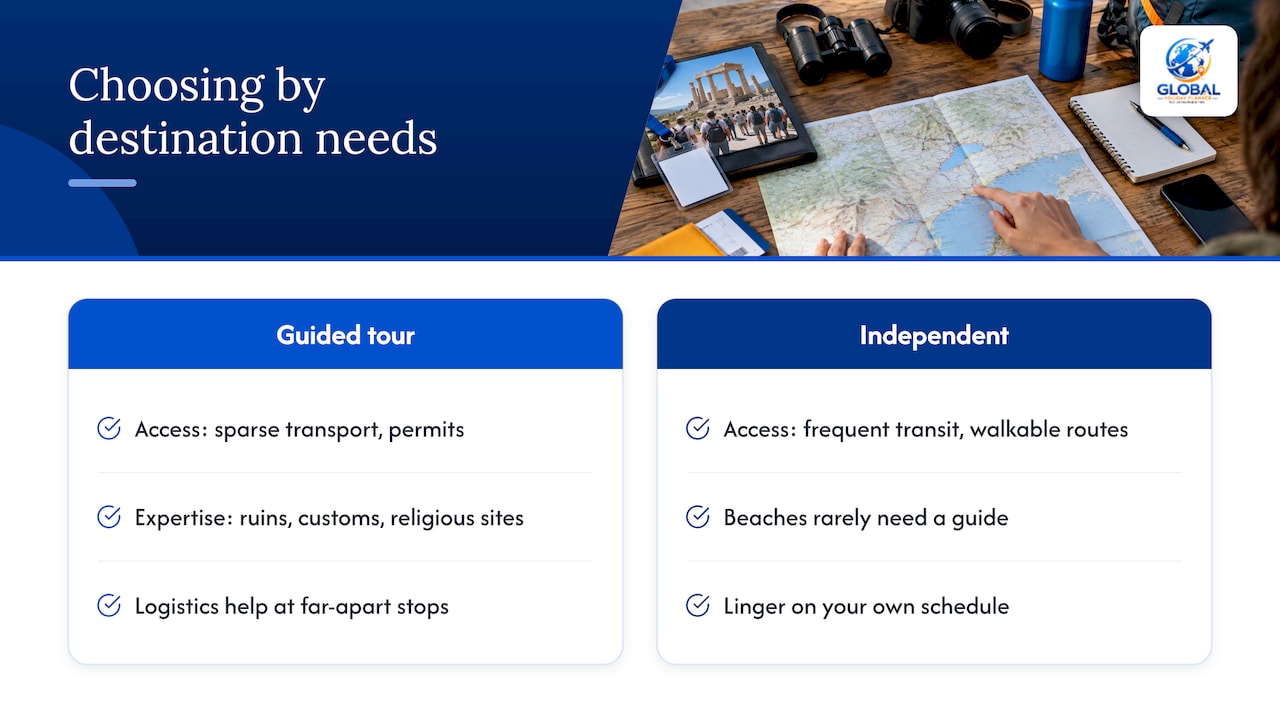
Complex or logistically difficult places often favor guided or private tours. Think of regions with infrequent public transport, scarce parking, language barriers, permit requirements or itineraries that string together several far-apart stops. In those places, a guide who already knows the roads, the schedules and the people can save you days of friction. Lonely Planet’s practical test is destination-led: ask whether public transport departures, parking, opening hours and routes make independent travel efficient. If they do not, a tour’s transport coordination can be worth the premium.
Well-connected cities, beach stays and places with regular public transport favor independent travel. If you can ride a metro to the museum, walk to dinner and take a frequent train to a neighboring town, a tour adds little you could not do yourself. The same holds for a week by the sea or a base in a village, where the plan is mostly to be there.
Activities matter as much as places. Historic sites, ruins and battlefields benefit from interpretation. As Lonely Planet’s advice notes, ruins and battlegrounds gain tenfold depth from a guide, while beaches rarely need one. Without context, an archaeological site is a field of low walls. With a good guide, you can see the street plan, the daily life and the reasons it fell. Cultural customs and religious sites work the same way: a guide tells you what you are looking at and how to behave around it.

By contrast, slow beach stays, village wandering, café hopping and open-ended walking are best done on your own schedule. There is no story to be told that justifies a fixed hour.
A simple way to apply this: list the main things you want to do. For each one, decide whether it needs expertise, whether getting there is easy and whether you would want to linger. Expertise and difficult access point toward a tour. Easy access and a wish to linger point toward going alone.
Many trips are mixed. A common pattern is to base yourself independently in a well-connected city and book a single guided day trip to the hard-to-reach site. You get the freedom of the city and the logistics support where it counts, and you pay for a guide only on the day it earns its fee.
What do the different travel formats actually mean?
Listings use these terms loosely, so it helps to know what each one means. The most useful way to think about it is a spectrum rather than two boxes, a point made in destination research on the range of formats.
- Escorted group tour: a set itinerary with a guide and a group of fellow travelers, usually including transport between stops, accommodation and some meals or admissions.
- Private tour: the same kind of arranged logistics, but for your party only, with more say over pace and stops.
- Self-guided package: hotels, transfers and sometimes tickets are pre-booked, and you sightsee without a guide.
- Hybrid: arranged logistics, such as hotels and intercity transport, with independent sightseeing in between.
The per-person price follows a few drivers: group size, included transport, guide time and meal inclusions. A larger group spreads the guide and vehicle across more people. A private tour does not. More included meals and admissions raise the sticker price but can lower what you spend elsewhere.
Before you book anything, confirm these items:
- The maximum group size, not just the average.
- Which meals and admissions are included and which are extra.
- Where the hotels are located relative to the sights.
- The guide’s language and how the group is split by language, if at all.
- What happens on free days and who handles you if plans change.
If a listing is vague on any of these, ask. Clear answers are a good sign, and evasive ones tell you something too.
What safety and preparation steps apply either way?
Both styles of travel need the same basics. Official guidance for independent travelers is a useful checklist even if you plan to join a tour. UK government advice on solo and independent travel recommends checking entry, health and safety information before you leave, arranging your first night’s accommodation, using licensed transport, and sharing your itinerary and insurance details with trusted contacts. This is general guidance, and local rules and risks vary by destination and nationality, so check the specifics for where you are going.
A few steps cover most situations:
- Book your first night before you fly, so you never arrive without a bed.
- Use licensed taxis or pre-booked transfers rather than unmarked offers at the airport.
- Share your itinerary and insurance details with someone at home.
- Save emergency numbers and your accommodation address offline.
- Buy travel insurance that matches the trip, whatever style you choose.
A tour removes some of the immediate arrival logistics, because transfers and hotels are usually arranged. It does not remove the need for insurance or emergency contacts. If you fall ill or miss a connection on the way to the tour’s start point, you are on your own until the group meets. Our guides on whether travel insurance is worth it and on solo travel safety go deeper on both.
Pro Tip: If mobility, stamina or luggage is a concern, ask the operator before booking how fast the group walks, who handles your bags at each hotel and whether transfers include help getting on and off vehicles. Get the answers in writing, since pace and assistance vary widely between operators.
For independent travelers, plan the arrival hour with extra care. It is the point where fatigue, an unfamiliar place and a lack of local knowledge combine. A pre-booked transfer and a confirmed hotel remove most of the risk. If you are still sorting out the rest of your preparation, our trip planning checklist covers the details that tend to slip.
How do you decide, and what should you ask before booking?
Work through this checklist in order. The first items matter most, and later ones break ties.
- Trip goals: are you here to see a lot, rest, learn or celebrate? Sightseeing-heavy goals favor guides; rest favors independence.
- Time available for planning: if you cannot spare the hours, a tour or hybrid saves you them.
- Budget tolerance for convenience: decide how much extra you will pay to avoid effort, then compare it to the real total cost.
- Transport connectivity: frequent, reliable public transport favors independent travel; sparse links favor a tour.
- Mobility and health: pace, stairs, luggage and heat can all push you toward arranged logistics.
- Wish for expert interpretation or companions: if you want stories and company, a tour supplies both. If you want solitude and surprise, it will not.
When you evaluate a tour listing, ask the operator:
- What exactly is included in the price, and what is extra?
- How large will the group be?
- Where is the hotel for the first night, and how do I get there?
- What is the cancellation policy, and what if you cancel?
- Who do I call in an emergency, and is support available around the clock?
- How much free time is built in each day?
When you evaluate your own independent plan, ask yourself the mirror questions. What happens if a connection fails? Do I know how I will get from the station to the hotel? What is my plan for the first night? Is the cancellation policy on each booking one I can live with?
Then apply a simple decision rule: choose the guided option if the time and stress it saves are worth more to you than the extra it costs. If the saved effort is trivial, or the premium is high compared to what you would pay yourself, plan it yourself. A hybrid is the answer when one hard part of the trip is worth outsourcing and the rest is not.
Be careful about one trap: choosing based on how you imagine yourself, not how you actually travel. If you have never enjoyed planning, a spreadsheet of bus times will not become fun in a foreign country. If you have always chafed against schedules, a fixed itinerary may soon wear on you. Pick for the traveler you really are.
If you do decide to plan independently and want to lock components in a sensible order, our guide on flexible date flights shows how to find the best dates without wasting hours.
What does the data say about how people travel?
Demand is strong, which makes planning more important whichever way you go. UN Tourism reported that international arrivals reached 1.52 billion for 2025, after more than 300 million international tourists in the first quarter, a 5% rise over the previous year. Busy seasons mean fuller hotels and tighter availability, so booking early helps tours and independent trips alike.
Destination research adds nuance. A 2025 study of travelers in Iceland, comparing independent and guided experiences, found that preferences are shaped by flexibility, safety, cultural immersion and convenience. Independent travel appealed to people seeking freedom and authenticity. Guided travel was valued for convenience and expert interpretation. Neither group was wrong; they wanted different things.
For a practical rule of thumb, Lonely Planet’s guidance stays the most useful: let transport decide. Where connections are frequent, go alone. Where they are not, pay for someone else to handle them.
Our view: plan the whole trip, then decide who does the work
We think the guided versus independent question gets argued in the wrong terms. It is not a contest between adventurous and cautious travelers, or between thrift and comfort. It is a question about where your effort is best spent, and that changes with the destination, the season and who is traveling.
We encourage travelers to compare the whole trip side by side, which is why we put so much weight on it. Flights, hotels, transfers and insurance each look manageable in isolation. Stacked together, they show you whether a package is a bargain or a premium.
Our approach is simple. Price the independent version honestly, including the small transfers and the planning hours. Price the guided version honestly, including the extras it leaves out. Then pick the one that matches what you want from the trip, not the one that sounds more impressive to friends.
For many readers, the best answer turns out to be a mix: book the flights, hotels and transfers yourself where it is straightforward, and hand the hard day to a guide. We built our comparison tools around exactly that way of traveling.
— Global
Compare flights, hotels, transfers and insurance in one place
We help you put numbers on the decision. On Global Holiday Planner you can compare flights, hotels, car rentals, airport transfers, rail tickets and travel insurance side by side, so you see the real total for a self-planned trip before you decide whether a tour is worth it.
If you go independent, you can book each piece in the same place, from flights to hotels to airport transfers. If you go with a tour, you can still book your flights and your insurance with us. Start with the part of the trip that is hardest to rebuild if it falls through, and compare the options today.
FAQ
What is the difference between a guided tour and independent travel?
On a guided tour, an operator arranges much of the trip, such as transport, accommodation, activities and sometimes meals. Independent travelers choose and coordinate each of those pieces themselves. A self-guided trip sits between the two, with pre-booked arrangements but no guide, as UN Tourism describes it.
What is a private tour?
A private tour is a guided experience arranged for your own party instead of a mixed group. You keep the arranged logistics and a guide’s knowledge, and you gain more say over pace and stops. It usually costs more per person than a group departure, because the guide and vehicle are not shared.
Are guided tours always more expensive than traveling independently?
No. Research on destination spending shows no fixed premium for guided tours worldwide, and the answer depends on the place. Compare the full itinerary price against what you would pay for transport, hotels, admissions, transfers, meals and insurance.
Are travel guides still worth hiring?
Yes, especially at historic sites, ruins and culturally complex destinations where context makes the visit richer. They matter less at beaches and in easy-to-navigate towns. A good guide is worth the most where signage and guidebooks leave gaps.