
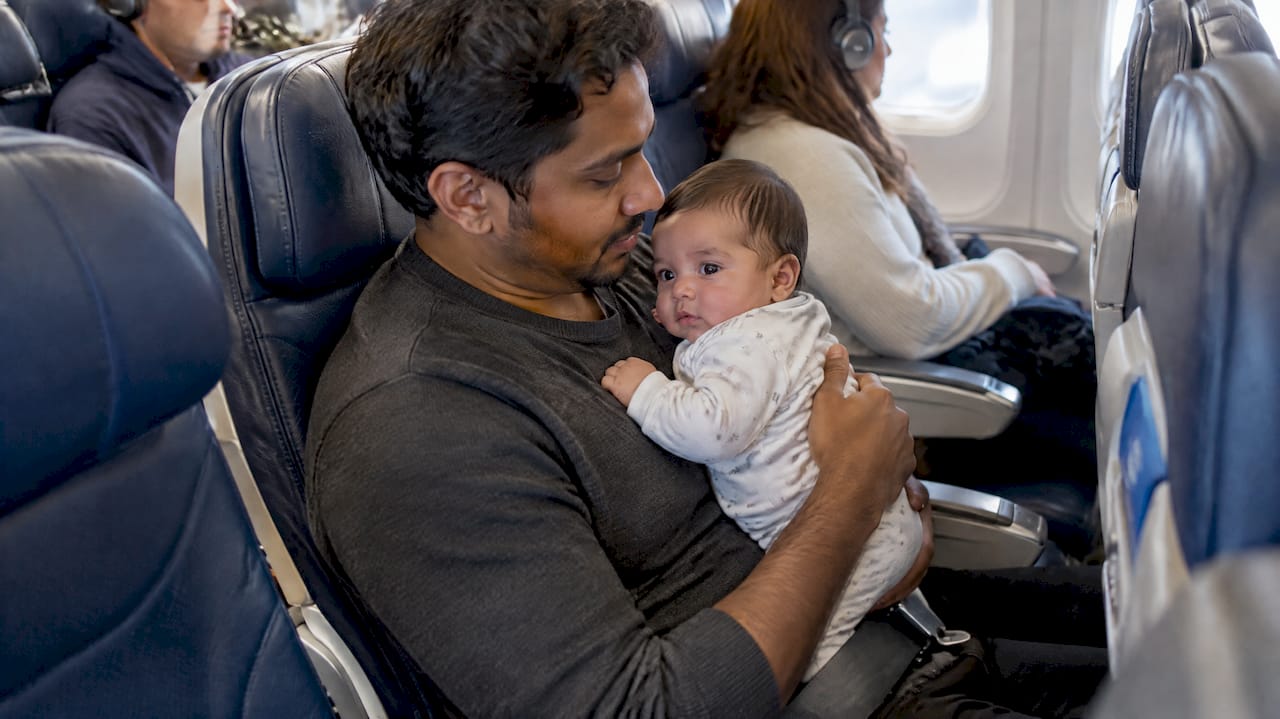
A lap infant is a child under two who rides on an adult’s lap instead of in their own seat. On U.S. domestic flights that child usually flies free. On international flights you typically pay about 10% of the adult fare plus taxes. Airlines set the details, and the FAA strongly recommends a child restraint in their own seat instead. This guide covers the age limit, what an infant costs, what baggage comes with them, what to carry on an international trip and how to weigh the safety question.
TL;DR
- A lap infant must be under two on the day of every flight in the itinerary. A child who turns two before the return flight needs their own seat on that leg.
- U.S. domestic lap infants generally fly free. International lap infants usually need a ticket at roughly 10% of the adult fare plus taxes and fees.
- A lap infant usually has no baggage allowance of their own, but strollers and car seats are commonly carried free for the adult.
- One lap infant per ticketed adult is the usual limit. Tell the airline at booking, not at the gate.
- The FAA and the American Academy of Pediatrics recommend an approved restraint in a purchased seat for the whole flight.
Table of Contents
- What counts as a lap infant
- Do infants fly free?
- International lap infant rules
- Baggage allowance for a lap infant
- How to add a lap infant to your booking
- Safety: what the FAA and pediatricians say
- Book the whole trip with the real total in view
- Our perspective
- FAQ
- Sources
What counts as a lap infant
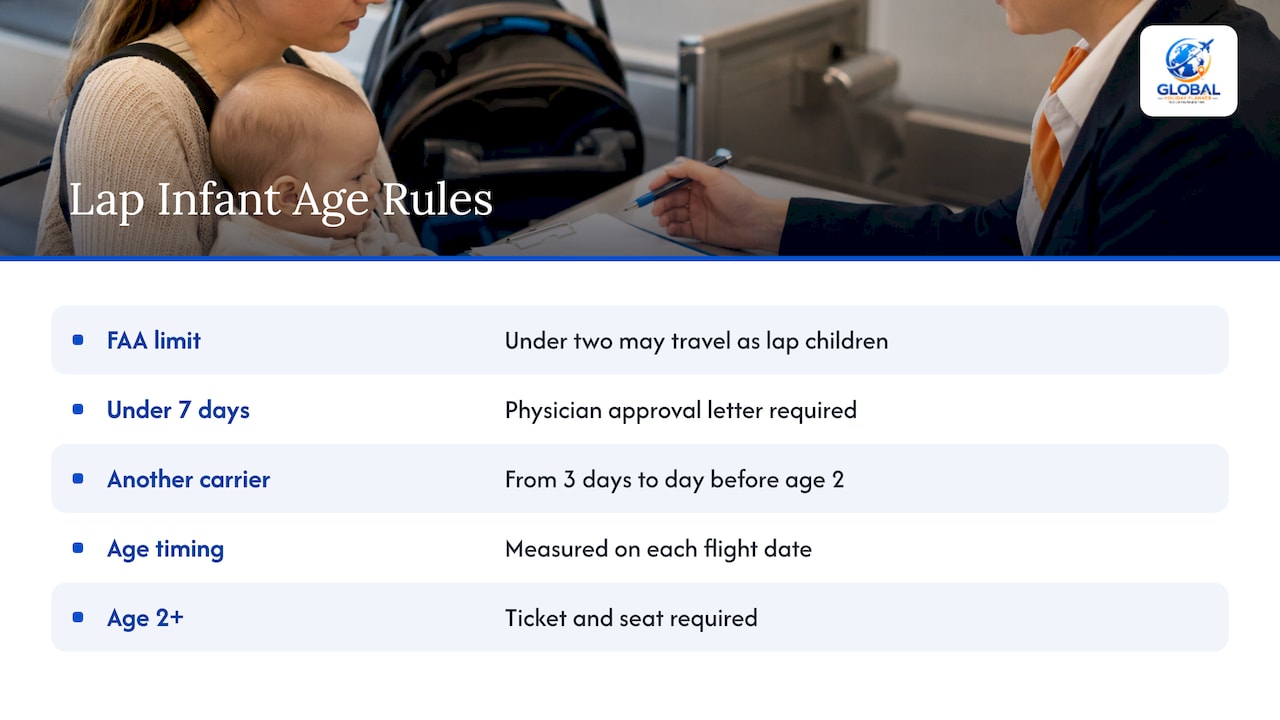
The rule is simple: the child must not have reached their second birthday. The FAA permits children under two to travel as lap children in the United States. Everything else is set by each airline, and that is where the variation sits.
The main variable is the minimum age. Some carriers accept newborns only with a doctor’s note. One major U.S. airline says babies under seven days can fly only with an approval letter from a physician who examined the baby. Another allows a lap infant from three days old through the day before the second birthday. Check the airline’s page for your carrier. Most parents of very young babies will also want a pediatrician’s view before flying.
The upper limit is where families get caught. Age is measured on each flight date, not on the booking date. If your child turns two between the outbound and return flights, the return needs a purchased seat. Book it as a two-seat itinerary from the start, or you may face a higher fare when you add the seat later. Airlines require a ticket and seat for any child aged two or older.
Proof of age
Airlines can ask for proof, and some ask at the airport. One U.S. carrier lists a passport, birth certificate or government-issued photo ID as acceptable proof, original or photocopied. It does not accept screenshots or immunization records. Carry the document in paper form, even if you have a photo on your phone.
Who can hold the baby
The holding adult must usually be at least 18. Some carriers set lower thresholds. One airline’s rule is that the carer must be over 15, or at least 16 on Canada itineraries. The U.S. Department of Transportation notes that lap eligibility and the age of the accompanying adult are airline-policy matters. A teenage sibling or a grandparent holding the baby is therefore a question for the airline’s policy page, not a general rule.
Do infants fly free?
On domestic U.S. flights, generally yes. Under one major carrier’s policy, a U.S. domestic lap infant flies free without a ticket. Another says lap infants travel free within the United States. “Free” means no fare. You still must tell the airline the baby is coming.
International is different. The common pattern is an infant ticket priced at about 10% of the adult fare plus international taxes or fees. Here is how the pattern looks across routes:
| Trip type | What lap infants typically pay |
|---|---|
| U.S. domestic | No fare; the infant is added to the reservation |
| U.S. to Canada, Mexico, U.S. Virgin Islands | A ticket with applicable taxes, or 10% of the adult fare plus taxes, per one carrier’s policy |
| Other international | A ticket and a partial fare, often 10% of the adult fare plus taxes and fees |
| Canada to U.S. | $0 base fare with taxes applying, per one fare table |
The exact percentage and the taxes differ by airline and destination. A Canadian carrier says lap infants pay no base fare or taxes on most routes, but some destination taxes and U.S.-bound government fees may apply. A European carrier’s rule is that domestic lap infants need a ticket but travel free, while international lap infants need an infant ticket at 10% of the adult fare plus airport taxes.
A worked example
Say the adult fare on a transatlantic round trip is $800 before taxes. A 10% infant fare would be about $80 plus the infant’s taxes and fees. Those fees vary by route, so the all-in cost is somewhat above $80. The point is that the infant ticket is a fraction of an adult fare, not a second adult fare, and the real extras are the taxes. This is an illustration of the 10% pattern, not a quote for any route.
This is exactly where comparing totals matters. When you compare flights on our flight comparison page, look at the all-in price for your whole party, not the headline fare for one adult. Add-on charges can also shift a total, which we cover in how a $30 bag changes your total.
International lap infant rules
Three things change when you cross a border: the ticket, the passport and the destination’s own rules.
The ticket. Unlike many domestic itineraries, the infant is normally listed on the ticket. One airline requires international lap infants to be listed on the ticket and asks travelers to notify its reservations team. Do this before you travel.
The passport. The infant needs a passport for international travel. One carrier says all customers, including lap infants, need a valid passport, and the infant’s passport must be shown to a crew member before boarding an international flight. Apply for the infant’s passport early, because a newborn without one cannot take an international flight.
Mixed itineraries. If part of your trip is on a partner airline, the strictest policy in the chain is the one that bites. Different carriers on one itinerary can have different minimum ages, different fares and different seat-map limits. Confirm each leg before you pay.
For a family with a toddler close to the cutoff, international flights are where the two-year line costs the most. A child who turns two abroad needs a full seat home, usually at a child or adult fare, not the 10% infant fare.
Baggage allowance for a lap infant
The baby generally gets nothing of their own, but the adult gets baby gear exemptions. Policies vary, so use these examples as a pattern.
- Domestic, no seat. One U.S. airline says a lap child may not check or carry on baggage, while the accompanying adult may check one stroller and one car seat free of charge.
- Some international routes. A lap infant paying at least 10% of the adult fare may get one checked piece: up to 10 kg on Asia, Pacific, Middle East or Europe routes, or up to 23 kg on North America or Japan routes. Carry-on is not applicable on that carrier.
- Carry-on bag. One carrier lets infants under two bring one carry-on bag but no checked baggage, and allows two listed items such as a bassinet, cot, car seat or stroller free for each infant or child under 12.
So the answer to “does a lap infant get a personal item” depends on the airline. Pack the diaper bag as your own personal item and treat any extra allowance as a bonus. If you are building a family trip on one carry-on each, our guide to carry-on only travel shows how to pack light, and our 2026 baggage fee comparison helps you see what an extra bag costs for a family.
Strollers and car seats
Strollers and car seats are usually checked free, either at the ticket counter or at the gate. Our guide to the car seat on a plane explains approval labels and gate checking, and the child car seat rental guide covers what to do once you land.
How to add a lap infant to your booking
The process is short, but the order matters.
- Book the adults first. The infant is attached to a ticketed adult. One carrier says each adult may travel with one lap infant.
- Tell the airline. One carrier requires notification of a lap child on domestic and international journeys, either by selecting an infant-on-lap option during booking or at check-in. Do it at booking. Surprising an agent at the gate can mean a denied boarding for that seat.
- Check the seat map. Oxygen mask supply drives row limits. One airline explains that oxygen-mask availability limits how many infants can sit in a row, so two lap infants in adjacent seats may not be possible even when each adult has just one baby.
- Two infants, one adult. This is generally not allowed on a lap. One airline allows up to two infants with one adult only if the second infant has a separately reserved seat and child fare.
- Avoid exit rows. FAA rules prohibit children under 15 and passengers caring for small children from exit-row seats.
Traveling in a larger group of grandparents, aunts and kids? Our group flight booking guide shows how to lock seats for 10 or more travelers, and in multi-generational groups, extra adults can each take a lap infant.
Safety: what the FAA and pediatricians say
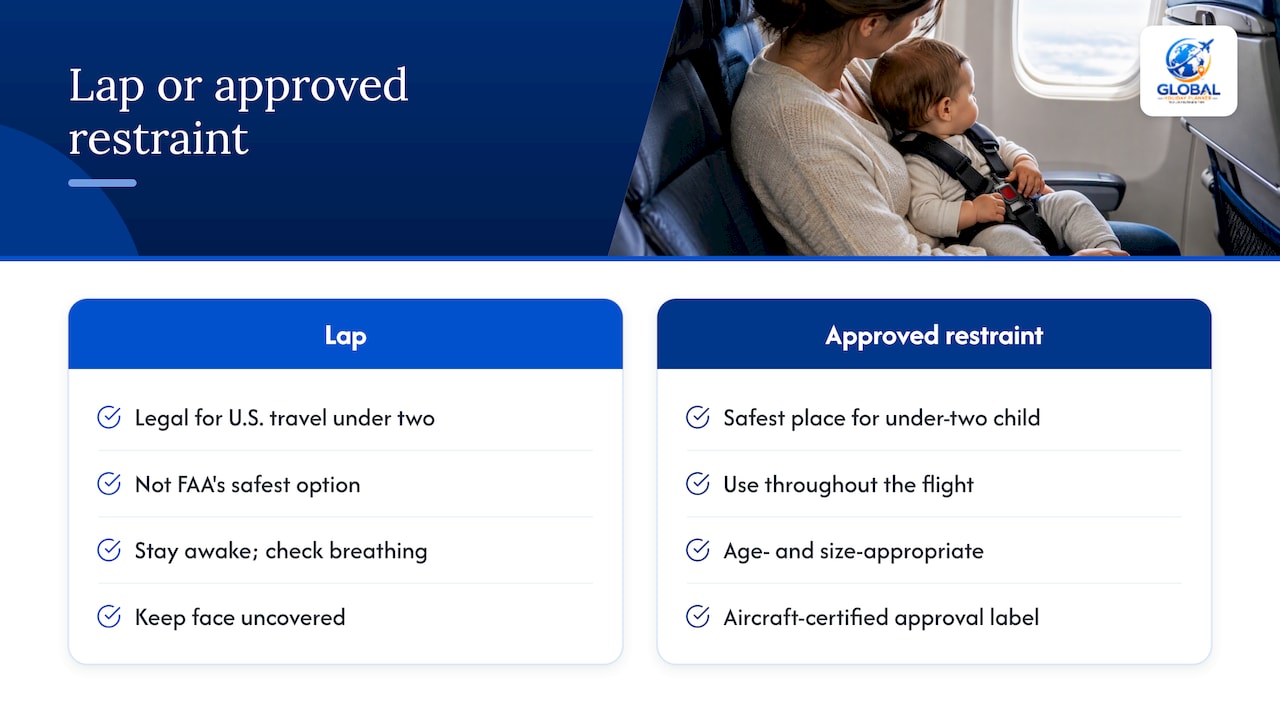
The lap option is legal in the U.S., but it is not what safety agencies recommend. The FAA says the safest place for a child under two is in an approved restraint, not in your lap. It recommends that restraint for the whole flight, particularly in turbulence, because you cannot be sure of holding a baby through sudden motion.
The American Academy of Pediatrics says turbulence is the leading cause of children’s airplane injuries and recommends an age- and size-appropriate restraint certified for aircraft use. If you do let your baby sleep on your lap, the AAP advises you to stay awake and check that the baby can breathe easily and the face stays uncovered.
A practical way to use this: price both options. If the infant fare is only the 10% plus taxes on an international trip, the cost of a seat might be closer than you expect, and a seat gives you a place to use the car seat you already own. If your baby is under two and you buy a seat, bring a restraint with an approval label. Our car seat on a plane guide walks through the labels to look for.
The “5-3-3 rule” that appears in search suggestions is a baby sleep-training schedule, not an airline or FAA rule, so it has no bearing on lap infant travel.
Book the whole trip with the real total in view
A lap infant changes the math of a family trip in small ways: a taxes line here, a baggage exemption there, a seat decision on the longer leg. Global Holiday Planner compares flights, hotels, car rentals, airport transfers, rail tickets and travel insurance in one place, with side-by-side cost and feature comparisons so you can see the real total for your itinerary. Start with flights, then line up the hotel, the car rental and the airport transfer around the same dates.

For a family, a connecting room or a transfer with a preinstalled child seat often matters more than a few dollars on the fare. Our guides to connecting rooms and airport transfers with a car seat cover both.
Our perspective
Most lap infant questions are really total-cost questions. The infant fare looks tiny next to an adult fare, but families only see the true price when the taxes, the baggage rules for the adult and the seat decision sit next to each other.
That is how we build our comparisons: flights, hotels, car rentals, transfers and insurance side by side, with recommendations for the trip type you are planning, whether that is a family vacation with three generations or a romantic getaway that turns into a family trip a few years later.
For a family with a child under two, we suggest deciding early whether the baby will have a seat, then comparing itineraries on that basis. A trip you plan around the real group size has fewer surprises at the airport, and a travel insurance plan that names every traveler keeps the whole party covered.
Global
FAQ
Do infants fly free?
On U.S. domestic flights, lap infants under two generally fly free, though you must tell the airline. On international flights they usually need a ticket at about 10% of the adult fare plus taxes and fees. Policies differ by airline, so check yours before you book.
What is the lap infant age limit?
The child must be under two years old. Age is measured on each flight, so a child who turns two before the return flight needs a seat for that leg. Some airlines also set a minimum age, from a few days old to seven days, and some require a doctor’s letter for newborns.
Can I fly internationally with a lap infant?
Yes. The infant normally needs a ticket, is listed on the reservation and needs a passport. One airline requires the infant’s passport to be shown to crew before boarding an international flight. Confirm each carrier on your itinerary, since partner airlines can differ.
Does a lap infant get a baggage allowance?
Often not. One U.S. carrier gives a domestic lap child no baggage at all, but lets the adult check a stroller and a car seat free. On some international routes, an infant ticket at 10% or more of the adult fare includes one checked piece, so the airline’s page is the final word.
How many lap infants can one adult hold?
One per ticketed adult is the usual rule. A second infant generally needs its own reserved seat and fare. Seat-map limits tied to oxygen masks can also cap how many infants sit in a row.
Sources
- FAA Kids’ Corner: child restraint guidance and lap child rule
- U.S. DOT tips for families traveling by air
- AAP HealthyChildren: flying with a baby
- Airline children’s policy: lap child age, notification and fares
- Airline infant travel policy: newborn letter and international fares
- Airline lap infant page: minimum age and passports
- Airline infant page: proof of age and baggage
- Airline children page: carer age and carry-on
- Airline infant fare table, Canada to U.S.
- Airline children’s discount page: domestic and international infants
- Airline children and family page: taxes and fees
- Airline infant baggage allowance on international routes
- Airline lap infant page: one infant per adult
- Airline child reservations page: row limits and oxygen masks