

For most trips, the best time to book a hotel is one to three months ahead. That window usually balances price and choice. If you can stay flexible in a slow season, a booking made one to two weeks before arrival can be cheaper. For peak weeks and big events, book as early as you can, and pick a room you can cancel for free.
The reason there is no single answer is that hotels reprice their rooms constantly. The right moment depends on when you travel, where you go and how much risk you can accept. This guide gives you the windows, the cheapest days, and a routine that lets you lock in a room now and still catch a price drop later.
TL;DR
- Default window: one to three months before arrival suits most trips and most major chains.
- Peak seasons and big events: book as early as you can, up to six months or a year ahead for major annual events.
- Slow seasons and flexible plans: studies and price indexes point to the last one to two weeks as a real chance for lower rates, but with less choice.
- Day of the week: the day you book matters far less than the day you stay. Sunday check-ins tend to cost less than Friday ones.
- Best of both: reserve a free-cancellation rate early, then recheck prices and rebook if they fall.
Table of Contents
- The short answer: one to three months ahead
- Why the “book early” rule is only half true
- Do hotel prices go down closer to the date?
- How the window changes with season and destination
- What is the cheapest day to book a hotel?
- Do hotel prices drop at 4 p.m.?
- Balance price and risk: the free-cancellation routine
- A quick planner by trip type
- Our perspective
- Compare and book your hotel
- FAQ
- Sources
The short answer: one to three months ahead
AAA’s travel advice says industry data shows one to three months in advance is the best time to book for most major chains, because it usually strikes a balance between price and availability. Lonely Planet gives the same range and says booking one to three months ahead is usually fine outside peak periods.
This window works because you are early enough to see most of the inventory in your price bracket. You are also not so early that you pay for the hotel’s uncertainty about future demand. It is a safe default, not a guaranteed lowest price.
Why the “book early” rule is only half true
Many guides say earlier is always cheaper. The research is more mixed.
A 2019 study of hotel bookings, “Myth of early booking gains”, found that for online bookings the earliest reservations were associated with the highest room rates and the latest with the lowest. For lower-priced leisure rooms booked offline, it found a U-shaped pattern, with the lowest prices booked between 10 and 24 days before check-in. The same study put the overall price gap between booking times at about 10% for external online bookings and up to 28% for offline leisure bookings.
A 2026 report in Frommer’s, drawing on a hotel price index, describes a sweet spot of about 8 to 14 days before travel. It says booking around two weeks out saved an average of 23% compared with reserving four months or more ahead.
These findings do not contradict the one-to-three-month advice. They describe different travelers. The early window protects your choice of room and location. The late window rewards people who can take whatever is left.
| Booking window | Best for | Main upside | Main risk |
|---|---|---|---|
| 6 to 12 months | Major annual events, holiday weeks, small popular properties | Best choice of rooms and locations | Prices set before demand is clear; you need a flexible rate |
| 1 to 3 months | Most vacations, family trips, weddings and conferences | Balance of price and availability | Not always the lowest price |
| 2 to 4 weeks | Flexible city breaks and shoulder-season trips | Prices often settle as hotels see how full they are | Fewer rooms in your preferred bracket |
| Last 1 to 2 weeks | Slow seasons, flexible travelers | Possible deepest discounts | Sold-out risk; limited choice |
Do hotel prices go down closer to the date?
Sometimes. Hotels sell a perishable product: a room empty tonight earns nothing. An analysis of dynamic pricing in Ireland’s hotel market explains that hotels adjust rates using demand forecasts, remaining availability, competitor prices and local events. The same piece points out that a room advertised at one price can cost more the next day if demand rises.
So the direction is not fixed. A 2026 write-up of search data for bookings between January 2025 and March 2026 found that hotel prices moved by an average of 34% over the 30 days before a stay, and could go either way depending on how full the hotel was. Lonely Planet notes that hotels try to fill unsold rooms as the date approaches, which can produce lower-than-expected prices, especially in destinations that are not in high demand at peak season.
The practical rule: waiting works when demand is soft and supply is plentiful. It backfires when demand is strong.
How the window changes with season and destination
Peak season and big events
When many people want the same dates, hotels have no reason to discount. Lonely Planet says big annual events may require booking as much as six months or a year in advance. The analysis from Ireland adds that delaying around major events can mean prices that are significantly higher or rooms that are gone.
Think of these trips as early-booking trips:
- Holiday weeks such as Thanksgiving, Christmas and New Year
- Spring break and summer school-holiday weeks in beach and theme-park destinations
- Big sports weekends, festivals, graduations and conventions
- Small hotels in places with limited rooms
AAA makes the same point: peak periods need earlier booking because supply runs short, while shoulder seasons and some last-minute windows can work when demand is lower.
Shoulder and low seasons
Frommer’s says that in shoulder seasons or slow tourism months, waiting until two weeks or less before travel is likely more effective for saving money, because peak-season strategy is built around limited supply. If you are heading to a beach town in November or a ski town in May, you have more room to wait.

Big cities and business trips
City hotels fill on weekdays with business travelers and on event nights. Check the local calendar before you wait. If you travel for work, our guide to business travel booking tips covers how to avoid delays, and the page on better hotel corporate rates shows how to lower the price on repeat trips.
What is the cheapest day to book a hotel?
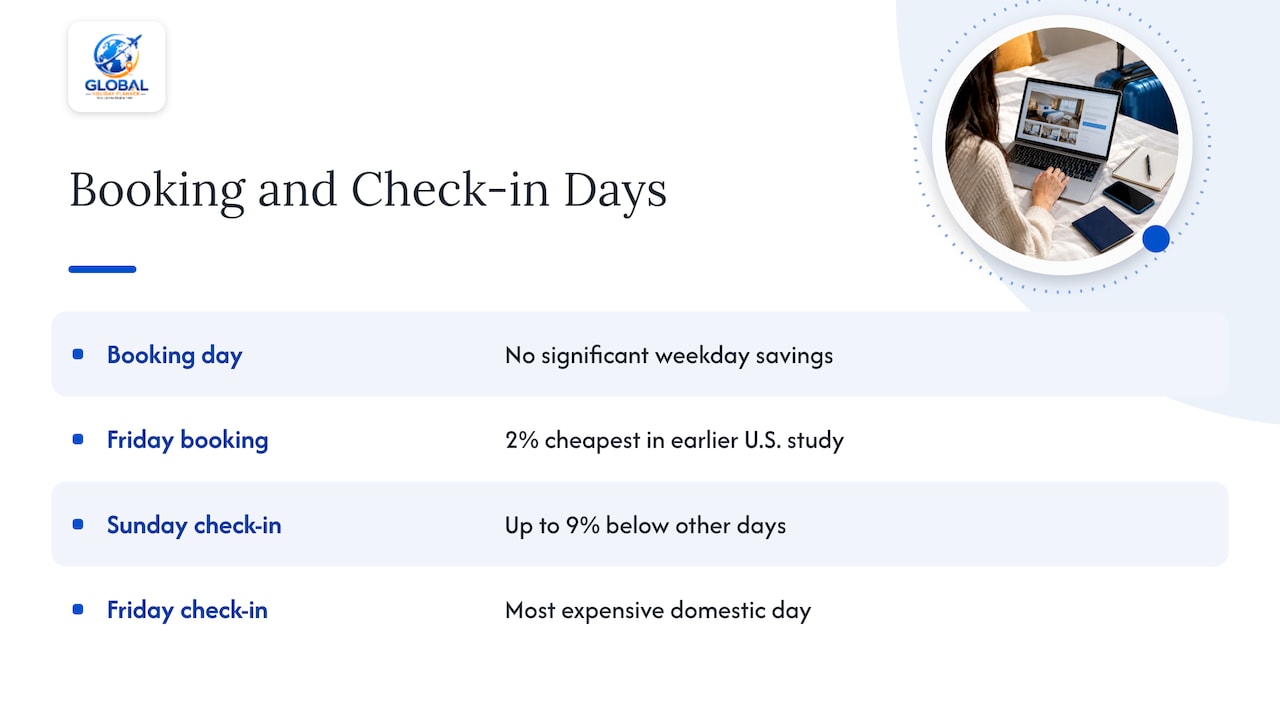
The day you click “book” matters little. A hotel guide in Afar quotes a 2024 travel search analysis finding no specific day of the week that gives a significant saving when you book a room. It also cites an earlier study that found Friday the cheapest booking day in the U.S., by a margin of only 2%.
The day you stay matters more. The same Afar piece reports that, in 2024 search data, Sunday was the cheapest check-in day, up to 9% below other days, and Friday was the most expensive domestic check-in day. If your dates are movable, shifting a Friday arrival to Sunday or a weekday is the easier saving.
If you are stretching a trip around a weekend, how to book a weekend stay and get the best deal is a good companion read on timing and flexibility.
Do hotel prices drop at 4 p.m.?
There is a basis for the idea, but it is a same-day tactic, not a plan. Forbes reported that hotels cut rates when they miss expected targets, and that by 4 p.m. on the day of arrival, empty rooms can get very good deals. That article dates from 2019, and it is advice for flexible travelers who can sleep anywhere that has a room.
If you have a family, a flight arriving late, or a destination with a busy night, do not gamble on 4 p.m. Book a refundable room earlier and treat any late drop as a bonus.
Balance price and risk: the free-cancellation routine
The best strategy for most travelers is not to pick the perfect day. It is to take the early availability and keep the option of a lower price. The advice from the Irish analysis is to stay flexible, compare prices, and book with free cancellation so you can cancel and rebook if prices fall.
Hotels spell out these terms differently. One Canadian chain’s flexible rate, for example, can be cancelled until 24 hours before 3 p.m. local time on check-in day without a penalty. A boutique hotel in Laos offers a flexible option with no prepayment and free changes up to a stated deadline. Always read the deadline on your own reservation, because it is in the hotel’s local time and can fall a day or more before arrival.
Here is a routine you can follow:
- Pick your dates and area. Check whether a big event or holiday overlaps.
- Reserve a free-cancellation rate once you are inside your window, or earlier for peak trips.
- Note the cancellation deadline in your calendar.
- Recheck the price every week or two, and again a few days before the deadline.
- Rebook if the rate drops enough to matter, then cancel the original.
- Keep the nonrefundable deal only when the saving is large and your plans are firm.
Our page on travel deal alerts shows how to track your dates and recheck hotel rates without refreshing a search page every day. For the prepay question, see the one-rule guide on when a prepaid discount beats paying at the hotel. If a nonrefundable booking has already gone wrong, the refund script for nonrefundable hotel bookings lays out the steps.
Evidence from academic work also supports mixing strategies. A 2024 paper on the timing of hotel bookings found that the effects of price and availability on when people book are not steady over time. Travelers book earlier when their hotel is pricier than others and the arrival date is far off, and also when it is less available, but only once arrival is under two months away. In plain terms, scarcity pushes people to act within the last two months, so that is when watching availability matters most.
A quick planner by trip type
- Family vacations and multi-generational trips: you need several rooms or connecting rooms in one place, so book early within the one-to-three-month window or sooner in school holidays. See how to book connecting rooms.
- Romantic getaways: small inns and boutique hotels have few rooms, so reserve earlier for weekends and holidays. Midweek stays are the easier saving.
- Golf trips: resorts with tee times fill around tournaments and in prime season. Book the hotel as soon as the group’s dates are set, with a rate you can change.
- Budget trips: choose off-peak dates, check Sunday and weekday arrivals, and use the cancel-and-rebook routine.
- Business trips: book when the meeting is confirmed, and use a negotiated or corporate rate where your employer has one.
If you are comparing places to stay, the hotel vs. vacation rental checklist helps you decide before you start the timing question. And if you are not sure whether to lock in flights first, read whether to book flights or hotel first. For airfare timing, the best time to fly guide covers cheapest days, hours and seasons.
Our perspective
Timing helps, but it is only one of three things that decide what you pay. The other two are the total cost of the trip and how well the room fits your plans.
At Global Holiday Planner, we built our platform around side-by-side comparison of flights, hotels, car rentals, rail tickets, transfers and travel insurance, because a cheap room can hide costs elsewhere in the trip. A hotel that saves you $20 a night but sits an expensive transfer away from the airport is not a saving.
Our approach is to compare the real total for your itinerary first, then pick a rate with flexible terms and watch it. We design our guides around trip types, from family vacations to romantic getaways, golf trips and business travel, so you can match the booking window to the way you actually travel.
Global
Compare and book your hotel
Ready to put the window into practice? Global Holiday Planner lets you compare hotels for your dates in one place, so you can see options and terms side by side before you reserve. Start with our hotel reservations page, choose a rate with free cancellation if you are booking early, and come back to recheck as your dates approach.

You can also compare flights, car rentals and airport transfers for the same trip, so the whole plan is priced together.
FAQ
How far in advance should you book a hotel?
For most trips, one to three months ahead is a safe window. Book earlier, up to six months or a year, for major annual events and peak holiday weeks. If you are flexible and traveling in a slow season, one to two weeks ahead can also bring lower prices.
Do hotel prices go down closer to the check-in date?
Sometimes, but not reliably. Hotels reprice based on demand, availability and local events, so a room can get cheaper or more expensive as the date nears. A large search-data analysis found average price movement of 34% in the 30 days before a stay, in either direction.
What is the cheapest day to book a hotel?
The day you book makes little difference, according to a 2024 travel search analysis cited by Afar. The day you check in matters more: in that data Sunday arrivals were the cheapest and Friday the most expensive for domestic stays.
Do hotel prices drop at 4 p.m.?
On the day of arrival, hotels with empty rooms may cut rates through the afternoon, and Forbes has reported 4 p.m. as a common point for deals. It only suits flexible travelers. For anything important, book a refundable room in advance.
Is it better to book a refundable or nonrefundable rate?
A refundable rate lets you rebook if the price drops, which is useful when you book early. A nonrefundable rate can be cheaper, so it makes sense when your dates are fixed and the discount is large.
Sources
- AAA Club Alliance: Travel Smarter with the Best Time to Book Flights and Hotels
- Lonely Planet: Travel hack, the best time to book a hotel
- Myth of early booking gains (RePEc)
- Frommer’s: Are We Booking Hotel Rooms Too Far in Advance?
- RTE Brainstorm: Why have hotels become so expensive?
- Rateranger: Do Hotel Prices Go Down Closer to Your Check-in Date?
- Afar: The Best Time to Book a Hotel Room, According to Travel Experts
- Forbes: Why You Should Wait Until 4 P.M. To Book A Last-Minute Hotel Deal
- Timing of hotel bookings: not monotonic (Journal of Travel & Tourism Marketing)
- Coast Flex Rate
- The Namkhan Boutique Hotel: Special Offers
[…] matters for price, too. If your rule says “book early,” back it up with data: our piece on the best time to book hotels explains how far ahead to reserve, and the flexible date flight grids show how shifting a departure […]