

Eurail vs Interrail comes down to one thing: where you live, not where you’re going. If you’ve been a resident of a participating European country for six months or more, you buy Interrail. Everyone else buys Eurail. Both cover the identical 33-country rail network, cost the same for matching pass types, and both add reservation fees on many high-speed and night trains, which vary and can add notable cost on top of the pass, so budget beyond the sticker price.
TL;DR:
- Interrail requires residents to have lived in a participating European country for at least six months, while Eurail is for non-residents.
- Both passes cover the same 33 countries and cost the same, but reservation fees for high-speed or night trains can add significant extra cost.
- The home-country travel rule limits Interrail holders to one outbound and one inbound domestic trip within their residence, unlike Eurail buyers.
- Reservation costs vary by route, with high-speed trains charging between $10 and $30, and night trains incurring additional fees up to $60 or more.
- A rail pass is most valuable when taking five or more long-distance journeys crossing multiple countries and when plan flexibility outweighs fixed, prebooked tickets.
Table of Contents
- Eurail vs Interrail Differences at a Glance
- Who Qualifies for Each Pass?
- What Does the Pass Actually Cover?
- Reservations and Mandatory Fees: What Costs Extra
- When Is a Rail Pass Actually Worth It?
- How to Buy, Activate, and Use Your Pass
- How Global Holiday Planner Helps You Compare the Real Cost
- The Real Lesson Behind Eurail vs Interrail
- Book Your Full Trip in One Place, Not Five Tabs
- Sources
- FAQ
Eurail vs Interrail Differences at a Glance
Before you dig into the fine print, here’s what separates the two passes and what stays identical between them.
- Residency rule: Interrail is for residents of the 33 participating countries; Eurail is for everyone else.
- Home-country travel: Interrail restricts travel within your own country to one outbound and one inbound trip; Eurail carries no such limit since your home country typically isn’t in the network anyway.
- Network coverage: Both passes unlock the same 33 participating countries.
- Price: Identical for equivalent pass types and durations. A 7-day flex Global Pass runs around $231 either way.
- Reservation fees: Typically $5 to $35 or more per high-speed or night train, charged on top of the pass.
Who Qualifies for Each Pass?
Residency is the gate, and it’s stricter than most travelers expect. You need to have lived in a participating European country for at least six consecutive months to qualify for Interrail, not just hold a passport from one. A German citizen who’s spent the last two years working in Singapore buys a Eurail Pass. A Canadian who relocated to Lisbon eight months ago and can prove it buys Interrail.

Proof matters more than people assume. Ticket inspectors can ask for ID that matches the country of residence printed on your pass, and sometimes for supporting residency documentation like a visa, work permit, or utility bill. Carry something beyond your passport.
Ordering is simple once you know your status: check the country dropdown at Interrail.eu. If your country of residence appears there, buy through that site. If it doesn’t, you’re a Eurail buyer, and Eurail.com is your only option regardless of nationality.
What Does the Pass Actually Cover?
Both brands sell the same lineup, just under different names depending on where you shop. A Global Pass covers travel across all 33 countries and suits multi-country itineraries. A One Country Pass gives unlimited travel within a single nation for a set number of days, which fits someone spending two weeks entirely in Italy or Spain. Regional and “Plus” variants bundle a handful of neighboring countries for travelers who want more than one country but less than the whole continent.
Coverage has real limits worth knowing before you build an itinerary. Some private scenic trains charge separately even with a pass in hand. Fully domestic products like BritRail, which covers unlimited UK travel, sit outside the Eurail and Interrail system entirely and require their own ticket. Certain operators also layer on supplements the pass doesn’t absorb.
The home-country rule trips up more Interrail buyers than any other detail. Say you live in Amsterdam and you’re starting a Global Pass trip in Berlin. Your train from Amsterdam to the German border, or wherever you cross out of the Netherlands, counts as your one allowed outbound travel day within your home country. Your return trip home at the end of the trip counts as the one inbound day. Any other domestic Dutch travel outside those two legs isn’t covered and needs a separate ticket. Eurail buyers don’t deal with this because their home country usually isn’t part of the 33-country network to begin with.
Reservations and Mandatory Fees: What Costs Extra
Owning the pass doesn’t mean every train is free to board. High-speed and many international services require a paid seat reservation on top of the pass itself, and this is where trip budgets quietly balloon if you don’t plan for it.
Reservation costs vary by operator and route:
- France’s TGV: roughly $10 to $20
- Italy’s Frecciarossa: around $13
- Spain’s AVE: $10 to $30
- Eurostar (Paris/Brussels to London): around $22
- Austria’s RailJet: as low as $3
Night trains add another layer. Couchette or sleeper berth supplements typically run $29 to $60 or more, depending on cabin class and route length.
Regional trains and most standard intercity services, by contrast, need no reservation at all. Hop on with your pass activated and go.
Book reservations through the official Rail Planner app, directly on the operator’s website, or at a station ticket window. High-speed seats on popular summer routes sell out weeks ahead, so reserve as soon as your dates firm up rather than waiting until you land in Europe.
When Is a Rail Pass Actually Worth It?
A pass isn’t automatically cheaper than buying tickets one at a time. It wins under three specific conditions.
- You’re taking five or more long-distance journeys. Below that, individual tickets bought in advance usually cost less.
- You’re crossing three or more countries. Cross-border pricing on individual tickets adds up fast, and the pass smooths that out.
- Your dates aren’t locked in. If you want to change plans mid-trip, a flex pass beats rebooking fixed tickets every time.
Point-to-point advance fares booked six or more weeks out often undercut a pass for a fixed, planned route. The pass earns its price when flexibility is worth something to you, not just when it looks convenient on paper.
When comparing rail against flights, measure door-to-door, not gate-to-gate. Factor in airport transfer time, security lines, and checked-bag fees against a train that drops you in a city center. Trains generally beat flights on trips under four to five hours door-to-door, think Paris to Amsterdam or Rome to Florence. Flights still win on long diagonal hops like Lisbon to Athens, or anywhere involving an island.
Pro Tip: A night train that replaces both a hotel night and a travel day is one of the strongest value plays a pass offers, especially on longer east-west routes where flying would otherwise eat a whole day.
How to Buy, Activate, and Use Your Pass
Getting the pass in hand is the easy part. Using it correctly is where people slip up.
- Buy from the right site. Interrail.eu for qualifying European residents, Eurail.com for everyone else.
- Activate before you travel. Flex passes require you to log a travel day in the app or paper pass each time you ride; continuous passes run automatically from your chosen start date.
- Reserve ahead on high-speed and night trains, then keep confirmation numbers with your itinerary since paper backups matter when phone battery or signal fails.
- Carry ID that matches your pass. Inspectors check both identity and, for Interrail holders, residency proof. Unused travel days on a flex pass typically aren’t refundable once the validity window closes, so check the terms before you buy.
How Global Holiday Planner Helps You Compare the Real Cost
Rail passes solve part of the puzzle. The harder part is seeing whether a $231 flex pass actually beats three budget flights once you add transfers, bags, and hotel timing. Travel platforms let you compare trains, flights, and lodging side by side so the total trip cost, not just one leg’s ticket price, drives the decision. Booking transport and hotels together also cuts the risk of a missed connection wrecking a night’s reservation. For deeper route planning, our travel blog breaks down specific corridors worth building a trip around.
The Real Lesson Behind Eurail vs Interrail
Most confusion around this topic comes from treating Eurail and Interrail like competing brands fighting for your money. They aren’t. They’re the same product sold through two doors, gated by residency, and that single fact resolves nearly every other question people ask. Once you know which door you’re walking through, the real decision isn’t pass A versus pass B. It’s pass versus point-to-point tickets, and that choice hinges on trip shape, not brand loyalty.
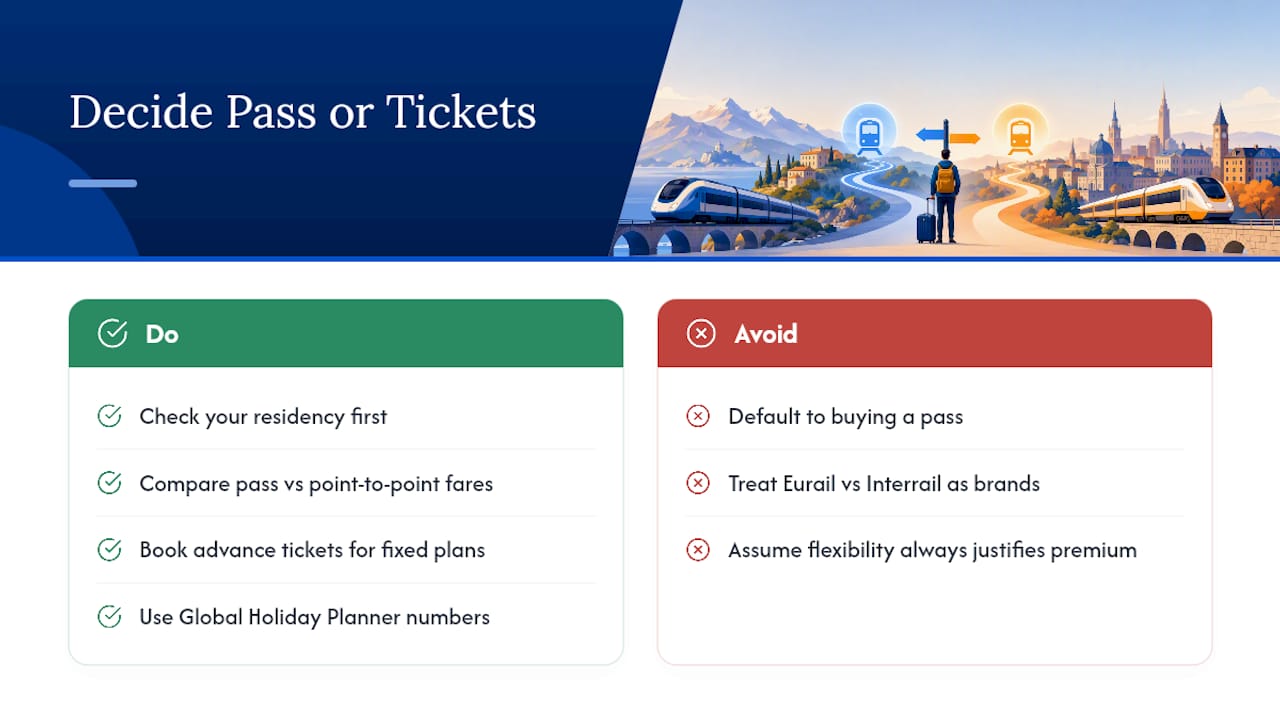
The advice that gets this wrong usually pushes readers toward a pass by default, treating flexibility as though it’s always worth the premium. It isn’t. If you’ve already mapped four cities and fixed dates, book tickets in advance and skip the pass entirely. Save the pass for the trip you haven’t fully planned yet, where crossing borders on a whim is the point.
Where Global Holiday Planner fits into that decision is simple: run the door-to-door numbers before you commit to either path, because the right answer changes by itinerary, not by preference.
— Global
Book Your Full Trip in One Place, Not Five Tabs
Global Holiday Planner is the practical alternative to juggling separate bookings for trains, flights, hotels, and transfers across five different sites. Once you’ve settled on a pass or ticket strategy using the rules above, compare that plan against real flight prices and total trip costs in one search.

If your itinerary includes any leg where flying beats the train door-to-door, whether it’s a long diagonal hop or an island route, compare flight options here before you lock in a pass you might not fully use. Check today’s fares against your rail plan and book whichever leg actually saves you time and money.
Sources
- Residency rules for Eurail and Interrail | EveryRail
- European Rail Passes: The Complete Buyer’s Guide (Eurail, Interrail, Point-to-Point)
- Train vs plane in Europe — real cost comparison | Move2Europe
FAQ
Can US citizens use Eurail?
Yes. US citizens and residents of any non-European country are exactly who Eurail was built for, and Eurail.com is the correct purchase site.
What is the best train pass to get for Europe?
There’s no single best pass; the right one depends on residency first, then trip shape. A Global Pass suits multi-country trips with five or more journeys, while a One Country Pass fits travelers staying within a single nation.
What is not covered by a Eurail Pass?
Seat reservations on high-speed and night trains, some private scenic railways, and fully domestic-only products like BritRail all sit outside standard Eurail coverage and require separate tickets or fees.
Is a Eurail Pass worth it?
It’s worth it when you’re taking five or more long-distance journeys, crossing three or more countries, or want flexible, unplanned travel dates. For a fixed itinerary booked well in advance, individual point-to-point tickets often cost less.