

Yes — if you apply for a Schengen visa, you must present travel medical insurance meeting Article 15 of the EU Visa Code, with at least €30,000 in coverage for emergencies, evacuation, and repatriation. Your certificate must be valid in every Schengen state and cover every day of your trip, with your name, dates, and coverage amount printed clearly on the policy schedule.
TL;DR:
- Travel insurance must explicitly name the Schengen area, cover at least €30,000 for emergencies, and include clear details like your name, dates, and coverage amount on the certificate.
- The policy should be purchased before booking your visa appointment, with the start and end dates matching your travel plans, and must be downloadable instantly in PDF form.
- Common reasons for visa rejection include policies with sub-limits on repatriation, exclusions during health crises, vague geographic scope, or non-euro limits without clear currency conversion.
- A single-trip policy suits short visits, while multi-trip annual plans can be accepted if they specify coverage for each individual trip at the required minimum amount.
- Use comparison tools built around Article 15 compliance to find policies that offer the needed coverage and instant certificates, simplifying the application process.
Table of Contents
- What Does the Schengen Visa Code Require From Your Insurance?
- How Do You Get a Compliant Schengen Insurance Certificate?
- Why Do Schengen Insurance Applications Get Rejected?
- What Type of Schengen Insurance Policy Should You Buy?
- How Global Holiday Planner Helps You Get a Compliant Certificate Fast
- Traveler Checklist: The Week Before Your Visa Appointment
- Where to Verify These Rules Yourself
- Get Your Schengen Insurance Certificate Sorted Today
- Sources
- FAQ
What Does the Schengen Visa Code Require From Your Insurance?
Consulates don’t call your insurer to check anything. They read the document in front of them, and if the required details aren’t printed clearly on the page, the application can be refused on the spot.
Article 15 of the Visa Code sets a floor, not a suggestion: applicants for a uniform Schengen visa need travel medical insurance covering emergency treatment, hospitalization, medical evacuation, and repatriation, with a minimum coverage of €30,000. Some policies now bundle COVID-19 treatment into that same medical category, which is worth confirming if you’re buying from an insurer that still treats it as a separate add-on.
A compliant policy schedule needs to show, in plain language:
- Your full name, matching your passport exactly
- Coverage amount stated in euros (or a currency the consulate can convert), at or above €30,000
- Policy start and end dates that match your travel itinerary, not just the purchase date
- Geographic scope explicitly naming the Schengen area, not a vague “Europe” designation
- A repatriation clause, ideally called out by name rather than buried in a general medical benefit
That’s the whole test. If it isn’t legible on the page, it doesn’t count. Consulates lean on Article 32(1)(a)(ii) to refuse visas over missing or insufficient insurance, and that clause gets used more often than applicants expect.
Pro Tip: Ask your insurer for the “policy schedule” or “certificate of insurance” specifically. A generic confirmation email rarely contains all five fields a visa officer needs to see in one glance.
How Do You Get a Compliant Schengen Insurance Certificate?
Buy your policy before you book your visa appointment, not after. Most consulates want proof of insurance submitted with the rest of your application file, and a policy purchased the night before your appointment leaves zero room for error if something’s missing.
Here’s the practical sequence:
- Set your dates first. Match the policy’s start and end dates to your actual travel itinerary, including a buffer day on each end if your plans could shift.
- Choose where to buy. A licensed local insurer, an international provider that issues Schengen-specific certificates, or a comparison platform that filters specifically for Article 15 compliance all work. The filtering option saves the most time if you’re unfamiliar with policy wording.
- Download the certificate immediately. Reputable insurers issue a downloadable PDF certificate within minutes of purchase, showing the policy schedule on its first page.
- Check for a refusal refund. Some insurers refund your premium if your visa is denied. It’s not a compliance requirement, but it removes the financial risk of buying early.
- Keep two copies. Save the PDF on your phone and cloud storage, and print a paper copy for your visa file and your carry-on.
Buying early also gives you time to fix a mismatched date or a missing field before it becomes a rejection reason instead of a quick edit.
Why Do Schengen Insurance Applications Get Rejected?
Most rejections trace back to fine print nobody read closely, not to a total lack of insurance. A cheap policy with no repatriation limit written into it fails the same way a policy with no insurance at all does.
Watch for these specific red flags:
- Repatriation sub-limits. Repatriation typically costs €3,000 to €15,000 depending on distance and medical condition. If your policy caps repatriation at a few hundred euros inside a larger medical limit, that sub-limit is what a consulate officer will flag, not your headline coverage number.
- Pandemic and hazardous sports exclusions. These don’t automatically break compliance, but a policy that excludes emergency treatment outright during a declared health event can still cause trouble if the exclusion touches core medical coverage.
- Vague territory wording. “Covers Europe” is not the same as “covers the Schengen area.” Consulates want to see Schengen states named or clearly implied by an EU-wide scope.
- Non-euro limits with no conversion. A policy quoted only in US dollars or another currency without a stated euro equivalent forces the officer to guess, and guessing usually resolves against the applicant.
Border guards can also ask for proof of insurance at entry under the Schengen Borders Code, even after your visa is approved. Carry the printed certificate and policy schedule in your travel documents folder, not just saved to your phone.
What Type of Schengen Insurance Policy Should You Buy?
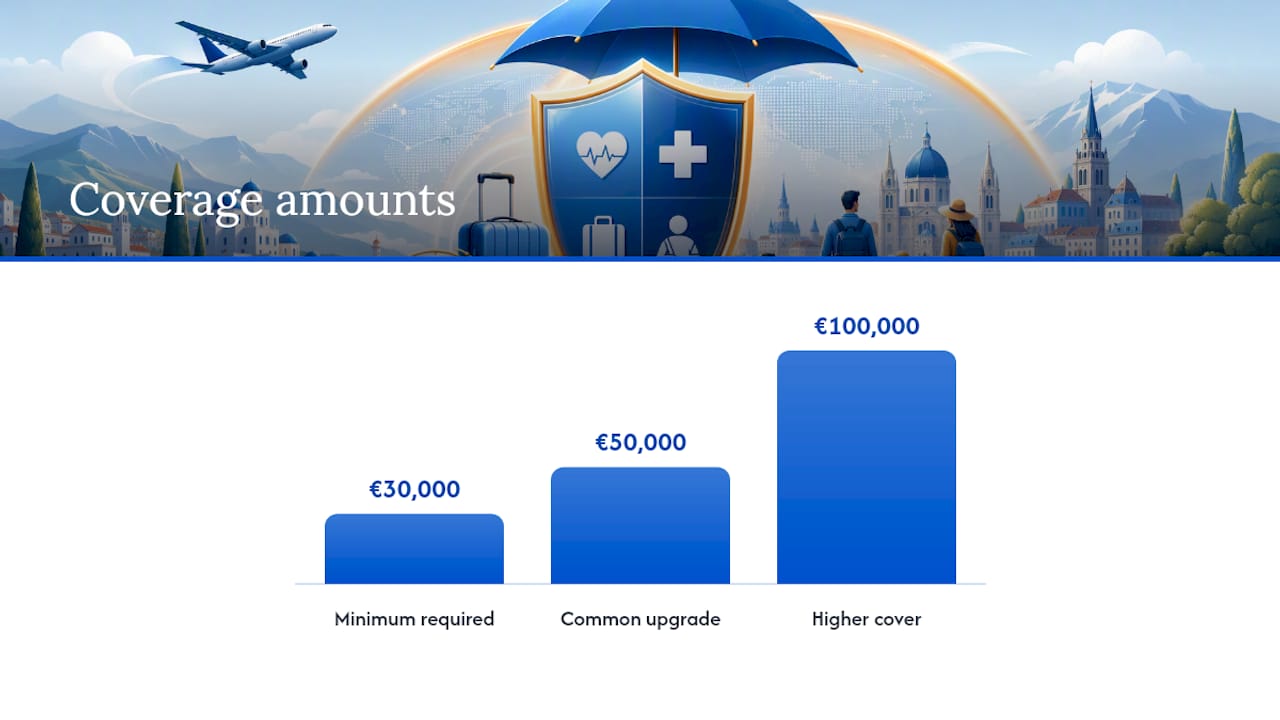
A single-trip policy suits a one-time visit with fixed dates, and it’s usually the cheapest way to hit the €30,000 minimum for a short stay. Frequent travelers on multiple-entry visas often do better with an annual multi-trip plan, since consulates commonly accept annual coverage as long as each individual trip is covered up to the required minimum.
A few things shape the price and the right fit:
- Trip length and age. Longer stays and older travelers push premiums up, sometimes significantly for applicants over 65.
- Coverage limits above the minimum. Some travelers buy €50,000 or €100,000 policies for extra peace of mind on top of the €30,000 floor.
- Student and long-stay variants. These typically cap coverage duration differently than standard tourist policies, so check the maximum insured period before assuming it matches your visa length.
- Basic short-trip plans run roughly €20 to €80, depending on those factors.
Skip relying on premium credit card travel insurance unless you’ve confirmed in writing that it meets the €30,000 euro-denominated minimum and issues a certificate consulates recognize. Most card benefits weren’t built with visa officers in mind.
How Global Holiday Planner Helps You Get a Compliant Certificate Fast
Comparing policy wording across insurers is tedious when you’re also assembling flight bookings, hotel confirmations, and an itinerary letter. Global Holiday Planner’s travel insurance comparison tool cuts that step down by surfacing plans built around the Article 15 minimums, side by side.
Look for these filters when comparing:
- Coverage at or above the €30,000 minimum, shown clearly in euros
- Repatriation included as a named benefit, not folded into a small sub-limit
- Instant certificate download so you can attach it to your visa file the same day
- Refund-if-visa-refused options where the insurer offers them
| What to check | Why it matters |
|---|---|
| €30,000 minimum coverage | Legal floor under Article 15 |
| Repatriation named separately | Prevents rejection over sub-limits |
| Instant PDF certificate | Lets you submit before the appointment |
| Refusal refund option | Reduces financial risk of early purchase |
Compare a few plans, pick the one whose schedule shows every required field, download the certificate, and print it the same day you buy it.
Traveler Checklist: The Week Before Your Visa Appointment
Give yourself a full week before your appointment to run through the details, not the night before.
Confirm your travel dates one more time against your policy, then print the certificate and the first page of the policy schedule. If you’re managing a chronic condition, carry a doctor’s letter listing your medications, since border officers sometimes ask about prescriptions matching a medical history.
Save digital copies of everything to your phone and a cloud folder you can access offline. At the border, if a guard asks about your insurance, hand over the policy schedule showing the euro amount and the repatriation clause directly. Keep your insurer’s emergency phone number saved somewhere you’d actually find it in a crisis, not buried in an old email.
— Global
Where to Verify These Rules Yourself
Don’t take any insurance summary at face value, including this one. Check the primary sources before you submit anything.
- Regulation (EC) No. 810/2009 for the full text of Article 15 and the Article 32 refusal ground
- Netherlands Worldwide’s visa insurance guidance for a real consulate’s documented field requirements
- AXA Schengen’s certificate page for a practical look at how insurers structure instant certificates
Get Your Schengen Insurance Certificate Sorted Today
Some platforms allow you to compare Schengen-compliant travel insurance plans alongside flights, hotels, and car rentals, so your certificate and your itinerary come from the same place instead of multiple sources.
That matters most for first-time applicants who don’t yet know what a compliant policy schedule is supposed to look like. Run a comparison, pick a plan that clears the €30,000 threshold with repatriation named on the schedule, and download your certificate the same day. If you’re also finalizing flights for the same trip, check current flight deals while your visa file is still open, since having a confirmed itinerary makes matching your policy dates far easier. And if you’re connecting through multiple Schengen countries on a single trip, a Europe eSIM keeps you online long enough to pull up your certificate at any border crossing.
Sources
- Regulation (EC) No. 810/2009 (Visa Code)
- Insurance requirements for Schengen visa — Netherlands Worldwide
- Schengen Visa Insurance Coverage Limits & Repatriation rules — EntryPolicies
- AXA Schengen travel insurance — certificate & benefits
FAQ
Is travel insurance required for a Schengen visa?
Yes. Article 15 of the EU Visa Code makes travel medical insurance with at least €30,000 in coverage mandatory for uniform Schengen visa applicants, and missing it is a valid ground for refusal.
What is the best travel insurance for a Schengen visa?
The best policy is whichever one clearly shows the €30,000 minimum, names repatriation as an included benefit, and issues an instant downloadable certificate. Comparison tools like Global Holiday Planner’s insurance page let you filter for those exact criteria instead of reading policy wording line by line.
Does Schengen insurance need to cover all Schengen countries?
Yes, your policy needs to name the Schengen area or explicitly list its member states, since generic “Europe” coverage wording is a common reason consulates flag a policy.
How much does Schengen visa insurance typically cost?
Basic short-trip policies generally run €20 to €80, depending on trip length, your age, and how much coverage you buy above the €30,000 minimum.
Can I use annual multi-trip insurance for a Schengen visa?
Yes, as long as the policy states per-trip coverage that meets the €30,000 minimum for each trip, consulates generally accept annual multi-trip plans for multiple-entry visas.