
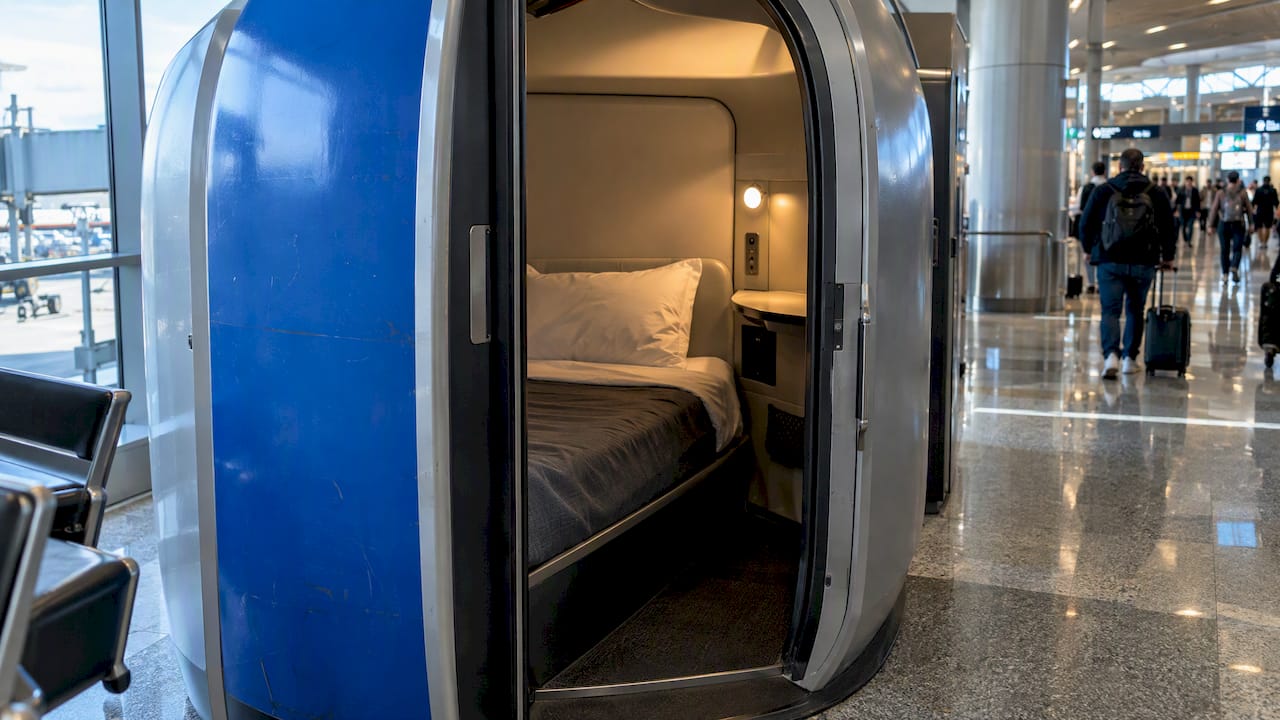
Airport sleep pods are small, private rooms inside the terminal that you rent by the hour, usually to rest between flights. Some are reclining shells, others are lockable cabins with a real bed. They cost far less than a hotel night in most of the world, but they are not available at every airport, and a pod behind the wrong security line can be useless to you. This guide covers what a pod includes, what it costs at airports that publish rates, what to check before you pay, and how to sleep at an airport that has none.
TL;DR
- A sleep pod is a private, hourly-rate rest space inside the terminal. Cabins may have a bed, controllable lighting and ventilation, and some include a shower.
- Published rates range from about €12 an hour in Munich overnight to €30 an hour at peak times in Istanbul. Short stays in Madrid start at €45.
- Check three things first: airside or landside, walking time to your gate, and whether the unit locks or only has a curtain.
- If your airport has no pods, free rest areas, an airport hotel or a lounge are the fallback. Compare them before you are tired and your phone is at 8%.
- Pods suit long layovers and late delays. For a 10-hour overnight with a bag to collect, a hotel room often wins.
Table of Contents
- What an airport sleep pod actually is
- What sleep pods cost
- Which airports have sleep pods, and where to find them
- When you can use one, and whether to book ahead
- What to check before you pay
- Sleep pod, hotel or lounge: how to choose
- How to sleep at an airport that has no pods
- Our view on pods
- Plan the layover before you fly
- FAQ
- Sources
What an airport sleep pod actually is
The term covers several products. Airport sleep pods range from reclining shells to fully lockable cabins. A cabin may offer a bed, controllable lighting and ventilation, and at some sites a private shower. They sit inside terminal buildings and are rented by the hour rather than by the night, which is the main difference from a hotel.
In practice you will meet three types:
- Open recliner pods. A shell or hooded chair, often in a gate area. Cheap, but you are still in public space. Good for a two-hour gap, poor for real sleep.
- Cabins with a bed. A single room roughly the size of a bed with a door, a light dimmer and a plug. This is what most travelers mean by a sleep pod.
- Suites with a daybed and a desk. Larger private rooms, sometimes with a shower. Several U.S. airports have these, and they are priced accordingly.
Technology varies too. One operator in Istanbul, Kuala Lumpur and Riga lets guests control lighting and climate from a phone and offers a private smart TV. Others are plainer: a bed, a lamp, a socket.
What sleep pods cost
Prices vary by operator, length of stay and time of day. Airports that publish their rates show the pattern well, and it is worth knowing before you compare against an airport hotel.
| Airport | Rate (as published) | Minimum or note |
|---|---|---|
| Munich, standard cabin | €17/hour from 6:00 am to 10:00 pm, €12/hour from 10:00 pm to 6:00 am | €34 minimum |
| Munich, larger XL cabin | €24.50/hour by day, €18/hour at night | €49 minimum |
| Istanbul | €17.50, €25 or €30/hour depending on the time | Blanket, pillow and pillowcase €5 |
| Shanghai Pudong | 35 yuan for 30 minutes, 65 yuan for an hour, 185 yuan for three hours | Priced by short blocks |
| Madrid-Barajas | Short stays of 3 to 6 hours start from €45 | Capsule format |
Three lessons come out of that table.
Night rates are often lower. Munich drops its hourly price after 10:00 pm. Istanbul varies by time of day. If you can choose between a late-afternoon rest and a post-midnight one, the later slot is usually cheaper.
Minimums matter more than the hourly rate. A €17 rate with a €34 minimum means you pay for two hours even if you only need 90 minutes. Do the math for your real layover, not the headline number.
Block pricing is common. Pudong prices in blocks of 30 minutes, one hour and three hours, so a three-hour sleep costs well under three one-hour sessions.
In the United States, private suites at larger hubs are generally priced per hour and cost noticeably more than the European and Asian pods above. Rates change, so read the operator’s current page for your terminal rather than relying on a review from a few years ago.
Which airports have sleep pods, and where to find them
Pods cluster at big connecting hubs: Munich, Frankfurt, Istanbul, Doha, Madrid, Shanghai and a group of large U.S. airports. Location inside the terminal is the detail that decides whether a pod helps you.
Doha is a clear example. Hamad International Airport’s Sleepover is in Concourse B and Concourse C, including Gate C41 and the South Plaza transit area. If your connection lands you at the far end of Concourse A, you are already walking.
In the U.S., private rest suites sit in specific concourses of major hubs, not terminal-wide. The same applies to the smaller “nap room” products: they may be in only one terminal. Before you count on one, look for your exact terminal on the airport’s own website, then check the map.
Airside or landside
This is the first check. A pod before security means you must leave the secure area and clear it again. An airside pod can be reached without clearing immigration or re-queuing for security. On an international connection, a landside pod might mean passport control, a re-check of your bags and a full security line at 5:00 am.
Madrid’s guidance makes the same point for its public-area rooms: passengers should allow time for terminal transfers, immigration and customs where required, baggage check-in and security. Add that time to your layover math before you book.
When you can use one, and whether to book ahead
Hours differ by site. Frankfurt’s NapCabs are accessible 24 hours a day and can be reserved in advance or used on the spot if one is free. Munich’s napcabs are open daily around the clock and can be booked online. Some U.S. suite locations close overnight, so confirm hours for the exact location.
A simple rule: book ahead when your arrival is late at night, when a major delay is likely to strand many passengers at once, or when you have a tight connection and cannot afford to hunt for a free cabin. Walk up when you have a long layover in the middle of the day and are happy to wait.
What to check before you pay
Run through this list. It takes two minutes and saves the most common regrets.
- Terminal and walking time. Pods are often far from your departure gate. Check the terminal and the walking time to your gate, then set an alarm for earlier than you think.
- Door or curtain. Does the unit lock, or is it a curtain? Your bag and your sleep are only as safe as the door.
- Shower. Is a shower included, bookable separately or absent? Some sites charge extra, and Istanbul charges separately for bedding.
- Minimum charge. Look for the minimum block, as in Munich’s €34 for a standard cabin.
- Check-in and cancellation terms. Know what happens if your flight is rebooked while you sleep. Ask what the late arrival or no-show rule is.
- Power and Wi-Fi. Almost all have sockets. Not all have good Wi-Fi.
- Alarm. Set your own phone alarm and one on your watch. Some pods have wake-up calls. Never rely on only one.
Sleep pod, hotel or lounge: how to choose
Pods are one of several ways to rest. The right one depends on your layover length and how much you need to leave the terminal.
| Layover | Best fit | Why |
|---|---|---|
| Under 3 hours | Quiet gate, lounge or short pod block | Not enough time to leave and return |
| 3 to 6 hours | Pod or lounge | Pod minimums fit this window well |
| 6 to 10 hours, overnight | Airport hotel or pod, depending on bags | A bed and shower, with a shuttle ride |
| Disruption with no end in sight | Hotel, booked early | Nearby rooms go quickly when flights are canceled |
For the 6 to 10 hour case, a hotel with an airport shuttle usually gives a fuller night. You can compare airport-area hotels and rooms by price, distance and cancellation terms before you land. If you will arrive after midnight, read up on arriving late to a hotel so your room is not released before you arrive.
Lounges are the other option. If you want showers, food and seating more than a bed, VIP lounges and terminals are worth a look, particularly if a day pass or a card benefit covers the entry.
If you have a long layover and can leave the airport, a stopover can beat both. Some airlines add a free city to your itinerary, turning a dead night into a night in a real bed in a real place.
How to sleep at an airport that has no pods
Most airports do not have pods, and this is where “sleep at the airport” searches usually end up. Policies differ. Some airports allow resting in the terminal, some limit it to certain areas, and some close overnight. In the U.S., after TSA checkpoints close at night, only passengers already through security can stay airside. If you are landside when it closes, you may be asked to leave or to wait in a limited area.
Some airports invest in free rest areas. Shanghai Pudong has free rest areas with sofas, recliners and charging ports, and Hongqiao has free overnight rest areas with seating, hot water, restrooms and internet, according to the Shanghai municipal government.
Where there is nothing designated, a few habits help:
- Go through security first if you can, so you stay in the open airside area.
- Find a low-traffic gate at the end of a concourse, away from announcements.
- Pack an eye mask, earplugs and a scarf. They work better than any amenity.
- Keep a strap through your bag and your passport on your body.
- Charge before you sleep, and move near a socket.
- Tell the airline desk if you are stranded by a delay. They may rebook you or offer a voucher.
If the delay is the airline’s fault and it stretches into the night, ask for care and rebooking before you pay for a pod yourself. Keep your receipts either way, since you may claim them back through the airline or your insurer. Our guide to trip cancellation versus interruption explains what travel insurance may cover when a trip is cut short.
Our view on pods
We compare flights, hotels, car rentals, transfers and insurance side by side, and the same logic applies to a night in transit: look at the total cost and the best fit for the trip, not the cheapest headline price.
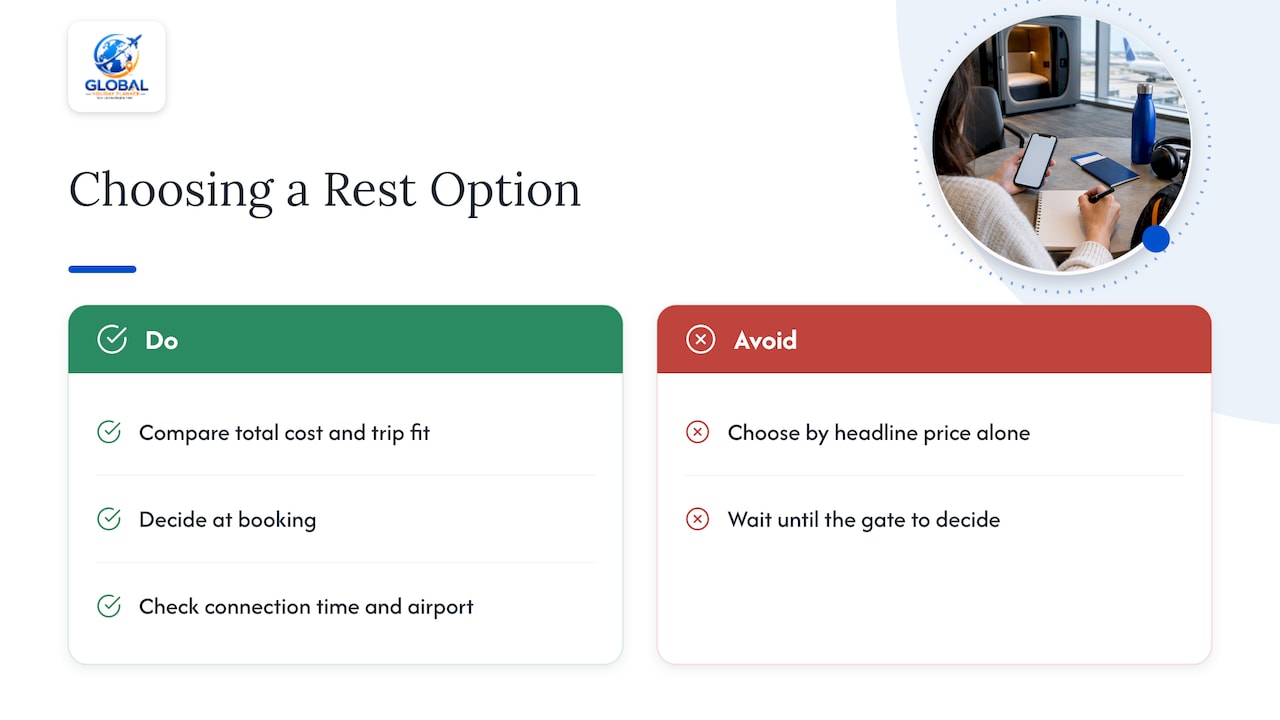
A pod is good value when three things line up: your layover is long enough to sleep, the pod is airside, and you do not need to leave. Change any one of those and it can become the worse option. A €34 minimum plus a long walk plus a security re-entry is a poor deal next to a room 10 minutes away with a shuttle. A $0 gate bench is a poor deal if you are traveling with kids or a long day ahead.
We suggest travelers decide at booking, not at the gate. When you choose a flight, look at the connection time and the airport, then decide if you will want a pod, a hotel or a lounge. Longer layovers on the cheaper itineraries are exactly where the savings tend to be, and the rest option is part of the real cost.
— Global
Plan the layover before you fly
The cheapest long layover is the one you planned. When you compare flights on Global Holiday Planner, you can see connection times and airports side by side, then check airport-area hotels for the same dates. If you land late and want a ride to your room, our airport transfers can be arranged before you leave home.
For help choosing the right ride from the terminal, read how to match your trip to an airport transfer. If budget is the main concern, our hostel versus hotel comparison covers cheaper beds near the airport.
FAQ
Can you sleep in an airport sleep pod without a ticket?
Generally you need to be inside the area where the pod sits. If it is airside, that means passing security with a boarding pass. Landside pods can be easier to reach but are less useful for connecting passengers. Check the operator’s page for the access rule at your airport.
How much does an airport sleep pod cost?
It depends on the airport and the time of day. Munich lists €17 an hour by day and €12 an hour at night for a standard cabin, with a €34 minimum. Istanbul lists €17.50, €25 or €30 an hour, and Madrid short stays start at €45. U.S. suites usually cost more, so check the current rate.
Do I need to book a sleep pod in advance?
Not always. Frankfurt allows advance reservations or ad hoc use if a cabin is free, and Munich allows online booking. Book ahead if you arrive late at night, have a short connection or are traveling during a disruption.
Are sleep pods safe for my luggage?
It depends on the unit. A cabin with a locking door is safer than a curtain or an open recliner. Ask before you pay, and keep your passport, wallet and phone on your body.
What if my airport has no sleep pods?
Look for free rest areas, a quiet gate airside, a lounge or an airport hotel with a shuttle. Some airports, such as Shanghai Pudong, offer free rest areas with sofas and charging ports. Check the airport’s own website for what is allowed overnight.
Sources
- Airport sleep pods and capsule hotels, Airport After Dark
- Kepler Club airport sleeping pods
- Sleepover, Hamad International Airport
- napcabs and napcabsXL, Munich Airport
- iGA Sleepod, Istanbul Airport
- Shanghai Airport (Group) Co Ltd
- Sleeping at Madrid airport
- NapCabs Offer Peace and Privacy, Fraport
- Pudong airport to introduce sleep pods, Shanghai government
- Can you sleep overnight in an airport, Austin American-Statesman