
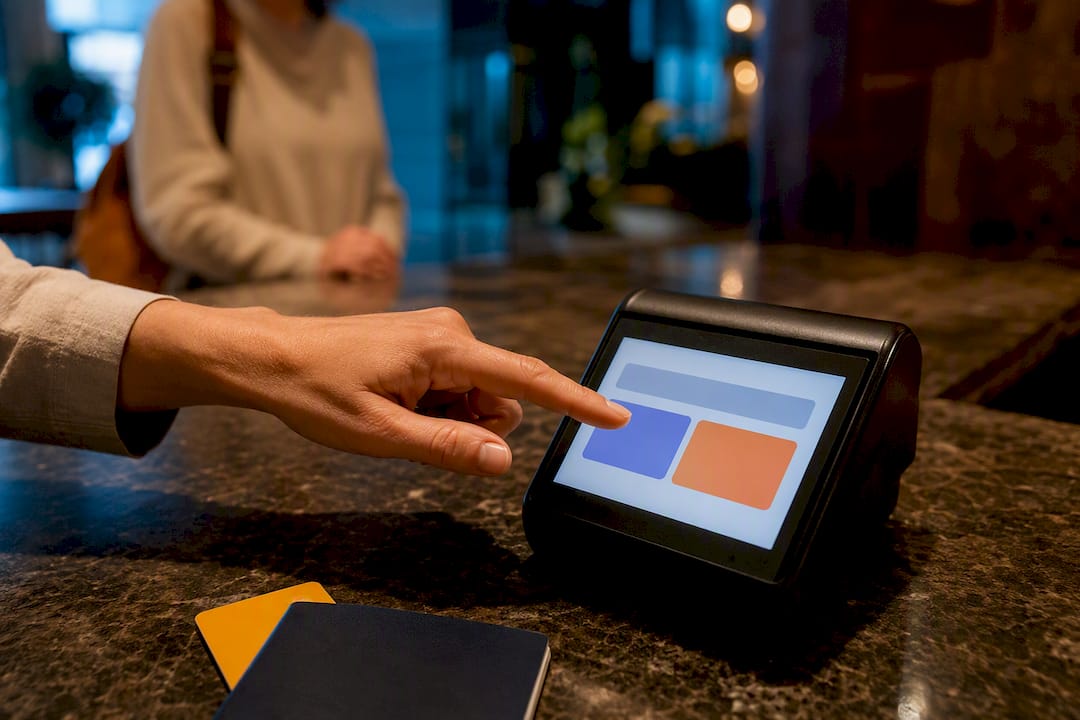
Decline dynamic currency conversion in almost every case. When a terminal or ATM abroad asks whether you want to pay in your home currency instead of the local one, the exchange rate behind that offer usually carries a markup that costs more than your card issuer’s standard conversion. Say no, choose the local currency, and let your card network handle the math.
TL;DR:
- Dynamic currency conversion almost always involves a markup that can add up to 18% over the wholesale rate, increasing the total cost of transactions.
- Card networks require merchants to disclose both currencies, the exchange rate, and any fees, but many display this information in a way that nudges travelers to accept DCC.
- Declining DCC and choosing local currency is the best way to avoid unnecessary extra costs, especially for transactions over $20 or when the rate is significantly worse than the market rate.
- Travelers should compare the terminal’s exchange rate with a live midmarket rate using a currency app to verify if DCC offers a fair rate before accepting.
- Using cards without foreign-transaction fees and preparing backup payment methods help minimize DCC-related expenses and avoid being forced into costly conversions.
Table of Contents
- What Is Dynamic Currency Conversion and How Does It Work?
- What to Expect When a Merchant or ATM Offers DCC
- How Much Extra Does DCC Cost? Typical Markups and Examples
- Should You Accept DCC? A Practical Decision Rule for Travelers
- How to Avoid DCC and Lower-Cost Alternatives
- Regulations and Consumer Rights: What Visa, Mastercard and the Rules Require
- Practical Examples and a One-Screen Checklist
- How Global Holiday Planner Thinks About DCC and Trip Costs
- Another Way to Control Your Total Trip Cost
- Sources
- FAQ
What Is Dynamic Currency Conversion and How Does It Work?
Dynamic currency conversion, often shortened to DCC (and sometimes labeled CPC or POI CC on a receipt), lets you pay in your home currency while shopping or withdrawing cash abroad instead of the merchant’s local currency. It sounds convenient. You see a number in dollars, euros, or pounds instead of unfamiliar foreign digits, and you know exactly what’s leaving your account. That convenience is the entire sales pitch, and it’s also where the cost hides.
Here’s the mechanics. When you insert or tap your card, the terminal reads the issuer identification number and detects which country issued it. That triggers a routing decision: if DCC is available, the terminal hands the transaction to a third-party DCC operator rather than letting your card network handle the conversion. That operator returns three things: the amount in your home currency, an exchange rate, and a built-in markup over the wholesale rate, though that markup is rarely labeled as such on the screen.
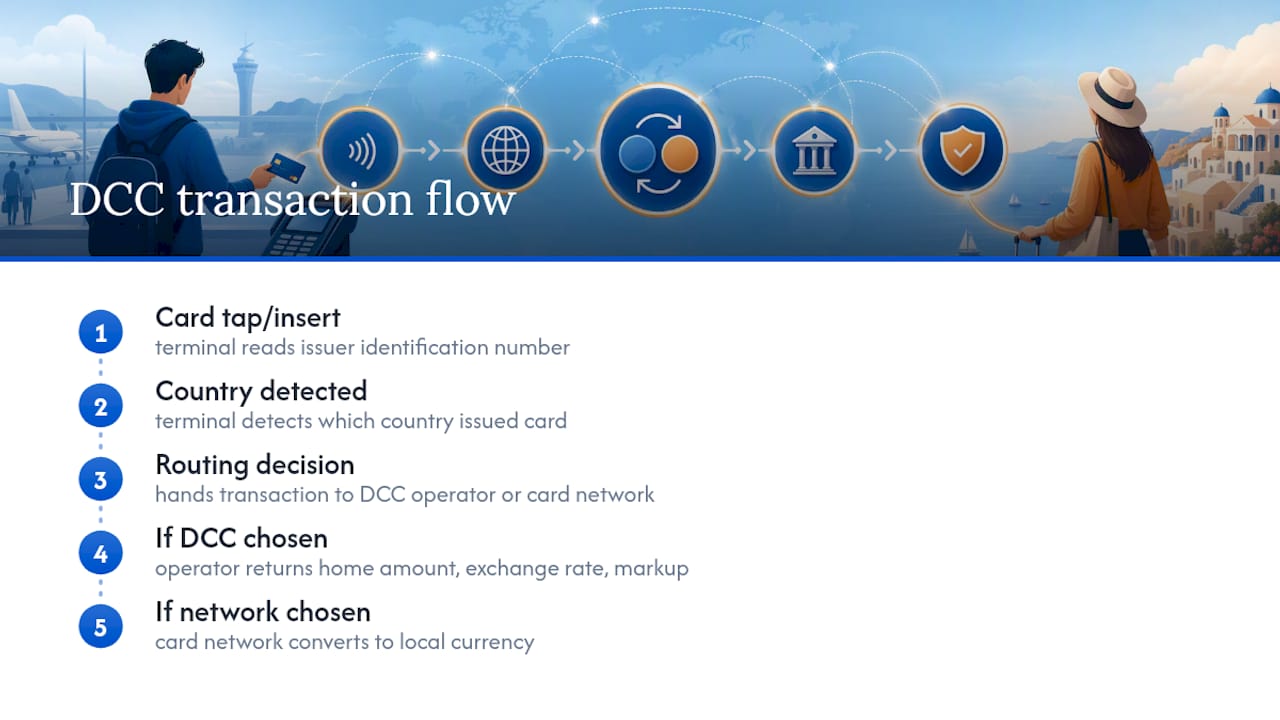
DCC shows up in three settings: physical point-of-sale terminals, ATMs, and online checkouts. The same disclosure logic applies to card-not-present transactions, meaning a hotel booking site or ecommerce checkout can offer DCC just as a shop register does. The mechanism doesn’t change. Only the screen does.
What to Expect When a Merchant or ATM Offers DCC
You’ll usually see a prompt asking you to confirm the transaction “in US dollars” or “in your home currency,” followed by two amounts: one in the local currency, one in yours, plus an exchange rate. Card network rules require that both amounts and the rate appear clearly before you confirm anything.
Mastercard’s compliance guidance requires merchants and ATM operators to disclose the transaction amount in both currencies, the exchange rate applied, and any additional fee, and to give you an explicit choice to accept or decline. Visa carries similar requirements. In practice, disclosure and fairness aren’t the same thing.
Watch for these common tactics at the terminal:
- The local currency option is listed second or in smaller type, nudging your eye toward the home-currency choice.
- “YES” is highlighted or pre-selected, while declining requires an extra tap or a less obvious button.
- The exchange rate is shown but not compared to anything, so you have no reference point without pulling out your phone.
- ATMs often stack the DCC prompt before the withdrawal amount screen, so you’re deciding on the conversion before you even see how much cash you’re taking out.
None of this is necessarily illegal. It’s influence built into the screen design, and the fix is the same every time: read the actual rate, don’t just glance at the currency symbol.
How Much Extra Does DCC Cost? Typical Markups and Examples
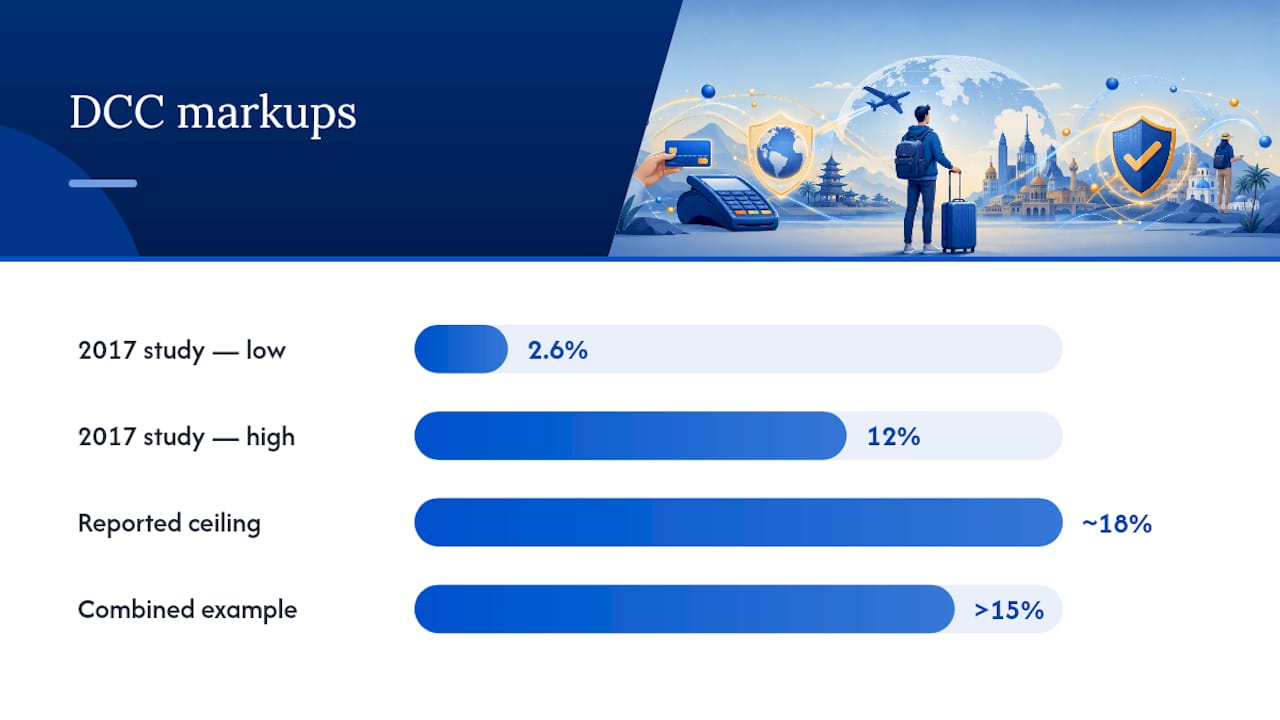
Markups vary by provider and merchant, but they add up fast. Reported DCC markups can run as high as roughly 18% over the wholesale interbank rate, though most transactions land well below that ceiling.
A 2017 European consumer study found DCC users paid between roughly 2.6% and 12% more than they would have paid letting their card issuer handle the conversion.
That range matters because it stacks on top of whatever your card already charges. A card that already charges a 3% foreign-transaction fee combined with a 12% DCC markup can push your effective cost past 15% on that single purchase, since issuer fees don’t disappear just because DCC handled the conversion.
Run the numbers on a $500 hotel bill in a foreign currency. At a moderate DCC markup typical for many merchant terminals, you’d pay noticeably more than the interbank rate would produce. Decline DCC and let your card network convert it, and you likely pay only your issuer’s standard fee, if any, on top of a rate much closer to the wholesale figure.
The one caveat: markups aren’t posted publicly and vary by terminal, country, and operator. Always check the actual rate shown on screen rather than assuming a fixed percentage.
Should You Accept DCC? A Practical Decision Rule for Travelers
Decline DCC by default. That’s the rule for the overwhelming majority of transactions, whether you’re at a restaurant register, a hotel front desk, or a foreign ATM.
Run through this quick sequence when the prompt appears:
- Check the amount. If it’s a small purchase, say under $20, the dollar difference from a markup is trivial and not worth the friction of arguing with a cashier.
- Read the exchange rate on screen, not just the converted total.
- Compare it on your phone against a live rate from a currency app or your card network’s published rate.
- Decline if the shown rate is worse than the reference rate by more than a percent or two. In almost every case, it will be.
- Accept only if the terminal rate is verified equal to or better than midmarket, which happens rarely but does happen with some ATM networks abroad.
Pro Tip: Before you leave home, note your card issuer’s published foreign-transaction fee (many charge zero, some charge 1 to 3 percent). That single number is your benchmark for every DCC prompt you’ll face on the trip.
If a cashier insists you must choose the home-currency total, you can still ask them to run it in local currency. You have the legal right to decline under card network rules, even if the request gets you a puzzled look.
How to Avoid DCC and Lower-Cost Alternatives
The easiest way to avoid DCC entirely is to never let the question come up in a way that traps you. That starts with a few habits before you even land.
- Choose “local currency” every time a terminal or ATM asks, unless you’ve already verified the offered rate is genuinely better.
- Carry a card that waives foreign-transaction fees; several travel-focused cards charge nothing extra on international purchases, which removes one layer of cost even before DCC enters the picture.
- Keep a moderate amount of local cash on hand for small vendors, taxis, and markets where card terminals may push DCC harder than larger merchants do.
- Download a currency-conversion app before departure so you have an instant comparison rate available offline or on hotel Wi-Fi.
- Know your card’s foreign-transaction fee and daily ATM withdrawal limit before you travel, so a prompt abroad doesn’t catch you making a rushed decision.
Pro Tip: Set up a second card from a different issuer as a backup. If a terminal misreads your card’s issuing country and defaults to DCC, having an alternative card lets you simply switch rather than negotiate.
Restaurants and hospitality venues are common DCC hot spots, since local dining transactions often see conversion prompts baked into card readers. Airport transfers and taxi payments carry the same risk, so the same decline-by-default habit applies whether you’re booking an airport taxi or paying a driver directly at the curb.
Regulations and Consumer Rights: What Visa, Mastercard and the Rules Require
Card network rules exist specifically to stop DCC from becoming a hidden fee. Mastercard’s guidance requires that both currency amounts, the exchange rate, and any markup appear clearly before you confirm the transaction, and that merchants give you an unambiguous choice rather than defaulting you into conversion. Visa applies a comparable standard.
Enforcement varies by country, and not every jurisdiction treats a violation the same way. If a merchant refuses to let you pay in local currency or fails to disclose the rate, that’s a rules violation you can report to your card issuer. Keep the receipt or a photo of the terminal screen showing the rate and provider name; that evidence is exactly what your bank needs to investigate a dispute or push back on a merchant.
Practical Examples and a One-Screen Checklist
That’s roughly $33 gone before your card issuer’s own fee, if any, applies on top.
Use this sequence at any checkout or machine:
- Ask which currency you’re being charged in before confirming anything.
- Read the exact exchange rate on the screen, not just the total.
- Compare that rate on your phone against a live midmarket rate.
- Decline if there’s a visible markup, which is nearly always the case.
- Keep the receipt or a screenshot in case you need to dispute the charge later.
How Global Holiday Planner Thinks About DCC and Trip Costs
Avoiding a bad currency conversion is a small decision with an outsized payoff, and that’s exactly the kind of detail our mission at Globalholidayplanner is built around. Trip costs rarely blow up from one big mistake. They leak out through dozens of small ones: a markup here, an unnecessary fee there, a booking made without comparing options.
That’s why we built tools that compare flights, hotels, car rentals, and travel insurance side by side, so travelers can catch savings before they book, not after they’ve already paid too much. Declining a bad DCC offer at a hotel counter and comparing your options before you book that hotel are the same instinct applied twice.
— Global
Another Way to Control Your Total Trip Cost
Skipping a bad currency conversion saves you a few dollars per transaction. Comparing your flights, hotels, and insurance before you book saves considerably more, and that’s the gap Globalholidayplanner is built to close. Instead of hunting across multiple booking sites and hoping you found the best rate, travelers can compare flights, hotels, car rentals, and travel insurance in one place, side by side, before committing to anything.

The same logic that tells you to decline a marked-up exchange rate at a foreign ATM applies to every booking decision on your trip: check before you commit, and never take the first number you’re shown. If your next trip is still in the planning stage, start by comparing flight deals or look into travel insurance options that protect the budget you’ve worked to trim.
Sources
- Dynamic currency conversion: How it works, how to handle it, and how Stripe can help
- Dynamic currency conversion — Wikipedia
- Dynamic currency conversion compliance guide — Mastercard
FAQ
Should I accept dynamic currency conversion?
No, in almost every case decline it and pay in the local currency instead. DCC markups typically make the transaction more expensive than letting your card issuer handle the exchange.
What is dynamic currency conversion?
Dynamic currency conversion (DCC) is an optional service at point-of-sale terminals, ATMs, and online checkouts that lets you pay in your home currency instead of the local one, usually with a built-in markup over the standard exchange rate.
Does my bank charge extra on top of DCC fees?
Yes, your card issuer’s foreign-transaction fee can still apply even after a DCC markup, since DCC is provided by a separate third-party operator, not your bank.
How do I check if a DCC exchange rate is fair?
Compare the rate shown on the terminal or ATM screen against a live rate on a currency app before confirming; if the terminal rate is noticeably worse, decline and choose the local currency.