

Cancel For Any Reason (CFAR) is an optional travel insurance add-on that lets you cancel a fully prepaid, nonrefundable trip for literally any reason and still recover part of your money. It typically reimburses a partial percentage of insured trip costs, but only if you buy it inside a tight purchase window and cancel at least 48 to 72 hours before departure. It earns its cost on expensive, nonrefundable trips where flexible or refundable bookings simply aren’t an option.
TL;DR:
- CFAR must be purchased within 10 to 21 days of the initial trip deposit to remain valid and cannot be added later if missed.
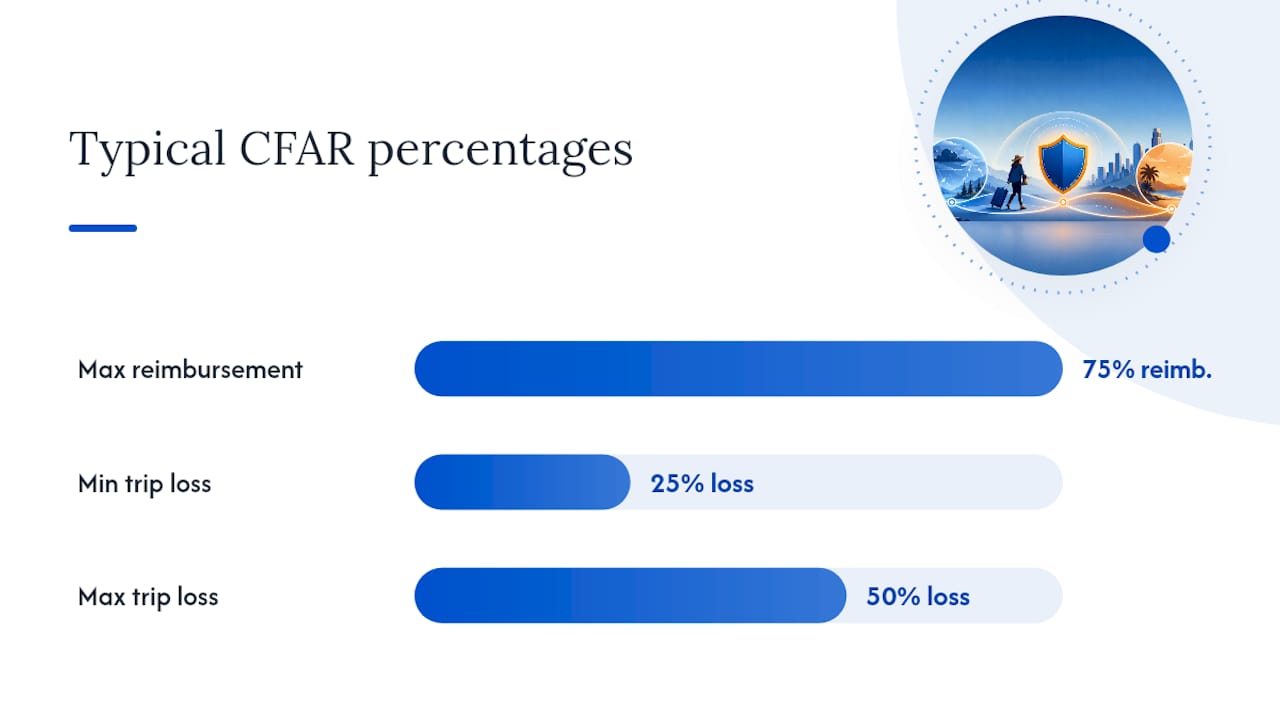
- Reimbursements typically cover only 50% to 75% of prepaid, nonrefundable expenses, leaving travelers to absorb some financial loss.
- The policy requires you to fully insure all prepaid costs and cancel at least 48 to 72 hours before departure to qualify for a claim.
- CFAR excludes refunds for vouchers, loyalty points, or refundable components, and doesn’t cover changes to parts of a trip or late cancellations.
- Comparing policies on dedicated travel insurance platforms helps identify which plans include CFAR, their reimbursement rates, and purchase deadlines before booking.
Table of Contents
- What CFAR Covers and How It Differs From Standard Trip Cancellation
- Eligibility, Purchase Windows, and Timing Rules That Trip People Up
- Limitations, Exclusions, and Where People Get CFAR Wrong
- How Much CFAR Costs and When It’s Worth Buying
- Buying CFAR and Filing a Claim: What You Actually Need to Do
- Alternatives and Complementary Strategies to CFAR
- How Global Holiday Planner Helps You Compare CFAR Availability
- A Practical Framework for Deciding on CFAR
- Compare Policies and Find CFAR Options Before You Book
- Sources
- FAQ
What CFAR Covers and How It Differs From Standard Trip Cancellation
CFAR never stands alone. It rides on top of a comprehensive travel insurance policy as an upgrade, not a separate purchase, according to Progressive. Standard trip cancellation coverage only pays out for a defined list of covered reasons: illness, a death in the family, a natural disaster, a canceled flight. CFAR throws that list out. You can cancel because you got a better job offer, because your dog needs surgery, or because you simply changed your mind.
The tradeoff is that CFAR doesn’t make you whole. NerdWallet puts typical reimbursement at a partial percentage of your prepaid, nonrefundable costs. For example, on a trip insured at that level, the payout may cover a substantial part but still require you to absorb some loss.
Coverage only applies to expenses that were genuinely nonrefundable when you paid them:
- Prepaid hotel and resort deposits with no refund clause
- Nonrefundable flight tickets and tour packages
- Cruise fares paid in full ahead of the sail date
- Prepaid excursions, event tickets, or rental deposits tied to the trip
CFAR won’t reimburse airline vouchers, credit for a future stay, or trips booked with loyalty points and miles, since those aren’t cash losses in the same sense. And if your policy also includes standard trip cancellation, insurers generally expect you to file under that benefit first when your reason for canceling qualifies. CFAR only kicks in when your reason falls outside the standard list, or when you want the extra cushion of a guaranteed partial refund regardless of why you’re backing out.
Eligibility, Purchase Windows, and Timing Rules That Trip People Up
CFAR runs on a clock, and missing it disqualifies you entirely. Most insurers require you to buy the add-on within 10 to 21 days of your initial trip deposit, according to Squaremouth. Wait past that window and CFAR simply isn’t available on that trip anymore, no matter how much you’re willing to pay for it.
Timing snapshot: Buy CFAR within the typical early purchase window after your deposit, insure 100% of prepaid nonrefundable costs, and plan to cancel at least 48 to 72 hours before departure.
A few rules define whether you actually qualify:
- You generally must insure the entire value of your prepaid nonrefundable trip cost, not just a portion of it.
- You typically need to cancel the entire trip at least a few days before departure, per Squaremouth.
- Some insurers require you to insure every traveler on the reservation, not just yourself.
- CFAR availability varies by state; regulatory restrictions in places like New York and Washington can limit or eliminate the option entirely.
Insurers calculate your premium against full trip value, so a single big-ticket item like a cruise deposit or an all-inclusive resort package can push the CFAR premium noticeably higher than travelers expect. And the 48 to 72 hour cutoff creates a real gap: if something goes wrong the night before your flight, standard cancellation benefits might still apply, but CFAR generally will not.
Limitations, Exclusions, and Where People Get CFAR Wrong
The single biggest misunderstanding about CFAR is that it works like a refund button. It doesn’t. Here’s what actually happens when you use it:
- You lose part of your money no matter what. Reimbursement tops out around 75%, which means you’re accepting a 25% to 50% loss on the trip even when your claim is approved cleanly.
- It’s all or nothing. CFAR covers canceling the entire trip. You can’t use it to bail on one leg of a multi-city itinerary while keeping the rest, or to skip a single excursion.
- Vouchers and points don’t count the same way. If a supplier gives you a future travel credit instead of a cash refund, that portion of your claim usually gets reduced or denied since you didn’t suffer a full cash loss.
- Late purchases are a dead end. Once you’re past the 10 to 21 day window from your deposit, no amount of extra premium buys you back in.
- Free-look periods are short and upgrades are limited. Most policies give you a brief window (often 10 to 15 days) to cancel the whole policy for a refund if you change your mind, but you typically can’t add CFAR to an existing policy after the fact.
Pro Tip: Before you buy, read the “cancellation” clause for exact wording on partial trip changes. Some policies define “trip” broadly enough that changing your return date could jeopardize the whole claim, not just that one segment.
Travelers also tend to forget the timing gap between CFAR’s 48 to 72 hour cutoff and a genuine last-minute emergency. If your reason for canceling happens the morning of your flight, CFAR usually won’t help, though your standard trip cancellation benefit still might.
How Much CFAR Costs and When It’s Worth Buying
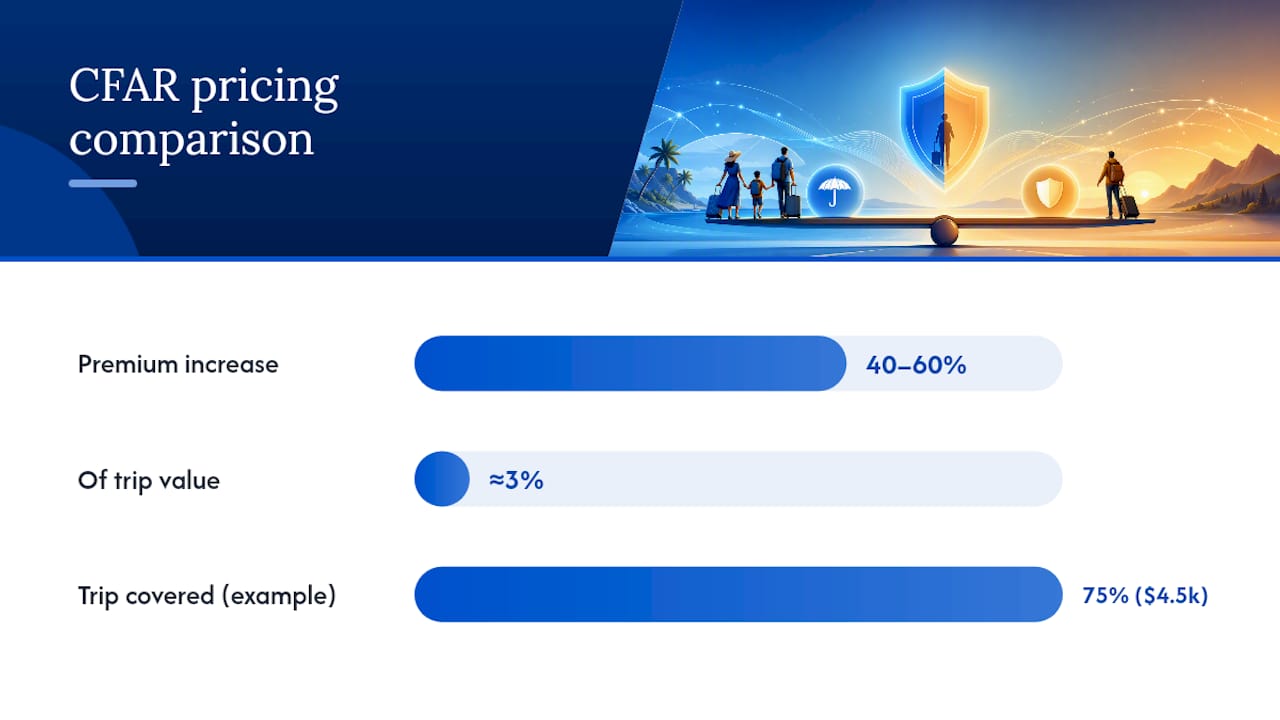
CFAR isn’t cheap, and the pricing structure explains why. Adding it to a comprehensive policy commonly increases your total insurance premium by 40% to 60%, according to The Points Guy, while some providers frame the add-on cost closer to an extra 3% of total trip value on top of the base policy. The spread depends heavily on your trip cost, age, and destination.
Here’s a simplified way to see whether that premium is worth paying:
On trips with varying costs, the additional CFAR premium generally increases the insurance cost significantly, and the partial CFAR payout can cover a sizable portion of the prepaid nonrefundable expenses. Buyers should weigh whether the extra premium justifies the potential payout, especially for expensive, nonrefundable trips.
The math tells the real story: on a $6,000 trip, paying roughly $175 extra for CFAR to protect $4,500 in potential reimbursement is a reasonable trade for a lot of travelers. On a $2,000 trip with mostly refundable components, that same math rarely justifies the premium.
A few situations tip the decision clearly toward buying CFAR:
- You’ve prepaid a large, nonrefundable deposit, like a cruise or destination wedding package.
- Your travel plans depend on something uncertain (a pending work project, a health situation that isn’t quite “covered reason” territory).
- You’d rather guarantee a partial refund than gamble on whether a standard policy’s reason list covers your situation.
If your trip is mostly refundable already, or the total cost is low enough that a full loss wouldn’t hurt much, skip CFAR and put that premium toward a refundable fare instead.
Buying CFAR and Filing a Claim: What You Actually Need to Do
Getting CFAR right starts before you ever buy the policy. Confirm these details in the policy wording, not just the marketing page:
- Verify the purchase deadline. If you’re more than 10 to 21 days past your deposit date, ask the provider directly whether CFAR is still available.
- Insure 100% of your prepaid, nonrefundable trip cost. Underinsuring reduces or voids your CFAR eligibility.
- Check the exact cancellation deadline stated in your policy. Most sit at 48 to 72 hours before departure, but some vary.
- Confirm CFAR is actually offered in your state before you buy, since availability isn’t universal.
When it’s time to file a claim, documentation makes or breaks it. Insurers and consumer sources like Squaremouth point to a consistent checklist:
- Proof of payment for every prepaid expense you’re claiming
- Written cancellation confirmations from each supplier (airline, hotel, cruise line, tour operator)
- Records showing whether you received a refund, voucher, or nothing from each supplier
- A copy of your policy documents showing the CFAR endorsement and purchase date
Cancel with your suppliers first, save every confirmation email, and file your claim promptly. Insurers process CFAR claims faster when the paper trail is complete on the first submission rather than trickling in over follow-up requests.
Alternatives and Complementary Strategies to CFAR
CFAR isn’t the only way to protect prepaid money, and it isn’t always the smartest one. Refundable and flexible bookings often solve the same problem more cheaply, especially for mid-priced trips, according to The Points Guy.
- Refundable fares and flexible tickets cost more upfront than basic economy but let you cancel or change plans without losing the full fare, and you keep 100% of your money rather than 50% to 75%.
- Credit-card trip protections sound similar but rarely match CFAR. They usually cover a fixed list of reasons, not any reason, so they don’t close the same gap.
- Hybrid booking works well in practice: insure your whole trip cost against major losses, but book the most changeable pieces (a flexible flight, a cancel-anytime hotel rate) separately so you’re not relying on CFAR’s partial payout for the parts most likely to change.
- Skip CFAR entirely when your trip is inexpensive, largely refundable already, or built around components you could rebook without major financial pain.
The smartest approach for a lot of travelers isn’t choosing CFAR or flexibility. It’s stacking both where each one covers the other’s weak spot.
How Global Holiday Planner Helps You Compare CFAR Availability
Finding a policy that actually offers CFAR shouldn’t require reading a dozen provider pages. Comparison tools on travel planning platforms let you search travel insurance options side by side and check which plans include CFAR upgrades, what their reimbursement percentage is, and what their purchase and cancellation deadlines look like.
That matters because CFAR rules vary enough between providers that the “best” option depends entirely on your trip cost, your state, and your deposit date. Instead of digging through fine print on each insurer’s site, you can:
- Compare reimbursement rates and purchase windows across multiple providers at once
- Check state availability before committing to a policy
- Weigh a CFAR upgrade against the base plan’s standard cancellation coverage
The best travel insurance plans page organizes these comparisons so you can see policy differences without opening ten browser tabs.
A Practical Framework for Deciding on CFAR
Skip it when your booking is mostly refundable already, or the total exposure is small enough that a full loss is annoying rather than damaging.
Risk-averse travelers should treat CFAR as insurance against regret, not a refund guarantee. Cost-conscious travelers often do better stacking flexible fares on the pieces most likely to change and saving the CFAR premium for the one nonrefundable anchor, like a cruise deposit, that would actually sting to lose.
— Global
Compare Policies and Find CFAR Options Before You Book
Specialized travel insurance comparison sites provide a faster path to a CFAR-capable policy than combing through provider websites one at a time. Because CFAR rules differ so much between insurers, from purchase windows to reimbursement percentages to state restrictions, comparing several sides by side is the only way to know you’re getting the coverage you actually need at a price that makes sense.

Head to the best travel insurance plans page, filter for CFAR availability, and check reimbursement rates and deadlines before you commit to a policy. If your trip includes flights you’re still deciding on, you can also compare flight booking options to see whether a refundable fare might cost less than the CFAR premium on that same trip. Either way, start the comparison now, before your purchase window closes.
Sources
- How Cancel For Any Reason Travel Insurance Works – NerdWallet
- Cancel For Any Reason (CFAR) Travel Insurance – Squaremouth
- Everything you need to know about ‘cancel for any reason’ trip insurance – The Points Guy
- What is cancel for any reason in travel insurance? – Progressive
FAQ
Is Cancel For Any Reason Insurance Worth It?
It’s worth it for expensive, fully prepaid, nonrefundable trips where you want protection beyond a standard cancellation reason list.
What Is the Best Cancel For Any Reason Trip Insurance?
The best policy depends on your trip cost, state, and deposit date, since reimbursement percentages, purchase windows, and cancellation deadlines vary by provider. Comparing multiple CFAR-eligible policies on a platform like Globalholidayplanner’s insurance comparison page is the fastest way to match a policy to your situation.
What Is a Good Reason to Cancel Insurance?
CFAR doesn’t require a specific reason at all, which is its entire point.