

An advance purchase rate is a discounted hotel price you get by booking ahead and, usually, paying in full at booking, in exchange for giving up most or all of the right to cancel or change. Hotel brands in the U.S. typically advertise savings of roughly 10% to 20% off the flexible price. Whether that discount is worth taking depends on how sure you are about your dates, and that is a decision you can make with a little math. On our hotel comparison page you can set the advance purchase price next to the flexible price for the same room and see the real total before you commit.
TL;DR
- An advance purchase rate (also called an advance purchase discount) is a lower room price tied to a booking window, prepayment and limited or no refunds.
- Published U.S. hotel offers commonly save about 8% to 20% off the flexible rate, and the lead time required ranges from a few days to several weeks.
- The rate pays off only when you are very unlikely to cancel: a 12% discount needs a cancellation chance well under 12%.
- Compare taxes, resort fees, change rules and loyalty points, not just the headline percentage.
- Check the advance rate against the flexible rate for the same room before you pay.
Table of Contents
- What an advance purchase rate actually is
- How much you can save and how far ahead you must book
- When you pay and what happens if plans change
- The break-even test: is the discount worth the risk?
- What to compare before you click book
- How far ahead should you book?
- A simple routine for booking an advance rate
- Where advance purchase rates fit in your wider trip
- Our perspective
- Compare and book your stay
- FAQ
- Sources
What an advance purchase rate actually is
Hotels sell the same room at several prices. The flexible price, often called the Best Available Rate (BAR), lets you cancel close to arrival. An advance purchase rate is a separate rate code with conditions attached. A hotel industry glossary describes what defines it as the conditions, not the size of the saving: prepayment, a booking window and limited or no refunds.
The booking window is the part people miss. A rate such as “book 21 days ahead and save 15%” only shows up while you are at least that many days from arrival. Once the window closes, the rate disappears from the search results. If you cannot find the deal a friend found, the lead time is usually the reason.
You will see the same idea under several names: advance purchase discount, advance saver, book early and save, prepaid rate, or a member discount with an advance purchase requirement. The names differ, but the trade is the same: pay less, commit earlier.
How much you can save and how far ahead you must book
There is no single number, because every hotel group sets its own. The published figures from major U.S. hotel brands give a realistic range:
| Offer type | Typical saving | Booking window | Terms |
|---|---|---|---|
| Large hotel group advance purchase discount | Up to 15% off BAR, commonly 8% to 15% | At least 7 days ahead | Full prepayment, non-refundable, no changes |
| Another major group’s advance booking rates | Typically 10% to 20% below the flexible rate | Varies by offer | Paid in full at booking, full charge if canceled |
| Economy chain advance purchase offer | Up to 15% off BAR, average 12% | At least 7 days ahead | Full payment with taxes at booking, no refunds for cancellations, no-shows or early departures |
A rate-types guide updated in 2026 puts typical prepaid savings at 10% to 25% against BAR, so you may see a bigger discount at a resort or in a slow season. Treat these as ranges, not promises: each hotel sets its own percentage and window, and the figure on your search results is the one that counts.
A worked example
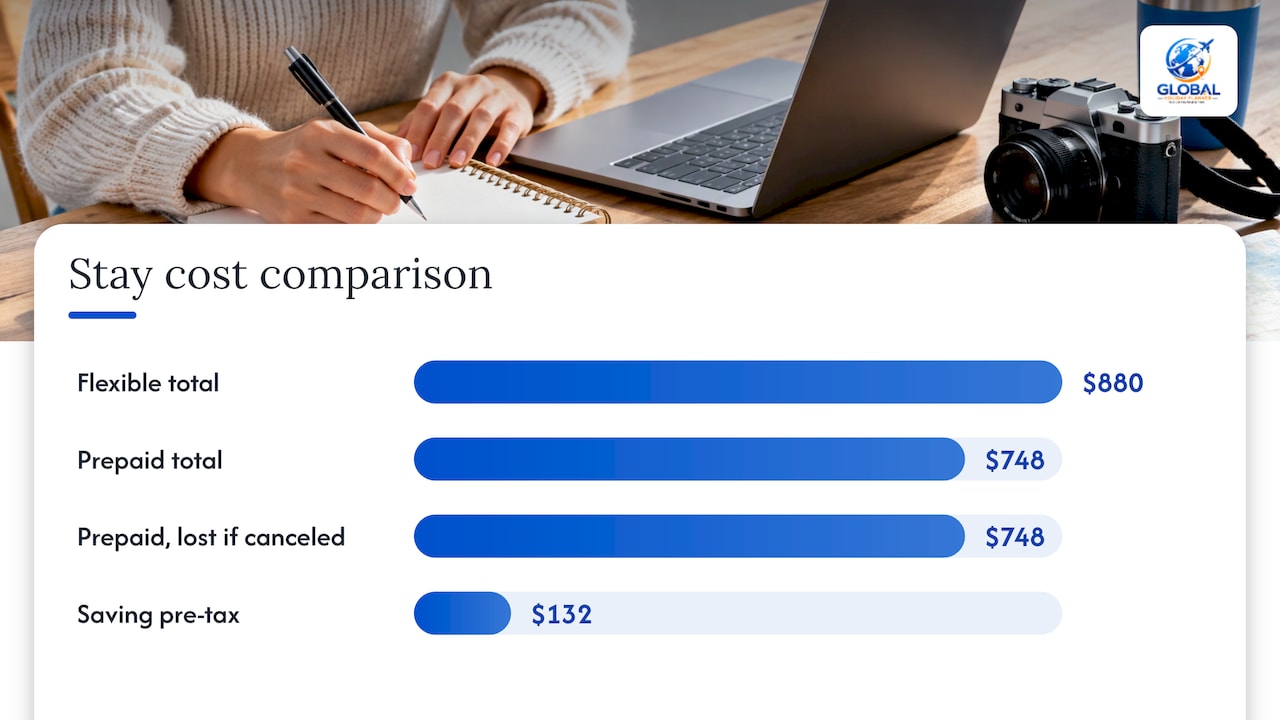
Say a hotel quotes $220 a night for a flexible room and $187 a night for the advance purchase version, which is about 15% less. For a four-night stay, that is $880 flexible against $748 prepaid, a saving of $132 before taxes. That money is yours as long as the trip goes ahead exactly as planned. If you have to cancel, you generally lose the full $748 under non-refundable terms.
When you pay and what happens if plans change
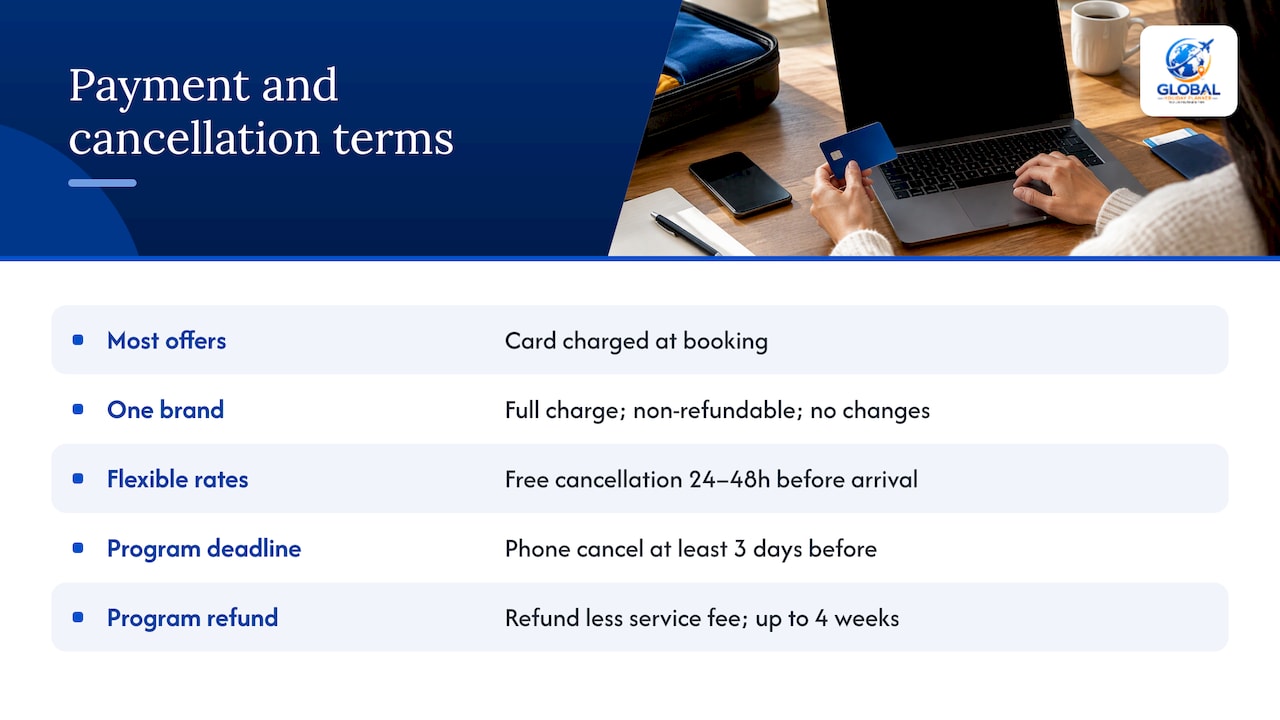
With most advance purchase offers, your card is charged at booking, not at check-in. One major U.S. brand’s terms say the full amount for the entire stay is charged immediately, payments are non-refundable, and the booking cannot be modified, including name and date changes. Another group’s guide says prepaid rates are charged in full, with a full charge if you cancel, while date changes are typically restricted or carry a fee. The flexible rates it compares them with allow free cancellation up to 24 to 48 hours before arrival at most of its properties.
Some brands offer a narrow exit. In the U.S., Canada, Mexico and the Caribbean, one program lets members cancel and rebook a new advance purchase reservation by phone at least 3 days before check-in, with a refund less a service fee that can take up to 4 weeks, according to its offer terms. That is a program rule, not an industry standard, so read the terms of the specific rate you choose.
The lesson: read the cancellation line before you read the price. A rate-types guide notes that the cancellation window is the biggest difference between rates, and that a rate can be refundable but not changeable, or the other way around. If you have already booked a non-refundable room and your plans moved, our refund script for nonrefundable hotel bookings walks through the steps.
The break-even test: is the discount worth the risk?
You do not need a spreadsheet. The discount percentage is roughly your break-even cancellation chance. A 12% discount pays off if the chance you will cancel is below about 12%, which means about one trip in eight. Above that, the flexible rate costs you less on average.
Be honest about the odds. Cancellations come from ordinary things: a delayed flight, a sick child, a work trip that moves, a storm warning. Here is how that plays out for different travelers:
- Couples on a romantic getaway with fixed dates, such as an anniversary, are often a good fit for an advance rate, because the dates are the whole point.
- Families planning multi-generational trips coordinate many schedules. If everyone has confirmed leave and flights, prepaying can lock in a lower price on a large room bill; if one grandparent’s health or a school date is uncertain, the flexible rate is the sensible choice.
- Golf travelers booking around a tournament or tee times have fixed dates and usually a deposit already paid elsewhere, so the advance rate suits them well.
- Corporate travelers whose meetings can shift should usually keep flexibility. Our business travel booking tips cover how to protect against delays.
- Budget travelers gain the most in percentage terms, since a 15% cut on a long stay is real money, but they also feel a lost non-refundable payment the most.
For a deeper look at the same math applied to paying at the hotel versus paying up front, see our one math rule for prepaid discounts.
What to compare before you click book
Two rates that look 15% apart can cost the same once the fine print is counted. Check these five items:
- Taxes and fees. Quoted rates are typically per room, per night, and exclude taxes, gratuities, incidental charges and resort fees. A resort fee charged per night can erase a small discount.
- The cancellation and change rules. Is it fully non-refundable, or can you change dates for a fee?
- The booking window. Confirm how many days before arrival the rate was bookable, and whether you are inside it.
- Promotion stacking. The same terms say the offer may not be combined with other promotions, so a member rate or coupon could beat it.
- Points and eligibility. Some prepaid rates do not earn loyalty points, and some require loyalty membership, so confirm before you assume the points will arrive.
Because our platform compares flights, hotels, car rentals, rail tickets, transfers and travel insurance in one place, we show costs side by side so you can judge the total trip price, not one line item at a time.
How far ahead should you book?
There is no universal best window. One hotel group’s 2026 seasonal guide suggests:
- 60 to 90 days ahead for peak summer beach and resort stays and Christmas or New Year travel;
- 90 to 180 days ahead for luxury or high-demand resorts;
- 14 to 30 days for flexible leisure trips;
- 7 to 21 days for shoulder-season trips.
The same guide notes that no single window fits every stay. Earlier is not automatically cheaper, either. Hotels use lead-time controls in both directions: they reward early commitment with advance purchase rates, and may close or open discounts closer to arrival depending on demand. That is why it helps to compare, then recheck. Our guide to the best time to book hotels goes deeper on timing, and our travel deal alerts guide shows how to track the same dates and recheck rates. If you are booking a short break, this advice on booking a weekend stay also covers lead-time rules and rate availability.
If you are building a whole trip, the order matters too. Our rule on whether to book flights or the hotel first helps you avoid prepaying a room before your flights are settled, and our guide to when to book packages covers the window by trip type.
A simple routine for booking an advance rate
- Fix your dates. Confirm leave, flights and everyone traveling. If any of that is unsettled, price the flexible rate first.
- Pull both prices. Look at the flexible and advance purchase rate for the same room type, same occupancy and same dates.
- Add the extras. Include taxes and resort fees to get the true total for each.
- Run the break-even. If the discount is 12%, ask whether you are more than 88% certain you will travel on those dates.
- Read the change terms. Note whether you can change names, dates or cancel, and by when.
- Book and save the confirmation. Keep the rate name and terms with the receipt.
Step two is where side-by-side comparison does the heavy lifting. On our hotel page you can compare options for your dates, and the price you see is the one to weigh against the flexible alternative.
Where advance purchase rates fit in your wider trip
A hotel is one of several things that carry restrictions. Airfares, rail tickets and car rentals have their own versions of the same trade: lower price for less flexibility. If you are pairing a prepaid hotel with fixed flights, our flexible date flight guide shows how to find the cheapest days before you lock the room. And since a non-refundable payment is exactly the kind of cost travel insurance is designed to address in some circumstances, check what a policy covers before you rely on it.
Our perspective
Most travelers do not lose money on hotels because they pick the wrong brand. They lose it because they compare one number, the nightly price, and ignore the conditions around it. An advance purchase rate is a good deal when the trip is certain and the total is lower. It is a poor one when the discount hides a resort fee or when plans are still moving.
That is why we built Global Holiday Planner around side-by-side cost and feature comparisons across flights, hotels, car rentals, transfers and insurance. Seeing the real total for an itinerary in one place, with recommendations for the kind of trip you are taking, makes the prepay-or-stay-flexible decision a matter of arithmetic instead of guesswork.
Our advice: when your dates are fixed, take the advance purchase rate and put the saving toward the rest of the trip. When they are not, hold a flexible rate and recheck as the date approaches.
Global
Compare and book your stay
Ready to put a price on your dates? Our hotel reservations page lets you compare hotel options, and you can pair them with flights, a rental car or an airport transfer from the same place, so you see the whole trip cost before you pay for any one part.
FAQ
What is an advance purchase reservation?
It is a hotel booking made at a discounted rate, usually at least several days or weeks before arrival, and usually paid for at booking. In return you accept strict limits on changes and refunds. The discount, window and terms are set by each hotel brand.
Is an advance purchase rate always cheaper than the regular rate?
Usually it is lower than the flexible rate for the same room, but not always the lowest price available. Another promotion, a member rate or a special offer may beat it, and fees can narrow the gap. Compare the total after taxes and fees, and note that advance offers often cannot be combined with other promotions.
Can I cancel an advance purchase hotel booking?
Often not. Many advance purchase rates are fully non-refundable and cannot be changed, and canceling can mean losing the entire payment, as in one major group’s published guide. A few programs allow a limited cancel-and-rebook with a fee, so read the exact terms before you pay.
How far in advance do I need to book to get the discount?
It depends on the offer. Some require only 3 to 7 days, as with an economy chain’s offer at 7 days, while others ask for 30, 60 or 90 days. The rate appears in search results only while you are inside the window.
Why was I charged the full amount before I arrived?
Prepayment is part of the deal. The hotel receives your money early and in exchange gives you a lower price, so the card is typically charged at booking for the whole stay, as the terms of major U.S. offers describe.
Sources
- What is an advance purchase rate? (Flyerfolio)
- Lead-Time Restrictions in Hotels: How They Work (Guestara)
- Advance Purchase Discount, hotel offer terms (Hilton)
- Flexible vs. Prepaid Hotel Rates (IHG Rate Guide)
- When to Book IHG Hotels, 2026 Seasonal Deals Guide
- Book Early and Save, advance purchase offer (Red Roof)
- Hotel Rate Types Explained (Hotelier’s Choice)