
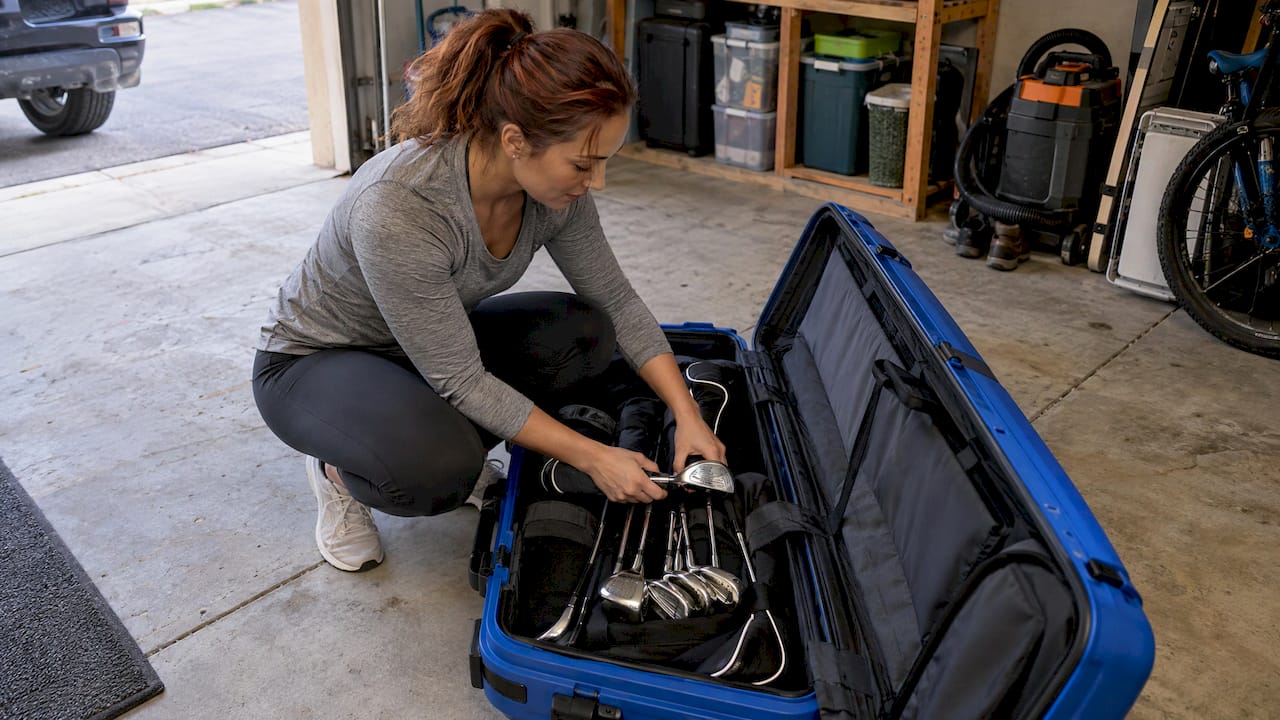
You can fly with golf clubs, and the simplest way is to check them. TSA lists golf clubs as prohibited in carry-on bags and permitted in checked bags, so plan on one golf bag in a protective travel case, weighed and packed before you leave for the airport. Most large U.S. airlines treat a single golf bag as a standard checked bag, which means the real questions are the fee, the 50 lb weight line and how well the case protects your driver.
This guide covers each of those, plus what happens at security, how to choose between hard, soft and hybrid cases, and how to pack so nothing arrives bent or cracked.
TL;DR
- Golf clubs go in checked baggage, never the cabin. One golf bag per passenger is usually treated as a standard checked bag.
- The number that matters is weight: major U.S. airlines charge overweight fees above 50 lb, and the case itself eats into that allowance.
- Pick a case by trade-off: hard shells protect most, soft cases weigh least, hybrids sit in between.
- Remove adjustable driver heads, add a stiff arm, pad the top of the bag and shake-test it before you zip it.
- Check the airline that actually operates your flight, not just the site where you bought the ticket.
Table of Contents
- Are golf clubs checked baggage?
- What flying with golf clubs costs
- Choosing a golf travel case
- How to pack golf clubs for a flight
- Security screening and airport day
- Insurance and what if your clubs go missing
- Planning the whole golf trip
- Our perspective
- Plan your golf flight with Global Holiday Planner
- FAQ
- Sources
Are golf clubs checked baggage?
Yes. Golf clubs are a sports item that travels in the hold. The TSA entry is clear that they are not allowed in carry-on bags and are allowed in checked bags, and it adds that the officer at the checkpoint makes the final call. In practice, that means you never need to try to talk a club through the cabin screening line. Not even a single iron or a putter belongs in your carry-on.
Whether the bag counts as a regular checked bag depends on the airline, but at the big U.S. carriers the answer is mostly yes:
- American allows one golf bag containing clubs, balls, tees and one pair of shoes. Standard checked-bag fees apply up to 50 lb (23 kg), overweight fees apply from there up to 70 lb (32 kg), and oversize fees do not apply.
- Delta treats one golf bag per passenger as a standard checked item. Standard charges apply, excess-weight charges start above 50 lb, and bags over 115 linear inches (292 cm) are rejected. A hard case or a soft-sided bag is accepted, with a limited-release form signed for the soft one.
- United allows one set of clubs in a hard or soft-sided case. A soft case needs a limited-liability release, oversize fees are waived, and overweight charges may apply.
That last point about soft cases is worth understanding. The release form means the airline limits what it will pay if a soft-sided case is damaged in transit. It is a routine step, and it is one reason some golfers choose a rigid case for expensive sets.
If you are deciding between bringing a bag in the hold and packing light, our guide to checked bag versus carry-on shows how to weigh the fees for the rest of your luggage.
What flying with golf clubs costs
The golf bag itself is rarely the expensive part. The fee is the airline’s normal first or second checked-bag price, and the surprises come from weight. A September 2026 golf travel guide lists online, standard-economy domestic examples of $45 for a first bag and $55 for a second on American, Delta, United and Southwest, and $39 to $49 for a first bag on JetBlue depending on whether the date is peak or off-peak. The same guide reports 50 lb economy limits across those carriers and waived golf oversize fees on American, Delta, United and Southwest.
| Airline type | Typical treatment of one golf bag | What to watch |
|---|---|---|
| American, Delta, United | Standard checked bag, oversize fee waived or not applied | Overweight fee above 50 lb; soft cases need a release at Delta and United |
| Southwest | Standard checked bag in the 2026 guide’s examples | $45 first bag, $55 second bag online in the examples |
| JetBlue | First bag $39 to $49 depending on date | 50 lb limit in the guide’s examples |
| Alaska | Reported as more generous on golf weight | Confirm the current rule before you fly |
These are examples published in 2026 and fees change, so treat them as a planning range and confirm on the airline’s own page before booking. Two habits keep the cost down. American’s own guidance is to prepay online where it is cheaper, use any free-bag benefit that applies to you and weigh the packed bag. For a wider comparison of what each bag costs on a typical trip, see our look at 2026 baggage fees and landed cost, and for the other charges that stack up on a ticket, how a $30 bag changes your total.
Flying abroad
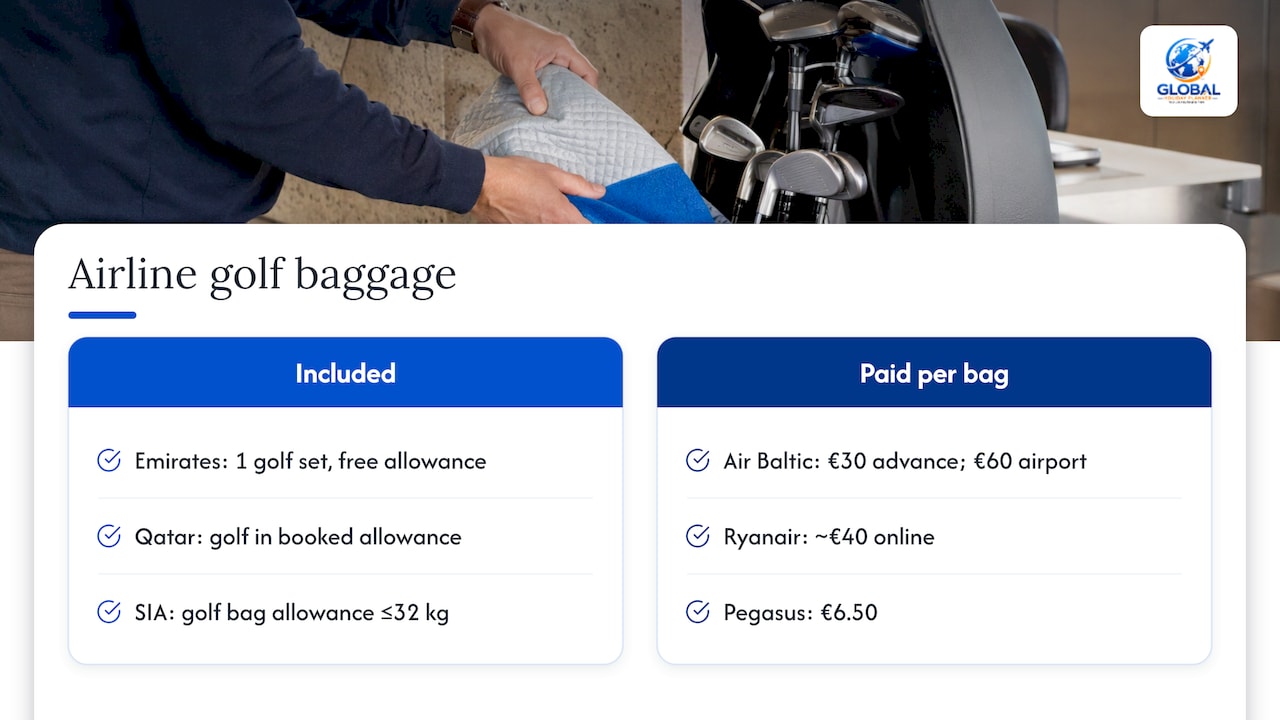
International rules differ a lot. A December 2023 European comparison reports that Emirates includes one golf set in the free baggage allowance, Qatar Airways includes golf equipment within the booked allowance, and Singapore Airlines includes a golf bag within the allowance up to 32 kg. The same comparison reports low-cost European carriers charging per bag: Air Baltic at €30 booked in advance or €60 at the airport, Ryanair at around €40 online and Pegasus at €6.50. Those figures date from 2023, so use them only to see the pattern: full-service carriers on long-haul routes often fold golf into the allowance, while budget carriers charge a fee that rises at the airport.
The sensible workflow for any trip abroad is to check the rule of the carrier that operates each leg. Baggage rules vary by route, fare, codeshare and country of departure, so the airline that sold you the seat may not be the one whose policy applies. One 2026 packing guide makes the same point: confirm the operating carrier, not just the ticket seller.
Choosing a golf travel case
A travel case does two jobs: it keeps the clubs from being crushed or hit, and it keeps the total weight under the airline’s line. Those goals pull against each other. GolfWeek’s equipment analysis describes the central trade-off as protection against empty weight: rigid construction resists crushing better but uses more of the 50 lb allowance.
| Case type | Strength | Trade-off |
|---|---|---|
| Hard shell | Strongest against crushing, puncture and impact | Heavier and bulkier; harder to store |
| Soft-sided | Lighter, easier to store and carry | Relies on padding, careful packing and usually a stiff arm |
| Hybrid | Rigid or semi-rigid protective section with a lighter soft body | A compromise on both protection and weight |
An independent 2026 comparison gives example empty weights of 10 to 16 lb for hard shells, 11 to 12 lb for a hybrid and 7 to 9 lb for a soft-sided case. Those are individual products rather than category rules, but they show the gap: choosing a soft case can leave you several pounds of extra room for shoes and clothing. GolfWeek puts typical travel-case weight at 12 to 20 lb, and suggests that if you are close to the limit, a lighter stand bag inside a soft cover is worth considering.
Which case fits which trip
- One or two flights a year, a set you care about: a hard or hybrid case, since protection matters more than a couple of pounds.
- Frequent flyer, light bag, tight weight limits: a soft case with a stiff arm and careful packing.
- Multiple connections or a long-haul route: lean toward more protection, as every transfer is another chance for the bag to be handled roughly.
- Heavy shoes, rain gear and a pushcart in the same trip: weigh the packed case first, then decide whether the case itself needs to be lighter.
How to pack golf clubs for a flight
Most damage happens at the top of the bag, where driver and wood heads take the impact. CaddyDaddy’s travel guide identifies that zone as the vulnerable one, and the fixes are simple.
- Remove adjustable heads. Take off the adjustable driver head where you can, wrap it and pack it inside the bag. GolfWeek says this can lower the risk of breakage.
- Add a stiff arm. A club protector, also called a stiff arm, is a telescoping rod that absorbs impact and keeps weight off the shafts.
- Pad the top. Towels or clothing between the grips and the top of the case cushion the heads. Soft clothes do double duty: they protect clubs and save space in your suitcase.
- Secure loose items. Balls, tees and shoes should not slide around. Loose weight at the bottom is also where a rigid case puts the most stress.
- Shake-test the bag. If clubs clank or move freely, add padding until they do not.
- Weigh the packed case. A packing guide recommends weighing the full case, not the empty one, because the total includes clubs, bag, shoes, balls, accessories and padding. A bathroom scale works: weigh yourself holding the case, then subtract.
Keep valuables, electronics, medication, travel documents and spare lithium batteries or power banks in your cabin baggage instead of the golf case. Power banks in particular belong with you. If you use a rangefinder or a battery-powered cart, check the airline’s battery rules before you pack it.
If you are only stuck without a dedicated case, forum advice is to bundle the clubs together firmly with bubble wrap and a sheet, then wrap the whole thing in plastic. Airlines expect the clubs to be contained as one piece, and a dedicated case is a much safer option for a set you value.
Security screening and airport day
Expect your golf bag to be checked at oversize baggage rather than the main belt, and expect it to be inspected sometimes. TSA’s travel reminder for the 2024 Masters says golf bags that alarm may be opened and screened by hand. It advises removing prohibited items, cleaning the equipment and allowing extra time. Practically, that means:
- Do not leave knives, tools or other prohibited items in side pockets.
- Leave the case unlocked, or use a lock the screener can open, so a hand search does not mean cutting anything.
- Clean the heads and grooves of dirt and grass. Some countries are strict about soil on sports gear, so check that rule if you are flying abroad.
- Arrive early. In the same release, TSA urged passengers leaving Augusta Regional Airport after the 2024 Masters to arrive at least two hours before departure. A major tournament week is an extreme case, but golf-heavy airports can be busy at oversize drop-off.
Non-stop beats connections
Fewer layovers means fewer times your bag is moved, loaded and transferred. One set of eight golf travel tips is not the only one to say it; flying non-stop is widely recommended for exactly this reason. When you compare fares, filter for non-stop flights first and see how much extra they really cost before you settle for a connection. Our guide to flexible-date flight searches shows how to find the cheapest day without changing the route.
Insurance and what if your clubs go missing
Bag problems are uncommon, but a full set is worth thousands of dollars to many golfers. Airline liability for checked bags has limits, and soft-sided cases carry the release form noted above, so it helps to know what your own cover includes. Golf travel insurance can cover equipment, and our page explains what it covers and how to choose. If a bag is delayed or lost, the filing windows are short: see how U.S. lost luggage compensation works and file with the airline before you leave the airport.
Planning the whole golf trip
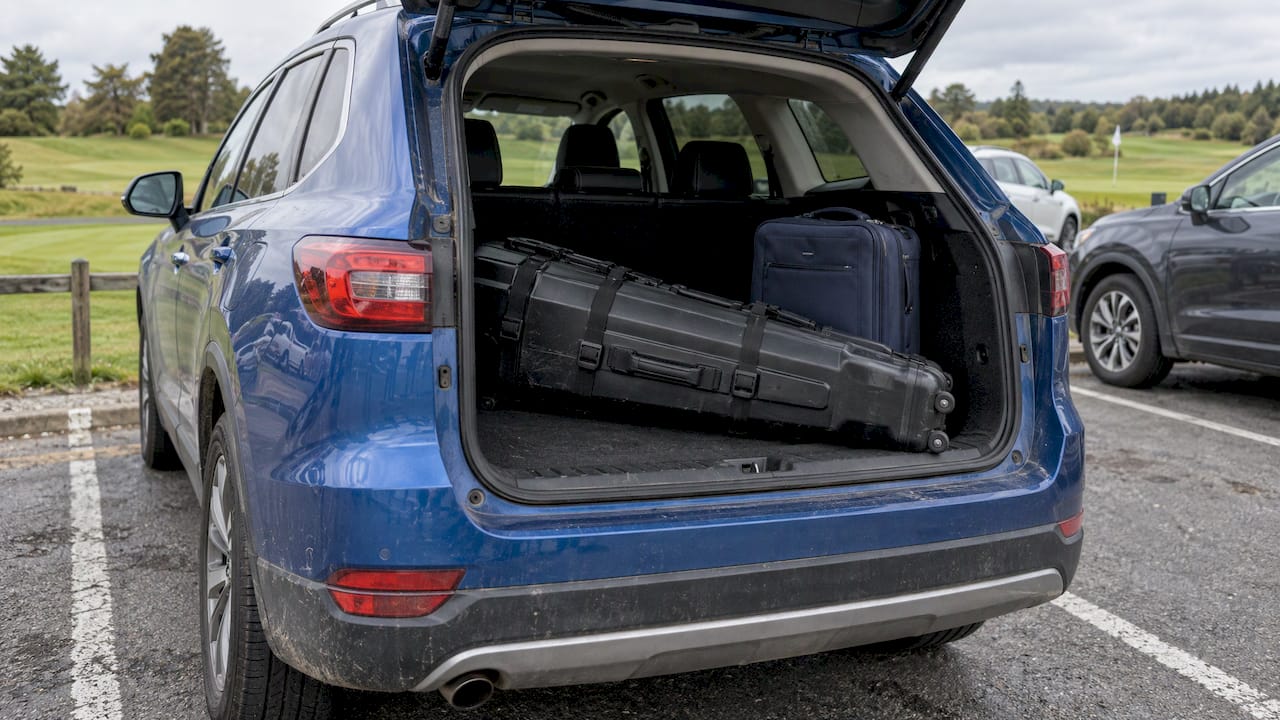
Flying is only one part of a golf trip. The clubs need to get from the airport to the first tee, and the hotel needs to be near the course. A mid-size or larger car or an airport transfer with enough boot room matters more than people expect, because a travel case is long and heavy. Our guide to car rental classes explains which sizes will take a golf case plus luggage, and if you are traveling as a group, the group flight booking playbook covers locking seats for ten or more people.
If you are building a trip around a tournament, event tickets come first and flights second. For example, fans planning for 2029 Ryder Cup tickets at Hazeltine National Golf Club in Chaska, Minnesota, can book travel once they know which days they will attend.
Our perspective
Golf trips go wrong in the details that sit between bookings: a bag fee that was not in the fare, a case that pushes you over 50 lb, a rental car too small for the case.
That is why we built our platform around comparing the real total, not just the headline fare. When you can see flights, hotels, car rentals, transfers and travel insurance side by side, you can decide whether a slightly pricier non-stop flight with a bag allowance beats the cheaper connection with fees.
Our approach is scenario-based: a golf group needs different things than a couple on a romantic getaway, and a business traveler needs something else again. For golfers, we think the best sequence is to choose the airline, confirm its rule for the operating carrier, pick the case, and then book the car and cover that fit the case.
Global
Plan your golf flight with Global Holiday Planner
When you are ready to book, compare flights in one place and look at the total cost with bags, then add an airport transfer or a car rental with room for the case. Our platform also lets you compare hotels and travel insurance for the same trip.

FAQ
How do you bring golf clubs on a plane?
Pack them in a golf travel case and check them at the airline counter. Golf clubs are not permitted in carry-on bags, and TSA allows them in checked baggage. Weigh the packed case beforehand so you do not pay an overweight fee.
Are golf clubs considered a regular checked bag?
On American, Delta and United, one golf bag per passenger is treated as a standard checked bag with the normal fee. Oversize fees are waived or do not apply, but overweight charges can apply above 50 lb. Other airlines and international carriers differ, so check the operating carrier’s page.
Does TSA search golf bags?
TSA says golf bags that alarm may be opened and screened by hand. Remove prohibited items, clean the clubs and give yourself extra time. Leaving the case unlocked makes a hand search quicker and avoids damage to the lock.
Is a hard case or a soft case better for flying?
A hard case protects best against crushing and impact but weighs more, while a soft case is lighter and relies on padding and a stiff arm. A hybrid sits in between. Pick the one that matches how valuable your set is and how close your packed weight is to 50 lb.
Sources
- Golf Clubs | Transportation Security Administration
- TSA reminders for 2024 PGA Masters at Augusta National
- Special items and sports equipment | American Airlines
- Flying With Sports Equipment | Delta Air Lines
- Traveling with sports equipment | United Airlines
- Flying With Golf Clubs: 2026 Fees, Shipping & Rentals
- Das kostet für Golfgepäck bei Fluglinien
- Golf travel bags 2025: Protect clubs, avoid damage
- Hard Case vs Soft Case Golf Travel Bag
- How to Travel With Golf Clubs: 2026 Protection Guide
- Can You Take Golf Clubs on a Plane? 2026 Guide
[…] extra bags and counter stops mean you are likely to visit the airline desk anyway. Our guide to flying with golf clubs covers the […]