

The best time to fly depends on what you want to protect: your budget, your schedule or your nerves. For the lowest fares, fly midweek, book roughly one to three months ahead for domestic trips and two to six months ahead for international ones, and stay flexible by a day or two. For the smoothest trip, take the first flight of the morning. Below, we break down each choice with the data behind it, so you can pick the combination that fits your trip.
TL;DR
- Cheapest day to fly: Monday, Tuesday and Wednesday fares run about 13% below weekend fares, according to flight-search data reported by CNBC.
- Best time of day: the first departure of the morning, ideally 6 to 7 a.m., is the most likely to leave on time. Late evening flights can be cheaper.
- When to book: the lowest domestic fares have typically appeared about 39 days before departure, and about 49 days for international trips.
- Biggest lever: the day you fly matters more than the day you buy. Flexible dates beat any booking-day trick.
Table of Contents
- What “best” really means when you choose a flight
- The cheapest day of the week to fly
- The best time of day to fly
- Seasons, holidays and disruption
- When to book for the best price
- Business class, premium economy and the weekend effect
- Our view: compare the whole trip, not just the fare
- Putting it together: three sample trip plans
- Compare flights and the rest of your trip in one place
- FAQ
- Sources
What “best” really means when you choose a flight
Most people type this question hoping for one answer. In practice there are three different answers, and they sometimes pull in opposite directions.
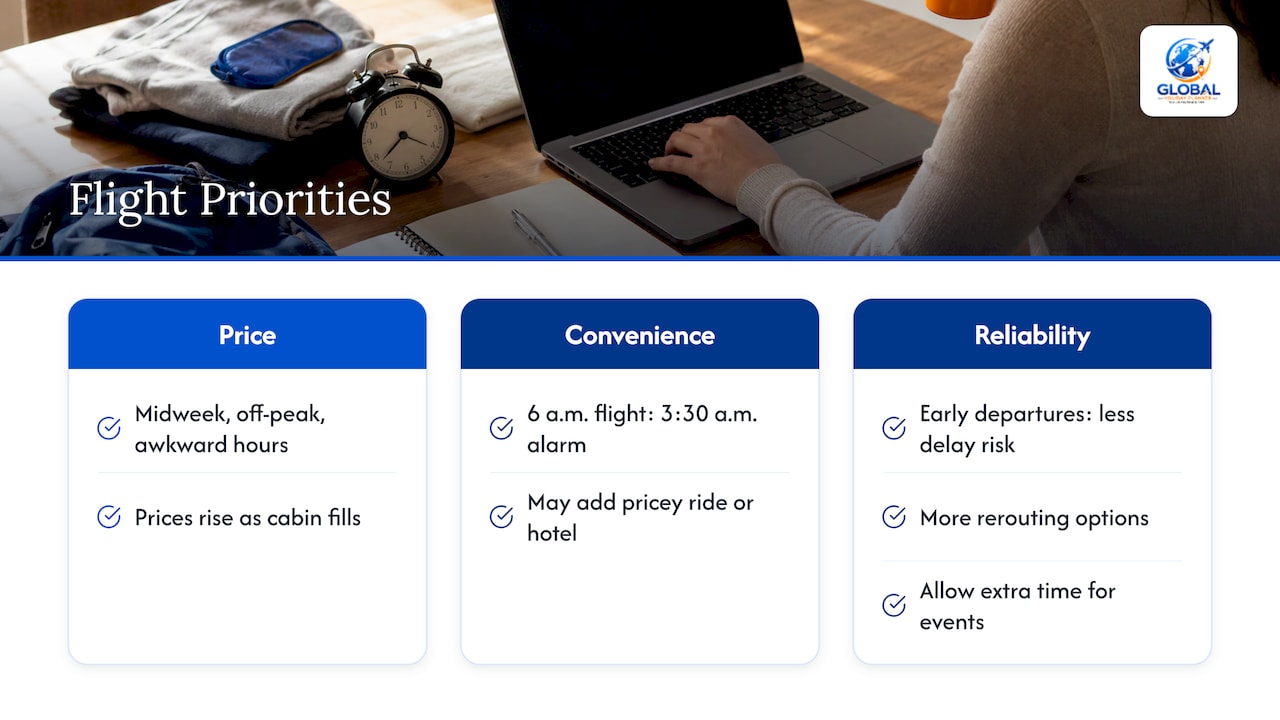
Price. Fares follow supply and demand. Seats on popular days and hours sell out first, and prices generally rise as the cabin fills, as travel experts quoted by Condé Nast Traveler explain. The cheapest flight is the one nobody else wants: midweek, off-peak, and often at an awkward hour.
Convenience. A 6 a.m. departure may be cheap and punctual, but it means a 3:30 a.m. alarm and perhaps a pricey ride to the airport. A fare that saves $40 and costs you a hotel night near the airport is not a saving.
Reliability. The U.S. Department of Transportation notes that an early departure is less likely to be delayed and may offer more rerouting options, and it advises allowing extra time for time-sensitive events. If you are flying to a wedding, a cruise departure or a tournament tee time, reliability should outrank price.
Decide which of the three matters most for this trip. The rest of the article shows how to get the best of that one without paying too much for the others.
The cheapest day of the week to fly
The pattern is consistent across the data: the middle of the week is cheaper than the weekend.
- Flight-search data reported by CNBC shows that Monday, Tuesday and Wednesday flights are generally 13% less expensive than weekend flights.
- An online travel agency’s 2026 air report, summarized by Money, identified Tuesday as the cheapest day to fly domestically, with savings of 14% compared with Sunday.
Why does this happen? Hopper’s lead economist Hayley Berg told USA Today that midweek flights are less popular with both business and leisure travelers, so airlines price them lower to fill seats. Her advice follows: prioritize the day you depart rather than the day you book.
Treat these percentages as averages, not guarantees. A route with one daily flight, or a holiday week, can break the pattern completely. The only way to know for your route is to look at prices across several days side by side, which is what a fare calendar is for. Our guide to using date grids to book flexible-date flights walks through it in about 15 minutes.
A quick way to test your own route
- Search your route with a one-way or round-trip fare calendar.
- Shift your departure by one day in each direction, then by two.
- Do the same for the return, since return-day pricing is often independent.
- Note the cheapest combination, then check whether the saving survives the cost of an extra hotel night or a missed work day.
Moving a trip from a Sunday to a Tuesday is the single most effective change most travelers can make, and it costs nothing.
The best time of day to fly
Time of day is where price and punctuality part ways.
Early morning: the reliability pick
AirAdvisor recommends the first flight of the day, often between 6 and 7 a.m., because the aircraft is usually ready and a cancellation leaves the rest of the day for rebooking. Travel expert Paul Charles makes the same point in Condé Nast Traveler: an early flight is the first out of the day, so it avoids delays compounded by earlier arrivals.
The risk rises as the day goes on. Travel + Leisure reports that thinner morning air traffic means fewer delays, and that flights after 3 p.m. had a 50% higher chance of cancellation in a 2023 industry report. Morning departures also tend to mean smaller airport crowds.
Late evening: the budget pick
Condé Nast Traveler also cites airfare data suggesting that late evening flights can be a cheaper option, while morning departures are preferred for punctuality. If you can absorb a delay, a late flight on a Tuesday or Wednesday is a strong value play. Just check that your ground transport still runs at your arrival hour.
Which should you choose?
| Your priority | Best departure window | Trade-off |
|---|---|---|
| Arrive on time, protect a fixed event | First flight, about 6 to 7 a.m. | Very early start, airport transport at night or dawn |
| Lowest fare | Late evening, midweek | Higher cancellation risk after 3 p.m., late arrival |
| Easier connections | Morning departure with a short, single connection or nonstop | Fewer flight options on small routes |
One more reliability rule from AirAdvisor’s international lawyer Anton Radchenko: avoid extra legs where you can, because every connection raises the chance of cascading problems. A nonstop that costs a little more can be the cheaper option once you count the risk.
Seasons, holidays and disruption
Season shapes both price and punctuality. Holiday weeks and summer peaks bring the highest demand, so the cheapest fares usually sit in the shoulder periods around them. Because exact seasons differ by destination (a beach in the Caribbean and a ski town in Colorado have opposite calendars), check the specific destination’s high and low season before locking dates.
On reliability, a January 2025 TravelPulse report, cited by AirAdvisor, found that September, October, November and February had the fewest flight disruptions, while July, May and January had the most. That gives a useful rule of thumb: if your dates are flexible, early autumn is a calm time to travel, and midsummer is the time to build in buffers.
A few habits help in any season:
- Avoid the peak days around holidays. The day before and the day after a major holiday are usually the busiest. Moving by two days often changes the price noticeably.
- Pair a quiet season with a midweek day. The two effects stack.
- Book hotels and ground transport with the flight in mind. If you are unsure which to lock first, our simple rule for booking flights or hotel first helps.
When to book for the best price
There is no magic hour or weekday for buying a ticket, but there is a sweet spot on the calendar.
Jesse Neugarten, quoted in a roundup of travel experts, puts it at one to three months before a domestic trip and two to six months before an international one. The flight-search data CNBC reported fits that: the lowest prices have typically been found 39 days before departure for U.S. domestic flights and 49 days for international travel.
What about the day you buy? The 2026 air report summarized by Money says Friday is the cheapest day to book an international flight, and Saturday the cheapest for domestic. The old “Tuesday” rule is a myth for most travelers, a point USA Today’s coverage of the topic also supports by stressing departure day over purchase day. We cover the buying-day question in more detail in our piece on why Friday is now the best day to book flights.
Practical timing rules:
- Start watching early. Price alerts let you learn what a normal fare looks like on your route.
- Buy inside the window. For a domestic trip, aim for roughly six weeks out. For an international one, roughly seven weeks out is the typical low point, but earlier is safer in peak season.
- Do not wait for a drop in peak season. Prices generally climb as seats fill, so a holiday trip rarely gets cheaper close to the date.
- Keep the cancellation terms in view. Some fares are cheaper because they are less flexible.
For a longer list of money-saving habits, see our 15 insider tips for finding cheap flights.
Business class, premium economy and the weekend effect
The weekday rule has a twist for premium cabins. The Airlines Reporting Corporation’s air travel outlook found that premium cabin fares are often lower on weekends, because corporate and business travelers are less likely to book them then. That report covers 2016 and 2017 data, so treat it as a pattern to test, not a rule. Compare your own dates both ways.
It is the same logic that applies when you decide how to book a weekend stay and get the best deal: who else wants the same slot changes the price. If you are weighing a cabin upgrade, premium economy versus economy and upgrade bidding are worth a look before you pay a full buy-up fare.
Our view: compare the whole trip, not just the fare
Most advice about the best time to fly stops at the ticket. We think that is where travelers lose money.
A fare that is $60 cheaper on a Sunday evening can cost more once you add an extra hotel night, a pricey late-night transfer, or a car rental day. That is why we built Global Holiday Planner around side-by-side comparison of flights, hotels, car rentals, transfers, rail tickets and travel insurance in one place, so you can see the real total cost of a date choice and not only the airfare.
Our approach is scenario based. A family planning a multigenerational trip needs different dates than a couple on a romantic getaway, a golf group chasing a tournament, or a corporate traveler who cannot miss a 9 a.m. meeting. For the family, a midweek departure and a comfortable mid-morning hour may be worth a slightly higher fare. For the budget traveler, flexible dates and a late midweek flight may be the winning combination. For the business traveler, the first flight out is usually the right call, and our business travel booking tips are written for exactly that.
Our advice is simple: pick your priority first, test a few dates, then book the flight, the stay and the ground transport together so the whole plan holds.
Global
Putting it together: three sample trip plans
These are planning patterns built from the data above, not real fares.
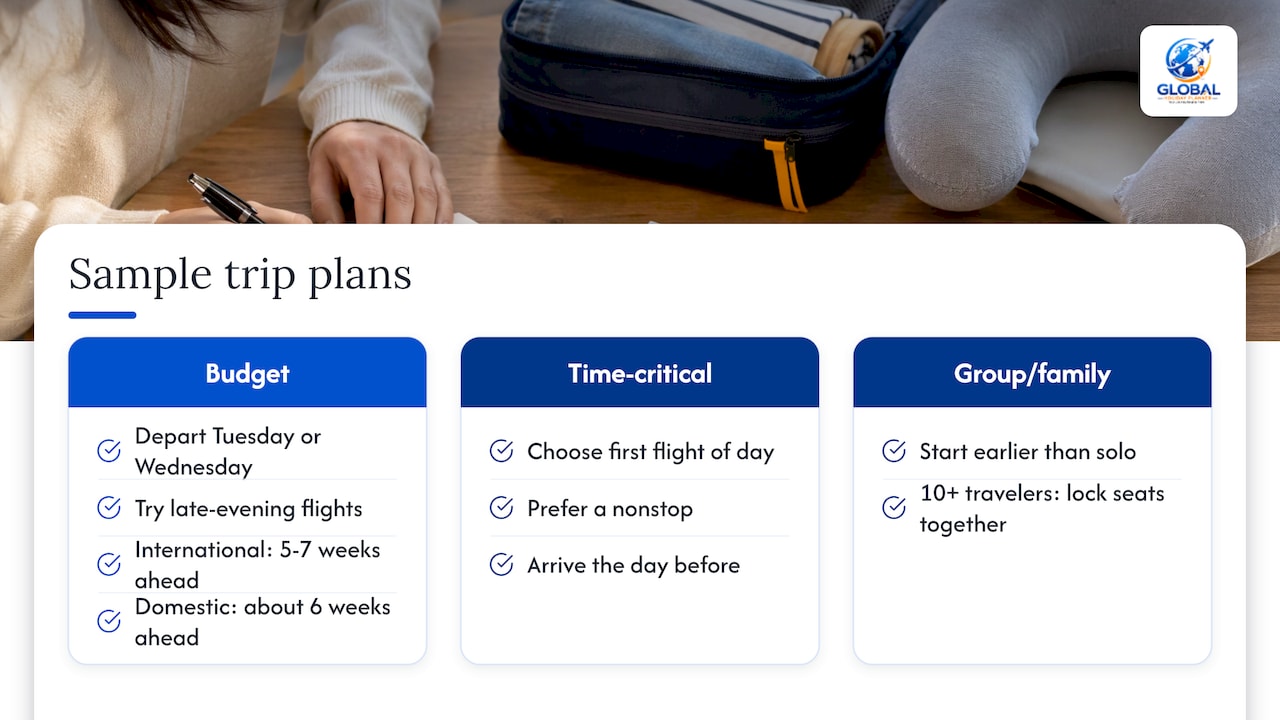
The budget traveler. Flexible by several days. Search a fare calendar, choose a Tuesday or Wednesday departure, look at late-evening flights, and book roughly 5 to 7 weeks ahead for an international trip or about 6 weeks ahead for a domestic one. Set a price alert as soon as you know the route.
The time-critical traveler. Heading to a wedding, a cruise or a tournament. Choose the first flight of the day, prefer a nonstop, and arrive the day before. The DOT advice to allow extra time for time-sensitive events is the guiding principle.
The group or family. Seats for many people are harder to find on the cheapest flights, so start earlier than you would solo. If you are organizing ten or more travelers, our group flight booking playbook explains how to lock seats together.
Whichever plan you pick, remember the arrival end of the journey. Booking a ride before you land removes a common stress point, and matching your trip to the right airport transfer helps with that, especially for a late-evening arrival.
Compare flights and the rest of your trip in one place
When you have a few candidate dates, put them side by side. On Global Holiday Planner you can compare flight options and fares, then add hotels, car rentals and airport transfers so the date you choose works for the whole itinerary. We compare options from our travel providers, so you see the real total cost before you commit.

Start with your route, test two or three departure days, and book when the price sits in the sweet spot for your trip.
FAQ
What is the best time of day to fly?
For reliability, the first flight of the morning, around 6 to 7 a.m., is the best choice. Aircraft are usually ready and you have the rest of the day to rebook if something goes wrong. For a lower fare, late evening departures can be cheaper, but flights after 3 p.m. carry a higher risk of cancellation.
What is the cheapest time to fly?
Generally midweek, in the off-peak season, and outside holiday periods. Monday through Wednesday flights have been about 13% cheaper than weekend flights in flight-search data reported by CNBC, and Tuesday was the cheapest domestic day in a 2026 industry report. Flexibility on dates is what unlocks the lowest fare.
When should I book a flight to get the best price?
Aim for one to three months ahead for domestic trips and two to six months ahead for international ones. Data reported by CNBC found the lowest fares typically about 39 days out for domestic and 49 days out for international flights. In peak holiday periods, book earlier.
Do flight prices go down on Tuesdays?
Not reliably. The day you fly matters more than the day you buy. A 2026 report says Friday is the cheapest day to book international flights and Saturday the cheapest for domestic ones, but the savings are small compared with moving your travel day to midweek.
Which months have the fewest flight delays?
A January 2025 TravelPulse report found September, October, November and February had the fewest disruptions, while July, May and January had the most. If your dates are flexible and reliability matters, early autumn is a good bet.
Sources
- Plane Talk: Coping with Flight Delays, U.S. Department of Transportation
- Flight-search advice for cheap airfare, CNBC
- Cheapest days to book flights, 2026 air report, Money
- Do flight prices go down on Tuesday? USA Today
- When Is the Best Time to Fly? Condé Nast Traveler
- Why You Should Only Ever Book an Early Morning Flight, Travel + Leisure
- How to Book Flights That Won’t Get Delayed, AirAdvisor
- 2018 Air Travel Outlook Report, Airlines Reporting Corporation