

A resort fee is a mandatory per-room, per-night charge hotels add on top of the advertised rate, and it can push your real cost well above what you saw on the search page. Current disclosure rules mean the all-in total should show up before you book. The practical move is simple: check the total price and line-item breakdown before you commit, not after.
TL;DR:
- Most hotels charge a mandatory resort fee that is not included in the advertised rate, often around a few tens of dollars per night, regardless of amenities used.
- These fees typically cover services like Wi-Fi, pool access, parking, or discounts, but vague descriptions mask whether these benefits are actually provided or relevant to your stay.
- The upcoming FTC rule requires hotels and booking platforms to display the total price, including all mandatory fees, upfront and clearly, to prevent deceptive advertising.
- Comparing total prices across different platforms and inspecting itemized fee breakdowns before booking can help avoid surprises at check-in or checkout.
- If a fee was misrepresented, travelers should document the listing and booking details to file complaints with the FTC or their state attorney general.
Table of Contents
- 1. What is a resort fee and how does it work?
- 2. What resort fees usually cover
- 3. Why hotels use resort fees anyway
- 4. What the FTC’s rule on hidden fees requires
- 5. How to spot resort fees before you book
- 6. How to avoid, reduce, or dispute a resort fee
- 7. Why fee transparency matters more than it seems
- How Global Holiday Planner helps you avoid surprise fees
- Where to verify the rules and reporting on resort fees
- Sources
- FAQ
1. What is a resort fee and how does it work?
A resort fee goes by several names: resort fee, destination fee, amenity fee, or facility fee. Whatever the label, it functions the same way. It is billed per room, per night, and it is mandatory, meaning you cannot decline it the way you might skip a spa treatment or valet parking.
Reporting and industry estimates place many of these fees at a typical value often in the range of a few tens of dollars per night, with amounts varying by property and market. That is separate from lodging taxes, which are government-imposed and calculated as a percentage, and separate from truly optional add-ons like room service or pay-per-view movies.
- Resort fees are fixed dollar amounts, not percentages, unlike most hotel taxes.
- They apply per room per night regardless of occupancy or how many amenities you actually use.
- They are charged whether you booked directly, through an app, or through a travel agent.
2. What resort fees usually cover
Hotels typically bundle a handful of services into the fee: Wi-Fi, pool or gym access, parking, a shuttle to a nearby attraction, bottled water in the room, or discounts at an on-site restaurant or partner business. Some properties list a longer menu that includes newspaper delivery or a fitness class, items many guests never use.
- Wi-Fi and in-room internet access, sometimes even when a paid upgrade is also offered.
- Pool, hot tub, or fitness center entry.
- Parking or a local shuttle service.
- Bottled water, coffee, or a welcome amenity.
- Discounts at a spa, restaurant, or activity partner.
A recurring complaint in FTC’s economic analysis of resort fees is that separating these charges from the room rate makes it harder for shoppers to judge true cost before booking. Vague language such as “hotel services fee” without an itemized list is a common red flag, and it often signals a charge unrelated to anything you would actually use during your stay.
3. Why hotels use resort fees anyway
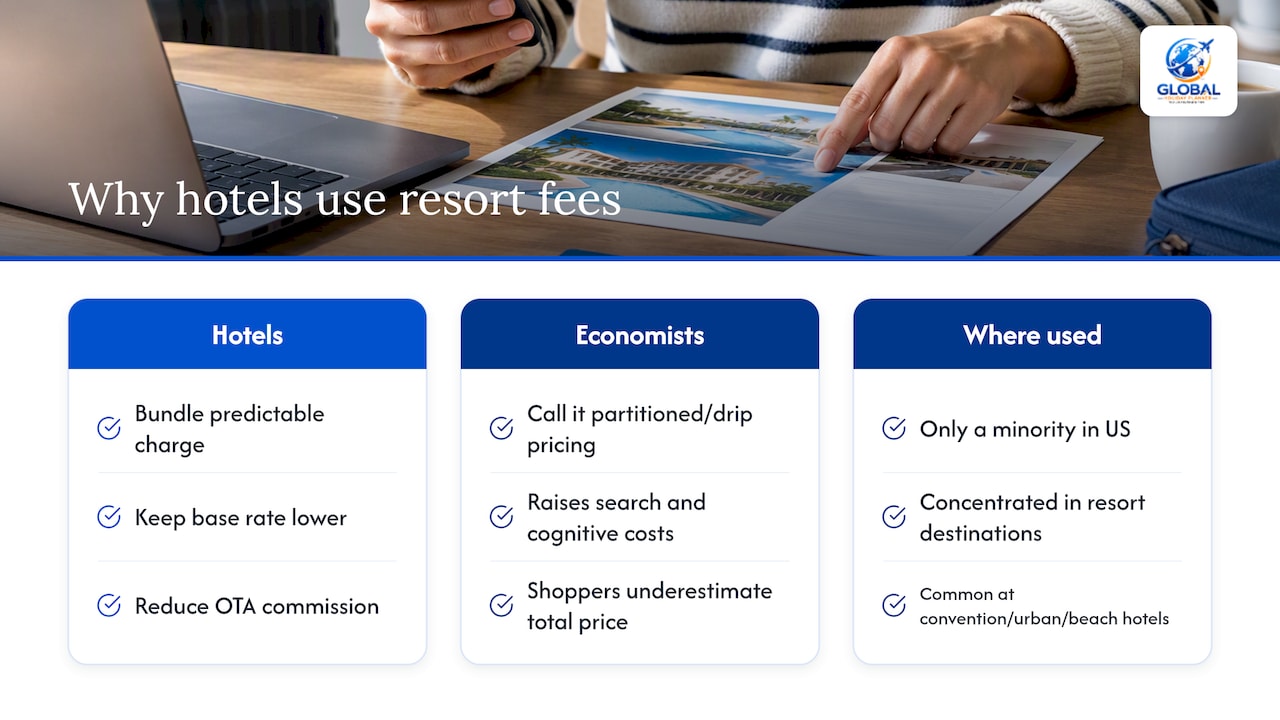
Hotels frame resort fees as a bundled value: one predictable charge instead of a dozen small ones. Keeping the base rate lower also reduces the commission a hotel pays an online travel agency, since many commissions are calculated on the room rate alone rather than the total price paid at checkout.
Economists see it differently. Splitting a mandatory charge from the advertised price is a form of partitioned or drip pricing, and research cited in the FTC’s economic analysis of resort fees found that this practice raises the cognitive and search effort needed to find the real price, often causing shoppers to underestimate what they will actually pay.
Separating mandatory fees from the posted price increases search and cognitive costs and can lead consumers to underestimate the total price of a stay.
Resort fees are not universal. The American Hotel & Lodging Association notes that only a minority of hotels in the United States charge them, and the practice is concentrated in resort destinations, convention hotels, and certain urban and beach markets rather than spread evenly across the industry.
4. What the FTC’s rule on hidden fees requires
Regulators have taken direct aim at this pricing pattern. In December 2024, the Federal Trade Commission announced a rule banning junk fees that requires businesses advertising short-term lodging to clearly and conspicuously display the total price, inclusive of all mandatory fees, whenever a price is shown.
Under the rule, hotels and booking platforms cannot:
- Advertise a room rate that omits a mandatory resort fee from the headline price.
- Use misleading descriptions of what a fee covers or whether it is refundable.
- Bury the true total in fine print or a separate page from where the price first appears.
Pro Tip: If a listing shows a price that seems too good to be true, scroll to checkout before assuming it is accurate. The total price line, not the headline rate, is what the rule actually protects.
If you believe a hotel or booking site misrepresented a fee, you can document the listing and file a complaint. The FTC’s guidance on unfair or deceptive fees explains that businesses cannot misstate the nature, amount, or refundability of a fee, and it outlines how travelers can escalate concerns to the agency or a state attorney general.
5. How to spot resort fees before you book
Catching a resort fee early saves you from a surprise at checkout or, worse, at the front desk.
- Search for the hotel’s total price, not just the nightly rate shown in search results.
- Compare the advertised rate against the amount shown right before you enter payment details.
- Open the reservation confirmation and look for a separate line labeled fee, amenity charge, or facility charge.
- Treat vague or unfamiliar fee names as a signal to call the hotel directly and ask what the charge covers.
- Take a screenshot of any page showing a price that later changes, in case you need it for a dispute.
Pro Tip: Taxes are usually a percentage of the room rate; a flat dollar amount added separately is almost always a resort fee, not a tax.
6. How to avoid, reduce, or dispute a resort fee
Your best leverage comes before you book. Compare total prices across platforms rather than headline rates, since two listings for the same room can show identical nightly rates but very different totals once fees are added. Booking sites that display an all-in total upfront make this comparison far faster than calling multiple properties.
- Filter or sort by total price when a platform allows it, rather than by base rate alone.
- Check the hotel’s own fee policy page, since some properties disclose fees more clearly on their direct site than on third-party listings.
- Review loyalty program terms before booking with points, since award stays can still carry resort fees unless the program explicitly waives them for that redemption type or elite tier.
At check-in, ask the front desk for an itemized breakdown of the fee and what it includes. A waiver is sometimes granted as a courtesy, particularly for elite loyalty members or when a guest can show they will not use the bundled amenities, but resort fees are contractual charges and hotels are not obligated to remove them.
- If you believe the fee was misrepresented, note exactly what was displayed when you booked and when the discrepancy appeared.
- Ask to speak with a manager rather than front-line staff if the first request for a waiver or explanation is denied.
- Save screenshots of the original listing, the confirmation email, and the final folio, since this documentation carries real weight with a hotel, a credit card issuer, or a regulator.
- If the hotel does not resolve the issue, file a complaint with the FTC or your state attorney general, attaching your saved evidence.
Pro Tip: A one-night resort fee affects your total cost more than a multi-night stay does on a percentage basis, so for short trips, weigh the room-plus-fee total even more carefully than usual.
7. Why fee transparency matters more than it seems
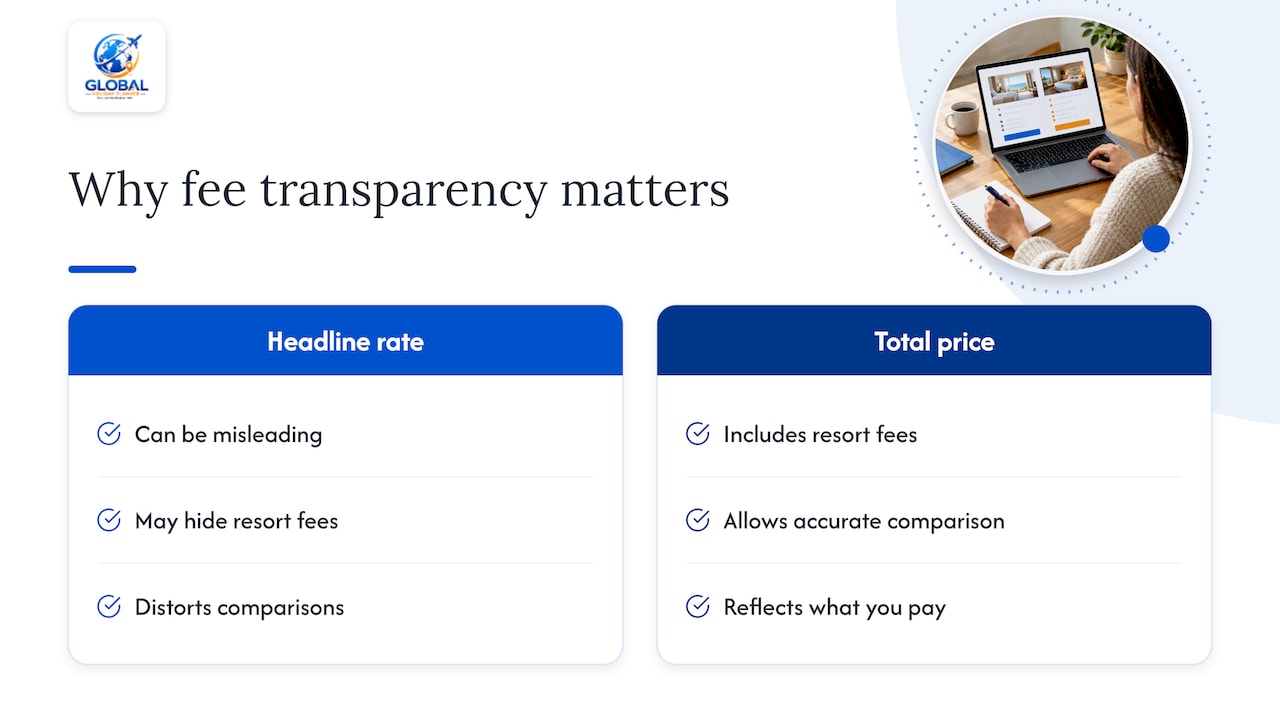
Resort fees are not the biggest line item on most travel budgets, but they are the one most likely to distort your comparison between two otherwise similar hotels. A property with a lower nightly rate and a high resort fee can end up costing more than a competitor with a higher rate and no fee at all, and that math is easy to miss when you are comparing headline numbers across a dozen browser tabs.
Clear, upfront total pricing is not a courtesy: it is the only way to actually compare lodging options on equal footing. Some hotel search platforms are built around showing the total price alongside the room rate, so the comparison you make on the search page reflects what you will actually pay, not a number that changes three screens later.
— Global
How Global Holiday Planner helps you avoid surprise fees
Comparing hotel listings across multiple sites to hunt for hidden fees takes time you would rather spend planning the trip itself. Global Holiday Planner’s hotel reservations search puts the total cost front and center, so you can weigh two properties against each other without doing separate checkout runs to find out which one actually costs less.

- Search hotels and compare all-in totals side by side before choosing a property.
- Check the fee breakdown on the listing page instead of waiting for checkout.
- Complete bookings through your chosen platform once you have confirmed the total matches what you expect.
If your trip needs more than a room, the same platform handles flight bookings, car rentals, and airport transfers so you can plan the full itinerary with total costs visible at every step. For tactics on finding the lowest total airfare too, see our guide on how to find cheap flights.
Where to verify the rules and reporting on resort fees
- The FTC’s Junk Fees Rule announcement lays out the legal requirement to disclose total prices upfront.
- The FTC’s economic analysis of resort fees explains the consumer harm behind partitioned pricing.
- The American Hotel & Lodging Association’s resort fee page presents the industry’s rationale and frequency estimates.
- For a firsthand look at how hotel pricing tactics play out when booking a short stay, see this practical guide on booking a weekend stay and getting the best deal.
Sources
- Economic analysis of hotel resort fees (FTC report)
- Resort Fees | American Hotel & Lodging Association (AHLA)
FAQ
Can you refuse to pay a resort fee at check-in?
Generally no, since a resort fee is a mandatory, contractual part of the room rate rather than an optional charge you can decline. You can ask for a waiver or an itemized explanation, and hotels occasionally grant one as a courtesy, but there is no legal right to refuse a properly disclosed fee.
Are resort fees a rip-off for travelers?
Whether a resort fee feels fair depends on whether you actually use the bundled amenities and whether the fee was clearly disclosed before you booked. The core consumer complaint, backed by FTC economic research, is that hiding the fee from the headline price makes comparison shopping harder and can mislead travelers about the real cost.
How can I avoid paying a resort fee?
Compare all-in totals across platforms before booking, check the hotel’s own fee policy, and consider properties that do not charge one at all, since the American Hotel & Lodging Association notes that only a minority of hotels do. You can also ask about waivers tied to loyalty status, though these are granted case by case rather than guaranteed.
Why am I being charged a resort fee I did not expect?
If the listing you booked did not clearly show the total price including the fee, that may violate the FTC’s rule requiring upfront total-price disclosure. Screenshot the original listing and your confirmation, then contact the hotel first and escalate to the FTC or your state attorney general if the charge was misrepresented.