

An open jaw flight lets you fly into one city and depart from another on the same round-trip ticket, skipping the backtrack to your entry point. It usually beats booking two one-ways and often costs less than you’d expect. Example: fly into Rome, spend two weeks working your way north, fly home from Paris. No wasted train ride back to Rome just to catch your flight.
TL;DR:
- Open jaw flights often cost less than two one-way tickets and can save time by avoiding backtracking on domestic travel.
- Booking requires using the multi-city search feature, comparing with round-trip prices, and testing nearby airports for best fares.
- Airlines support open jaw booking within alliances and full-service carriers, but budget airlines frequently do not, often pricing legs separately.
- Fare rules may restrict open jaw itineraries based on segment length, regional constraints, or “ARNK” limitations, especially on discount fares.
- Using ground transport and planning early can maximize savings, but travelers should verify baggage, visa, and insurance coverage for the non-flight segments.
Table of Contents
- What Are Open Jaw Flights, and What Are the Three Types?
- How to Book an Open Jaw Flight Step by Step
- When Does an Open Jaw Actually Save Time or Money?
- Routing Restrictions and Fare Rules to Check Before You Book
- Common Open Jaw Booking Mistakes and Search Tips
- Planning the Ground Leg Between Your Two Cities
- How Global Holiday Planner Simplifies Open Jaw Searches
- What Happens to Your Frequent Flyer Miles on an Open Jaw?
- Does Travel Insurance Cover Open Jaw Itineraries?
- Can You Combine Open Jaw Flights With Round-Trip or One-Way Tickets?
- How Do You Track and Manage Changes to an Open Jaw Ticket?
- Which Airlines and Alliances Support Open Jaw Bookings?
- Real Open Jaw Itinerary Examples Worth Copying
- An Open Jaw Planner’s Honest Checklist
- Search and Book Your Open Jaw Route With Global Holiday Planner
- Sources
- FAQ
What Are Open Jaw Flights, and What Are the Three Types?
Think of it as a round-trip ticket with a gap in the middle where you fill in the travel yourself. Instead of a closed loop (fly to City A, fly home from City A), you fly to City A and eventually fly home from City B, C, or D. The “jaw” refers to that visual gap on a route map where the two ends don’t meet.
Airlines and booking sites recognize three basic patterns:
- Destination open jaw: You fly into one city and out of a different city, but you depart from and return to the same home airport. Example: New York to Lisbon, then Barcelona back to New York.
- Origin open jaw: You depart from one city and return to a different one on your end. Example: fly Chicago to Tokyo, then fly Osaka back to Los Angeles.
- Double open jaw: Both ends are mismatched. Example: fly Boston to Rome, then fly Athens back to Miami. Neither city pair matches on either end.
This differs from a true multi-city itinerary, which can involve three or more separate flight segments strung together with layovers you actually plan around. An open jaw is specifically the round-trip version with one gap where you handle the ground transport yourself. It also differs from booking two entirely separate one-way tickets, which usually costs more and strips away rebooking protections if one flight gets disrupted.
How to Book an Open Jaw Flight Step by Step
Booking one is not complicated once you know where to look. Most search engines bury the option under a tab labeled “multi-city,” and skipping that tab is the single biggest reason people give up and book two round-trips instead.
- Open the multi-city search tool on your airline’s site or an aggregator. This is different from the standard round-trip box.
- Enter your first leg as normal: origin city, destination city, departure date.
- Enter your second leg with your new departure city (the one you’ll fly out of, not the one you flew into) and your final destination (usually home), plus your return date.
- Compare against a round-trip baseline first. Since flexible-date calendars often don’t display multi-city pricing directly, search a standard round-trip calendar to establish a price range, then run the multi-city version with your preferred dates to see the real gap.
- Test nearby airports on both ends. Swapping Milan for Venice, or Nice for Barcelona, can shift the fare by a wide margin depending on which airline dominates each route.
- Check award availability separately if you’re using points. Open-jaw award searches sometimes surface seats that a straight round-trip search misses, since return availability can vary airport by airport even within the same alliance.
Pro Tip: Search each leg on its own first using one-way fares to see what each city pair costs individually. If the sum is close to the multi-city total, book the multi-city version anyway. You keep one itinerary, one confirmation number, and airline protection if a flight gets delayed or canceled.
When Does an Open Jaw Actually Save Time or Money?
The clearest win is avoiding backtrack travel. If you’re touring Portugal and Spain, flying home from Madrid instead of returning to Lisbon can save a full day of travel and a domestic flight or long train ride you didn’t need.
Money savings show up in a few recognizable patterns:
- Regional fare gaps. Some cities have far cheaper outbound fares than inbound ones, or vice versa, because of competition on that specific route.
- Smaller-airport return deals. Flying home from a secondary airport sometimes undercuts the fare from the major hub you flew into.
- Bundled routing efficiencies. Open jaw fares are frequently cheaper than two separate one-way international tickets, and depending on the route, can sometimes beat a standard round-trip too.
A two-week Northern Europe trip flying into Amsterdam and out of Copenhagen, connected by a five-hour train through Germany, is a textbook case. So is a US trip flying into Denver for the mountains and out of Seattle after driving the coast. The trade-off is real: you’re now paying for that train ticket or rental car, and you need to double-check baggage allowances and visa rules apply the same way on both ends of a mismatched itinerary.
Routing Restrictions and Fare Rules to Check Before You Book
Fare rules can quietly block or reprice an open jaw itinerary you thought was locked in, so check them before you pay, not after.
- Open-segment length limits. Some airlines require the unflown gap between your two cities to be shorter than the segments you’re actually flying. Fly a long-haul segment, and your open jaw between two nearby cities usually clears fine.
- IATA-region constraints. Certain fares require both ends of your open jaw to sit within the same IATA-defined region, or even the same country, which matters more on discount fare classes than full-service ones.
- ARNK segments. Some systems log the unflown portion as ARNK (“Arrival Not Known”), a placeholder marking that you’re covering that leg on your own. It rarely affects pricing, but a travel agent or airline rep may reference it when reviewing your booking.
- Reading the fare rule text. Before purchase, most booking engines show a “fare rules” or “fare conditions” link. It’s dense, but scan for routing restrictions and minimum-stay requirements specifically.
None of this is common on major international fares between big cities. It shows up more on discount carriers, some award tickets, and complex three-or-four-country routings.
Common Open Jaw Booking Mistakes and Search Tips
The biggest trap is confusing a multi-city ticket for something with an unflown gap in it. If you actually fly every leg with no ground travel of your own, you’ve booked multi-city, not an open jaw. That distinction affects how you search for it and how airlines price it.
- Booking two separate one-way tickets instead of one multi-city itinerary. Separate tickets mean separate baggage policies, no protection if a delay causes a missed connection, and often a higher combined price.
- Ignoring airport codes. Two airports serving the same metro area can confuse a booking engine into treating your trip as an open jaw when you meant a simple round-trip, or vice versa. Double-check the three-letter code on every leg.
- Skipping flexible-date searches. Shifting your departure by even a day or two, or trying a nearby airport, regularly turns up a meaningfully cheaper combination.
- Not calling in for complex routings. If you’re stitching together four or more cities with award points involved, an airline agent or travel advisor can sometimes build combinations the online search tool won’t show.
Pro Tip: Run your search on an aggregator first for a fare baseline, then verify the exact itinerary directly on the airline’s own site before entering payment. Aggregators occasionally miss fare rule nuances that the airline’s own engine catches immediately.
Planning the Ground Leg Between Your Two Cities
The gap in your open jaw is on you to fill, so budget real time and money for it. A train between Amsterdam and Copenhagen runs several hours and needs booking days or weeks ahead in peak season. A domestic flight between Denver and Seattle might be faster but adds another security line and baggage question.
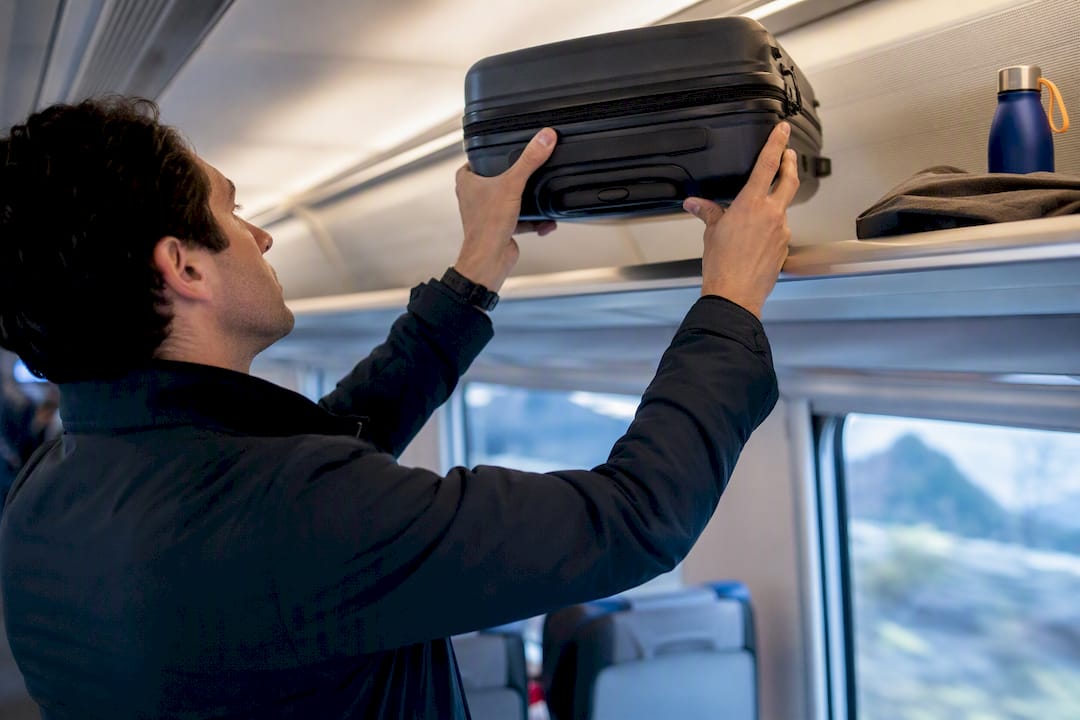
Decide early whether you’re renting a car, taking rail, or booking a short domestic flight, since prices climb fast closer to departure on popular routes. For helpful tips on planning and booking your stay, see How to Book a Weekend Stay and Get the Best Deal – Wild Foodz by Hotel Entree Brugge. If you’re checking bags, confirm whether your ground transport has the same baggage limits as your flights. Book high-demand rail tickets and rental cars in advance rather than assuming you’ll sort it out on arrival.
How Global Holiday Planner Simplifies Open Jaw Searches
Comparing a dozen airport-pair combinations by hand eats an afternoon. Global Holiday Planner’s flight search lets you test multiple departure and arrival airports side by side, so you can spot the cheaper return city without rerunning a search five separate times. Since the ground leg matters as much as the flights, the same platform lets you line up car rental or airport transfers for the city you’re flying out of, without juggling three separate bookings.
What Happens to Your Frequent Flyer Miles on an Open Jaw?
Open jaw tickets earn miles the same way any qualifying flight does: based on the distance flown, the fare class booked, or a flat per-segment amount, depending on the program. The unflown gap between your two cities earns nothing, since no flight happens there, but that’s expected and doesn’t reduce what you earn on either flown leg.
Status credits work the same way. Airlines calculate elite qualifying miles or segments off the flights you actually take, so a destination open jaw with two long-haul legs typically earns close to what a standard round-trip covering similar distances would. Where it gets interesting is redemption. Since award seat availability can differ by airport even within the same alliance, an open jaw search sometimes finds award seats a straight round-trip search misses entirely. Flying into Tokyo Narita but out of Osaka Kansai on points, for instance, might unlock saver-level seats that don’t exist on the matching round-trip date.
One thing to verify with your specific program: some airlines calculate mileage runs or elite qualifying dollars based on total ticket price rather than distance. If that’s the case, an open jaw priced lower than two one-ways could shrink your status credits slightly compared to paying full fare on separate tickets. Check your program’s earning chart before assuming parity.
Does Travel Insurance Cover Open Jaw Itineraries?
Most travel insurance policies treat an open jaw ticket the same as any round-trip itinerary, since the policy covers your trip dates and destinations, not the specific airport-pairing pattern of your ticket. What matters to the insurer is the full list of destinations, your travel dates, and the total trip cost you’re insuring, not whether your ticket has a technical gap in it.
Where it gets more particular: if you add a domestic flight, train, or ferry to cover the ground leg between your two open jaw cities, check whether your policy’s trip interruption and delay coverage extends to that segment too. Some policies bundle every leg of your itinerary under one trip definition; others only cover the flights you booked through the same provider. If your rail ticket or domestic flight is booked separately, ask directly whether a missed connection on that leg qualifies for reimbursement.
Multi-destination trips, which is effectively what every open jaw itinerary is, also tend to benefit from higher trip-cost coverage limits, since you’re often prepaying more nonrefundable pieces (train tickets, hotel deposits, a rental car) across more cities than a simple round-trip. Before buying a policy, list every nonrefundable cost across both ends of your open jaw and confirm the coverage limit actually covers that total. Comparing travel insurance plans side by side before you commit to a multi-city routing is worth the ten minutes it takes.
Can You Combine Open Jaw Flights With Round-Trip or One-Way Tickets?
Yes, and it’s more common than most travelers realize. A frequent pattern: book an open jaw for your main international loop, then add a separate round-trip for a side trip that doesn’t fit the main routing. Someone flying into Rome and out of Athens might book a standalone round-trip from Athens to a Greek island partway through, entirely separate from the international open jaw ticket.
One-way tickets get combined in too, usually to extend a trip past where the open jaw ticket ends. If your open jaw brings you home from Athens but you decide midway through the trip to add a week in London first, a one-way from Athens to London, followed by your existing return leg from a different city, patches the gap without forcing you to rebook the whole itinerary.
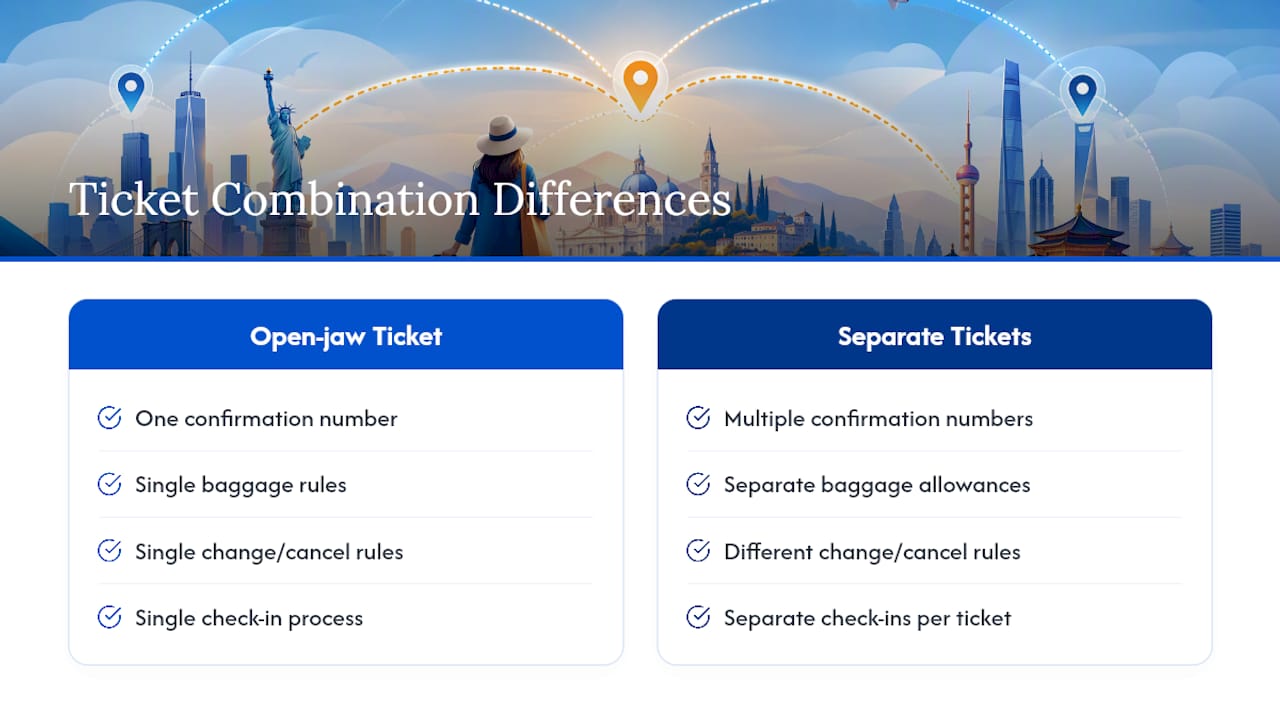
The catch with mixing ticket types is that each ticket has its own change and cancellation rules, its own baggage allowance, and its own check-in process. If your open jaw is on one airline and your add-on one-way is on a budget carrier, you’re managing two separate confirmation numbers, two separate baggage policies, and no guaranteed protection if the first flight runs late and causes you to miss the second. Build in a buffer of at least a few hours, ideally overnight, between tickets booked with different airlines or different booking systems.
How Do You Track and Manage Changes to an Open Jaw Ticket?
An open jaw ticket is still one ticket, which means one confirmation number covering both flown segments. Changes, cancellations, and refunds get processed against that single record, the same way they would on a standard round-trip, rather than as two independent transactions.
That single-ticket structure is actually the main practical advantage over booking two one-ways. If your first flight gets delayed and you miss a connection, the airline has a contractual obligation to rebook you toward your final destination on that same ticket. Two separate one-way tickets carry no such obligation between them; a delay on ticket one is entirely your problem to solve on ticket two.
When you need to change a date or a city on an open jaw ticket, expect the airline to reprice the entire itinerary rather than just the leg you’re touching, since the fare was calculated as one combined price across both segments. This is different from two one-ways, where changing one ticket never touches the price of the other. Keep your confirmation email and check the Department of Transportation’s air consumer guidance if a schedule change or cancellation leaves you wondering what the airline owes you. Most airlines let you manage open jaw tickets through the standard “manage my booking” tool online, same as any other itinerary.
Which Airlines and Alliances Support Open Jaw Bookings?
Nearly every major full-service airline supports open jaw ticketing on its own multi-city search tool, including the big US, European, and Asian carriers and their regional partners. This isn’t a niche feature; it’s built into standard fare construction across the industry.
Where it gets more useful is within airline alliances. Star Alliance, SkyTeam, and Oneworld all support open jaw itineraries that combine flights from different member airlines under specific fare rules, which matters most for award travel. Booking an open jaw through an alliance partner network means you can fly one airline into your first city and a completely different partner airline out of your second, provided the routing and fare class both qualify.
Budget and ultra-low-cost carriers are the exception worth watching. Many either don’t offer a multi-city search option at all, or they price each leg entirely independently, which erases the cost advantage an open jaw usually delivers on full-service fares. If your itinerary leans on a discount carrier for one leg, price it as two separate one-ways and compare that total against booking a full-service open jaw before assuming the budget option wins.
Real Open Jaw Itinerary Examples Worth Copying
A few patterns come up again and again because they consistently work well:
The European rail loop: Fly into Amsterdam, spend a week working south through Belgium and into France, fly home from Paris. The four-hour train ride between cities costs far less than backtracking to Amsterdam for a flight, and airfare into Amsterdam plus out of Paris is often close to what a Paris round-trip alone would cost.
The US coast-to-coast road trip: Fly into Denver, rent a car, drive west through the mountains and desert, drop the car and fly home from Las Vegas or Los Angeles. This avoids a multi-day drive back to your entry point entirely.

The Southeast Asia island hop: Fly into Bangkok, take a short regional flight or ferry down through Malaysia, fly home from Singapore. Regional carriers on that route are frequent and cheap, making the ground-hop segment nearly painless.
The double open jaw business trip: Fly Chicago to London for a conference, then London to Berlin for a second meeting, then fly home from Berlin to New York for a personal visit. Neither end matches, but each leg serves a distinct purpose that a closed round-trip couldn’t cover in one ticket.
An Open Jaw Planner’s Honest Checklist
I reach for an open jaw when the trip covers ground between two cities that’s genuinely worth seeing, when a rental car or train makes more sense than a return flight, or when award seats only show up out of a different airport. Two flags kill the plan fast: fare rules requiring same-country endpoints, or a ground leg that eats a full travel day I don’t have. Before paying, I check the fare rules once, confirm the airport codes twice, and book the ground transport before the flight sale ends.
— Global
Search and Book Your Open Jaw Route With Global Holiday Planner
Comparing return-city options one search at a time wastes hours you don’t have. Global Holiday Planner’s flight search puts multiple departure and arrival airport combinations side by side in one pass, so you can spot the cheaper open jaw pairing without rerunning the same search five times over.

Once you’ve picked your route, the same platform handles the pieces that usually get booked separately: a rental car for the ground leg between cities, an airport transfer on either end, or a hotel near your final departure airport. If your open jaw crosses multiple countries or adds nonrefundable train tickets, it’s worth pairing the flight with a travel insurance plan built for multi-destination trips before you lock in dates. Start your search now and see what your open jaw route actually costs compared to a standard round-trip.
Sources
- Open-jaw ticket
- Open-jaw flights: What they are and how to book them
- Open Jaw Flights: The Booking Trick You Should Know | Condé Nast Traveler
FAQ
What Does an Open Jaw Flight Mean?
An open jaw flight is a round-trip ticket where you fly into one city and out of a different one, leaving a gap you travel through on your own instead of a matching flight home.
Can You Give an Example of an Open Jaw Flight?
Flying from Boston into Rome, then departing for home from Paris after traveling overland between the two, is a classic destination open jaw.
Do Open Jaw Flights Cost More Than a Standard Round-Trip?
Not usually. They’re frequently cheaper than booking two separate one-way tickets, and depending on the route, can sometimes match or beat a standard round-trip fare.
Which Airlines Allow Open Jaw Bookings?
Nearly all major full-service airlines and their alliance partners (Star Alliance, SkyTeam, Oneworld) support open jaw itineraries through their multi-city search tools; many budget carriers do not.
Is an Open Jaw the Same as a Multi-City Ticket?
No. A multi-city ticket has you flying every segment, while an open jaw specifically has one gap between two cities that you cover yourself, by train, car, or a separately booked flight.