
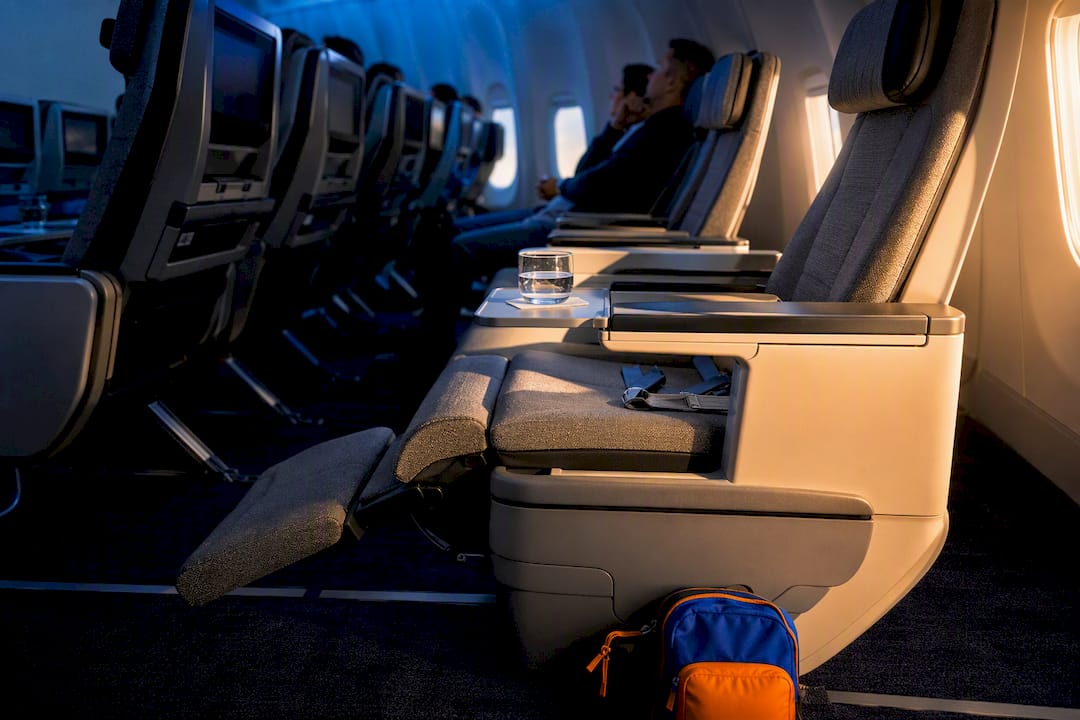
If you’re flying long-haul overnight and you actually need to sleep, premium economy is usually worth the extra cost. For short daytime flights under five hours, it rarely is. The three factors that decide it every time: flight length, how much more the seat costs, and whether your body needs the extra room.
TL;DR:
- Premium economy offers about 38 inches of seat pitch and wider, more reclined seats, significantly improving comfort on long-haul flights over economy.
- The fare premium generally remains worthwhile if the cost is under 50% more than economy for flights over seven hours, especially if sleep is needed.
- Upgrading with points, bidding, or last-minute offers can reduce the financial burden, making premium economy more accessible without full-price purchase.
- Lounges are rarely included in premium economy, but priority boarding and baggage allowances are standard benefits that add value.
- Airline reputation varies by aircraft type, so verifying the specific plane and seat layout before booking is essential for actual comfort gains.
Table of Contents
- Premium Economy vs Economy: The Feature Breakdown
- What the Numbers Actually Look Like in the Air
- The Real Cost of Premium Economy and When It Pays Off
- How to Decide at the Booking Page
- How to Get Premium Economy Without Paying Full Price
- Which Airlines Lead Premium Economy in 2026
- Boarding Priority and Lounge Access, Sorted Out
- Cancellation and Change Policies Aren’t the Same Either
- How Frequent Flyer Miles Add Up in Each Cabin
- Global Holiday Planner’s Take on the Premium Economy Question
- Compare Fares and Book the Right Cabin With Global Holiday Planner
- Sources
- FAQ
Premium Economy vs Economy: The Feature Breakdown
The gap between these two cabins is bigger than most travelers expect until they’ve sat in both. Premium economy isn’t a slightly nicer economy seat with a fancier name. It’s a distinct product with measurable differences in space, service, and where you sit on the plane.
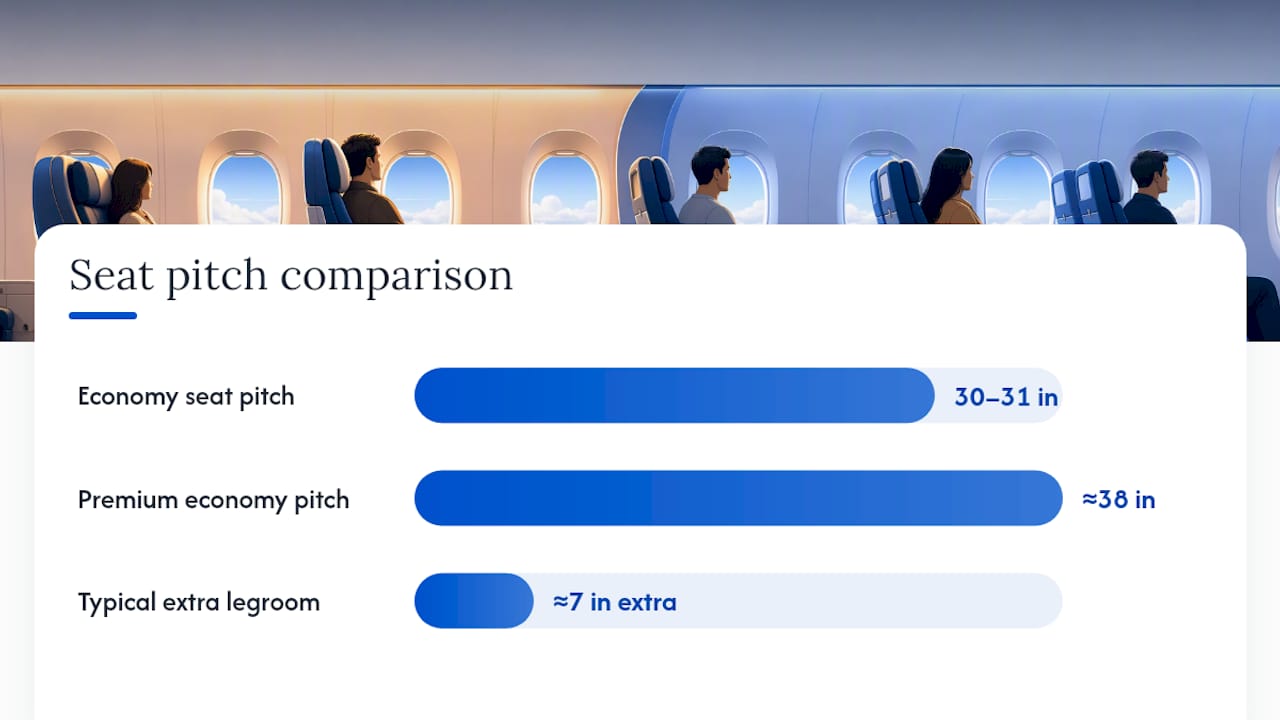
Seat pitch, width, and recline. Economy seat pitch typically runs 30 to 31 inches. Premium economy jumps to around 38 inches, according to Forbes Advisor. That’s roughly seven extra inches of legroom, which sounds modest until you’re the one unfolding a laptop tray at hour nine. Width typically increases by an inch or two per seat, and recline goes deeper, often with a leg rest or footrest that economy seats don’t have.
In-flight amenities. Most premium economy cabins include a larger personal screen, noise-canceling headphones, a dedicated amenity kit with basics like socks and an eye mask, and sometimes a proper multi-course meal service with metal cutlery instead of a tray thrown together in a hurry. Power outlets are more consistently available row by row, which matters more than people admit when a phone is dead at boarding.
Ground perks, with a catch. Priority check-in and boarding are close to universal in premium economy. Baggage allowance is usually bumped up, often an extra bag or higher weight limit depending on the carrier. What premium economy almost never includes is lounge access. That’s reserved for business and first class on nearly every airline, and Forbes’ breakdown of the cabin confirms it’s one of the most common misconceptions travelers have about the tier.
Cabin placement. Premium economy sits in its own mini-cabin, usually right behind business class and ahead of the main economy block. That placement alone changes the flying experience. Fewer rows, fewer people, less noise from the back of the plane, and a quieter path to the galley.
- Seat pitch: about 38 inches versus 30 to 31 inches in economy
- Recline: deeper angle, often with a leg or footrest
- Amenity kit and better headphones: common in premium economy, rare in economy
- Baggage allowance: typically one extra checked bag or a higher weight cap
- Lounge access: almost never included, despite what some travelers assume
Premium economy seat pitch runs about 38 inches on average, compared to 30 to 31 inches in economy — a difference of six to eight inches that shows up most in your knees, not your seatback screen.
What the Numbers Actually Look Like in the Air
Specs on a spreadsheet don’t tell you what a seat feels like at hour six. Real aircraft examples do.
Take a widebody long-haul jet running a 2-4-2 or 2-3-2 premium economy layout against a 3-4-3 economy cabin behind it. Same aircraft, same flight, radically different feel. The wider premium economy configuration means fewer people per row and easier aisle access, so even when the width numbers look close on paper, the lived experience isn’t. A 3-4-3 economy row packs nine people wall to wall. Drop that to 2-4-2 or 2-3-2 up front and suddenly nobody’s climbing over three strangers to reach the bathroom at 2 a.m.
Here’s what that gap tends to look like across the major long-haul carriers:
- Seat pitch: 38 to 40 inches in premium economy versus 30 to 32 inches in economy
- Seat width: roughly 19 to 21 inches in premium economy versus 17 to 18 inches in economy
- Recline: 5 to 8 inches of additional travel in premium economy seatbacks
- Footrest or leg rest: standard in most premium economy products, rare in economy
The World Airline Awards 2025 rankings for best premium economy class consistently reward carriers that nail this layout difference, not just the raw pitch number. A seat with great pitch in a cramped 3-4-3-style premium cabin still feels tight. A seat with slightly less pitch in a genuine 2-3-2 layout can feel roomier.
The perceived comfort gain in premium economy comes mainly from seat space and a calmer cabin. Meals and amenity kits matter, but they’re secondary to how much room you actually have and how many people are crammed in around you, according to Forbes Advisor’s analysis of the cabin.
That’s worth sitting with for a second. Airlines love to market the amenity kit and the multi-course meal. Neither one matters if you’re still shoulder-to-shoulder with a stranger for nine hours. Check the seat map and the layout diagram before you check the meal menu.
The Real Cost of Premium Economy and When It Pays Off
Money is where this decision actually gets made, so let’s talk numbers.
Premium economy fares typically run significantly more than economy, with most routes clustering at a moderate to high premium above the economy fare, according to SimpleFlying’s breakdown of pricing across major carriers. That’s a wide range, and where you land in it depends heavily on route, season, and which airline is selling the seat.
A simple rule of thumb: if the premium economy fare costs moderately above economy on a long-haul flight, it’s usually worth paying for. If the premium economy costs roughly double or more of the economy fare, the math stops working for most travelers unless comfort is a non-negotiable priority, like a medical need or a genuinely sleep-deprived work trip on the other side.
- Premium under 50% above economy on a long flight: usually a good deal
- Premium between 50% and 100%: worth it if the flight is 7+ hours or overnight
- Premium above 100% (2x or more): only worth it for specific comfort or health needs
- Short-haul flights under 5 hours: rarely worth any premium, regardless of percentage
If you’re flying on points instead of cash, the math flips in your favor. Award analysis of more than 110,000 redemptions found that premium economy requires about 58% more points than economy on average, while business class requires roughly 114% more, per Aeronautics Magazine’s review of redemption data. That makes premium economy the most efficient upgrade in the miles world. You’re paying a smaller point premium for a proportionally bigger comfort jump than you’d get stretching those same miles toward business class.
Route length and aircraft type shift all of this. A widebody long-haul jet with a dedicated premium economy cabin delivers far more value per dollar than a narrowbody plane where “premium economy” is really just economy with a blocked middle seat. Airline execution varies a lot here, which is exactly why comparing total trip cost, not just the base fare, on a tool like Global Holiday Planner’s flight search matters before you commit.
How to Decide at the Booking Page
You don’t need a spreadsheet to make this call. You need four quick checks and about ninety seconds.
- Check flight duration first. Under 5 hours, skip premium economy almost every time. Over 7 hours, especially overnight, it starts earning its price.
- Ask if you can actually sleep sitting up. If you can’t sleep in economy no matter what, the extra recline and footrest in premium economy may be the difference between arriving functional and arriving wrecked.
- Calculate the exact price delta. Look at the dollar gap, then convert it to a percentage above the economy fare. Anything at or under 50% on a long flight is worth serious consideration.
- Factor in height, age, and any physical needs. Taller travelers, older travelers, and anyone recovering from an injury or surgery benefit disproportionately from the extra pitch and width.
Once you’re past those four questions, check the actual booking page specifics, not just the marketing copy:
- Confirm the seat pitch in inches, not just the label “premium economy”
- Check whether the cabin is a true-dedicated section or just blocked-off economy rows
- Verify baggage allowance is actually included in the fare, not sold separately
- Check upgrade eligibility rules if you’re using points or a companion certificate
Red flags that should kill the upgrade: a “premium economy” fare that’s really just economy plus a blocked middle seat, a price delta above 100% on anything under 6 hours, or a seat map showing 3-4-3 density in a cabin marketed as premium.
Pro Tip: Pull up the seat map before you compare prices. A 38-inch pitch number means nothing if the layout still packs you between two strangers. Layout tells you more than the spec sheet does.
How to Get Premium Economy Without Paying Full Price
Full-fare premium economy isn’t the only way in. A few tactics consistently work for travelers watching their budget.
Points upgrades are the strongest lever. Remember that 58% more points figure from Aeronautics Magazine’s redemption analysis? That’s the number to build a strategy around. If you’ve got miles sitting in an account, moving from economy to premium economy on points is a far better use of that balance than stretching toward business class, where the point cost jumps to roughly double.
Bid for the upgrade instead of buying it outright. Many airlines run bidding systems that let you name your price for a premium economy seat after booking economy. You often get the seat for a fraction of the published fare difference, especially on flights that aren’t selling out.
Watch for airport and check-in upgrade offers. Gate agents and check-in kiosks sometimes offer last-minute premium economy upgrades at a steep discount when the cabin isn’t full. This is a gamble, not a plan, but it’s worth a glance when you check in.
- Book a flexible economy fare that explicitly allows a paid upgrade later
- Set fare alerts through an aggregator to catch premium economy price drops
- Bid low first on upgrade auction systems. You can usually raise your bid if it’s rejected
Pro Tip: If your flight is more than three weeks out and doesn’t look close to full, hold off on paying full price. Bid or wait. If it’s inside two weeks and the cabin’s filling up, buy the upgrade now before the price climbs.
Which Airlines Lead Premium Economy in 2026
Product quality varies wildly by carrier, and by aircraft within the same carrier. A handful of airlines consistently rank at the top.
Virgin Atlantic, Japan Airlines, Singapore Airlines, Emirates, and EVA Air stand out as the leading premium economy carriers for 2026, according to BusinessClassJournal’s transatlantic rankings. Each brings something different to the table. Japan Airlines is known for dining quality that rivals some business class services. Singapore Airlines leans on a true dedicated cabin with strong recline mechanics. Virgin Atlantic’s Upper Class Premium product gets consistent praise for seat width and ground perks.
What actually separates a great premium economy product from a mediocre one comes down to six pillars, per Aerotime’s industry analysis:
- Seat pitch and width, the raw space numbers
- Recline mechanics, how far and how comfortably the seat reclines
- Dining quality, from tray meals to multi-course service
- Amenity kit contents, from basic to genuinely useful
- In-flight entertainment and Wi-Fi connectivity
- Ground perks like priority boarding and baggage allowance
Here’s the catch most travelers miss: airline-wide reputation doesn’t guarantee the aircraft you’re actually booked on delivers that standard. A carrier can run an excellent premium economy product on its newest widebody and a tired, cramped version on an older jet covering the same route. Always check the specific aircraft type listed on your booking, not just the airline name.
Boarding Priority and Lounge Access, Sorted Out
Boarding order in premium economy sits in a comfortable middle ground. Most carriers board premium economy passengers after first and business class but ahead of the general economy cabin, often in its own dedicated group. That means less scrambling for overhead bin space and a calmer walk down the aisle.
Lounge access is the part that trips people up most. Despite the price jump, premium economy tickets almost never come with lounge access on their own. That perk stays locked to business and first class fares, or to elite frequent flyer status, regardless of which economy tier you’re flying that day. If lounge access matters to your trip, you’ll need status or a day pass, not just a premium economy boarding pass.
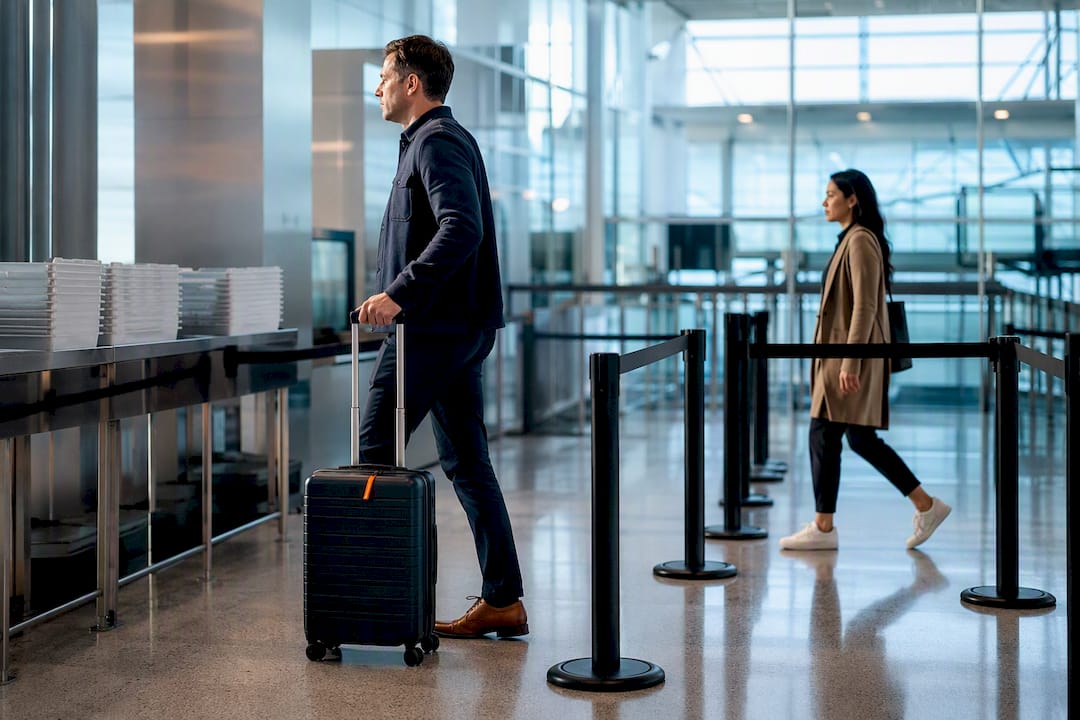
Where premium economy does earn its keep is at the check-in counter and the security line. Priority check-in queues and, on many carriers, expedited security lanes come standard with the fare. For a business traveler squeezing in a call before boarding, or a family trying to avoid a chaotic gate scramble, that time savings adds up fast, similar to how dedicated business traveler amenities at hotels save time on the ground.
The practical takeaway: budget for a lounge day pass or rely on a credit card lounge benefit if that access matters to you. Don’t assume the premium economy fare covers it, because on the overwhelming majority of carriers, it doesn’t.
Cancellation and Change Policies Aren’t the Same Either
Flexibility is one of the most overlooked differences between these two cabins, and it can matter more than the seat itself if your plans are uncertain.
Economy fares, especially basic economy tiers, often come with strict change fees and limited or no refund options. Premium economy fares typically sit one tier up in flexibility. Many carriers allow date changes with a smaller fee, and some routes offer premium economy fares that are fully changeable for a modest cost difference compared to the change-fee walls economy passengers hit.
Cancellation policies follow a similar pattern. A refundable premium economy fare is more commonly available than a refundable basic economy fare, though it usually costs more upfront to get that flexibility locked in. If your travel dates aren’t fixed, that flexibility can offset part of the price premium you’re paying for the seat itself.
The practical move: read the fare rules before you book, not after. A cheaper premium economy fare with no change allowance might leave you worse off than a slightly pricier economy fare that lets you shift dates for free. Compare the actual fare conditions side by side, not just the sticker price, especially if there’s any chance your itinerary moves.
How Frequent Flyer Miles Add Up in Each Cabin
Mileage earning is where premium economy quietly outperforms economy in a way a lot of travelers never check.
Most airline frequent flyer programs award mileage earning based on a percentage of the fare paid or a multiplier tied to fare class, not a flat per-mile rate. Because premium economy fares cost more than economy, you generally earn a noticeably larger number of miles or points on the same route, even before factoring in any elite-status bonus.
Elite qualifying credit, the kind that pushes you toward status tiers, often follows the same pattern. A premium economy fare frequently earns more qualifying miles or segments than the equivalent economy fare, which matters if you’re chasing status by year’s end.
None of this means premium economy is a mileage-earning strategy on its own. The fare cost still needs to make sense for your trip. But if you’re already leaning toward the upgrade for comfort reasons, the extra mileage earned is a real, if secondary, benefit worth factoring into the total value equation alongside the 58% points-efficiency finding covered earlier. Check your specific program’s earning chart before you book, since the multiplier varies by carrier and by fare bucket within premium economy itself.
Global Holiday Planner’s Take on the Premium Economy Question
Most advice on this topic treats premium economy like a single, consistent product. It isn’t. We see it as six variables stacked together: seat pitch, layout density, price delta, points cost, route length, and aircraft type. Skip any one of those checks and you can overpay for a seat that’s barely better than economy, or underpay attention to a seat that would have genuinely improved a rough overnight flight.
Our recommendation stays simple and ties straight back to the checklist earlier: if the flight runs 7 hours or more, the fare premium sits at or under 50%, and you know sleep in economy isn’t happening for you, book premium economy. Below that threshold on any of the three, stick with economy and put the savings toward your hotel or activities instead, an option worth weighing in luxury versus budget travel trade-offs generally.
— Global
Compare Fares and Book the Right Cabin With Global Holiday Planner
Deciding between premium economy and economy gets a lot easier when you can actually see the numbers side by side instead of guessing from a fare label. Global Holiday Planner’s flight search tool pulls together fares, seat specs, and baggage inclusions in one place, so you’re comparing total trip cost, not just the ticket price on its own.
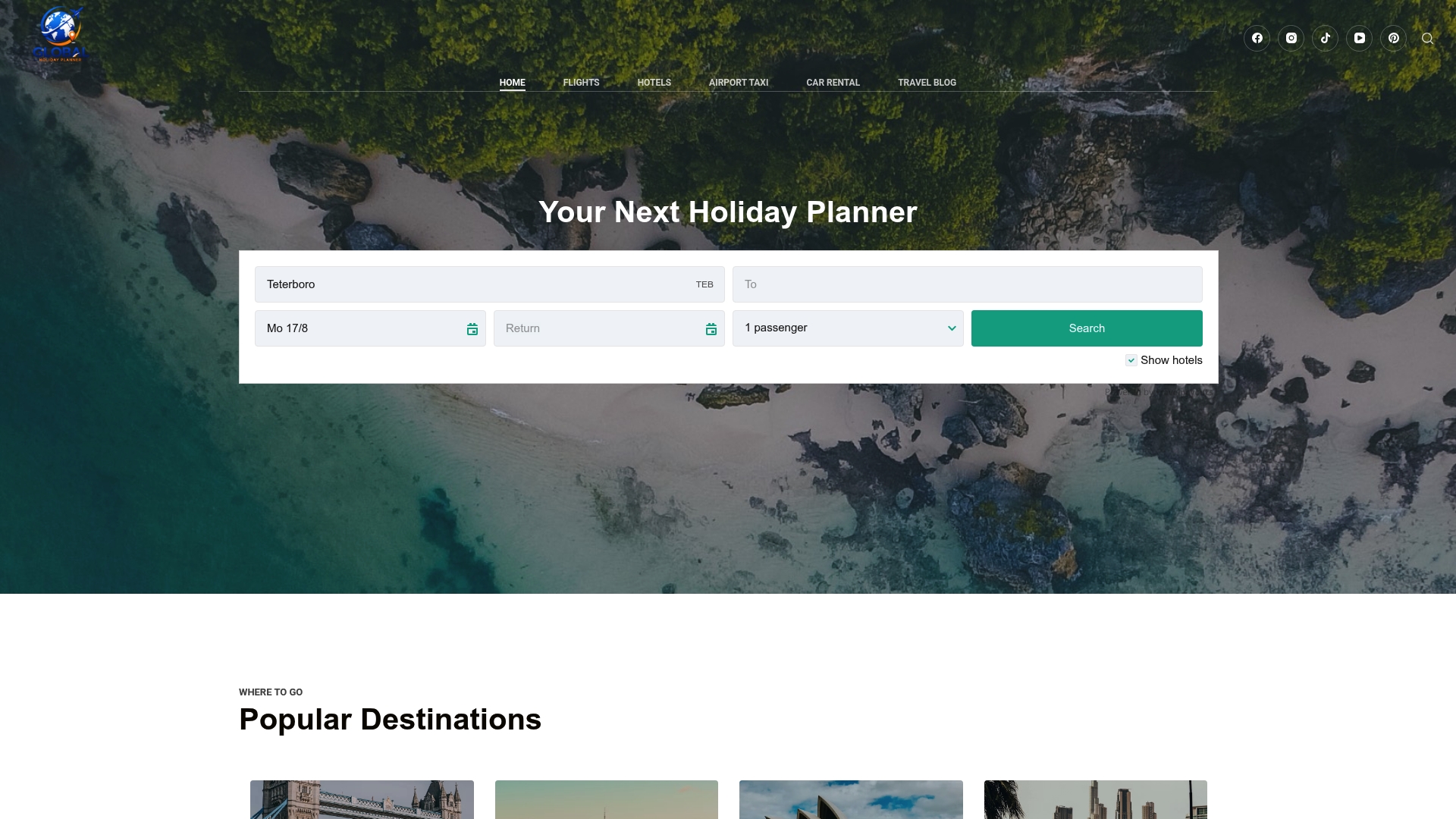
That total-cost view matters more than most travelers realize. A cheap economy fare that charges separately for a checked bag and seat selection can end up costing close to what premium economy would have, minus the extra legroom. Run your route through the flights page, check the seat pitch and baggage terms listed for each fare, and book whichever cabin actually wins once every line item is counted. If economy comes out ahead, our cheap flight tips can help you shave the fare down even further.
Sources
- Best premium economy transatlantic 2026 — BusinessClassJournal
- What is premium economy? — Forbes Advisor
- Is premium economy worth it? — SimpleFlying
- Best premium economy airlines and award analysis — Aeronautics Magazine
FAQ
Is It Worth Paying Extra for Premium Economy?
It’s usually worth it on flights over 7 hours, especially overnight, when the premium economy fare costs 50% or less above economy. On short flights under 5 hours, the extra cost rarely delivers enough comfort benefit to justify the price.
Is Premium Economy Really Better Than Economy?
Yes, in measurable ways: seat pitch averages around 38 inches versus 30 to 31 inches in economy, with wider seats, deeper recline, and a quieter dedicated cabin section, according to Forbes Advisor. Ground perks improve too, though lounge access is almost never included.
Can You Sleep in Premium Economy?
Sleeping is easier in premium economy thanks to the deeper recline, footrest, and extra pitch, but it’s still not a flat bed like business class. Travelers who struggle to sleep upright in economy often find premium economy makes a real difference on overnight long-haul flights.
Which Airline Is the Best for Premium Economy?
Virgin Atlantic, Japan Airlines, Singapore Airlines, Emirates, and EVA Air rank among the top carriers for premium economy, according to BusinessClassJournal’s 2026 rankings. Product quality still varies by aircraft type, so check the specific plane on your route through a tool like Global Holiday Planner before booking.