

Price drop protection for flights is real, but it only works in narrow, conditional cases. It’s not a universal safety net. Your best free tool is the U.S. Department of Transportation’s 24-hour cancellation rule, followed by a small set of portal and card-based programs that automatically monitor eligible bookings and pay out under strict caps. Everything else, including most airline “price promise” pages, requires you to catch an identical fare drop yourself and file a claim before a tight deadline closes.
TL;DR:
- Price drop protection generally only applies if the fare drop is within a strict window, matching the exact itinerary, fare class, and deadline conditions.
- U.S. DOT’s 24-hour cancellation rule is the most reliable protection, allowing free cancellation and full refund if canceled within a day of booking.
- Most airline and portal guarantees caps payouts around $50 to $500, with strict thresholds and often only offering travel credits rather than cash refunds.
- To successfully claim a refund, travelers must capture proof immediately, adhere to specific claim deadlines, and usually submit through designated portals or forms.
- Comparing fares before booking and choosing flexible, changeable tickets significantly increases the chance to benefit from price drops or refunds.
Table of Contents
- What Is Price Drop Protection for Flights?
- Who Offers Flight Price Guarantees, and How Do They Differ?
- How Does Flight Price Tracking Actually Pay Out?
- How Do You Claim a Refund When a Flight Price Drops?
- Why Do Most Price Drop Claims Fail?
- Booking Tactics That Actually Protect Your Fare
- Price Drop Protection vs. Travel Insurance and Refund Policies
- How Should Price Drop Protection Factor Into Your Travel Budget?
- What Consumer Protections Actually Apply to Flight Prices?
- What I’d Actually Do Before You Book Again
- Compare Fares Before You Need a Refund
- Where to Verify the Rules Yourself
- Sources
- FAQ
What Is Price Drop Protection for Flights?
Price drop protection covers a handful of different mechanisms, and they don’t behave the same way. Some trigger automatically. Others require you to notice the drop, gather proof, and submit a claim before a short window closes.
- Airline price promises: A formal policy where the airline compares your fare to a current identical fare and refunds or credits the difference, usually only if you file within hours of noticing it.
- Booking-portal guarantees: Programs like the one on Google Flights that flag select itineraries as price-guaranteed and pay you automatically after the flight departs.
- Credit-card travel portal monitoring: Card issuers that scan portal bookings for a short window after purchase and refund small differences without you lifting a finger.
- Alert-only tools: Free trackers that just notify you a fare dropped. They don’t process refunds at all. You still have to act.
The outcome also varies. You might get cash back to your original payment method, a travel credit tied to the booking site, or a voucher good only with that airline. Before you count on any of it, check which category your booking actually falls into. Most travelers assume they have automatic protection when they really just have an alert.
Who Offers Flight Price Guarantees, and How Do They Differ?
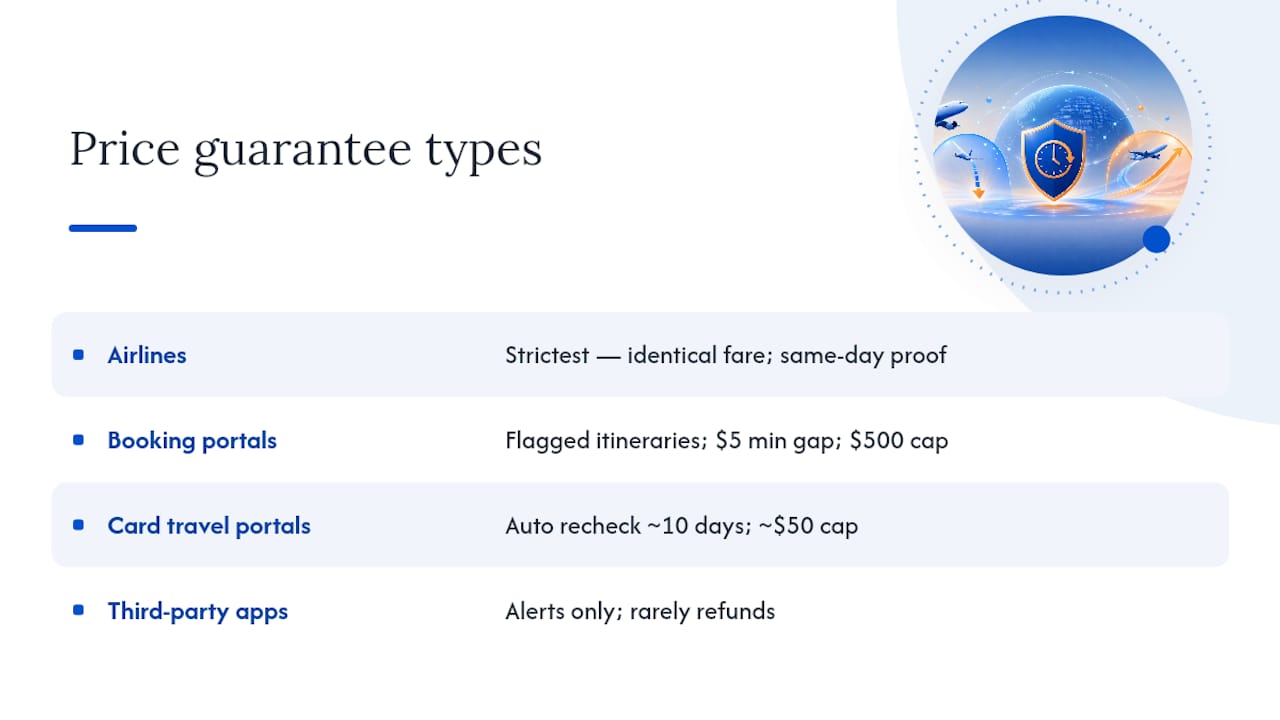
Airlines, booking portals, credit-card travel programs, and third-party apps all use the phrase “price protection,” but the fine print separates them fast.
Airlines run the strictest version. Their price-promise pages typically demand an identical flight, same fare class, same fare rules, and proof captured the same day you booked. Qantas’s price promise is a working example: a defined minimum difference and a per-ticket cap, with a narrow claim window.
Booking portals sometimes flag eligible itineraries with a badge and monitor them for you. Google Flights’ price guarantee applies only to select flagged itineraries, requires at least a $5 gap, and caps payouts at $500 per account, deposited after your first flight departs.
Credit-card travel portals run a lighter version of the same idea. Capital One Travel’s price-drop feature automatically rechecks eligible portal bookings for roughly 10 days, with refunds historically capped around $50 per passenger.
Third-party apps, by contrast, mostly just alert you to a lower fare elsewhere. They rarely process a refund themselves, which is the gap most travelers don’t see coming until they try to file.
How Does Flight Price Tracking Actually Pay Out?
The mechanics decide whether a price drop turns into cash, a credit, or nothing. Four factors matter more than any marketing page admits.
- The DOT 24-hour rule applies to nearly every U.S.-origin ticket bought 7 or more days before departure. You can cancel free within 24 hours of booking, no matter why you’re canceling, and it’s the most reliable refund tool available.
- Monitoring windows vary sharply. Capital One Travel checks for about 10 days. Google Flights checks until your first flight departs. Airline claims often close the same day you booked.
- Exact-itinerary and fare-class rules block most claims. If the lower fare is a different flight number, a different departure time, or a different fare bucket, most programs reject it even when the route and dates match.
- Minimum thresholds and caps limit the payout. Expect $5 to $10 minimum differences on many programs, per-ticket caps around $50 on card portals, and annual account caps as high as $500 on some portal guarantees.
That combination explains why a $60 fare drop on a $400 ticket might net you nothing. The gap has to clear the threshold, match the exact itinerary, and land inside the monitoring window all at once.
How Do You Claim a Refund When a Flight Price Drops?
Speed and paperwork decide most claims. Here’s the sequence that actually works.
- Capture proof immediately: a timestamped screenshot of the lower fare, your booking reference, the fare class, travel dates, and passenger count.
- Read the specific program’s terms before you submit anything. Minimum differences and deadlines vary by airline and portal, and a claim filed outside the window gets rejected on sight.
- Submit through the correct claim portal. Automatic programs like Capital One’s need nothing from you beyond letting the monitoring run its course. Manual airline claims need a form, a screenshot, and often a same-day deadline.
- Track the response. Automatic payouts typically show up as a statement credit or refund within days. Manual claims can take longer, so follow up in writing if you hear nothing after a week.
- Fall back if the claim fails. Inside 24 hours of booking, cancel outright under the DOT rule. Outside that window, look at whether your fare is refundable enough to cancel and rebook, or whether a travel credit is the realistic ceiling.
Pro Tip: Change the booking through the airline’s official change flow instead of canceling and rebooking. Canceling can forfeit your seat before you lock in the lower fare, while a change request often lets the system reprice the same seat and issue credit for the difference.
Why Do Most Price Drop Claims Fail?
Basic economy is the biggest trap. Most airlines block basic-economy tickets from any kind of change or reprice, which makes them ineligible for nearly every price-promise program by design. Fare structures have been loosening slightly, with airfares down 5.4% year over year as of late 2025, but that pricing softness doesn’t change the restrictions baked into the cheapest fare buckets.
A few other patterns trip up travelers constantly:
- Credit, not cash, is the default outcome. Most programs return a travel credit, and credits carry expiration dates and airline-specific redemption rules that cash refunds never do.
- Caps can make the whole exercise pointless. A $50 cap on a $1,200 international fare barely covers the hassle of filing.
- “Similar” isn’t “identical.” A lower fare on a different flight time, a connecting itinerary instead of nonstop, or a slightly different fare class will usually get a claim denied even when the price difference is real.
- Short windows punish hesitation. Many airline claims require same-day submission, so waiting a day to gather proof can cost you the refund entirely.
Booking Tactics That Actually Protect Your Fare
Most of what determines whether you’ll ever collect on a price drop gets decided the moment you book, not after.
- Skip basic economy whenever price tracking matters to you. A refundable or standard economy fare keeps your change and reprice options open.
- Pair a free fare tracker with a real action plan. An alert that tells you the price dropped is useless if you have no eligible path to claim it. Know in advance whether you’re inside the DOT 24-hour window or holding a genuinely changeable fare.
- Compare fares across multiple sources before booking rather than after. Tools like the flight comparison search on Global Holiday Planner let you check price movement across airlines and dates before you commit, which does more for your wallet than any post-booking claim ever will.
Pro Tip: Book the changeable fare tier even when it costs a little more upfront if your travel dates are more than a month out. The extra flexibility usually costs less than the fare swings you’d otherwise miss out on.
Price Drop Protection vs. Travel Insurance and Refund Policies
These three things get lumped together constantly, and they solve completely different problems. Price drop protection only addresses one narrow scenario: the fare for your exact itinerary fell after you booked. It has nothing to do with why your trip might get disrupted.
Travel insurance covers a different category of risk entirely: trip cancellation for illness or emergency, medical costs abroad, lost luggage, or a missed connection. It never reimburses you for a fare that simply got cheaper. If you cancel a trip because of a covered emergency, insurance can return your fare cost regardless of the current price. If you just want your money back because the airline dropped the price $40, insurance is the wrong tool. Readers who want that layer of protection separate from pricing concerns can compare travel insurance plans built around trip disruption rather than fare movement.
Standard refund policies are a third, separate track. For a detailed explanation of what “refundable” really means and why many travel credits are non-cash, see Why ‘Refundable’ Rarely Means Cash for Travel Gift Cards. A refundable fare lets you cancel for any reason and get your money back, minus any fees the fare class specifies. That has nothing to do with whether the price moved. You could hold a fully refundable ticket and never trigger a price-drop payout, or hold a non-refundable basic-economy fare and be locked out of both a refund and a price match.
The practical takeaway: treat these as three separate lines of defense, not one bundled protection. Price drop coverage protects your wallet from bad timing. Insurance protects your trip from disruption. Refund policy protects your flexibility to change plans. Overlap between them is rare.
How Should Price Drop Protection Factor Into Your Travel Budget?
Treat price drop protection as a small bonus, not a line item you can budget around. The caps involved (often $50 per passenger on card portals, up to $500 annually on portal guarantees) mean the maximum realistic recovery on most single bookings is modest compared to total trip cost. A family flying internationally for $3,200 in airfare shouldn’t plan around recovering more than a fraction of that even under generous protection terms.
Where it does matter is in how you allocate flexibility within your budget. Booking a changeable fare instead of the cheapest basic-economy ticket usually costs somewhat more upfront. That premium buys you the ability to actually use a price-promise claim or rebook at a lower fare if one appears, rather than just watching prices move around a ticket you can’t touch. Travelers planning tight budgets often skip that premium to save the difference, then lose more later when a fare drops and they have no path to claim it.
That buffer pays for the option value of changeable pricing, which matters more on volatile routes and longer booking windows. For short-haul or last-minute trips where fares tend to move less, the cheapest fare bucket is usually the better budget call since there’s less time for a meaningful drop to occur anyway.
What Consumer Protections Actually Apply to Flight Prices?
The only federally guaranteed protection in the United States is the DOT’s 24-hour rule, and it’s worth understanding exactly what it does and doesn’t cover. Airlines must let you cancel for a full refund within 24 hours of booking, provided the ticket was purchased at least 7 days before departure. That rule applies regardless of fare class, including basic economy, which makes it the single most powerful tool available to anyone who books and then spots a lower fare within the same day.
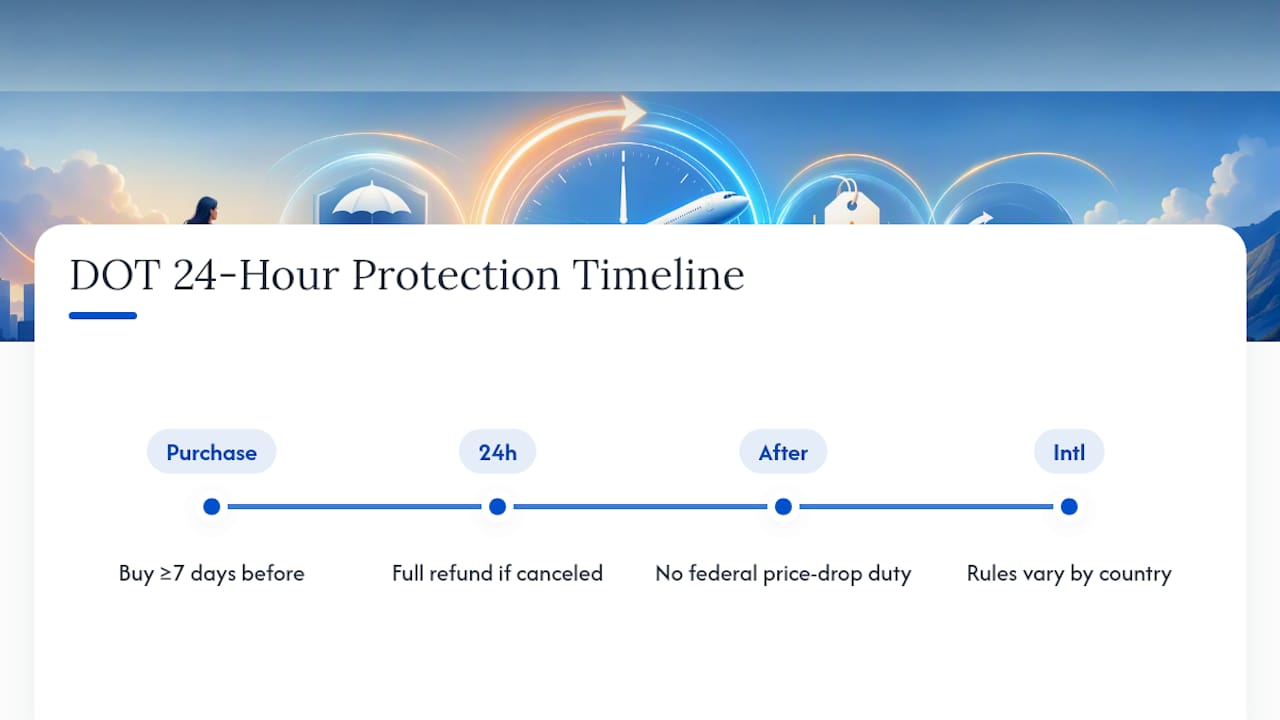
Beyond that rule, nothing in U.S. federal law requires an airline to honor a price drop after the 24-hour window closes. Price-promise and price-guarantee programs are voluntary business policies, not legal entitlements. That distinction matters for how you approach a denied claim: you can appeal to an airline’s customer service, but you generally have no regulatory backstop forcing repayment beyond the 24-hour window.
Outside the United States, rules vary by country and region, so a traveler booking through a European or Australian carrier should check that carrier’s own consumer protection framework rather than assume DOT rules apply. Airlines based outside the U.S. set their own price-promise terms entirely at their discretion, and those terms can be withdrawn or changed without the notice period a regulator might otherwise require.
The practical lesson: rely on the DOT rule as your legal floor, and treat every other price-drop program as a courtesy the provider can define, limit, or discontinue.
What I’d Actually Do Before You Book Again
If you take one thing from this, use the DOT 24-hour rule the moment you spot a drop within a day of booking. It’s the only guarantee with real legal weight. Beyond that window, choose changeable fares over the cheapest basic-economy ticket, save your evidence the moment you see a lower price, and read the specific program’s terms before assuming you qualify. Fare comparison tools make it easier to catch a good price before you book instead of chasing one after.
— Global
Compare Fares Before You Need a Refund
The tactics above only pay off if you’re booking the right fare in the first place. Flight comparison tools let you compare flights across multiple airlines and dates side by side, so you can pick a changeable fare when price movement is a real risk instead of discovering after the fact that basic economy locked you out of every claim option.

The platform’s flight search and comparison tool surfaces fare classes and price differences across carriers in one view, which does more good before you book than any price-drop claim can do after. If a rebook or credit becomes your best option once a fare drops, Global Holiday Planner’s broader booking tools, including hotel and car rental comparisons, help you reallocate that saved money into the rest of your trip. Start by checking current fares on your route and locking in a fare class that actually gives you options if the price moves.
Where to Verify the Rules Yourself
Check the DOT’s 24-hour rule guidance for the federal baseline, and review your airline’s own price-promise page, such as Qantas’s policy, before filing any claim.
Sources
- What airline passengers need to know about DOT’s automatic refund rule
- About price guarantee on Google Flights – Travel Help
- Capital One Price Drop Protection: What to Know – NerdWallet
FAQ
Will Airlines Refund You If the Price Drops?
Only in specific cases: within the DOT’s 24-hour cancellation window, or if the airline runs a price-promise program and your claim matches its exact-itinerary, fare-class, and deadline rules.
What Airlines Offer Price Drop Protection?
Several airlines, including Qantas and others with published price-promise pages, will match an identical lower fare within a short claim window, though minimum-difference thresholds and caps apply.
What Does Price Drop Protection Mean?
It means a policy, sold or offered by an airline, booking portal, or card issuer, that refunds or credits the difference when an identical fare drops after you book, usually within strict limits on time, itinerary match, and payout amount.
Can I Get a Refund If I Find a Cheaper Flight?
You can, but only if the cheaper flight is truly identical (same dates, fare class, and rules) and you file within the provider’s claim window; otherwise most programs, including Google Flights’ guarantee, won’t apply. Comparing fares before booking through a tool like Global Holiday Planner avoids the problem entirely.