

Hotel corporate rates are negotiated, employee-only room rates that give companies predictable discounts and tighter booking controls than public pricing. Getting one usually takes minutes, not a procurement cycle.
If you’re an employee, do this now:
- Enter your company’s corporate code in the “Corp/Promo Code” field when searching
- Book through your company’s online booking tool (OBT) or travel portal, not a generic search
- Bring corporate ID or proof of employment to check-in
If you’re a travel manager, do this now:
- Confirm your negotiated codes are actually loaded and live in your TMC portal
- Spot-check the rate on the hotel’s direct site and in the GDS to catch loading errors
- Verify your rate documentation (LRA terms, blackout dates) matches what agents are quoting
Table of Contents
- What Are Hotel Corporate Rates and Who Qualifies?
- How Corporate Hotel Rates Actually Get Negotiated and Loaded
- Corporate Rate Structures: Which Model Fits Your Program?
- Where Corporate Hotel Rates Actually Come From
- How to Book a Corporate Rate Step by Step
- Negotiation Tactics That Actually Move the Needle
- The 15-5 Rule and Other Rate Pitfalls to Watch For
- Booking Corporate Rates Doesn’t Have to Be Guesswork
- What Most Travel Programs Get Wrong About Corporate Rates
- Sources
- FAQ
What Are Hotel Corporate Rates and Who Qualifies?
A corporate hotel rate is a discount tied to a company account rather than to the general public. It’s set through a negotiated agreement, a volume-based program, or enrollment in a chain’s small-business platform, and it only applies to bookings made under that company’s identity.
Eligibility usually hinges on three checks: a corporate code entered at booking, a company email domain used for account signup, or an employee ID or business card shown at check-in. Hotels verify because the rate is a contractual perk, not a public offer, and letting it leak to non-employees breaks the agreement. This is why a rate that looked confirmed online can still get bumped to the public rate at the front desk if you show up without proof.
The discount itself is only part of the value. A well-structured corporate rate often bundles in:
- Free cancellation up to 24 or 48 hours before arrival, instead of a prepaid, non-refundable rate
- Complimentary breakfast or Wi-Fi that would otherwise cost extra
- Consolidated monthly billing instead of individual employee expense claims
- Full compatibility with the traveler’s personal loyalty account, so points still accrue
Major chains handle this differently at the booking-field level. Marriott’s corporate rate process requires a company-specific code entered during the reservation, plus valid corporate ID at check-in. Hilton and Accor run comparable code-based systems through their own business portals, which we’ll walk through below.
Pro Tip: Save your company’s corporate code in your phone’s notes app. Employees lose the discount surprisingly often simply because they forgot the code and booked through a general search instead.
How Corporate Hotel Rates Actually Get Negotiated and Loaded
Corporate rates originate through one of three paths: a direct contract with a hotel or chain, a travel management company (TMC) that negotiates on your behalf, or a consortia program that pools volume across many small buyers. Each path ends the same way: a code and a rate get loaded into the systems where employees actually search.
The contracting mechanics matter more than most travel managers realize. A typical agreement specifies:
- An effective date range, often tied to a January 1 start following a mid-year RFP cycle
- Whether the rate is a Last Room Availability (LRA) commitment, meaning the hotel must honor it even at near-full occupancy, or a Non-LRA rate that can sell out
- The discount structure (fixed, percentage-off, or dynamic) and any blackout exceptions
- Room-night volume commitments and reporting or audit rights
Once signed, the rate has to get distributed. It gets pushed into the GDS for TMC bookings, loaded into your company’s OBT, and often onto the hotel’s own direct-booking engine under your corporate code. This is where things break. A property can sign the contract and still fail to load the rate correctly in one or more of those channels, which means an employee searching your OBT sees nothing and books at BAR by default.
Pro Tip: Shop your own corporate rate across all three channels, direct site, GDS/TMC, and OBT, within 30 days of a new contract starting. Rate-loading errors are common enough at contract kickoff that a quick multi-channel check catches most of them before employees ever notice.
At check-in, front desk staff will ask for confirmation of eligibility. Carry a business card, employee ID, or be ready to show corporate email on your phone. Skip this and you risk getting rebooked at the public rate on the spot.
Corporate Rate Structures: Which Model Fits Your Program?
Not all corporate rates work the same way, and picking the wrong structure costs you either savings or availability, a decision informed by exploring executive lodging options that sometimes require alternative accommodation negotiations.
- Static/fixed negotiated rate: A flat dollar amount locked for the contract term. Predictable, but it can drift far from market pricing if demand spikes or crashes.
- Percentage discount off BAR: Moves with the hotel’s public rate, so it stays market-relevant but offers less budget certainty.
- Dynamic rate: Fluctuates with real-time demand, similar to a percentage discount but often algorithmically set. Good in soft markets, risky in peak season.
- Dynamic-with-cap: Floats with demand but never exceeds a ceiling you negotiate upfront. This is the structure gaining the most traction in enterprise contracts, because it lets the buyer capture off-peak savings while capping worst-case exposure during high-demand periods.
- Consortia/TMC rate: Pooled discount volume, typically fixed or percentage-based, useful when your own company volume is too thin to negotiate alone.
- Project or group rate: A short-term negotiated block for a specific event or relocation surge, separate from your standing corporate agreement.
For high-volume, low-volatility markets, a static fixed rate with LRA is usually the safer bet. For markets with unpredictable seasonal swings, dynamic-with-cap protects you from both overpaying in a rate spike and underselling your negotiating leverage in a slow month.
Where Corporate Hotel Rates Actually Come From
You get access to negotiated rates through four main channels, and each one suits a different company size and volume level.
| Channel | Best fit | Tradeoff |
|---|---|---|
| Direct hotel/chain negotiation | Companies with concentrated volume in specific cities or brands | Requires meaningful room-night commitments; slower to set up |
| TMC-negotiated rates | Mid-size to large companies wanting fast access without running their own RFP | Aggregates volume across clients but may add service fees |
| Consortia or wholesale programs | Small and mid-size businesses without enough volume to negotiate solo | Discounts are shallower than a direct enterprise contract |
| Chain small-business portals | SMBs and startups needing rates with zero minimum spend | Discounts capped lower than negotiated enterprise deals |
Direct negotiation makes sense once your company generates real volume in a specific market, since hotels want commitments before they’ll cut a custom deal. Corporate Traveler’s guide to negotiated rates notes that TMCs solve the volume problem by aggregating many clients’ bookings, which lets smaller companies access negotiated pricing they couldn’t get alone.

For businesses too small for either route, chain portals fill the gap. Hilton for Business offers free enrollment with no minimum spend and advertises up to 20% off at participating properties. Accor’s business travel program works similarly, giving instant portal access to discounted rates without a formal contract. Marriott runs a comparable code-based system tied to its own corporate booking tool. Across all three, rates typically load fastest into the chain’s own direct-booking engine, with GDS and TMC visibility following shortly after.
How to Book a Corporate Rate Step by Step
Booking correctly takes about two extra minutes, and skipping them is the single biggest reason employees lose the discount.
- Open your company OBT or the hotel’s direct site and locate the “Corp/Promo Code” or “Corporate ID” field, not the general promo code box
- Enter your company’s exact code, confirm the correct property and dates, and check that the displayed rate matches what your travel policy expects
- Before paying, confirm what’s included, breakfast, Wi-Fi, cancellation terms, since some corporate rates bundle perks that a public rate strips out
- Save or screenshot your confirmation showing the corporate rate and code
If the rate doesn’t appear at all:
- Contact your travel administrator before booking at the public rate
- Try booking through your TMC directly, since they can often manually apply a rate that isn’t showing online
- If you’ve already been overcharged at check-in, keep your folio and escalate to your travel team for a rate correction
Negotiation Tactics That Actually Move the Needle
Timing decides more of your outcome than the negotiation itself. Most hotel RFP cycles run from June through November for contracts starting the following January 1, and industry guidance on corporate hotel programs notes this window exists because hotels are finalizing next year’s revenue strategy during that period. Issue your RFP outside that window and you’ll get slower, thinner responses.
Come to the table with real numbers, not estimates:
- Twelve months of room-night data broken down by city and property
- Your average daily rate (ADR) paid over the past year, benchmarked against public rates in the same markets
- A ranked list of amenities or terms that matter most to your travelers (breakfast, late checkout, flexible cancellation)
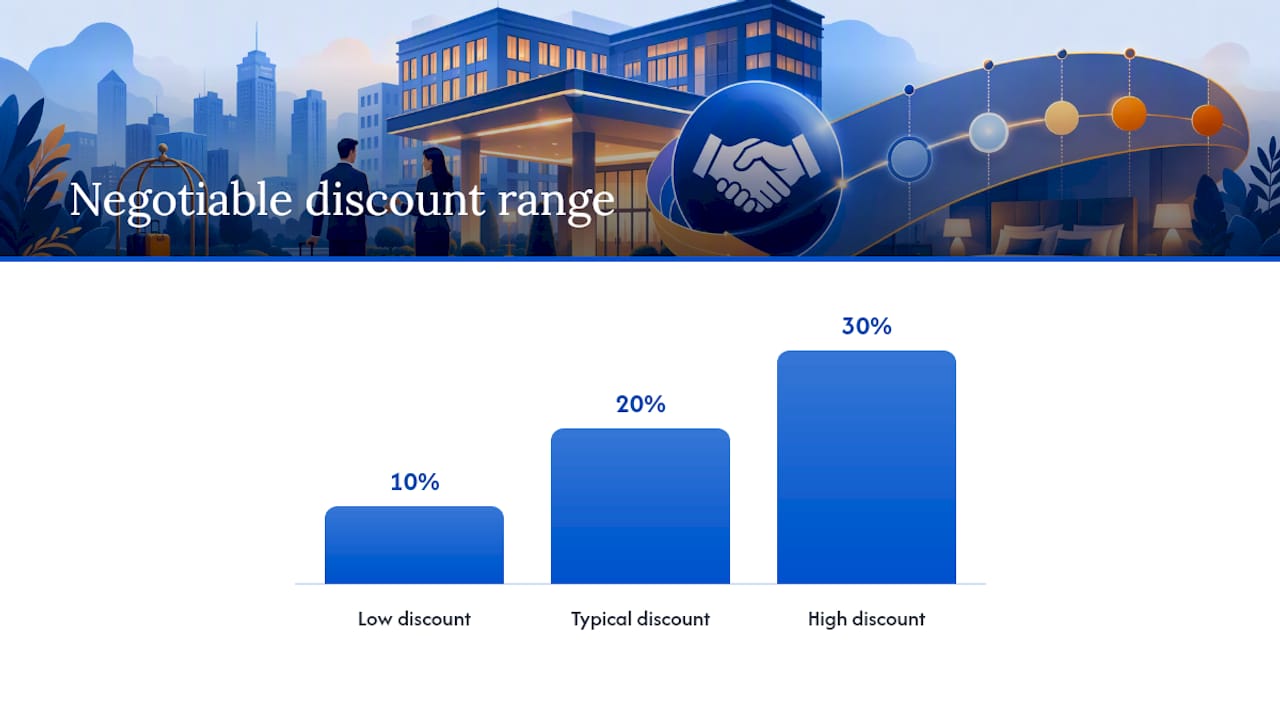
The levers worth negotiating hardest aren’t always the discount percentage. Discounts in these agreements typically land in the 10% to 30% off BAR range, but a deep discount that fails to load correctly or sells out during peak weeks is worth less than a modest one backed by guaranteed availability.
Pro Tip: Be willing to trade 2 to 3 points of discount for an LRA guarantee at your top three properties. A guaranteed room during a citywide convention is worth more than a slightly better rate you can’t actually book.
On governance, concentrating room nights on a smaller set of preferred properties consistently produces stronger effective savings than spreading volume thin across dozens of hotels, and it simplifies quarterly audits considerably. Pair that consolidation with AI-driven rate benchmarking or re-shop tools that flag when a preferred property’s rate drifts above market.
The 15-5 Rule and Other Rate Pitfalls to Watch For
The “15-5 rule” is hotel-industry shorthand for staffing and service-standard ratios at the property level, and travel managers sometimes see it referenced when a hotel explains why certain room categories or service tiers are unavailable at contracted rates during peak periods. It’s a property-side operational guideline, not a legal booking rule, but it can affect which rooms your corporate rate actually unlocks.
Other pitfalls show up more often in practice:
- Blackout dates around major conventions or holidays that quietly suspend your negotiated rate
- Minimum-stay requirements that block single-night corporate bookings
- Rates that never loaded correctly into the GDS or OBT, so employees never see them
- Front-desk surcharges applied when an employee can’t produce corporate ID
Always carry physical or digital proof of corporate affiliation, employee ID, a business card, or corporate email access, at check-in. Hotels can and do deny the corporate rate and charge the public rate when eligibility can’t be verified on the spot.
Mitigate this by enforcing OBT-only bookings, running a quarterly rate-load audit across all three channels, and training employees once, clearly, on what they need to show at the desk.
Booking Corporate Rates Doesn’t Have to Be Guesswork
Corporate rates deliver the most value when eligibility is verified upfront, the rate structure matches your travel volume’s volatility, and the code is confirmed live in every booking channel before employees rely on it.
| Point | Details |
|---|---|
| Verify before you travel | Confirm your corporate code loads in your OBT, GDS, and the hotel’s direct site, not just one channel. |
| Match structure to volume | Choose dynamic-with-cap for volatile markets and fixed rates for stable, high-volume city pairs. |
| Carry proof at check-in | Bring employee ID or a business card since hotels can deny the rate without verification. |
| Time your RFP right | Run RFPs between June and November for rates that start the following January 1. |
| Consolidate your volume | Concentrate room nights on fewer preferred properties to deepen effective savings and simplify audits. |
Once your corporate rate structure is set, pair it with a consistent booking habit. Global Holiday Planner’s hotel booking guide covers practical tactics for locking in the best available price whether you’re traveling under a corporate code or booking independently, and its comparison tools make it easy to check a negotiated rate against current market pricing before you commit.
What Most Travel Programs Get Wrong About Corporate Rates
The conventional advice on corporate rates fixates on the discount percentage, and that’s the wrong obsession.
The bigger opportunity most programs miss is consolidation. Companies chase modest discounts across a wide spread of properties instead of concentrating volume on a handful of preferred hotels in their top markets. That concentration is what actually earns LRA commitments, priority upgrades, and the kind of relationship where a hotel sales team calls you before a rate problem becomes an employee complaint.
Prioritize verification before negotiation. Run a rate-load audit on your existing program before you renegotiate a single term. You’ll often find the leak isn’t in the contract, it’s in the booking flow employees are actually using.
Sources
- How Do I Book My Marriott Corporate Rate?
- Hilton for Business
- A guide to corporate hotel rates – Accor Business Travel
FAQ
What is a corporate rate at a hotel?
A corporate rate is a discounted, negotiated room rate available only to employees of a specific company, accessed through a corporate code, company account, or enrollment in a chain’s business program.
How do I get corporate rates on hotels?
Enroll through direct negotiation if your company has concentrated volume, join a TMC or consortia program for aggregated discounts, or sign up for a chain’s free small-business portal like Hilton for Business with no minimum spend required.
What is the 15-5 rule in hotels?
The 15-5 rule generally refers to a property-level staffing and service-standard guideline used internally by hotels, and travel managers sometimes encounter it referenced when certain room categories are restricted from corporate rates during peak demand.
What is the Marriott corporate rate?
Marriott’s corporate rate is a discounted rate booked by entering a company-specific corporate code during reservation, with valid corporate identification required at check-in to confirm eligibility, according to Marriott’s own booking guidance.