
Yes, you can usually drive a U.S.-rented car into Canada if you notify the rental agent and get a non-resident insurance card at pickup. Driving that same car into Mexico is a different story: most major rental companies prohibit it outright, and the few exceptions apply only at specific border locations with mandatory extra insurance. Skip the notification step in either direction, and you risk voiding your coverage entirely.
TL;DR:
- Most U.S. rental companies allow driving into Canada with prior notification and a non-resident insurance card, but Mexican crossings require specific border location permissions and additional insurance.
- Crossing into Canada generally involves reciprocal insurance agreements, making it easier and often free to obtain the necessary documents at pickup, whereas Mexico usually mandates extra liability insurance paid separately.
- Vehicle classes like exotic cars, cargo vans, and large passenger vans are commonly excluded from cross-border travel, regardless of destination.
- Failing to declare border crossings can void insurance coverage and result in hefty fines, contract breaches, and personal liability for damages or theft.
- Confirm policies and permissions at the specific pickup location through official pages and direct calls, and always carry all required documents while on the road.
Table of Contents
- Which Border Routes Cross Border Car Rental Companies Actually Allow
- Documents You Need Before You Leave the Lot
- What Cross Border Fees and Insurance Voids Actually Cost You
- A Step-by-Step Checklist for Renting a Car Across Borders
- Restrictions, Penalties, and What to Do When Crossing Isn’t Allowed
- How Globalholidayplanner Simplifies Cross Border Car Rental Planning
- Book Your Cross-Border Rental With Confidence
- Official Policy Pages to Check Before You Travel
- Sources
- FAQ
Which Border Routes Cross Border Car Rental Companies Actually Allow
Rental companies treat the U.S.-Canada border and the U.S.-Mexico border like two completely different problems, and the gap comes down to insurance treaties, not distance or demand.

Crossing into Canada is the easier of the two. Most U.S. pickup locations will let you drive north once you flag the trip at booking or at the counter, because the rental network already has reciprocal insurance arrangements with Canadian coverage built into the contract. The agent hands you a non-resident insurance card, sometimes called a yellow card or green card depending on the company, and that document is what Canadian authorities and police expect to see if you’re stopped or in an accident.
Mexico works almost in reverse. A rental agreement written in the U.S. typically bars travel into Mexico entirely, and where it’s allowed, it’s usually restricted to:
- U.S. residents renting from select border-state locations (think San Diego, El Paso, or Laredo)
- Corporate or business accounts rather than standard leisure bookings
- Mandatory purchase of Mexican liability insurance, since U.S. policies generally don’t transfer
Vehicle class matters just as much as the route. Exotic cars, cargo vans, and large passenger vans are commonly excluded from cross-border travel altogether, regardless of destination, because insurers price those classes differently and recovery logistics get complicated if something goes wrong far from the rental office.
Documents You Need Before You Leave the Lot
Getting waved through at the border, or avoiding a denied insurance claim later, comes down to paperwork you should collect before the car ever leaves the parking lot.
- Passport and a valid driver’s license. Some countries also want an International Driving Permit, so check the entry requirements for wherever you’re headed.
- Written rental authorization. This should explicitly list every country you’re permitted to enter, not just a verbal “yeah, that’s fine” from the counter agent.
- Non-resident insurance card (yellow card). Required for Canada, and it should already list your rental’s coverage terms.
- Proof of special insurance for Mexico, if you’re one of the rare cases allowed to cross, plus any vehicle registration or green card the rental company issues for that leg.
Keep physical and digital copies. A phone photo of the authorization letter has saved more than one traveler at a checkpoint where the original paperwork was buried in a glove box.
What Cross Border Fees and Insurance Voids Actually Cost You
Cross-border fees aren’t universal, and the way companies charge them varies more than most travelers expect.
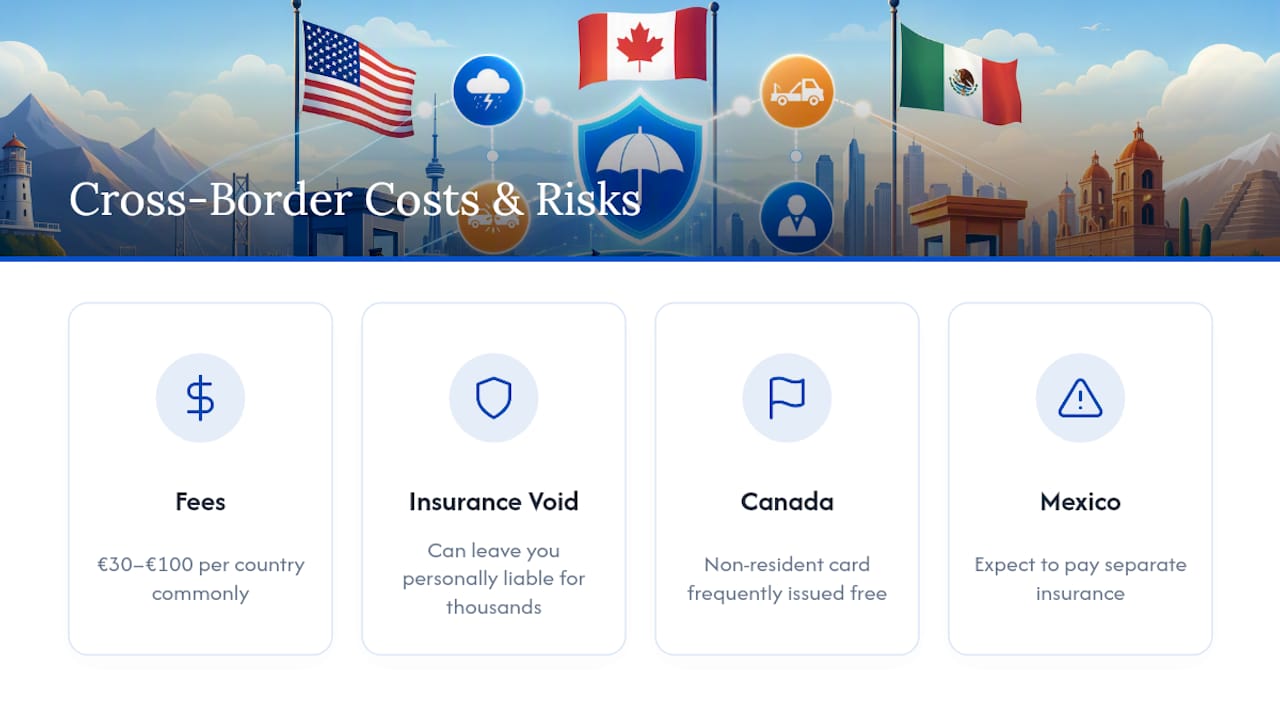
Some rental brands charge a one-time fee per additional country, billed once regardless of how long you stay. Others charge a daily incremental rate that adds up the longer your trip runs. European cross-border routes illustrate the range well: fees there commonly fall between €30 and €100 per country, and U.S.-Canada-Mexico pricing tends to follow a similar logic, just denominated in dollars.
The real cost isn’t the fee, it’s the coverage. A €50 cross-border charge is a rounding error next to a totaled rental with no insurance backing it.
For Canada, the non-resident insurance card is frequently issued free at the counter once you declare the trip. Mexico is the opposite: expect to pay for separate insurance on top of your regular rental cost, since domestic coverage doesn’t extend south of the border.
The bigger risk is invisible until it costs you thousands. Many rental fleets carry GPS or location-tracking hardware that flags unauthorized border crossings, and an undeclared trip discovered this way commonly voids your insurance entirely. That means you’re personally liable for any damage, theft, or accident, on top of contract-breach penalties the rental company can charge separately.
A Step-by-Step Checklist for Renting a Car Across Borders
Handling this correctly takes four short stages, and skipping any one of them is where trips go wrong.
- Before booking: Read the rental company’s country-conditions notice and confirm your pickup location and vehicle class actually permit the border you plan to cross. Call the specific pickup office directly. Policies vary by location even within the same brand.
- At booking: Declare every country you intend to visit, not just the main destination. Confirm one-way and return rules, and add whatever insurance product the crossing requires.
- At pickup: Request the written authorization and, for Canada, the non-resident insurance card. Keep both in the car, not in a bag in the trunk.
- On the road: Carry your documents at all times and follow the destination country’s equipment rules, things like warning triangles or reflective vests that some countries mandate but U.S. drivers rarely think about.
Pro Tip: Call the pickup office again a day or two before your trip, even after online booking confirms the crossing. Cross-border permission lists change by location and by season, and a phone call catches updates the website hasn’t caught up with yet.
Restrictions, Penalties, and What to Do When Crossing Isn’t Allowed
Rental contracts punish undeclared border crossings harder than most travelers assume, and the penalties stack.
- Voided insurance leaves you covering repair or replacement costs entirely out of pocket.
- Contract breach fees apply on top of any insurance gap, separate from the crossing itself.
- Unauthorized-return fines hit hardest when a car gets dropped off in a different country than the contract allows, sometimes running into hundreds of dollars for recovery and repositioning.
- Ferry crossings and certain countries are frequently blacklisted outright in the contract’s fine print, regardless of vehicle class.
When a route isn’t permitted, don’t force it. A cleaner strategy is dropping the rental at a border town and continuing by rail, bus, or a locally rented car on the other side. It costs a bit more logistically, but it avoids the disproportionate fines that come with an unauthorized international one-way return.
How Globalholidayplanner Simplifies Cross Border Car Rental Planning
Cross-border permissions live buried in fine print that changes by pickup location, which is exactly why Globalholidayplanner surfaces rental options with clearer terms up front, so you can compare which locations and vehicle classes actually support your route before you commit. Use the platform’s car rental search when your trip involves a U.S.-Canada or U.S.-Mexico leg, and lean on a local rental instead when the cross-border restrictions on your preferred vehicle class make the trip impractical. Either way, confirming permissions before booking beats discovering them at the counter.
— Global
Book Your Cross-Border Rental With Confidence
Booking a cross-border-friendly rental shouldn’t mean guessing whether your paperwork will hold up at the checkpoint. Globalholidayplanner’s car rental comparison tool lets you filter by pickup location and vehicle class, so you can spot which options actually support U.S.-Canada or U.S.-Mexico travel before you pay a deposit.
Pair that with a look at travel insurance options if your route needs supplemental coverage beyond what the rental company offers, especially for Mexico legs where domestic policies won’t transfer. If your trip also involves flights into a border city, check current flight deals to line up arrival times with your rental pickup window. Start by searching car rentals for your specific dates and cities, confirm the cross-border permissions listed for that location, and lock in the booking once the paperwork checks out.
Official Policy Pages to Check Before You Travel
Confirm current terms directly with these sources before booking or picking up your vehicle, since cross-border rules shift by location and season:
- Budget’s U.S. to Canada cross-border policy
- Avis’s guidance on driving to Mexico and Canada
- Alamo’s cross-border car rental policy
- Independent breakdown of cross-border rental fees
Call your specific pickup location too. Written policy pages set the baseline, but individual branches sometimes apply tighter restrictions.
Sources
- U.S. to Canada Cross-Border Car Rental | Budget Car Rental
- Driving My Rental Car to Mexico and Canada | Avis Rent a Car
- Cross-Border Car Rental Fees in Europe 2026 | BestTravelScout
- Cross-Border Car Rental Policy – Alamo Rent a Car
FAQ
Which Car Rental Companies Allow Cross-Border Travel?
Most major U.S. rental brands allow travel into Canada if you notify them and get a non-resident insurance card, while Mexico crossings are typically limited to specific border-state locations with corporate accounts and mandatory extra insurance. Always confirm with your exact pickup location, since permissions vary even within one company.
Are You Allowed to Cross the Border With a Rental Car?
Yes, but only if your rental agreement explicitly authorizes it in writing. Driving across an undeclared border can void your insurance and trigger contract-breach penalties, even when the destination country itself has no issue with the car.
What Is a Cross-Border Fee for Rental Cars?
It’s a charge rental companies apply for taking the vehicle into another country, billed either as a one-time fee per country or as a daily incremental rate. Fee structures for comparable international routes commonly range between €30 and €100 per country, and North American pricing tends to follow similar logic in dollars.
Do Car Rental Companies Know if You Cross the Border?
Often, yes. Many rental fleets use GPS or location-tracking technology that flags border crossings, so an undeclared trip is frequently discovered even without an accident or incident. That’s why declaring your route at booking matters more than hoping nobody checks.
Do I Need Special Insurance to Drive a Rental Car Into Mexico?
Yes. U.S. rental insurance generally doesn’t extend into Mexico, so wherever a crossing is permitted, you’ll need to purchase a separate Mexican liability policy at pickup. Skipping this step leaves you fully liable for any damage or accident south of the border.