
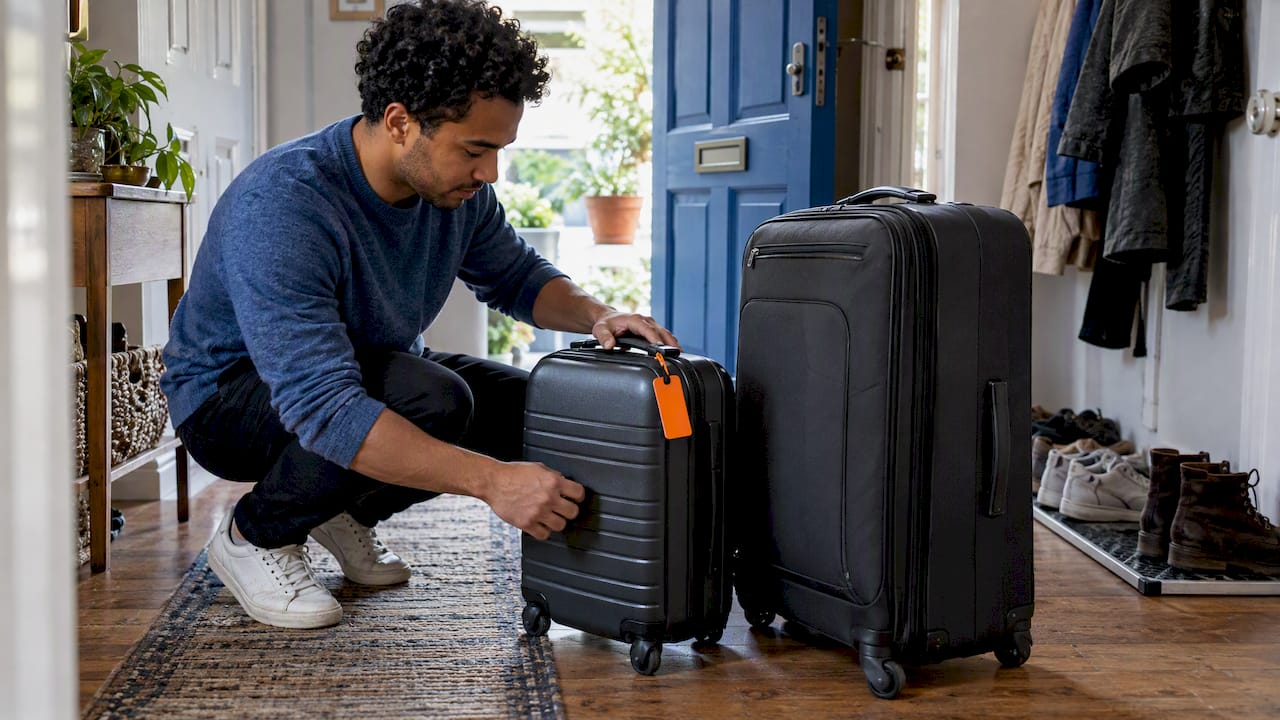
Pick a carry-on when your trip is short, your plans are tight and you can live with roughly 22 x 14 x 9 inches of stuff. Pick a checked bag when you are packing for more than a week, carrying bulky gear, or flying an airline that charges for carry-ons anyway. The deciding factor is rarely the bag. It is the fare you bought, the airline’s rules and what the whole trip costs once fees are added.
Below you will find how the two options differ, what a personal item really is, what U.S. airlines charge, which items must stay with you, and how to decide in about two minutes.
TL;DR
- A carry-on rides in the overhead bin; a personal item must fit under the seat. Many fares include a personal item only, so check your fare before you pack.
- Checked bags cost roughly $45 to $50 for the first bag on the big U.S. carriers, so a one-bag trip can save $90 to $100 round trip.
- Power banks and spare lithium batteries go in the cabin, never in a checked bag, and that includes a carry-on you are forced to gate-check.
- Checked bags are protected by federal rules and international treaty if they are lost or damaged, but you must document and file promptly.
- Compare the total cost of the fare plus bags, not the base fare alone.
Table of Contents
- Carry-on, personal item and checked bag: the real differences
- What counts as a personal item, and how big can it be
- Checked bag vs carry-on: side-by-side comparison
- What U.S. airlines charge for bags
- When a carry-on is the better choice
- When a checked bag is the better choice
- What must stay in the cabin
- If your checked bag is lost, delayed or damaged
- How to avoid baggage fees
- Our view: price the bag before you pick the flight
- Compare flights with your bags included
- A two-minute decision guide
- FAQ
- Sources
Carry-on, personal item and checked bag: the real differences
Airlines sort luggage into three groups, and the names matter because each has its own price and size limit.
Personal item. The smaller bag that goes under the seat in front of you: a backpack, a purse, a laptop bag. It is the one you can almost always bring.
Carry-on. The larger bag, usually a roller or duffel, that goes in the overhead bin. The FAA notes that the maximum carry-on size for most airlines is 45 linear inches, the sum of height, width and depth. That is where the familiar 22 x 14 x 9 inch figure comes from: those three numbers add up to 45.
Checked bag. The bag you hand over at the counter or bag drop. It travels in the cargo hold and you collect it at baggage claim. Weight and size limits are higher, and a fee usually applies.
The IATA passenger baggage rules say it plainly: allowances vary by airline, cabin class and aircraft type, and the airline’s conditions of carriage always apply. That one sentence explains most confusion. There is no single universal rule, only your airline’s rule for your fare on your date.
What counts as a personal item, and how big can it be
A personal item is whatever fits entirely under the seat in front of you without blocking your legroom or the aisle. Common examples are a small backpack, a tote, a handbag, a briefcase or a laptop bag. Items that usually do not count: a loose jacket you carry by hand is typically fine, but a duffel that bulges past the frame is not.
Sizes differ more than most travelers expect. According to one 2026 chart of U.S. airlines, the most common limit is 18 x 14 x 8 inches, while United uses a narrower 17 x 10 x 9 inches and Alaska limits depth to about 6 inches. The narrow width is the trap: many standard travel backpacks run 12 to 13 inches wide and look fine until you try to slide them into a measuring frame.
What happens if your personal item is too big
Two outcomes are common. On airlines that include a carry-on, an oversized personal item may be treated as your carry-on, and the rest of your luggage then becomes the problem. On airlines that sell carry-on space separately, an oversized item can trigger a gate fee. The same chart lists gate charges of about $65 at United and $100 at Frontier for bags over the limit, though these figures change, so confirm on your airline’s page before you fly.
A practical test: pack the bag as you will actually carry it, soft-sided and full, and measure it at its widest point, not the number on the tag. A bag that compresses an inch or two gives you margin.
Checked bag vs carry-on: side-by-side comparison
| Factor | Personal item | Carry-on | Checked bag |
|---|---|---|---|
| Where it travels | Under the seat | Overhead bin | Cargo hold |
| Typical size limit | About 17 to 18 x 10 to 14 x 8 to 9 in, by airline | Often 22 x 14 x 9 in (45 linear in) | Usually up to 62 linear in and about 50 lb before extra fees |
| Typical cost | Usually included | Included on many standard fares, extra on some basic or low-cost fares | Roughly $45 to $50 for the first bag, more for the second |
| Speed | Fastest | Fast, no baggage claim | Slower, wait at carousel |
| Risk of delay or loss | None, stays with you | Low, but gate-check possible | Small, but real |
| Liquids and sharp items | Liquid limits apply | Liquid limits apply | Fewer limits, but other restrictions apply |
The size and weight limits for checked bags are the most variable column, so treat them as a guide and read your carrier’s page.
What U.S. airlines charge for bags
A 2026 roundup of U.S. airline checked bag fees puts the first checked bag at about $45 to $50 across the major carriers as of April 2026. In that table, American and United charge $50 for a first bag ($45 if prepaid), with $60 ($55 prepaid) for a second, and Delta charges $45 and $55. Prepaying online at least a day ahead usually saves a few dollars.

The same roundup notes that some legacy carriers do not charge for carry-ons, even on basic economy fares. Budget carriers often do, and some charge for any bag larger than a small personal item. Fees move, and they differ by route, fare and loyalty status, so read them at the time you book.
Here is the arithmetic that matters. One checked bag at $50 each way is $100 round trip. If you travel with a partner and both check a bag, that is $200 before you have picked a seat. That is why a cheap base fare can end up costing more than a fare that includes a bag. Our guide to baggage fees and landed cost for U.S. travelers walks through that comparison in detail, and how a $30 bag changes your total shows why the headline price is rarely the final one. If you are weighing fare classes, see basic economy versus economy for budget trips.
Worked example: a four-night trip for two
Take two travelers on a four-night city break. With two carry-ons, they pay nothing in bag fees on a carrier that includes carry-ons. With one shared checked bag at $50 each way, they add $100. If one of them wants to bring a larger bag for gifts on the way home, a second bag may add another $55 to $60 each way. The difference between packing light and not is easily $100 to $220 on one short trip, which can be more than the fare gap between two airlines.
Now flip it. On a low-cost carrier that charges for a carry-on, packing a single personal item may be the only genuinely free option. The cheapest approach changes with the airline, so always price your actual bags, not an imaginary one.
When a carry-on is the better choice
Choose a carry-on or personal item only when most of these are true:
- The trip is under about a week, or you will have laundry access.
- You have a tight connection, and waiting at baggage claim would be a risk.
- Your fare includes a carry-on, so the saving is real.
- You are not bringing bulky gear such as ski boots, golf clubs or a stroller you cannot gate-check.
- You want the least exposure to delayed bags, especially when changing airlines or terminals.
The tradeoff is overhead bin space. The FAA says some aircraft have limited overhead room, and a full flight can run out of space. When it does, crews gate-check bags, often for free, and the bag goes in the hold. If that happens, you want a plan: a small personal item holding medicine, electronics, documents, a charger and a change of clothes that stays under your seat.
Smart packing helps more than a bigger bag. If you want a practical look at packing your bags for a trip built around gear, it shows how to decide what to carry and what to leave behind.
When a checked bag is the better choice
Check a bag when:
- You are traveling more than a week, or in multiple climates.
- You carry liquids in more than travel sizes, or tools and sports equipment that cannot go in the cabin.
- You are traveling with children and need extra clothing, diapers or gear.
- Your fare charges for carry-ons anyway, which narrows the cost gap.
- You are moving, relocating or bringing items back.
A checked bag also removes the stress of lifting a heavy roller into a bin and the risk of being forced to gate-check at the last minute. If you are already paying a fee for a carry-on, the price difference may be a few dollars, and the capacity difference is large.
What must stay in the cabin
A few items do not belong in the cargo hold, no matter which bag you choose.
Power banks and spare batteries. The TSA states that portable chargers and power banks with a lithium-ion battery must be packed in carry-on bags, not checked ones. Spare lithium batteries, including phone charging cases, are prohibited in checked bags. Batteries installed in devices are generally allowed in both, with special instructions for devices with 100 watt-hours or less.
Gate-check trap. If an agent asks you to gate-check your carry-on because bins are full, take out power banks and spare batteries first. They must stay in the cabin with you, and you are the one who has to remember.
Essentials. Medication, glasses, travel documents, keys, a laptop, valuables and a day of clothes. Not because checked bags are unprotected, but because a delay of even one day is painful when your prescription is in the hold.
If your checked bag is lost, delayed or damaged
Many travelers carry on only because they fear losing a bag. The risk is real but modest, and your rights are stronger than most people think.
According to the U.S. Department of Transportation, most checked bags arrive on time and in the condition received, but when they do not, rules apply. For domestic travel, the DOT’s airline consumer FAQ confirms the domestic liability limit is $3,500 per passenger. For international flights, the Montreal Convention sets a limit of roughly $1,820 as of 2026, per the DOT.
Three points worth knowing:
- Delay expenses. The DOT says airlines cannot set an arbitrary daily cap, such as $50, on reimbursement for delayed bags. They must cover reasonable, verifiable incidental expenses, up to the total liability limit. Keep receipts for toiletries, clothing and necessities.
- Damaged wheels and handles. Airlines often say they are not responsible for these parts, but the DOT says they cannot categorically exclude them. Photograph your bag before check-in.
- Deadlines. Report the problem before leaving the airport, and file a written claim quickly. Our page on lost luggage compensation and filing deadlines covers the 7 and 21 day windows for U.S. travelers.
If you want a safety net beyond what the airline owes, compare what your card already covers with a policy using our five-step guide to travel insurance or card coverage.
How to avoid baggage fees
You can rarely avoid every fee, but you can usually avoid the avoidable ones.
- Read the fare rules before you pay. Check whether the fare includes a carry-on and checked bag. Basic fares often exclude them, and the gap to a standard fare can be smaller than the bag fees.
- Measure and weigh at home. A luggage scale is cheaper than one overweight fee. Oversize and overweight charges on major carriers can run from $30 to $200 per bag, according to the fee roundup.
- Prepay online. Where airlines discount prepaid bags, you save a few dollars per piece.
- Share a bag. Two travelers on a short trip can often share one checked bag and pay once.
- Wear the bulky items. A coat, boots and a hoodie are free in transit.
- Use airline credit card or status perks if you already have them, since a free checked bag can be worth $100 round trip.
- Ship or buy there for long stays instead of hauling everything.
Before you commit, run the numbers on the full itinerary. Our trip planning checklist includes a bag check among the steps most people skip.
Our view: price the bag before you pick the flight
We compare flights, hotels, car rentals, transfers and insurance for travelers every day, and the same mistake shows up often: people shop on the base fare and discover the bag charge at the end. A fare that looks $40 cheaper can cost $60 more once two travelers add a checked bag each way.
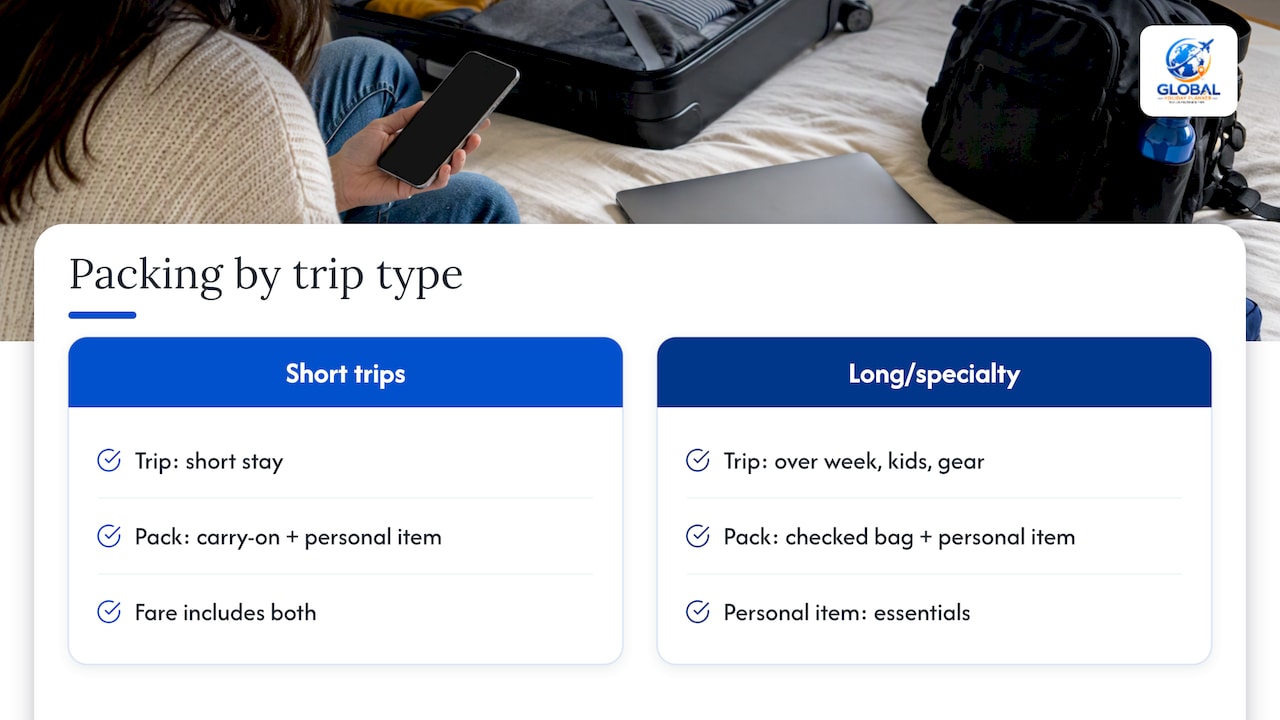
Our advice is simple. Decide how you will pack first, then compare fares with that bag included. For short trips, we lean toward one carry-on and one personal item, provided the fare includes them. For trips over a week, with kids, or with specialty gear, we lean toward a checked bag and a well-stocked personal item with everything you cannot afford to lose. The cheapest ticket is the one whose total, with bags, is lowest for your itinerary and your trip type, whether that is a romantic getaway, a family holiday or a golf trip with clubs.
It is also worth noting that your needs change by trip. A business traveler flying out and back in a day wants no checked bag. A family of four on a week at the beach almost certainly does.
— Global
Compare flights with your bags included
When you search on our flight comparison page, you can look at options side by side and keep your luggage plan in mind as you decide. We compare flights, hotels, car rentals, airport transfers, rail tickets and travel insurance in one place, so you can see the whole trip and not only the ticket. Before you book, confirm the bag rules shown for your specific fare on the airline’s own page.
A two-minute decision guide
Ask yourself five questions:
- Is my trip under seven nights? If yes, lean carry-on.
- Does my fare include a carry-on? If no, price both options.
- Am I bringing anything bulky, liquid or sharp? If yes, check a bag.
- Do I have a tight connection? If yes, lean carry-on.
- Does my personal item hold medicine, electronics and a power bank? If no, repack before you go.
If you answer “carry-on” to most, travel light and save the fee. If you answer “checked” to most, pay for one bag in advance and use the personal item for essentials.
FAQ
How does a gate check work?
If overhead bins fill up, an agent tags your carry-on at the gate and it travels in the hold. You usually collect it at the aircraft door or at baggage claim, depending on the airline and aircraft. Take out your power banks, spare batteries, medication, valuables and documents before you hand it over.
What is the weight limit for carry-on luggage on international flights?
There is no single worldwide number. The IATA says carry-on allowances vary by airline, cabin class and aircraft type. Many international carriers set a weight limit, so check your airline’s page for your exact flight, especially on codeshare or multi-airline itineraries.
Is a personal item the same as a carry-on?
No. A personal item goes under the seat and is usually smaller. A carry-on goes in the overhead bin and is larger. Some fares include only the personal item, and the carry-on costs extra, so check your fare before you pack.
Can I put a power bank in my checked bag?
No. The TSA requires power banks and portable chargers with lithium-ion batteries to travel in carry-on bags only. The same applies if your carry-on is gate-checked, so remove them first.
Sources
- FAA: Carry-On Baggage Tips
- IATA: Passenger Baggage Rules
- TSA: Power Banks
- TSA: Lithium batteries with 100 watt hours or less in a device
- U.S. DOT: Lost, Delayed, or Damaged Baggage
- U.S. DOT: Airline Consumers’ Rights FAQ
- 2026 Guide to US Airline Checked Bag Fees
- Personal Item Size 2026 chart
- Packing your bags