

Friday is the cheapest day to both book and fly in 2026, according to Expedia’s newest Air Hacks report, which found Friday bookings save about 3% over Sunday and Friday departures save up to 8%. Don’t get too excited by those numbers, though. They’re single-digit percentages, not dramatic markdowns, and they matter far less than how many weeks out you shop and whether your dates can move.
TL;DR:
- Booking on a Friday can save approximately 3% over Sunday, and flying out on a Friday can save up to 8% compared to Sunday departures.
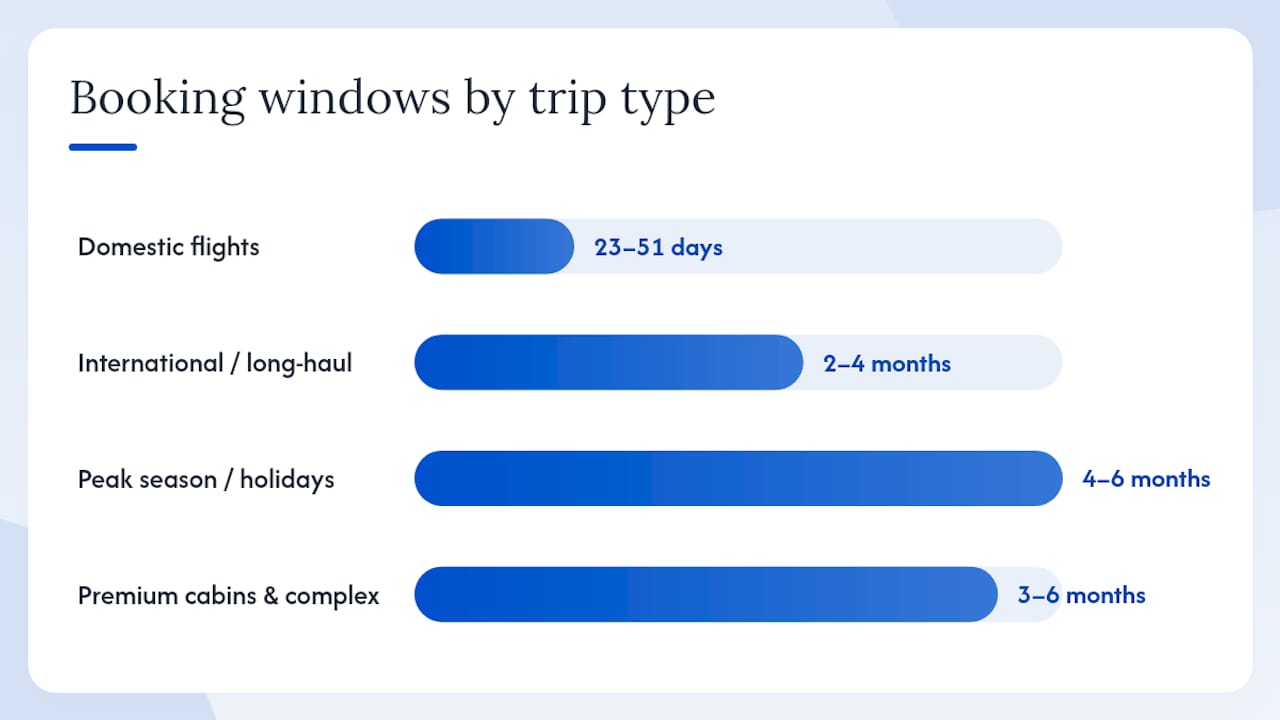
- The ideal window for domestic bookings is 23 to 51 days before departure, while international and peak-season flights should be booked two to six months in advance.
- Travel demand patterns differ for leisure and business routes, with leisure routes responding more predictably to weekday and lead-time trends.
- Day-to-day fare changes are driven by competitor matching, demand shocks, flash sales, and seasonal capacity shifts, making lead time more crucial than the specific weekday.
- The Tuesday booking myth is outdated; current data shows no consistent advantage to booking or flying on Tuesdays or Wednesdays.
Table of Contents
- What Is the Best Day to Book Flights?
- How Far in Advance Should You Book Flights?
- Does the Best Day to Book Change by Route or Fare Class?
- Why Do Flight Prices Change So Much Day to Day?
- What Are the Best Tactics for Finding Cheap Flights?
- When Should You Book Holiday and Peak-Season Flights?
- Is the Tuesday Booking Myth True?
- How Global Holiday Planner Applies These Booking Rules
- Ready to Put These Booking Rules to Work?
- Where This Data Comes From
- Sources
- FAQ
What Is the Best Day to Book Flights?
Friday now edges out every other day of the week for booking flights, reversing years of “book on Tuesday” folklore that never really held up under scrutiny. Expedia’s 2026 data shows the savings run around 3% compared to booking on a Sunday, which is the priciest day to buy a ticket. Flying out on a Friday saves even more, up to 8% versus a Sunday departure, likely because business travel has thinned out at the end of the workweek while leisure travelers haven’t yet claimed those Friday seats the way they’ve claimed weekend ones.
Here’s the quick version of what actually moves the needle:
- Best day to book: Friday, saving roughly 3% versus Sunday
- Best day to fly: Friday, saving up to 8% versus Sunday departures
- Worst day to book or fly: Sunday, consistently the priciest across Expedia’s dataset
- If your dates are flexible: Run a flexible-date search first; weekday timing is a tiebreaker, not a strategy
- If your dates are fixed: Focus on lead time and price alerts instead of chasing a specific weekday
Statistic Callout: Booking on a Friday instead of a Sunday can save a small percentage, and flying on a Friday instead of a Sunday can save a somewhat larger but still moderate amount, according to Expedia’s 2026 Air Hacks report. NerdWallet’s analysis of the same data cautions that these day-of-week gaps are consistently smaller than what you’ll save by booking within the right lead-time window.
Lead time does the heavy lifting. Weekday choice just fine-tunes it.
How Far in Advance Should You Book Flights?
There’s a sweet spot for every trip type, and missing it costs a lot more than picking the wrong weekday ever will. Airlines call it dynamic pricing; travel writers have taken to calling it the “Goldilocks window,” the stretch where you’re neither paying the early-bird premium nor scrambling in the last-minute panic zone.
- Domestic flights: Book about 23 to 51 days before departure. Google Flights data reported by the Seattle Times puts the low-price window at roughly three to seven weeks out for most domestic routes, though it shifts earlier for busy summer corridors and later for quieter shoulder-season trips.
- International and long-haul flights: Give yourself two to four months, sometimes more. Transatlantic and transpacific routes have fewer available seats per fare bucket, so the cushion of a slow demand build gets eaten up faster than on domestic routes with dozens of daily departures.
- Peak season and holiday travel: Push your booking window even earlier, often four to six months out for Christmas, New Year, or summer break in Europe, since inventory in the cheapest fare buckets disappears months before the actual price spike becomes visible.
- Premium cabins and complex itineraries: Start shopping three to six months ahead. Business and first class seats are limited in number from day one, and multi-city or open-jaw itineraries need more lead time simply because there are more fare rules that have to line up.
Each trip type has its own window, and the practical move is to set your price-tracking start date to match the trip, not to apply one generic rule to everything you book.
Pro Tip: Set your price alert to start about two weeks before your route’s Goldilocks window opens. That way you catch the moment prices start dropping instead of discovering, three weeks in, that you missed the dip entirely.
Domestic short hops with lots of competing carriers reward patience within that 23 to 51 day window, since airlines are actively undercutting each other on frequently flown routes. International routes punish patience the same way. A flight to Lisbon in July doesn’t wait around for you to feel ready to buy. Seats in the lowest fare bucket sell out first, and every day you wait past the ideal window locks you into a higher bucket, regardless of what day of the week it happens to be.
Does the Best Day to Book Change by Route or Fare Class?
Weekday rules hold up better on some routes than others, and knowing the difference saves you from chasing a pattern that doesn’t apply to your trip. Leisure-heavy routes, the kind connecting home cities to beach towns, ski resorts, or major tourist hubs, tend to track the broad Friday pattern fairly closely because pricing on those routes responds mostly to vacation demand curves.
Business-heavy routes are a different animal entirely. Routes between major financial or tech hubs get priced around corporate travel patterns: high demand for midweek outbound flights and Friday or Monday returns, which pushes prices up on exactly the days leisure travelers might expect to be cheap. On those routes, a Forbes Advisor analysis points out that corporate booking windows and revenue management dominate the pricing, so a broad “Friday is cheapest” rule can simply not apply.
Fare class adds another layer of variation. Expedia’s 2026 data found that Saturday, not Friday, was the cheapest day to book business class seats on several routes, a reminder that premium cabins run on their own demand logic separate from economy.
A few practical distinctions worth keeping in mind:
- Short domestic hops with multiple competing airlines respond most predictably to weekday and lead-time patterns.
- Long-haul international routes are driven more by seasonal demand and cabin inventory than by day of the week.
- Basic economy fares fluctuate more sharply day to day since they’re the first bucket airlines adjust.
- Business and premium economy fares often move on a separate schedule tied to corporate booking cycles rather than leisure demand.
Statistic Callout: Saturday, not Friday, was the cheapest day to book business class fares on some routes in Expedia’s 2026 findings, underscoring that fare class changes which weekday rule actually applies.
The most reliable test isn’t memorizing which weekday wins for which route type. It’s pulling up a flexible-date calendar for your specific trip and letting the actual numbers tell you, since that removes the guesswork a generic weekday rule can’t account for.
Why Do Flight Prices Change So Much Day to Day?
Airlines don’t set one price per flight. They sell the same seat inventory in dozens of separate buckets, each with its own price and its own limited seat count, and prices climb as each bucket sells out. That’s why the fare you saw at 9 AM can jump by the time you check back at lunch: it’s not that the algorithm is watching your cookies, it’s that a bucket quietly closed and the system moved on to the next one up.
A handful of forces stack on top of that base system and create most of the noise you notice:
- Competitor pricing: when one airline drops a fare on a route, others often match within hours, which can look like a random discount but is really a reaction.
- Demand shocks: a big event announcement, a holiday news cycle, or a viral destination trend can pull an entire route’s pricing up overnight.
- Flash sales: airlines periodically release short-term promotional fares that have nothing to do with the day of the week.
- Seasonal repositioning: as planes shift between routes for peak season, capacity changes reshuffle pricing independent of any weekday pattern.
This is also why studies disagree with each other so often. A study cited by The Hill found a different “best day” than Expedia’s report, and neither is necessarily wrong. Different datasets cover different route mixes, different time periods, and different mixes of leisure versus business travel, so the “winning” weekday shifts depending on whose numbers you’re looking at. Weekday advice is a useful heuristic built from averages across huge datasets. Your one specific flight on your one specific route doesn’t have to follow the average.
What Are the Best Tactics for Finding Cheap Flights?
Weekday timing and lead-time windows set the stage, but the tactics you use day to day are what actually put a cheaper fare in your cart. Start with these steps, roughly in the order that gets you the most value fastest:
- Set a price alert the moment you know your trip is happening, even before you’ve settled on exact dates. Most tracking tools will notify you the moment a route dips, which matters more than trying to time your search to a specific day.
- Search with flexible dates first, shifting your departure or return by a day or two in either direction. A Tuesday flight sandwiched between two Fridays can sometimes beat all three.
- Check nearby airports and alternate routings before locking in. A connection through a secondary hub or a drive to an airport 90 minutes away regularly beats the “convenient” nonstop by more than the weekday gap ever will.
- Act on an alert within 24 to 48 hours. NerdWallet’s analysis of Expedia’s pricing data notes that the cheapest fare buckets don’t sit open for long once demand starts building, so hesitation costs you the discount.
- Weigh refundable against nonrefundable fares honestly. A refundable ticket often costs 20% to 40% more upfront, but if your plans have any real chance of shifting, that premium can be cheaper than rebooking a nonrefundable fare from scratch later.
A few smaller habits round this out:
- Compare fare classes on the same flight before assuming basic economy is the best deal; sometimes a slightly pricier fare with a checked bag included beats basic economy plus a bag fee.
- Clear cookies or use a private browser window if you’re worried about dynamic repricing, though the effect is smaller than people assume; buckets sell out based on demand, not your browsing history.
- Bookmark routes you fly often so you can spot when a price genuinely looks low versus when it’s just normal.
A flexible-date search tool that layers alerts on top of multiple fare comparisons does more work for you than manually checking a single airline’s site every few days. That combination, alerts plus flexible-date comparison, consistently outperforms any single weekday trick.
When Should You Book Holiday and Peak-Season Flights?
Holiday windows follow their own calendar, and missing it by even a few weeks can turn a manageable fare into a painful one. Google’s holiday-specific data, reported through the Seattle Times, gives some of the clearest calendar-based guidance available:
- Christmas and New Year: Aim to book around 51 days before departure. Fares in the cheapest bucket for this stretch tend to vanish earlier than travelers expect, since so many people are booking the same narrow window of dates.
- Thanksgiving: The low-price window runs roughly 24 to 59 days out depending on your route, a wider range than Christmas because Thanksgiving travel spreads across more origin and destination pairs.
- Summer travel: Start shopping four to six months ahead for international summer trips, and two to three months ahead for domestic ones, since summer demand builds gradually rather than spiking all at once.
- Event-driven spikes: Major sports events, festivals, or conferences can push fares up on very specific dates with little warning. If you know the event calendar for your destination, book as soon as your dates are locked instead of waiting for a typical window to open.
- Last-minute peak travel: If you’re stuck booking close to a holiday, widen your airport search radius and check red-eye or early-morning departures first. Those slots hold onto cheaper inventory longer than the popular mid-day options.
Is the Tuesday Booking Myth True?
No. The idea that Tuesday afternoon is secretly the cheapest time to buy a ticket has been circulating since the early 2010s, and Forbes Advisor’s review of recent large-scale data confirms it doesn’t hold up anymore, if it ever fully did. The myth traced back to airlines occasionally releasing weekly sales early in the week, a habit that faded years ago as pricing became more continuous and algorithm-driven.
Two other myths worth retiring:
- Hour-of-day pricing: Booking at 3 AM doesn’t unlock a secret discount. Prices change based on fare bucket availability and demand signals, not the clock.
- Cookie tracking raises your price: There’s no solid evidence that airlines punish repeat searches by inflating fares. What looks like “revenge pricing” is almost always a bucket closing from real demand elsewhere.
Replace both myths with one rule: track lead time and flexibility, and treat weekday timing as a small bonus, not a strategy.
How Global Holiday Planner Applies These Booking Rules
Every rule in this article, Friday’s edge, the Goldilocks lead-time windows, the route-specific exceptions, only pays off if you’re actually watching the right dates and routes at the right moment. That’s the gap Global Holiday Planner is built to close: side-by-side fare comparisons across multiple airlines, flexible-date views, and alert tools that flag when a route drops into its cheapest bucket. Instead of manually rechecking five airline sites on five different weekdays, you set your parameters once and let the comparison do the tracking. Readers who want the step-by-step version of these tactics can also work through our flight-finding tips alongside the booking windows outlined above.
— Global
Ready to Put These Booking Rules to Work?
Knowing that Friday saves you money and that your domestic window opens around 23 to 51 days out is only useful if you’re actually comparing fares against that math in real time. Global Holiday Planner pulls flights, dates, and nearby airport options into one comparison screen, so you’re not toggling between five browser tabs trying to catch a Friday dip before it closes.

Global Holiday Planner’s flexible-date search and price tracking are built around exactly the tactics covered here: watching the right lead-time window, comparing fare classes side by side, and catching a route the moment it drops. If you’re weighing Global Holiday Planner against booking direct with a major travel site, our head-to-head comparison breaks down where each one wins. Ready to see it in action? Search flights now and set an alert on your route before its Goldilocks window closes.
Where This Data Comes From
- Expedia’s 2026 Air Hacks report: the primary source for Friday’s booking and flying advantage.
- The Seattle Times, citing Google Flights: lead-time windows for domestic and holiday travel.
- NerdWallet: cross-checks Expedia’s data and stresses lead time over weekday.
- Forbes Advisor: debunks the Tuesday myth and explains study variance.
Sources
- EXPEDIA 2026 AIR HACKS: FRIDAY TAKES OFF AS THE NEW CHEAPEST DAY TO DEPART AND BOOK
- When to book flights in 2026 to save the most money | The Seattle Times
- The Best Days to Book a Flight and When to Fly – NerdWallet
- Best Day And Time To Buy Plane Tickets – Forbes Advisor
FAQ
What Is the Best Day to Book Flight Tickets?
Friday is currently the cheapest day to book, saving about 3% compared to Sunday, according to Expedia’s 2026 Air Hacks report. Lead time and flexible dates still matter more than the weekday itself.
Do Airline Prices Go Down on Tuesdays?
No. The Tuesday myth traces back to old weekly sale patterns that airlines no longer follow, and recent large-scale data shows no consistent Tuesday discount.
Do Flight Prices Go Up on a Tuesday?
Not specifically. Tuesday isn’t reliably more expensive or cheaper; pricing depends far more on lead time, route demand, and fare bucket availability than on any single weekday.
Do Airlines Drop Prices on Wednesday?
There’s no dedicated Wednesday discount pattern in current data. Friday holds the edge for both booking and flying, while Sunday remains the most expensive day overall.
How Far in Advance Should I Book International Flights?
Aim for two to four months before departure for most international routes, and push to four to six months for peak season or premium cabins, since long-haul inventory in the cheapest fare buckets sells out earlier than domestic routes.