

Upgrade bidding lets ticketed economy passengers name a price for unsold premium seats, and the airline charges you only if your offer wins. It works best on off-peak leisure routes with weak business demand and gets risky on routes where everyone else is bidding the same math you are. Before you bid, check three things: whether your fare class and booking channel qualify, how big the cash gap is between your seat and the upgrade, and whether the bidding window is still open.
TL;DR:
- Bidding works best on routes with low business demand and when the fare gap between economy and premium seats is large enough to justify a bid of 20% to 40% of that difference.
- Most programs exclude basic economy, award tickets, group bookings, and third-party purchases, making eligibility checks essential before bidding.
- The bidding window typically opens around 72 hours before departure and may close a few hours prior, depending on the airline.
- Bids are submitted per passenger and per segment, with competition often driven by bid amount and sometimes loyalty status as a tie-breaker.
- Bidding is worthwhile mainly when the fare gap is significant and the route has soft demand, but less suitable if a guaranteed upgrade or fixed cost is preferred.
Table of Contents
- How upgrade bidding works: mechanics and program rules
- Which airlines run bidding programs and common eligibility limits
- How much to bid: an evidence-backed formula and tactical rules
- Timing and where to place your bid
- Step-by-step: how to place an upgrade bid correctly
- Is bidding worth it? A quick decision guide comparing bidding, buy-ups, and miles
- Global Holiday Planner’s take on bidding as part of a booking strategy
- Find flights worth bidding on
- FAQ
- Sources
How upgrade bidding works: mechanics and program rules
Most programs run the same way. You get a link, either through a confirmation email or your booking’s manage-trip page, where you enter your booking reference and last name to confirm eligibility. From there you place a bid per passenger and per flight segment, entering payment details that the airline charges automatically if you win.
Airlines set a minimum and a maximum for each bid, and you cannot go outside that range. Selection usually comes down to bid amount first, with loyalty status sometimes acting as a tie-breaker when two bids land close together, according to The Points Guy.
Winning gets you the seat, the extra space, and the meal or lounge access tied to that cabin. It does not change your original ticket’s fare rules or how miles accrue on that flight.
- Bids are submitted per passenger and per segment, not as a single trip total.
- Payment is required upfront and charged only if the bid is accepted.
- Bid amount drives the decision, with status sometimes breaking ties.
- The upgraded cabin’s perks apply, but your original fare conditions and mileage basis stay the same.
Which airlines run bidding programs and common eligibility limits
More than 50 airlines worldwide run some version of upgrade bidding, many of them through the third-party platform Plusgrade. Air Canada’s AC Bid Upgrade program is one widely cited example, and TAP Air Portugal publishes its own Plusgrade-based terms covering eligibility and charges. SAS runs a similar system with a live bidding interface on some routes.
Program rules vary by carrier, but a few restrictions show up repeatedly.
- Basic economy or heavily discounted fare classes are often excluded from bidding.
- Group bookings, award tickets, and infant passengers typically do not qualify.
- Tickets booked through a third party rather than directly with the airline may be ineligible.
The simplest way to check your own status is to look at your booking’s manage-trip page or wait for an invitation email, since program lists and eligibility rules change often enough that no single list stays accurate for long.
How much to bid: an evidence-backed formula and tactical rules
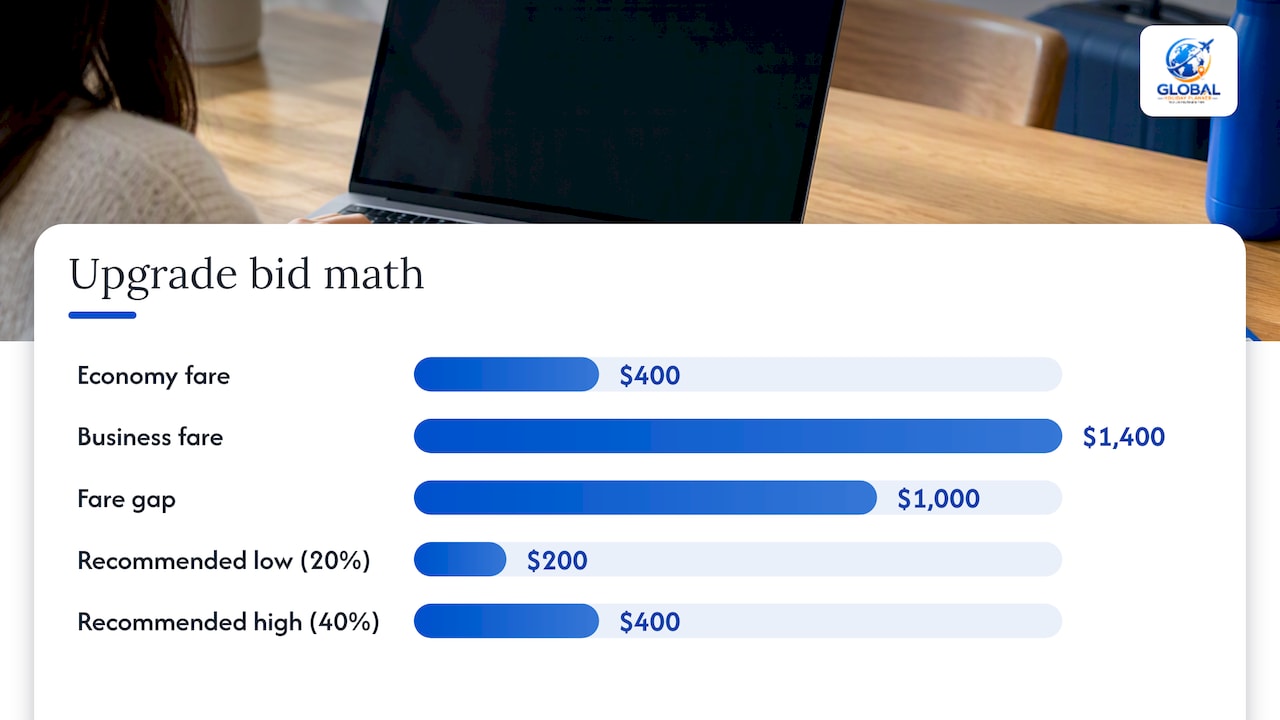
There is no fixed universal bid amount, but travel advisors generally point to the same starting math: aim for roughly 20% to 40% of the cash difference between your economy fare and the premium seat’s retail price, according to Frommer’s.
20% to 40% of the fare gap is the rule-of-thumb bid range most travel guides recommend, which keeps your offer competitive without paying close to the full upgrade price, per Frommer’s.
Say your economy fare cost $400 and the airline’s retail business class fare on that same flight is $1,400. The gap is $1,000, so a bid in the $200 to $400 range sits inside the commonly recommended band. A bid right at the airline’s posted minimum can lose to someone who bid even one dollar more, so nudging slightly above the floor is a common tactic for beating other bidders chasing the same seat.
Route demand changes the calculation. A leisure route in shoulder season with light business travel tends to clear more upgrades at lower bids, while a route packed with corporate travelers pushes the realistic winning bid toward the higher end of the range or beyond it.
Pro Tip: Treat your bid as the actual price you’re willing to pay, not a number meant to outsmart the system, since accepted bids are charged immediately and are usually nonrefundable.
Bids apply per person and per flight segment, so a connecting itinerary with a travel companion means calculating and submitting several separate amounts.
Timing and where to place your bid
Bidding windows differ by airline, but there is a common pattern worth planning around.
- Many programs open bidding around 72 hours before departure, once airlines begin releasing unsold premium inventory, per The Points Guy.
- Some carriers keep bidding open until just a few hours before departure, giving you a last chance if demand looks soft.
- A few airlines, including SAS on certain routes, run live bidding where you can see your rank and raise your offer before the window closes.
- Others skip the public page entirely and send a one-time email invitation instead.
If a guaranteed seat matters more than saving money, check the airline’s in-app buy-up price before bidding. It is usually higher than a winning bid but removes the uncertainty. Showing up at the gate with a direct buy-up request is also worth trying as a backup when bidding results arrive too late or not at all.
Step-by-step: how to place an upgrade bid correctly
- Confirm you’re eligible by checking your fare class, booking channel, and whether you booked directly with the airline.
- Gather your booking reference and last name, then open the bidding link from your confirmation email or manage-trip page.
- Check the posted minimum and maximum, then calculate your offer using the 20% to 40% fare-gap formula.
- Decide your personal ceiling before entering payment details, since that’s the amount you’ll actually be charged if you win.
- Submit the bid for each passenger and segment separately, then save the confirmation screen or email.
- Watch for the notification window and recheck your boarding pass once it opens, since cabin assignment usually updates automatically.
Pro Tip: Read the fine print on refund and change policies before submitting, since most programs, including TAP Air Portugal’s Plusgrade terms, charge accepted bids immediately and refund them only in narrow cases like a canceled flight.
Is bidding worth it? A quick decision guide comparing bidding, buy-ups, and miles
Bidding, buying up, and redeeming miles solve the same problem differently, and the right choice depends on how much certainty you need.
- Choose a direct buy-up when the price gap to a confirmed seat is small or you cannot risk missing the upgrade.
- Choose bidding when the cabin looks likely to have unsold seats and the cash gap between fares is large enough to make a lower bid worthwhile.
- Choose miles or points when you have a stash to spend and want to avoid paying cash altogether, since mileage upgrades often clear at different odds than cash bids, according to Frequentflyer.
- Weigh cabin and flight length together: a long-haul business class upgrade tends to deliver more value per dollar than a short-haul premium economy bump.
Whichever route you pick, remember that your original fare rules and mileage accrual basis stay tied to your original ticket, not the upgraded cabin.
Global Holiday Planner’s take on bidding as part of a booking strategy
Bidding only pays off when you know the real gap between your fare and the upgrade, which means comparing fares across airlines before you book matters as much as the bid itself. Global Holiday Planner helps travelers see that gap clearly across carriers, and it’s worth checking each airline’s own terms and favoring routes with lighter business traffic if winning the bid is the goal.
— Global
Find flights worth bidding on
Finding the fare gap that makes a bid worthwhile starts with comparing flights, not just checking one airline’s site. Global Holiday Planner lets you compare flight prices across carriers side by side, so you can see the real cash difference between your economy seat and the premium cabin before you commit to a bid.
If you’re also booking a hotel, car rental, or travel insurance for the same trip, comparing those alongside your flight on Globalholidayplanner can show the full cost picture in one place. Start with the flights page to see what fare gap you’re working with before you place a bid.
FAQ
How much should you bid for a flight upgrade?
A common rule of thumb is to bid between 20% and 40% of the cash difference between your economy fare and the premium cabin’s retail price, per Frommer’s. Bidding slightly above the airline’s posted minimum can also help you beat other bidders who stop at the floor amount.
Which airlines have bidding for upgrades?
More than 50 airlines worldwide run upgrade bidding programs, many through the third-party platform Plusgrade, according to AFAR. Air Canada, TAP Air Portugal, and SAS are among the carriers with published bidding or live-offer programs, though each sets its own eligibility rules.
Is bidding for an upgrade worth it?
It can be worth it on routes with light business demand and a large cash gap between fares, since lower bids are more likely to clear. It’s less worth it when you need a guaranteed seat or the route is heavily business-traveled, in which case a direct buy-up or miles redemption may suit you better.
How do airlines choose who gets upgraded?
Airlines generally award upgrades to the highest qualifying bid, with loyalty status sometimes used as a tie-breaker between close offers, per The Points Guy. Available seat inventory and how close you are to departure also affect whether any bids get accepted at all.
Sources
- Upgrade Bidding Tips: How to Game Airline Seat Auctions So You’ll Win | Frommer’s
- What you need to know about bidding on flight upgrades | The Points Guy
- You can bid for discounted flight upgrades with these airlines | AFAR
[…] Bid 20–40% to Win a Premium Seat: When Upgrade Bidding Beats a Buy-Up […]