

The best time to book a package is not one date. It depends on when you travel, where you go and how much choice you need. Peak-week and family trips reward early booking for the room and the dates. Off-peak and flexible trips reward patience. The most useful habit is to set a target window, track the price inside it and book when the package fits your budget. We built Global Holiday Planner to put flights, hotels, car rentals and the rest side by side, so you can see the total cost and decide when the numbers work.
TL;DR
- Peak school-holiday and large-family trips: start looking 6 to 12 months out, because rooms, connecting rooms and flight times sell out before prices fall.
- Off-peak and flexible trips: 2 to 4 months ahead is usually enough, and waiting can pay off.
- Booking very early is not automatically cheapest. UK data on summer packages shows January was pricier than later months.
- Compare the package against flights and a hotel priced separately before you pay, and check the cancellation and payment terms.
- Set a price alert at your target window, then book when the total fits your budget.
Table of Contents
- Why there is no single best date
- What the price data says about booking early
- How far ahead to book, by trip type
- Flights inside a package: do the day and window matter?
- Hotels: when to lock in a room
- How to decide when to book: a six-step routine
- Seasonal sales: worth planning around, not waiting for
- Special cases
- Insurance and add-ons: when to buy
- Our perspective
- Ready to compare your trip?
- FAQ
- Sources
Why there is no single best date
Package prices move with demand, and demand follows the calendar. A week in July with a family room is a different product from a Tuesday-to-Tuesday trip in late October. The first sells out. The second rarely does.
Two forces pull in opposite directions:
- Choice shrinks as the date approaches. The best rooms, the right flight times and the cheaper fare classes go first.
- Price can fall as the date approaches. Sellers with unsold rooms and seats discount, but only when demand is soft.
Your job is to find the point where the two lines cross for your kind of trip. That point is different for a couple choosing a romantic weekend, a three-generation family needing adjoining rooms and a golf group that has to fit tee times around a tournament.
What the price data says about booking early
Most advice online says “book as early as you can.” The better data says it is more nuanced.
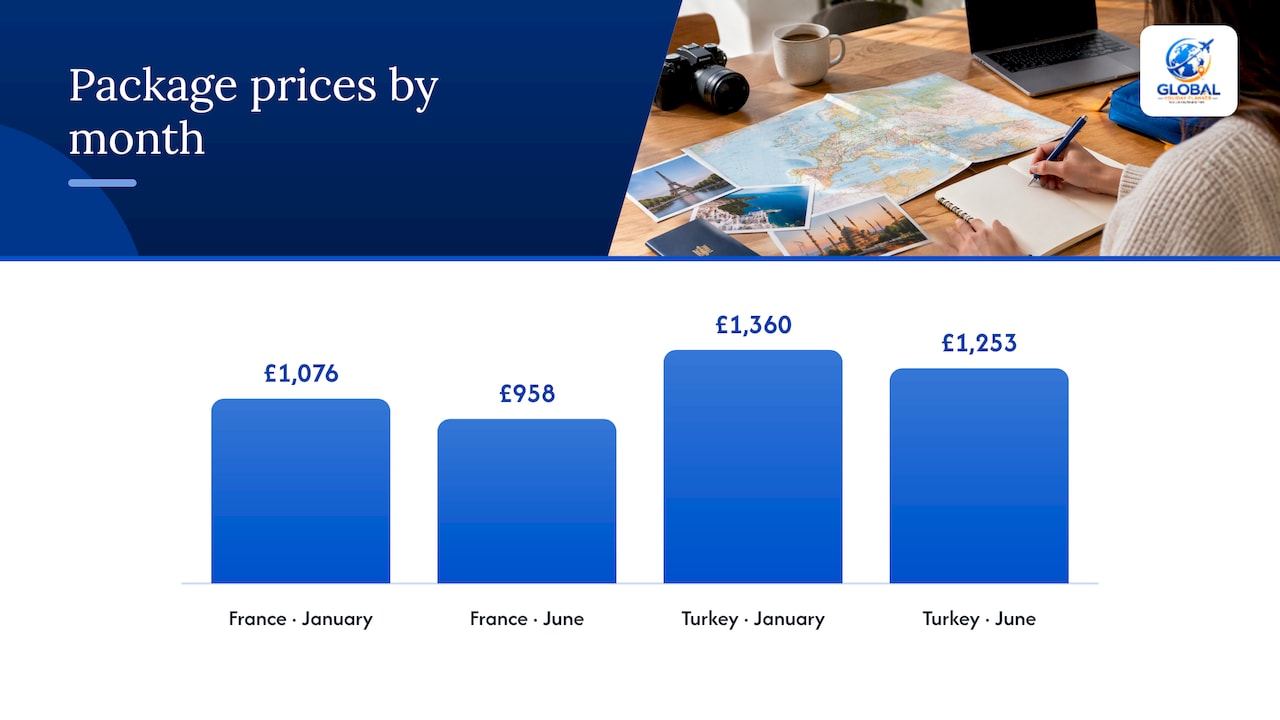
The UK consumer organization Which? tracked more than 40,000 summer package prices. It found that booking a European summer holiday in January cost on average £112 per person more than booking in the month before travel, nearly £450 for a family of four. For August trips, July was the cheapest month to book in most key destinations, with Morocco and Croatia as exceptions.
The same research found a spring window where prices were lower than in January while availability stayed high. France averaged £958 when booked in June against £1,076 in January, and Turkey £1,253 against £1,360.
A 2026 Which? check of more than 17,000 prices reached a similar conclusion. August prices had fallen in 53 of 71 European destinations, and a family of four could save £528 by booking in July rather than earlier. The cheapest destination it listed was the Dalaman region of Turkey, at £808 per person for a week, down 14% since March.
These are UK figures for European summer packages, so treat them as a pattern, not a US price promise. The pattern is useful anywhere: the very first release of summer inventory is rarely the lowest price. The exception is when you need a specific room, a specific week or free child places.
What early booking does buy you
The UK travel trade association ABTA says January and February is the traditional sales season, with potential savings of hundreds of pounds and limited free child places offered then. It also says rock-bottom last-minute deals are largely a thing of the past, because travel companies now handle flights and rooms more flexibly. Early booking is also the way to get choice, and in many cases a deposit-based payment plan.
So book early when availability is the risk. Wait when price is the risk and you are flexible. Most trips are a mix, which is why the next section splits them by type.
How far ahead to book, by trip type
Use these as starting windows for when to begin tracking prices. They combine the research above with how trips usually sell out. The actual booking date is the moment the price fits your budget inside the window.
| Trip type | Start looking | Why |
|---|---|---|
| Summer school holidays, family of four or more | 6 to 12 months ahead | Family rooms and flights on the right days sell first, and the dates are fixed. |
| Multi-generational trips (grandparents, parents, children) | 8 to 12 months ahead | Several rooms, adjoining or connecting, plus flights for everyone to match. |
| Thanksgiving, Christmas and New Year | 6 to 9 months ahead | Fixed dates and strong demand leave little room to wait. |
| All-inclusive beach resorts, peak weeks | 4 to 8 months ahead | Good resorts fill, and room categories are limited. |
| Romantic getaways, shoulder season | 2 to 4 months ahead | Demand is softer, so you can watch prices without losing much choice. |
| Off-peak short breaks | 4 to 8 weeks ahead | Often enough, especially if your dates can move. |
| Golf trips around a tournament | 6 to 12 months ahead | Tournament weeks pull in visitors to a small number of courses and nearby hotels. |
| Corporate trips | As soon as dates are firm | Fares rise with demand and changes cost money. |
If your dates are fixed and the trip is in a peak week, the table leans early. If you can move by a few days, the lean goes the other way.
Flights inside a package: do the day and window matter?
A package usually bundles a flight, a hotel and sometimes a transfer or car. The flight is the part with the most visible price swings, so the flight window deserves its own look.
We publish separate guides on this. Our piece on the cheapest days, hours and seasons to fly explains how timing changes fares, and the one on the best day to book flights covers the weekday pattern. Remember that day-of-the-week savings are small next to the effect of choosing the right month and the right week.
If your dates have some give, our walkthrough on booking flexible-date flights with a date grid shows how to find the cheapest neighboring days in a few minutes. Moving a trip by one day can matter more than any booking-day trick.
Hotels: when to lock in a room
The hotel half of a package behaves differently from the flight. Rooms for peak weeks and for larger parties go first, and a good rate on a refundable room can often be rebooked if prices fall. Our guide on how far ahead to reserve a hotel goes through the details.
If you are traveling with several generations, connecting rooms are worth booking early, because hotels hold few of them.

Short stays are a different case. Whether to wait for a late bargain or book ahead is a real decision for a weekend away, and this piece on booking a weekend stay for the best deal is a good companion if that is your trip.
How to decide when to book: a six-step routine
- Fix what cannot move. Write down the dates that are not negotiable (school break, tournament week, a wedding) and the number of rooms and people. This tells you whether you are an early booker or a flexible one.
- Set the start of your window. Use the table above. Begin watching prices then, not necessarily buying.
- Price the trip two ways. Get the package total, then price the same flights and the same hotel separately. Compare like for like: same room type, same board basis, same baggage. Our explainer on how dynamic packaging works walks through the steps to book, save and protect a bundled trip.
- Read the terms. Check the deposit, the final payment date, the change and cancellation rules, and what happens if the airline reschedules. A cheaper package with a rigid cancellation policy is not always cheaper.
- Set a target and an alert. Decide the total you will pay. If the price reaches it inside your window, book.
- Rebook if it drops. On refundable fares and rooms, check again before the cancellation deadline. A price drop after booking is only useful if you can still change.
Step 3 is where most people lose money without noticing, because a package that looks cheap may not include the room or bag you actually need. We compare flights, hotels, car rentals, transfers and insurance side by side at Global Holiday Planner, so the real total is visible in one place.
Seasonal sales: worth planning around, not waiting for
Tour sellers tend to run big sales at predictable times: the start of the year, after spring holidays and in the fall. In the UK, ABTA names January and February as the traditional sales season. In the US, the late-November shopping days and the holiday-week deal periods work the same way.
The risk is waiting for a sale on a trip that sells out. A discount on a room that is gone is worth nothing. If your dates are peak, lock in a flexible booking early and treat sale season as the time to check whether the price has fallen.
Special cases
Families and multi-generational groups
The cost of getting this wrong is high, because one missing room breaks the whole plan. Book rooms first, flights second, and choose refundable options while the group is still deciding. If ten or more travelers fly together, our group flight booking playbook explains how to hold seats for the whole party.
Couples
Romantic trips are usually the most flexible, which gives you leverage. Pick a shoulder-season week, start tracking about four months out and book when a room category you like drops. A weekday departure often costs less than a weekend one.
Golf trips
Tournament weeks fill nearby hotels fast, so book the rooms and car early. Add golf travel insurance when you book, since clubs are costly to replace and a trip planned months ahead has more time for something to go wrong.
Corporate travelers
Business dates are firm, so there is little to gain by waiting. Our business travel booking tips cover how to save money and avoid delays.
Insurance and add-ons: when to buy
Buy travel insurance soon after you pay the first deposit. That way the cost of a trip you may have to cancel is covered for longer. Our guide to whether travel insurance is worth it for US travelers helps you map the risk on your own trip. Book the car rental and airport transfer once flights are confirmed, using our car rental page and airport transfer page.
Our perspective
Most of the booking-time advice you read is a single number repeated by people who have never had to fit a family of nine into one resort in July. We see the question differently. The right moment is when your three variables line up: the dates are fixed, the room or seat you need is still available and the total is at or under what you decided to spend.
That is why we put flights, hotels, car rentals, rail, transfers and insurance next to each other, with side-by-side cost and feature comparisons. A package price only means something when you can see what it replaces. Seeing the real total for your itinerary in one place lets you tell a good bundle from a cheap-looking one.
We also build for different trips, not an average traveler. A romantic weekend, a family reunion, a golf week and a business trip each get a different timeline, and our scenario-based recommendations are designed around that.
Start tracking early, compare the total, and book when it fits your plan.
Global
Ready to compare your trip?
If you have a window in mind, put your dates into our flight search and hotel search and compare the combined cost against any package you are considering. Add a car, a transfer or insurance and you will see the full picture in one place.
For everything in one place, start from the Global Holiday Planner home page.
FAQ
When should I start booking things for a trip?
For peak school holidays and large family trips, start looking 6 to 12 months ahead. For off-peak or flexible trips, 2 to 4 months is a reasonable starting point. Begin tracking prices at the start of your window, then book when the total fits your budget.
Is it cheaper to book a package early or last minute?
Neither is always cheaper. Which? found that January bookings for European summer packages cost more on average than bookings made later in spring and summer. ABTA says deep last-minute deals are now much rarer than they used to be. Book early when you need specific rooms or dates, and keep flexibility when you do not.
What is the cheapest way to book an all-inclusive vacation?
Travel outside school-holiday weeks, keep your dates flexible by a few days and compare the package total with flights and a room priced separately. Check what the board basis includes and the cancellation terms. Booking four to eight months ahead for peak weeks protects your choice of resort and room.
Is a package always cheaper than booking separately?
No, so compare both for the same flights, room type and baggage. Add up any extras the package leaves out, such as transfers or a car. Then compare cancellation and payment terms, since those can outweigh a small price gap.
Sources
- Which?: Why I won’t book my European summer holiday in January
- Which?: We checked more than 17,000 prices, and package holidays are cheaper
- ABTA: Booking early