
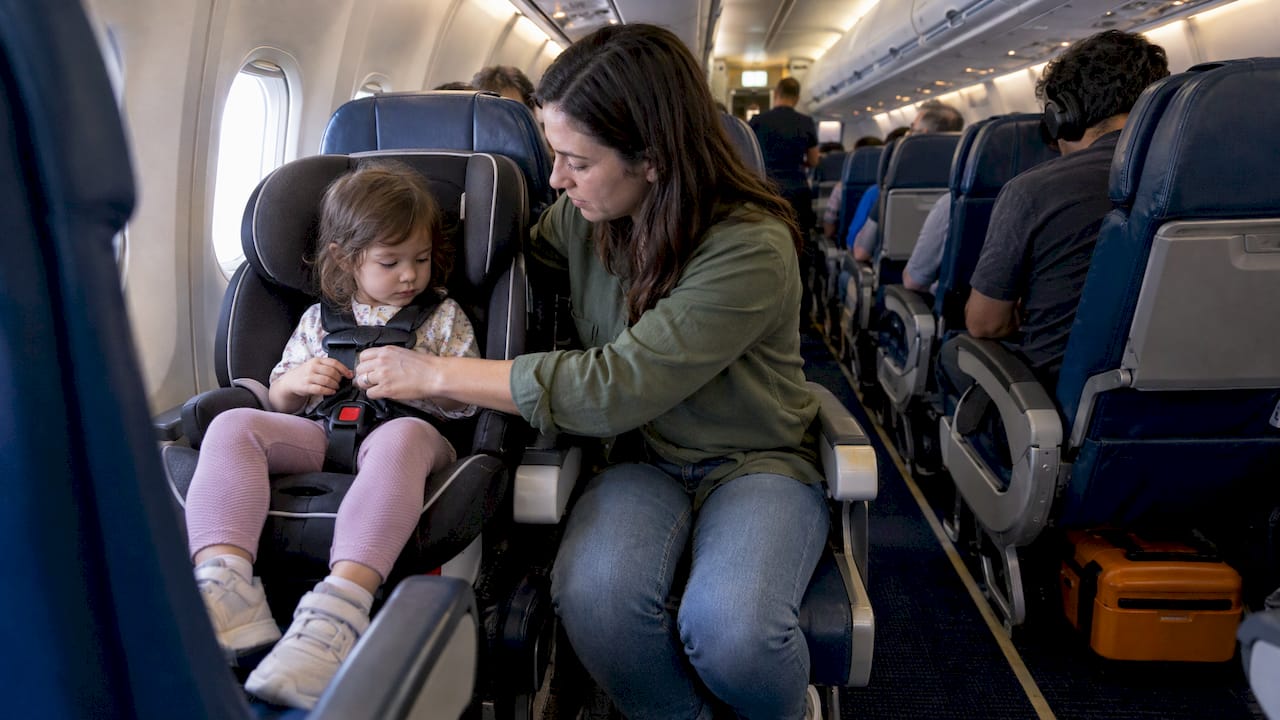
You are not required to bring a car seat on a U.S. flight, but the FAA strongly recommends one for young children, based on the child’s weight. If you bring one, it must be approved for aircraft use, it needs its own purchased seat (or an open seat the airline lets you use), and it must fit in a window seat. Booster seats can’t be used during takeoff and landing. This guide covers each of these points, plus what happens when you check the seat instead.
TL;DR
- The FAA does not require a child restraint system (CRS) on commercial flights. It does call an approved seat the safest place for a child under two.
- Look for a label saying the seat is certified for aircraft use. Then check the manual to confirm it can be installed with an airplane seat belt.
- Plan on a window seat, never an exit row. Booster seats and backless seats are not allowed for takeoff and landing.
- If you don’t use the seat onboard, you can usually check it at the ticket counter or gate. Airline fees and rules differ, so read your carrier’s page first.
Table of Contents
- Do you need a car seat on a plane?
- Which car seats are approved for aircraft use?
- Where to sit and how to install it
- Can you use a booster seat on a plane?
- Check it at the gate or with your luggage?
- What to check in an airline’s car seat policy
- Practical tips for a smoother trip
- Our view: plan the seat before you pick the flight
- Plan the whole trip in one place
- FAQ
- Sources
Do you need a car seat on a plane?
Legally, no. The FAA says it does not require child restraint systems on commercial airplanes. It does recommend using a CRS, or another FAA-approved device chosen by the child’s weight, and calls an approved seat the safest option for children under two.
The reasoning is turbulence. Australia’s aviation regulator CASA advises that children stay restrained whenever they are seated, not only for takeoff and landing, because turbulence can arrive without warning. A lap held in an adult’s arms can’t offer the same protection as a harnessed seat.
There is also a practical side. Many families find that a child who sits in the seat they know from the car settles more easily. You also arrive with a seat you can install at the other end, whether that is a rental car or a transfer. That convenience is a bonus, not the main argument.
When bringing one makes the most sense
- Your child is under two and you are buying a seat for them.
- Your child is a toddler who sleeps best in their own seat.
- You will rent a car or ride a transfer at your destination and want a seat you already know how to install.
If the airline has an open seat and lets you use it, you may be able to install the restraint without buying a ticket. Delta, for example, says an FAA-approved restraint may be used in an open passenger seat or a seat purchased for the child. Don’t count on an empty seat, though. Ask at check-in and again at the gate.
Which car seats are approved for aircraft use?
The FAA says to use a forward- or rear-facing, hard-backed CRS that is certified for aircraft use. It should show the U.S. aircraft-use statement, or be approved by a foreign government and carry the required label or marking. Follow the manufacturer’s instructions for installation and direction.
In practice, do this before you leave home:
- Find the sticker on the shell. Look for the wording that the restraint is certified for use in motor vehicles and aircraft.
- Open the manual and find the section on airplane installation. Check that the seat can be secured with a lap belt.
- Keep the manual, or a photo of the label and the page, in your bag. EASA recommends carrying the instructions and checking the seat’s width and height against the aircraft seat.
Flying outside the U.S.
Standards differ by country. Canada’s 2021 advisory accepts seats built to Canadian, U.S. or qualifying UN ECE standards, and qualifying UN ECE seats also need a separate “For use in Aircraft” label. EASA adds that airlines decide which approved seats they accept. Acceptance depends on the seat, the direction of the aircraft seat, seat pitch, how it is secured and the cabin layout. Aircraft approval alone does not guarantee the carrier will accept it.
On a trip that includes a foreign carrier or a connection abroad, read each airline’s child seat page. Don’t assume the same rules apply on every leg.
Harness alternative for older toddlers
The FAA also identifies CARES as a certified alternative for children up to 40 inches tall and weighing 22 to 44 pounds, as described on its child safety page. It is a harness that works with the airplane seat belt, so it suits families who don’t want to carry a full car seat.
Where to sit and how to install it
The FAA says car seats generally must go in a window seat. They can’t be placed in an exit row, and they must not block another passenger’s escape path in an emergency, according to its child safety guidance. Jetstar’s U.S. help page adds a point worth copying from any carrier: the seat must fit an airline seat, and only a limited number can be fitted on each flight, so contact the airline to add it.
Seat choice matters here, so decide it when you book. Our window vs aisle seat guide explains how to weigh legroom, exit rows and boarding order. For a family with a car seat, the window is the place to start.
Installation steps
- Board early, ideally during family pre-boarding if the airline offers it. HealthyChildren.org also suggests allowing extra airport time.
- Place the seat on the window seat. Follow the manual for direction. The FAA says to follow the manufacturer’s instructions, and that NHTSA advises keeping children rear-facing until they reach the seat’s top height or weight limit.
- Route the airplane lap belt through the correct belt path, exactly as the manual shows for aircraft.
- Tighten the belt and check that the seat does not move more than an inch at the belt path.
- Stow the tether strap out of the way. Canada’s guidance notes that tether straps cannot be used onboard.
Direction and airbag details
EASA guidance says a forward-facing child seat may be installed only in the same direction as the passenger seat. A rear-facing seat should go only on a forward-facing passenger seat. It also says a child seat should not sit within an airbag’s radius unless the airbag is deactivated, and that rigid-bar-only ISOFIX restraints should not be secured with an aircraft lap belt, per the EASA FAQ. Some aircraft have seat belt airbags, so ask the crew if you see one.
If the approved seat will not fit a particular seat, ask the crew for help. The FAA says that when an approved CRS with a purchased seat does not fit, the airline is responsible for accommodating it in another seat in the same class, subject to its aircraft-specific policies, as laid out on the FAA’s CRS page.
Can you use a booster seat on a plane?
No, not for takeoff, landing and ground movement. The FAA prohibits using booster seats and backless CRSs during those phases, according to its CRS guidance. That includes the backless booster many school-age kids use at home.
The reason is how the restraints work. A booster positions a car’s lap and shoulder belt over the child. A plane seat typically has only a lap belt. EASA says booster cushions can’t be used in aircraft because aircraft restraints differ from car restraints, and CASA states boosters are usable only with a shoulder harness.
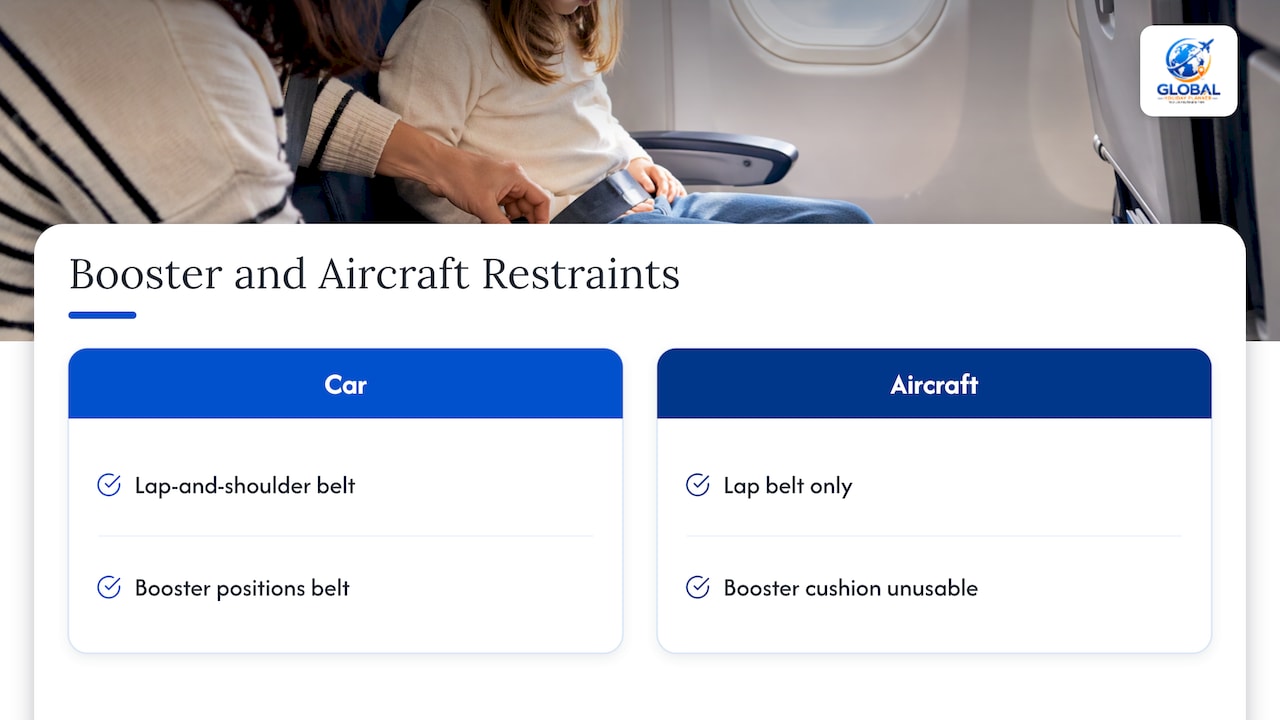
For a child who has outgrown a harnessed seat, the plane’s own lap belt is the restraint. Plan to check the booster or bring it as carry-on to use after landing. Our guide to renting a child car seat covers the three seat types and where to get one on arrival, so you may not need to carry a booster at all.
Check it at the gate or with your luggage?
If you won’t install the seat onboard, you have two choices. Both are common, and neither is wrong.
| Option | What it means | Watch for |
|---|---|---|
| Check at the ticket counter | Handled with your other bags | Longer time in the baggage system, more handling |
| Gate check | You carry it through the airport, then hand it over at the aircraft door | Carrying it through security and the terminal |
| Use onboard | Install it in your child’s seat | Needs an approved seat and enough room |
Airline fee rules are generous, but they are airline-specific. Delta allows child restraints to be checked before security or at the gate without fees and outside the baggage allowance. Delta also says that if no open seat is available for a restraint, it must be checked at the gate. Alaska Airlines states that a child’s car seat and stroller may be checked free with other baggage or at the gate. Breeze allows one stroller and one car seat or booster per child at no extra cost at the counter or gate, but protective packing is required for its damage-liability policy, and overweight fees may apply. These are those carriers’ own policies, not a rule for every airline.
Jetstar says an unapproved seat travels as checked baggage free of charge and outside the allowance, while an approved seat may be taken through security and installed once boarding is approved. Policies from one airline to the next often follow this pattern, but always confirm with yours. Our guide to checked bags vs. carry-on and our explainer on airline add-on fees show how to see the full cost of a trip before you pay.
Protecting a checked seat
Any seat that goes in the hold can be knocked about. Consumer Reports cites safety experts who recommend a protective bag, inspecting the foam and components after you retrieve it, and replacing the seat or consulting the manufacturer if you find structural or functional damage. The same experts note that a bag helps against dirt and moisture. It is not proof that the seat escaped structural damage.
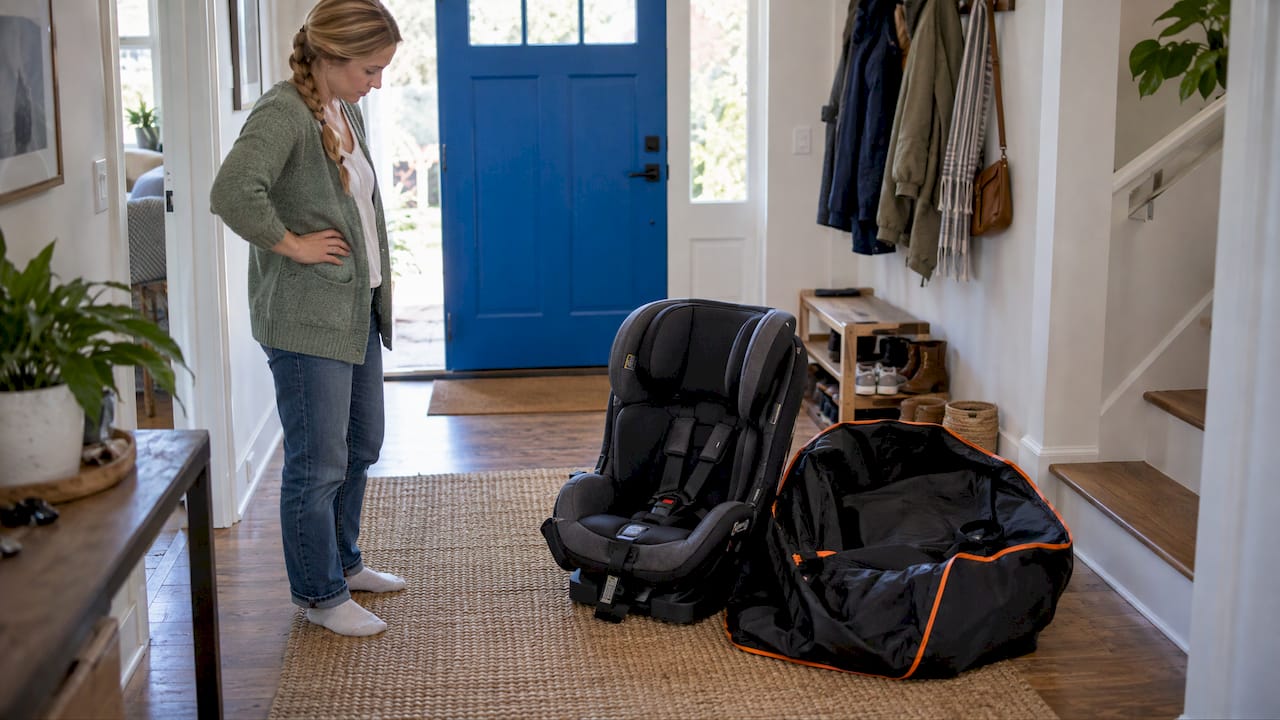
Gate checking reduces handling because the seat goes straight to the aircraft. If a seat is lost or delayed, see our guide to filing for lost luggage compensation, which explains the time limits that apply in the U.S.
What to check in an airline’s car seat policy
Every carrier writes its own rules, and the details decide whether your seat goes onboard. Before you book, look up these points on the airline’s family or special-items page:
- Approval wording. Does it accept seats with the FAA label, or foreign approvals too?
- Width limits. Some carriers state a maximum seat width or ask you to check your seat against the cabin type.
- Seat location. Window seat only, no exit rows, and any restriction on rows next to aisles.
- Limit per flight. Jetstar, for example, notes that only a limited number of car seats can be fitted on each flight.
- Gate-check procedure. Does the airline provide a tag, a bag or a place to drop the seat at the aircraft door?
- Fees. Whether the seat is free, and whether weight or packing rules apply.
Write down what you find and keep it in your phone. If the gate agent says something different, the written policy will help you resolve it quickly. Be polite and ask for a supervisor, since a crew member’s call on safety is final.
Practical tips for a smoother trip
- Pick a lightweight seat for travel. If you fly often, a smaller approved seat is far easier to carry down an aisle than your everyday one.
- Use a cart or strap. A luggage strap that joins the car seat to a rolling bag frees up a hand. Check that your seat’s manual does not forbid it.
- Practice at home. Run the lap belt through the aircraft belt path on a kitchen chair, so you aren’t reading the manual in the aisle.
- Have a plan at the other end. Know whether you are riding in a rental car, a taxi or a pre-booked transfer. A transfer with a seat already fitted spares you from carrying yours through arrivals. Our guide to airport transfer providers that include a preinstalled seat shows how to ask for one. If you are driving yourself, our car rental classes guide helps you choose a vehicle with room for a seat.
- Think about the long route home. For a family traveling from a distant airport, evaluating shuttle and airport transport in advance, including how vehicles are inspected and what seating they have, is a sensible habit before you commit.
- Book connections with margin. Gate-checking and re-installing a seat take time. A tight connection with a car seat and a toddler is stressful.
Our view: plan the seat before you pick the flight
Families often choose a flight first and then discover that the car seat question is complicated. We think it works better the other way around. Decide whether the seat is coming onboard, then book the seat map, the route and the ground transport around that decision.
That is why we put flights, hotels, car rentals and airport transfers side by side on one platform. When you can see the total picture, including the extra seat for your child, the baggage rules and how you will get from the airport to your hotel, you can make a calm decision rather than a rushed one.
Our scenario-based guides are built for trips like family vacations, so you can compare options that fit how your family travels, whether you bring a seat or arrange one at the destination.
Global
Plan the whole trip in one place
Once you know how you will handle the car seat, book the pieces that depend on it. You can compare fares and seat options on our flights page, then line up a car rental or an airport transfer for the other end.
If you are traveling with more than one family, see our group flight booking guide for tips on keeping seats together. Staying overnight with kids? Our guide to connecting hotel rooms shows how to request them.
FAQ
Can you carry a car seat on a flight?
Yes. Most airlines let you bring an approved car seat onboard for a child who has a ticketed seat, and you can usually check one for free if you don’t use it. The FAA says to check the manual to confirm the seat can be secured in an airplane seat. If it can’t, you may be asked to check it as baggage.
Is it better to gate check a car seat?
Gate checking reduces the time the seat spends in the baggage system, so it is often the gentler option. You must carry it through the airport, though. Some carriers allow checking at the counter or the gate at no charge, but confirm yours and use a protective bag.
How much does it cost to put a car seat on a plane?
Checking a car seat is often free on U.S. carriers, as the Delta, Alaska and Breeze policies above show, though packing and weight rules can apply. Bringing the seat onboard normally requires a purchased seat for your child, and that fare varies by route and date. Compare current fares on the airline’s or our booking pages.
Can you take a backless booster seat on a plane?
You can carry one, but you can’t use it for takeoff and landing. The FAA prohibits booster seats and backless child restraints in those phases. Pack it in your checked bags, gate check it or carry it on to use in the car at your destination.
Sources
- FAA: Does the FAA require children on commercial flights to be in child restraint systems?
- FAA: Child safety
- FAA: About child restraint systems
- Delta Air Lines: Children and infant baggage items
- Jetstar: Bringing a car seat on board
- EASA: Use of child seats on board
- EASA: Flying with children
- Transport Canada: Advisory Circular AC No. 605-003
- Government of Canada: Air travel with children
- CASA: Travelling with children
- HealthyChildren.org: Flying with baby
- Alaska Airlines: Free baggage for children and infants
- Breeze: Stroller and car seat policy
- Consumer Reports: Car seat and stroller travel bags