

An airline alliance is a partnership between separate airlines that lets you treat their combined routes almost like one network. You can earn and spend miles across members, get through the airport faster and connect between carriers more easily. Three alliances dominate: Star Alliance, oneworld and SkyTeam. The best one for you is usually the one that matches the airline that dominates your home airport, then your destinations, then the loyalty program you can realistically keep earning in.
This guide covers what alliances do, how the big three compare, what the benefits look like in practice, and why some big names, Emirates among them, stay outside all three.
TL;DR
- An alliance links independent airlines so you can earn miles, use status and connect across members. It does not merge the airlines or their prices.
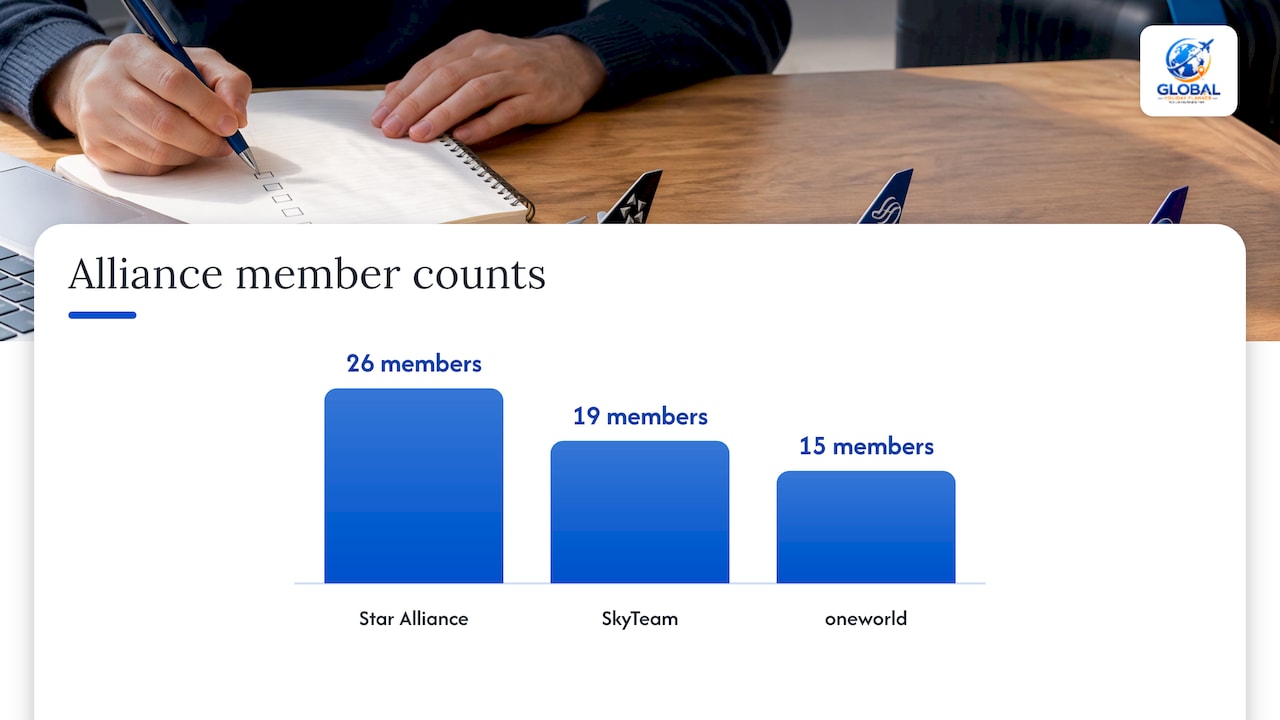
- Star Alliance is the largest, with 26 members and 1,150+ airports in 190 countries. SkyTeam and oneworld are smaller.
- Mid-tier and top-tier status is where alliances pay off: lounge access, priority boarding and extra baggage, often on partner airlines too.
- Pick by your home-airport airline first, then check the alliance’s reach to the places you fly.
- Some airlines skip alliances and use bilateral partnerships instead, so an alliance is a useful lens, not the only one.
Table of Contents
- What an airline alliance actually is
- The big three at a glance
- Star Alliance: the widest net
- oneworld: smaller, premium-minded
- SkyTeam: strong across the Atlantic
- oneworld vs Star Alliance vs SkyTeam: how they differ where it counts
- What you actually get from an alliance
- How to choose an alliance
- Special cases: business travelers, families and stopovers
- Why some airlines, like Emirates, stay outside alliances
- Our perspective
- Compare your options in one place
- FAQ
- Sources
What an airline alliance actually is
The airlines in an alliance stay separate companies with their own fares, planes, staff and finances. What they share is a framework of cooperation. According to one long-running travel guide, members agree to give each other’s customers reciprocal benefits such as priority check-in, boarding, and mileage earning and redemption.
It helps to separate four terms that often get blurred:
- Interline: two airlines agree to sell one ticket covering both of their flights and to transfer your bags between them. Many airlines have these, alliance or not.
- Codeshare: one airline sells seats on a flight operated by another, under its own flight number. You can buy a flight marked with one airline’s code and board a different airline’s plane.
- Alliance: a wider, formal framework that adds loyalty-program recognition, lounge access and coordinated connections on top.
- Joint venture: a deeper arrangement between a few airlines on specific regions, with coordinated pricing and schedules and revenue sharing.
If the difference between codeshare and interline affects what happens to your bags or your rights when a connection goes wrong, our guide to codeshare vs interline tickets walks through it.
The big three at a glance
Member counts shift as airlines join and leave, and sources count slightly differently (some count airports, some destinations). Treat the figures below as a snapshot of 2026 and check each alliance’s own site before a major purchase.
| Star Alliance | SkyTeam | oneworld | |
|---|---|---|---|
| Members | 26 | 19 | 15, with a 16th expected in 2027 |
| Reach | 1,150+ airports, 190 countries | 1,150 destinations, 175 countries | 1,100+ destinations |
| Known for | Largest, broadest global footprint | Strong transatlantic coverage | Premium cabins and premium-focused status benefits |
| Top tier | Gold | Elite Plus | Emerald |
The expected 16th oneworld member is Philippine Airlines, listed as joining in 2027.
A note on the numbers: you will see SkyTeam described with 18 or 19 members and with different destination counts depending on the date and whether a source counts airports or cities. The takeaway does not change: Star Alliance is biggest, and the other two are close to each other in size.
Star Alliance: the widest net
Star Alliance describes itself as uniting 26 airlines with access to more than 1,150 airports across 190 countries, covering most of the world. For US travelers the best-known members include United Airlines, Air Canada, Lufthansa, Singapore Airlines, ANA, Turkish Airlines and Thai Airways. Check the member page for the full current list.
Why people choose it:
- Breadth. With the most members, it is the likeliest to have a partner on an unusual route, including secondary cities in Europe, Asia and Africa.
- Consistent top status. Star Alliance Gold is recognized across all member airlines, with benefits such as lounge access, priority baggage delivery and extra baggage allowance whichever carrier you fly.
- Many ways to earn. More partners means more options for crediting a flight to the program you care about.
The trade-off most frequent flyers mention is that the sheer size means premium experiences vary more from member to member, so a Gold card does not guarantee the same cabin quality everywhere. That is a reason to look at the specific airline on your route, not just the alliance logo.
oneworld: smaller, premium-minded
oneworld has 15 members, with a 16th expected in 2027, and serves more than 1,100 destinations. Members include American Airlines, British Airways, Qatar Airways, Cathay Pacific, Japan Airlines, Iberia and Qantas.
It is well regarded for premium cabin quality and for benefits at the top end: Emerald status opens first-class lounges, which Star Alliance Gold generally does not. If you fly long-haul in business or first and want top-tier recognition, that matters. If your trips are mostly short economy hops to places a smaller network does not reach, it matters less.
SkyTeam: strong across the Atlantic
SkyTeam has 19 members serving 1,150 destinations in 175 countries. Delta Air Lines, Air France, KLM, Korean Air and Virgin Atlantic are among the names US travelers know. Its transatlantic strength comes from the close cooperation of Delta, Air France-KLM and Virgin Atlantic, a joint-venture style setup that coordinates schedules across the ocean.
It suits travelers based at Delta hubs such as Atlanta, Detroit, Minneapolis or Salt Lake City, and anyone who regularly flies between the US and Western Europe.
oneworld vs Star Alliance vs SkyTeam: how they differ where it counts
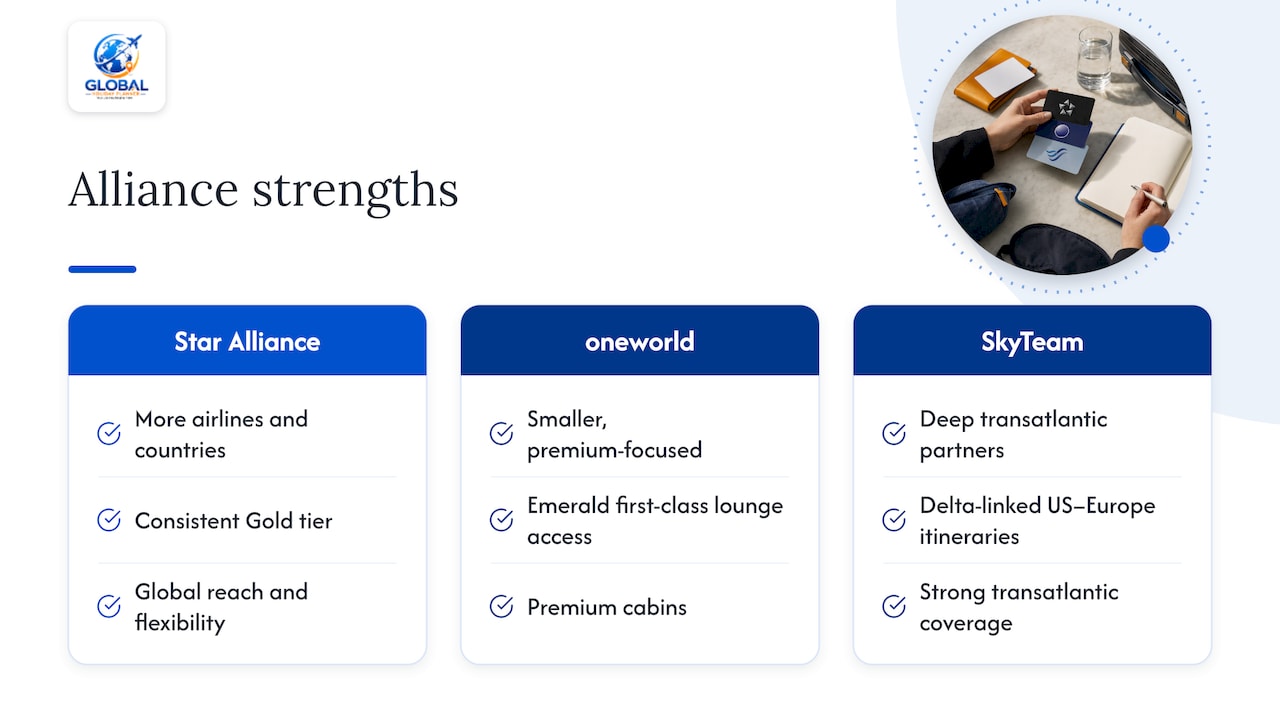
Star Alliance vs oneworld. Star is bigger and more global, with a consistent Gold tier. oneworld is smaller but leans premium, with Emerald giving more exclusive first-class lounge access. Choose Star for reach and flexibility; choose oneworld if premium cabins and lounges at the top end drive your decisions.
SkyTeam vs oneworld. SkyTeam offers strong transatlantic coverage through Delta, Air France, KLM and Virgin Atlantic. oneworld offers the premium reputation and Emerald lounge access. If most of your flying is US to Europe on a Delta-linked itinerary, SkyTeam can fit best. If you travel through London or Doha in premium cabins, oneworld may.
Star Alliance vs SkyTeam. Star Alliance wins on the number of airlines and countries, SkyTeam on the depth of its biggest transatlantic partners. For a traveler with no loyalty yet, the deciding factor is almost always the home airport, covered below.
What you actually get from an alliance
The benefits that travelers can typically expect are priority check-in, boarding and baggage handling, extra baggage allowance and lounge access at qualifying status levels. Miles can usually be redeemed on flights with another airline in the same alliance.
In practice:
- Earning. You fly a partner and credit the miles to your home program. The earning rate depends on the fare class, and the rules differ between programs, so check the partner chart before booking.
- Redeeming. You can use your miles for a partner’s seats, which opens routes your main airline does not fly. Availability for partner awards is often thinner than on the operating airline’s own flights.
- Status. Alliance-level tiers (Star Gold, SkyTeam Elite Plus, oneworld Sapphire and Emerald) are the passport. Entry-level tiers usually give fewer perks than the top ones, and they are what unlock lounges and extra bags.
- Connections. A single ticket across partners protects your connection and checks your bag through to the destination. Booking separate tickets does not.
Alliance perks rarely cover everything. Basic economy fares often exclude seat selection or mileage earning, and add-on charges still apply to the ticket you bought. Our breakdown of airline extra fees and how a $30 bag changes your total shows how to count the real cost before you compare fares.
How to choose an alliance
The most useful advice is to anchor on the airline that dominates your home airport, because that is where you will earn most of your miles. After that, check whether the alliance partners cover the international places you want to visit, and which loyalty programs give the best redemption value for how you fly. A simple rule from travel writers: the best alliance depends on your home airline and travel patterns.
A quick decision path:
- Find your hub. Which airline has the most flights from your nearest airport? That points to one alliance: American to oneworld, United to Star Alliance, Delta to SkyTeam.
- List your destinations. Do the partners in that alliance fly there? If not, consider whether a second alliance covers the gap.
- Check how you fly. Frequent short trips reward consistent status with one program. Occasional long-haul premium trips reward an alliance with strong premium products.
- Think about credit cards. Airline co-brand cards and transferable points can feed a program faster than flying does.
- Stay flexible on fares. Loyalty is worth something, but not at any price. A fare that is far cheaper on a non-alliance airline can beat a few thousand miles.
Budget-minded travelers should treat the alliance as a tiebreaker, not a rule. Comparing fares across several airlines at once, which is what our flight search is built for, keeps you from paying extra for loyalty you will not use.
Special cases: business travelers, families and stopovers
Business travelers. If you fly often for work, status accumulates quickly with one alliance, and priority services reduce friction on tight schedules. Convenience is a real driver in business trips, as this piece on the role of convenience in business travel points out. Our business travel booking tips cover booking habits that avoid delays.
Families and groups. Alliance tickets let families keep multi-leg trips on one booking, so bags and connections stay protected. Groups of ten or more travelers have their own rules for blocking seats, covered in our group flight booking playbook.
Stopovers. Some airlines let you add a city between origin and destination at little or no extra cost. See airline stopover programs that add a free city for how they work. These are programs of individual airlines, so your alliance does not determine them.
Why some airlines, like Emirates, stay outside alliances
Emirates is the question people ask most. According to aviation analysis, it prefers individual codeshare deals because they give it more flexibility in negotiating terms and managing agreements. Its network chiefs have said that staying non-aligned gives it more choice to select partners, replicate alliance benefits and work with low-cost carriers.
More broadly, airlines have increasingly deemphasized global alliances in favor of working with carriers that complement their own networks. For travelers, this means an airline outside an alliance can still connect smoothly with partners via codeshare and interline deals. It simply will not carry a common status tier across a bloc.
Our perspective
We built our platform around a simple idea: you should see the real total cost and the best fit for your itinerary in one place. Alliances are a good example of why.
An alliance is a strong reason to choose a flight when it matches how you travel. It is a poor reason when it hides a higher fare, an add-on fee or a longer connection. The strongest results come from comparing fares and conditions side by side, then letting alliance benefits break the tie.
That is how we approach trip planning for every kind of traveler, from families and couples to golf groups and business travelers: compare flights, hotels, car rentals, transfers and insurance together, and recommend by scenario rather than by logo.
Global
Compare your options in one place
Once you know which alliance suits you, the next step is seeing which flights on it are actually the best value for your dates. On Global Holiday Planner you can compare flights across airlines side by side, then add a hotel, a car rental, an airport transfer or travel insurance for the same trip.

Start with our flight comparison page, or visit Global Holiday Planner to plan the whole trip. If you like to adjust dates, our guide to flexible date flights shows how to find the cheapest day fast.
FAQ
Which airline alliance should I join?
Start with the airline that dominates your home airport, since that is where you will earn most of your miles. Then confirm its alliance reaches the places you want to go. In the US that often means American with oneworld, United with Star Alliance, or Delta with SkyTeam.
Why is Emirates not in any alliance?
Emirates prefers individual codeshare agreements, which give it flexibility in negotiating terms and choosing partners. Its executives have said this lets it replicate alliance benefits and work with a wider range of airlines, including low-cost carriers.
Do I need alliance status to get lounge access and extra bags?
You need a qualifying status level, not just a ticket. Mid-tier and top-tier members usually get lounge access, priority services and extra baggage allowance on member airlines. Star Alliance Gold, for instance, is recognized across all of its members.
Which airlines are part of Star Alliance?
Star Alliance has 26 member airlines, including United, Air Canada, Lufthansa, Singapore Airlines, ANA and Turkish Airlines. Membership changes over time, so check the alliance’s official member page for the current list.
Sources
- Star Alliance member airlines
- Airline Alliances: How They Work, Who’s in Which (NerdWallet)
- Airline Interline, Codeshare, Alliance, And Joint Venture (One Mile at a Time)
- Airline Alliances Explained: Star Alliance vs. oneworld vs. SkyTeam (Autopilot)
- Airline Alliances for Beginners: How to Pick One and Stick with It
- Airline Alliances 2026: Which One Actually Helps You?
- Why Emirates and Etihad Aren’t Part of an Alliance (Simple Flying)
- Emirates and Oman Air network chiefs on global alliances (Simple Flying)
[…] Airline Alliances Explained: Star Alliance, oneworld and SkyTeam […]